Yes, phones are very useful tech that can perform many functions. But we can also over-rely on them to our detriment. Many recent studies suggest that digital fasts — or even short times away from our screens — can bring about desirable outcomes. Read on to see how you might benefit from some time away from your phone.
OVERRELIANCE ON PHONES HURTS US
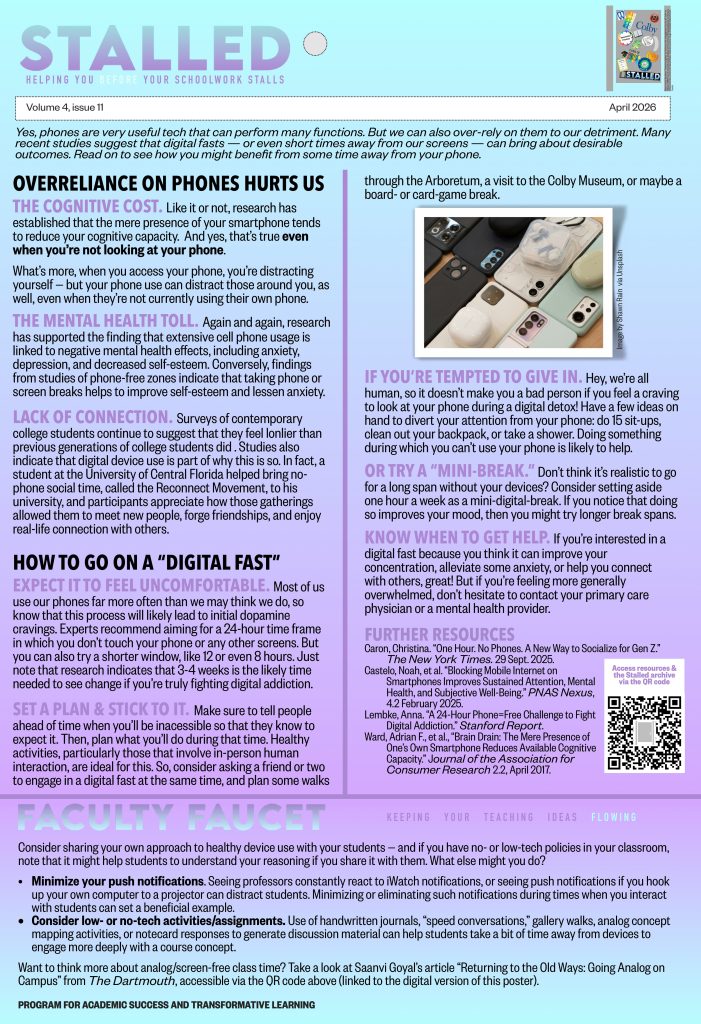
THE COGNITIVE COST. Like it or not, research has established that the mere presence of your smartphone tends to reduce your cognitive capacity. And yes, that’s true even when you’re not looking at your phone.
What’s more, when you access your phone, you’re distracting yourself — but your phone use can distract those around you, as well, even when they’re not currently using their own phone.
THE MENTAL HEALTH TOLL. Again and again, research has supported the finding that extensive cell phone usage is linked to negative mental health effects, including anxiety, depression, and decreased self-esteem. Conversely, findings from studies of phone-free zones indicate that taking phone or screen breaks helps to improve self-esteem and lessen anxiety.
LACK OF CONNECTION. Surveys of contemporary college students continue to suggest that they feel lonlier than previous generations of college students did . Studies also indicate that digital device use is part of why this is so. In fact, a student at the University of Central Florida helped bring no-phone social time, called the Reconnect Movement, to his university, and participants appreciate how those gatherings allowed them to meet new people, forge friendships, and enjoy real-life connection with others.
HOW TO GO ON A “DIGITAL FAST”
EXPECT IT TO FEEL UNCOMFORTABLE.Most of us use our phones far more often than we may think we do, so know that this process will likely lead to initial dopamine cravings. Experts recommend aiming for a 24-hour time frame in which you don’t touch your phone or any other screens. But you can also try a shorter window, like 12 or even 8 hours. Just note that research indicates that 3-4 weeks is the likely time needed to see change if you’re truly fighting digital addiction.
SET A PLAN & STICK TO IT. Make sure to tell people ahead of time when you’ll be inacessible so that they know to expect it. Then, plan what you’ll do during that time. Healthy activities, particularly those that involve in-person human interaction, are ideal for this. So, consider asking a friend or two to engage in a digital fast at the same time, and plan some walks through the Arboretum, a visit to the Colby Museum, or maybe a board- or card-game break.
IF YOU’RE TEMPTED TO GIVE IN. Hey, we’re all human, so it doesn’t make you a bad person if you feel a craving to look at your phone during a digital detox! Have a few ideas on hand to divert your attention from your phone: do 15 sit-ups, clean out your backpack, or take a shower. Doing something during which you can’t use your phone is likely to help.
OR TRY A “MINI-BREAK.” Don’t think it’s realistic to go for a long span without your devices? Consider setting aside one hour a week as a mini-digital-break. If you notice that doing so improves your mood, then you might try longer break spans.
KNOW WHEN TO GET HELP. If you’re interested in a digital fast because you think it can improve your concentration, alleviate some anxiety, or help you connect with others, great! But if you’re feeling more generally overwhelmed, don’t hesitate to contact your primary care physician or a mental health provider.
FURTHER RESOURCES
Caron, Christina. “One Hour. No Phones. A New Way to Socialize for Gen Z.” The New York Times. 29 Sept. 2025.
Castelo, Noah, et al. “Blocking Mobile Internet on Smartphones Improves Sustained Attention, Mental Health, and Subjective Well-Being.” PNAS Nexus, 4.2 February 2025.
Lembke, Anna. “A 24-Hour Phone=Free Challenge to Fight Digital Addiction.” Stanford Report.
Ward, Adrian F., et al., “Brain Drain: The Mere Presence of One’s Own Smartphone Reduces Available Cognitive Capacity.” Journal of the Association for Consumer Research 2.2, April 2017.
FACULTY FAUCET
Consider sharing your own approach to healthy device use with your students — and if you have no- or low-tech policies in your classroom, note that it might help students to understand your reasoning if you share it with them. What else might you do?
- Minimize your push notifications. Seeing professors constantly react to iWatch notifications, or seeing push notifications if you hook up your own computer to a projector can distract students. Minimizing or eliminating such notifications during times when you interact with students can set a beneficial example.
- Consider low- or no-tech activities/assignments. Use of handwritten journals, “speed converstations,” gallery walks, analog concept mapping activities, or notecard responses to generate discussion material can help students take a bit of time away from devices to engage more deeply with a course concept.
Want to think more about analog/screen-free class time? Take a look at Saanvi Goyal’s article “Returning to the Old Ways: Going Analog on Campus” from The Dartmouth.