We share equal responsibility for the well-being of every member … We seek to build relationships and restore them when they are damaged. … We accept responsibility for our actions and words, and commit ourselves to the education, personal growth and/or relational repair which are a consequence.” Each of these statements is included in Colby’s list of community values. Did you know that when you put your energy into abiding by these values you are also engaging with restorative practices?
WHAT ARE RESTORATIVE PRACTICES?
DEEP ROOTS. Restorative practices are a way of being in the world that prioritizes the importance of human relationships and connection, recognizes the inherent value of each member of a community, and creates opportunities to repair relational harm when it occurs through accountability rather than punishment. These practices have deep roots in the wisdom and practices of cultures across the world, including here in the homelands of the Wabanaki peoples.
RESTORATIVE PRACTICES AS OPPORTUNITIES. These practices also foster opportunities for social and emotional learning and skills that are essential for living in community, including self-awareness, self-management, social awareness, relationship management, and responsible decision-making.
WHAT THESE PRACTICES LOOK LIKE
FOR INDIVIDUALS. At the personal level, restorative practices might take the form of cultivating a mindset that prioritizes relationships, empathy, and openness and curiosity about others’ experiences. They could also look like practicing skills such as reflective listening, asking open-ended questions, and seeking to understand others’ perspectives.
FOR GROUPS. At the group level, restorative practices include building and deepening a sense of community and belonging, including community-building and support circles or other conversations and activities that focus on the shared experiences of or within a group. In instances where a member of a group has been harmed or caused harm, restorative practices can be used to address these harms through such techniques as restorative dialog, harm repair circles or conferences, and – in cases where someone has been excluded from the group for a period of time – community reintegration activities.
FOR COMMUNITIES. Restorative communities make a community-wide commitment to restorative ways of being and using restorative practices. This includes Colby, as evidenced by its statement of community values and its active use of restorative practices across campus to build community and repair harm.
RESTORATIVE PRACTICE IS FOR ALL
WHERE CAN I PARTICIPATE? Everywhere! Anyone can be a restorative practitioner. In fact, this is one of the distinguishing features of restorative practice: it is a mindset, as well as a set of skills and practices, that anyone can cultivate through intention and use. Try it!
WAYS TO EMPLOY RESTORATIVE JUSTICE PRACTICES. The next time you are in a conversation, practice reflective listening by sharing your understanding of what the speaker said using your own words and confirming if your understanding is accurate.
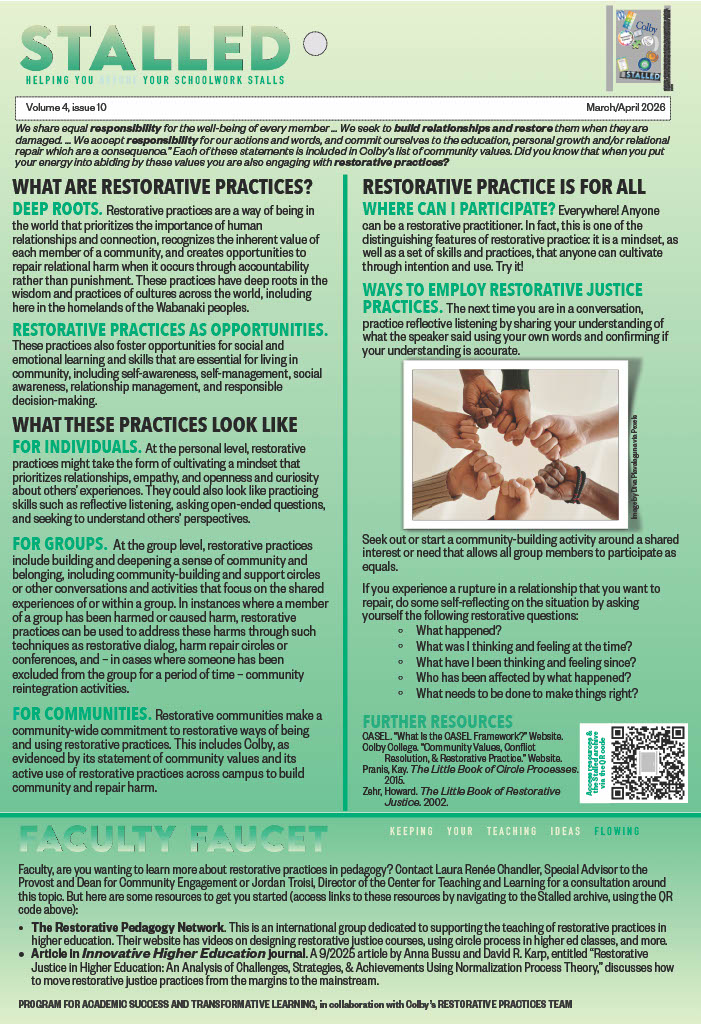
Seek out or start a community-building activity around a shared interest or need that allows all group members to participate as equals.
If you experience a rupture in a relationship that you want to repair, do some self-reflecting on the situation by asking yourself the following restorative questions:
- What happened?
- What was I thinking and feeling at the time?
- What have I been thinking and feeling since?
- Who has been affected by what happened?
- What needs to be done to make things right?
FURTHER RESOURCES
CASEL. “What Is the CASEL Framework?” Website.
Colby College. “Community Values, Conflict Resolution, & Restorative Practice.” Website.
Pranis, Kay. The Little Book of Circle Processes. 2015.
Zehr, Howard. The Little Book of Restorative Justice. 2002.
FACULTY FAUCET
Faculty, are you wanting to learn more about restorative practices in pedagogy? Contact Laura Renée Chandler, Special Advisor to the Provost and Dean for Community Engagement or Jordan Troisi, Director of the Center for Teaching and Learning for a consultation around this topic. But here are some resources to get you started:
- The Restorative Pedagogy Network. This is an international group dedicated to supporting the teaching of restorative practices in higher education. Their website has videos on designing restorative justice courses, using circle process in higher ed classes, and more.
- Article in Innovative Higher Education journal. A 9/2025 article by Anna Bussu and David R. Karp, entitled “Restorative Justice in Higher Education: An Analysis of Challenges, Strategies, & Achievements Using Normalization Process Theory,” discusses how to move restorative justice practices from the margins to the mainstream.