Helping you before your schoolwork stalls

Month: October 2025

SMART goal-setting (4.5)

If you’re finding it tough to get everything done, try setting SMART goals. This goal-setting method is very widely used, so you’re likely to encounter it when you join the work force. But it can help you manage your time here at college, too! Goal-setting can help you start SMART!
WHY TRY GOAL-SETTING?

HOW GOALS HELP. Setting clearly articulated goals helps you manage your time better by helping you think through what you need to do. Having goals also helps make you accountable to yourself, particularly when you use a method like SMART goals which encourages you to make your goals realistic and manageable.

WHAT DOES “SMART” MEAN? “SMART” is an acronym to help you remember the qualities of a well-set goal. The acronym stands for specific, measurable, achievable, relevant, and time-bound. If a goal has all of these characteristics, it’s much easier to know how to work toward achieving that goal. 

SPECIFIC. If a goal is too vague, you won’t really know how to reach it. Being specific makes it much more likely that you can develop a clear plan to achieve your goal. For example, “I’ll be a better student” isn’t a very specific goal. A more specific one would be “I’ll visit my professor in office hours to talk about the upcoming exam before I take that exam.”

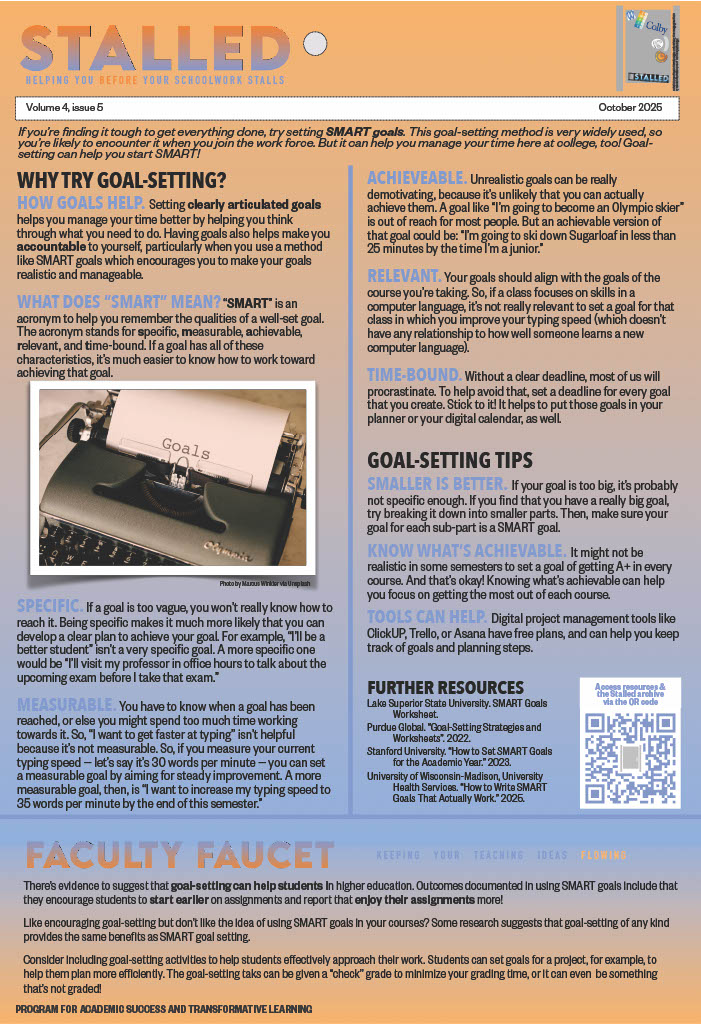
MEASURABLE. You have to know when a goal has been reached, or else you might spend too much time working towards it. So, “I want to get faster at typing” isn’t helpful because it’s not measurable. So, if you measure your current typing speed — let’s say it’s 30 words per minute — you can set a measurable goal by aiming for steady improvement. A more measurable goal, then, is “I want to increase my typing speed to 35 words per minute by the end of this semester.” 

ACHIEVEABLE. Unrealistic goals can be really demotivating, because it’s unlikely that you can actually achieve them. A goal like “I’m going to become an Olympic skier” is out of reach for most people. But an achievable version of that goal could be: “I’m going to ski down Sugarloaf in less than 25 minutes by the time I’m a junior.” 

RELEVANT. Your goals should align with the goals of the course you’re taking. So, if a class focuses on skills in a computer language, it’s not really relevant to set a goal for that class in which you improve your typing speed (which doesn’t have any relationship to how well someone learns a new computer language).

TIME-BOUND. Without a clear deadline, most of us will procrastinate. To help avoid that, set a deadline for every goal that you create. Stick to it! It helps to put those goals in your planner or your digital calendar, as well. 

GOAL-SETTING TIPS 

SMALLER IS BETTER. If your goal is too big, it’s probably not specific enough. If you find that you have a really big goal, try breaking it down into smaller parts. Then, make sure your goal for each sub-part is a SMART goal.

KNOW WHAT’S ACHIEVABLE. It might not be realistic in some semesters to set a goal of getting A+ in every course. And that’s okay! Knowing what’s achievable can help you focus on getting the most out of each course.

TOOLS CAN HELP. Digital project management tools like ClickUP, Trello, or Asana have free plans, and can help you keep track of goals and planning steps.

FURTHER RESOURCES 

Lake Superior State University. SMART Goals Worksheet.

Purdue Global. “Goal-Setting Strategies and Worksheets.” 2022.

Stanford University. “How to Set SMART Goals for the Academic Year.” 2023.

University of Wisconsin-Madison, University Health Services. “How to Write SMART Goals That Actually Work.” 2025.

FACULTY FAUCET

There’s evidence to suggest that goal-setting can help students in higher education. Outcomes documented in using SMART goals include that they encourage students to start earlier on assignments and report that enjoy their assignments more!

Like encouraging goal-setting but don’t like the idea of using SMART goals in your courses? Some research suggests that goal-setting of any kind provides the same benefits as SMART goal setting.

Consider including goal-setting activities to help students effectively approach their work. Students can set goals for a project, for example, to help them plan more efficiently. The goal-setting taks can be given a “check” grade to minimize your grading time, or it can even  be something that’s not graded!
Joy of learning (4.4)

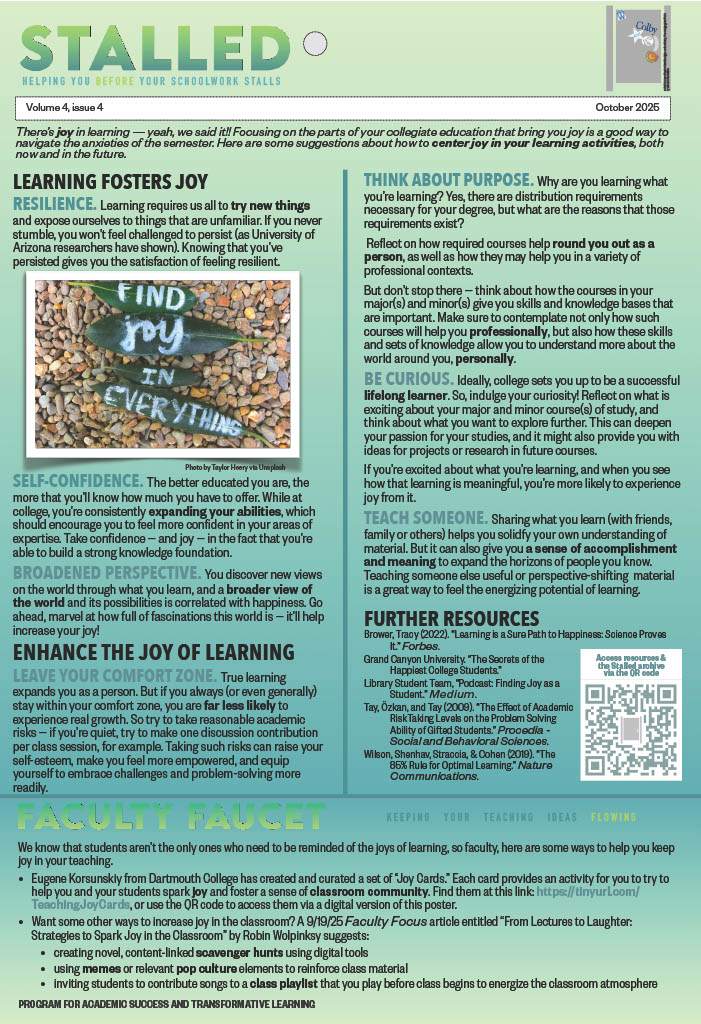
There’s joy in learning — yeah, we said it!! Focusing on the parts of your collegiate education that bring you joy is a good way to navigate the anxieties of the semester. Here are some suggestions about how to center joy in your learning activities, both now and in the future.

LEARNING FOSTERS JOY

RESILIENCE. Learning requires us all to try new things and expose ourselves to things that are unfamiliar. If you never stumble, you won’t feel challenged to persist (as University of Arizona researchers have shown). Knowing that you’ve persisted gives you the satisfaction of feeling resilient.

SELF-CONFIDENCE. The better educated you are, the more that you’ll know how much you have to offer. While at college, you’re consistently expanding your abilities, which should encourage you to feel more confident in your areas of expertise. Take confidence — and joy — in the fact that you’re able to build a strong knowledge foundation.

BROADENED PERSPECTIVE. You discover new views on the world through what you learn, and a broader view of the world and its possibilities is correlated with happiness. Go ahead, marvel at how full of fascinations this world is — it’ll help increase your joy!

ENHANCE THE JOY OF LEARNING 

LEAVE YOUR COMFORT ZONE. True learning expands you as a person. But if you always (or even generally) stay within your comfort zone, you are far less likely to experience real growth. So try to take reasonable academic risks — if you’re quiet, try to make one discussion contribution per class session, for example. Taking such risks can raise your self-esteem, make you feel more empowered, and equip yourself to embrace challenges and problem-solving more readily.

THINK ABOUT PURPOSE. Why are you learning what you’re learning? Yes, there are distribution requirements necessary for your degree, but what are the reasons that those requirements exist?

 Reflect on how required courses help round you out as a person, as well as how they may help you in a variety of professional contexts. 

But don’t stop there — think about how the courses in your major(s) and minor(s) give you skills and knowledge bases that are important. Make sure to contemplate not only how such courses will help you professionally, but also how these skills and sets of knowledge allow you to understand more about the world around you, personally.

BE CURIOUS. Ideally, college sets you up to be a successful lifelong learner. So, indulge your curiosity! Reflect on what is exciting about your major and minor course(s) of study, and think about what you want to explore further. This can deepen your passion for your studies, and it might also provide you with ideas for projects or research in future courses. 

If you’re excited about what you’re learning, and when you see how that learning is meaningful, you’re more likely to experience joy from it.

TEACH SOMEONE. Sharing what you learn (with friends, family or others) helps you solidfy your own understanding of material. But it can also give you a sense of accomplishment and meaning to expand the horizons of people you know. Teaching someone else useful or perspective-shifting  material is a great way to feel the energizing potential of learning.

FURTHER RESOURCES 

Brower, Tracy (2022). “Learning is a Sure Path to Happiness: Science Proves It.” Forbes.

Grand Canyon University. “The Secrets of the Happiest College Students.”

Library Student Team, “Podcast: Finding Joy as a Student.” Medium.

Tay, Özkan, and Tay (2009). “The Effect of Academic RiskTaking Levels on the Problem Solving Ability of Gifted Students.” Procedia – Social and Behavioral Sciences.

Wilson, Shenhav, Straccia, & Cohen (2019). “The 85% Rule for Optimal Learning.” Nature Communications.

FACULTY FAUCET

We know that students aren’t the only ones who need to be reminded of the joys of learning, so faculty, here are some ways to help you keep joy in your teaching. 

  • Eugene Korsunskiy from Dartmouth College has created and curated a set of “Joy Cards.” Each card provides an activity for you to try to help you and your students spark joy and foster a sense of classroom community. Find them at this link: https://tinyurl.com/TeachingJoyCards.
  • Want some other ways to increase joy in the classroom? A 9/19/25 Faculty Focus article entitled “From Lectures to Laughter: Strategies to Spark Joy in the Classroom” by Robin Wolpinksy suggests: 
    • creating novel, content-linked scavenger hunts using digital tools
    • using memes or relevant pop culture elements to reinforce class material
    • inviting students to contribute songs to a class playlist that you play before class begins to energize the classroom atmosphere

Mule Works (4.3)

The Colby Mule Works Innovation Lab is a free makerspace on the Street in Miller Library, where students from every discipline — regardless of experience level — may come together to explore interactive technologies, such as 3D printing, sewing, virtual reality & laser cutting, and use these tools to generate innovative forms of scholarship and creative expression.

WHAT IS MULE WORKS?

MAKE YOUR WORLD. Mule Works offers a wealth of maker tools to support your goals, whether academic or personal, artistic or technical. With lab computers boasting CAD, 3D modeling, and 2D design tools, a fleet of Bambu 3D printers – including one multi-color unit – a high-power laser cutter/engraver, Singer sewing machines, and a soldering station. Developing these skills can look great on a resume, or may inspire your entrepreneurial spirit! 

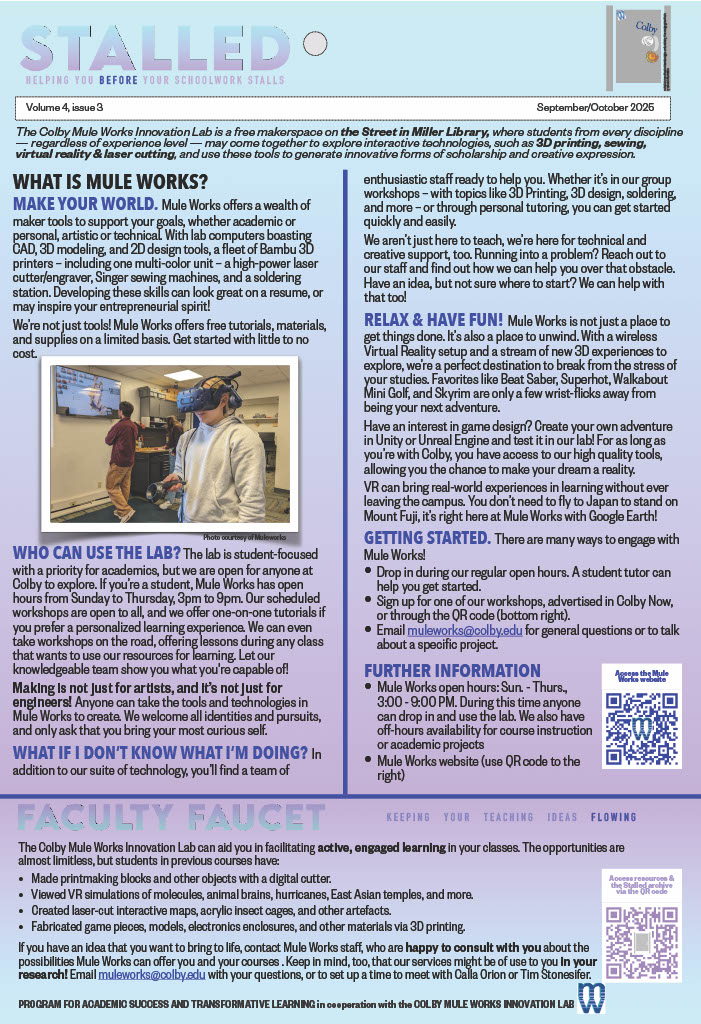
We’re not just tools! Mule Works offers free tutorials, materials, and supplies on a limited basis. Get started with little to no cost.

WHO CAN USE THE LAB? The lab is student-focused with a priority for academics, but we are open for anyone at Colby to explore. If you’re a student, Mule Works has open hours from Sunday to Thursday, 3pm to 9pm. Our scheduled workshops are open to all, and we offer one-on-one tutorials if you prefer a personalized learning experience. We can even take workshops on the road, offering lessons during any class that wants to use our resources for learning. Let our knowledgeable team show you what you’re capable of!

Making is not just for artists, and it’s not just for engineers! Anyone can take the tools and technologies in Mule Works to create. We welcome all identities and pursuits, and only ask that you bring your most curious self.

WHAT IF I DON’T KNOW WHAT I’M DOING

In addition to our suite of technology, you’ll find a team of enthusiastic staff ready to help you. Whether it’s in our group workshops – with topics like 3D Printing, 3D design, soldering, and more – or through personal tutoring, you can get started quickly and easily.

We aren’t just here to teach, we’re here for technical and creative support, too. Running into a problem? Reach out to our staff and find out how we can help you over that obstacle. Have an idea, but not sure where to start? We can help with that too!

RELAX & HAVE FUN! Mule Works is not just a place to get things done. It’s also a place to unwind. With a wireless Virtual Reality setup and a stream of new 3D experiences to explore, we’re a perfect destination to break from the stress of your studies. Favorites like Beat Saber, Superhot, Walkabout Mini Golf, and Skyrim are only a few wrist-flicks away from being your next adventure.

Have an interest in game design? Create your own adventure in Unity or Unreal Engine and test it in our lab! For as long as you’re with Colby, you have access to our high quality tools, allowing you the chance to make your dream a reality.

VR can bring real-world experiences in learning without ever leaving the campus. You don’t need to fly to Japan to stand on Mount Fuji, it’s right here at Mule Works with Google Earth!

GETTING STARTED. There are many ways to engage with Mule Works!

  • Drop in during our regular open hours. A student tutor can help you get started.
  • Sign up for one of our workshops, advertised in Colby Now, or through the QR code (bottom right).
  • Email [email protected] for general questions or to talk about a specific project.

FURTHER INFORMATION 

  • Mule Works open hours: Sun. – Thurs., 3:00 – 9:00 PM. During this time anyone can drop in and use the lab. We also have off-hours availability for course instruction or academic projects
  • Mule Works website (use QR code to the right)

FACULTY FAUCET

The Colby Mule Works Innovation Lab can aid you in facilitating active, engaged learning in your classes. The opportunities are almost limitless, but students in previous courses have:

  • Made printmaking blocks and other objects with a digital cutter.
  • Viewed VR simulations of molecules, animal brains, hurricanes, East Asian temples, and more.
  • Created laser-cut interactive maps, acrylic insect cages, and other artefacts.
  • Fabricated game pieces, models, electronics enclosures, and other materials via 3D printing.

If you have an idea that you want to bring to life, contact Mule Works staff, who are happy to consult with you about the possibilities Mule Works can offer you and your courses . Keep in mind, too, that our services might be of use to you in your research! Email [email protected] with your questions, or to set up a time to meet with Calla Orion or Tim Stonesifer. 

© 2026 Stalled

Theme by Anders Noren — Up ↑