You can use grades and feedback on assignments to identify strengths and areas of opportunity. Performing an “exam wrapper” or “feedback analysis” activity helps you strategize how to facilitate successful learning. Access your own copy of a template to complete these activities through the QR code at the bottom of this poster.
“EXAM WRAPPER” STEPS
RATIONALE. What was the goal of the module or part of class covered by the exam? The course’s learning objectives (on the syllabus) can give you insight into what your professor wants you to learn in class. In turn, that can help you organize your future studying.
REFLECTION. Examine your own studying habits leading up to the exam. This can allow you to identify successful study strategies as well as to find (and replace) strategies that were not successful for you.
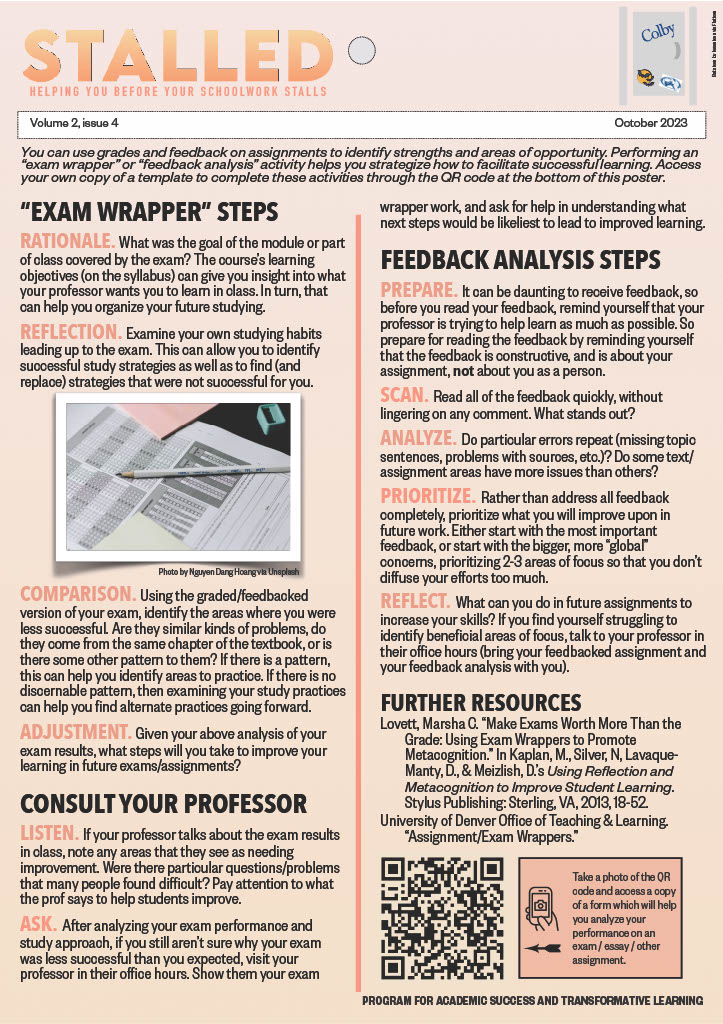
COMPARISON. Using the graded/feedbacked version of your exam, identify the areas where you were less successful. Are they similar kinds of problems, do they come from the same chapter of the textbook, or is there some other pattern to them? If there is a pattern, this can help you identify areas to practice. If there is no discernable pattern, then examining your study practices can help you find alternate practices going forward.
ADJUSTMENT. Given your above analysis of your exam results, what steps will you take to improve your learning in future exams/assignments?
CONSULT YOUR PROFESSOR
LISTEN. If your professor talks about the exam results in class, note any areas that they see as needing improvement. Were there particular questions/problems that many people found difficult? Pay attention to what the prof says to help students improve.
ASK. After analyzing your exam performance and study approach, if you still aren’t sure why your exam was less successful than you expected, visit your professor in their office hours. Show them your exam wrapper work, and ask for help in understanding what next steps would be likeliest to lead to improved learning.
FEEDBACK ANALYSIS STEPS
PREPARE. It can be daunting to receive feedback, so before you read your feedback, remind yourself that your professor is trying to help learn as much as possible. So prepare for reading the feedback by reminding yourself that the feedback is constructive, and is about your assignment, not about you as a person.
SCAN. Read all of the feedback quickly, without lingering on any comment. What stands out?
ANALYZE. Do particular errors repeat (missing topic sentences, problems with sources, etc.)? Do some text/assignment areas have more issues than others?
PRIORITIZE. Rather than address all feedback completely, prioritize what you will improve upon in future work. Either start with the most important feedback, or start with the bigger, more “global” concerns, prioritizing 2-3 areas of focus so that you don’t diffuse your efforts too much.
REFLECT. What can you do in future assignments to increase your skills? If you find yourself struggling to identify beneficial areas of focus, talk to your professor in their office hours (bring your feedbacked assignment and your feedback analysis with you).
FURTHER RESOURCES
Lovett, Marsha C. “Make Exams Worth More Than the Grade: Using Exam Wrappers to Promote Metacognition.” In Kaplan, M., Silver, N, Lavaque-Manty, D., & Meizlish, D.’s Using Reflection and Metacognition to Improve Student Learning. Stylus Publishing: Sterling, VA, 2013, 18-52.
University of Denver Office of Teaching & Learning. “Assignment/Exam Wrappers.”
Access your own copy of a tool for guiding you through your own “exam wrapper” or feedback analysis via the poster’s QR code.