Helping you before your schoolwork stalls

Month: April 2023

How to plan & lead a class discussion (1.6)

Stalled poster 1.6 (text is pasted below)

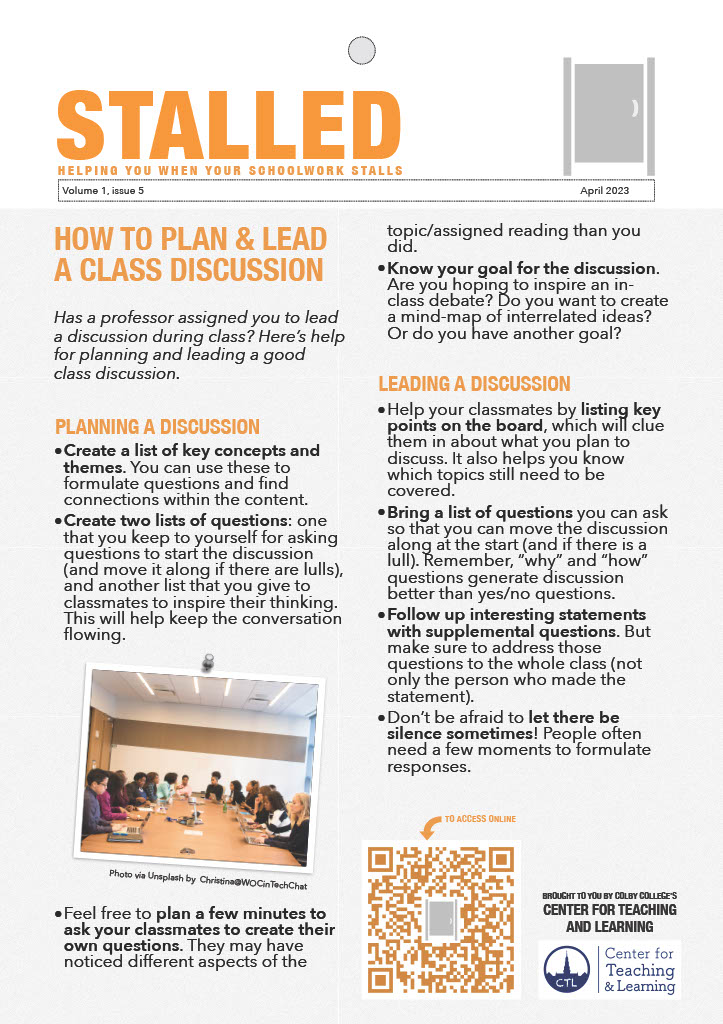
Has a professor assigned you to lead a discussion during class? Here’s help for creating and fostering a good class discussion.

PLANNING A DISCUSSION

  • Create a list of key concepts and themes. You can use these to formulate questions and find connections within the content.

  • Create two lists of questions, one that you keep to yourself for asking questions to start the discussion (and move it along if there are lulls), and another list that you give to classmates to inspire their thinking. This will help keep the conversation flowing.

  • Feel free to plan a few minutes to ask your classmates to create their own questions. They may have noticed different aspects of the topic/assigned reading than you did.

  • Know your goal for the discussion. Are you hoping to inspire an in-class debate? Do you want to create a mind-map of interrelated ideas? Do you want a range of points of view represented? Or do you have another goal?


LEADING A DISCUSSION
  • Help your classmates by listing key points on the board, which will clue them in about what you plan to discuss. It also helps you know which topics still need to be covered.

  • Bring a list of questions you can ask so that you can move the discussion along at the start (and if there is a lull). Remember, “why” and “how” questions generate discussion better than yes/no questions.

  • Follow up interesting statements with supplemental questions. But make sure to address those questions to the whole class (not only the person who made the statement).

  • Don’t be afraid to let there be silence! People often need a few moments to formulate responses, so let those silences unfold.
Managing fear of public speaking (1.5)

Stalled poster 1.5 (text is pasted below)


If you have fears about speaking in public, you’re in good company, because most college students feel this way. Just in time for CLAS and end-of-term presentations, here are suggestions on how to manage that fear.

KNOW YOUR AUDIENCE. Speaking tasks may feel like they are all about you, but the real focus is how to deliver benefit to your audience. So think about what your audience needs, and remember that the focus is on the talk’s content, not really on you.

BUT YOU MATTER, TOO! Take care of your physical self. Don’t eat immediately before your talk, but do eat something with protein on the talk day. Use the restroom beforehand, and keep a bottle of water handy when you’re speaking, too.

YOU’RE IN GOOD COMPANY. Notable public figures — including Thomas Jefferson, Mahatma Gandhi, and even Beyoncé — have had public speaking anxiety. But they achieved success in spite of their fears — and so can you!

PRACTICE, PRACTICE, PRACTICE! Practice is key to a good talk, and it is also helpful in easing fear. How?

  • Planning well ahead of your deadline makes it likelier that your talk will have good structure and content, which in turn often reduces speakers’ anxiety.

  • Practicing lets you discover difficult words to pronounce, giving you time to learn them (or find alternatives).

  • Practicing a talk makes you know the content better, allowing you to speak more freely (helping your delivery) and helping you feel more in control.

  • Practicing with your visuals gives you a chance to troubleshoot them, correcting mistakes and giving you time to make changes as needed.

  • Practicing gives a clearer sense of your talk’s timing, which provides more control over the pacing and delivery of the talk.


EYE CONTACT? Do you have a hard time looking audience members in the eye? If eye contact is uncomfortable, you can give the same impression of being attentive to the audience by looking at people’s ears instead.

TAKE A BREATH. Deep breathing can help calm anxiety (even the Mayo Clinic says so!). Take deep, slow breaths in through your nose, and exhale slowly through your mouth. Do this several times before you take the stage to help control your heart rate and calm yourself down.

Campus resources for students (1.4)

Stalled poster 1.4 (text is pasted below)


Colby has many resources for students, and you might not be familiar with all of them. These are a few of the key resources that you should know.

CLASS DEANS. There is a dean for each class year, and they are invaluable resources. If you have a problem and are unsure where to turn, contact your class dean first. They know the most usual issues that students face in the different stages of their time at Colby, but they are pros with handling unusual situations, too. They can also connect you to a Learning Consultant if one-on-one academic support is needed.

ACCOMMODATIONS. Colby’s Office for Student Access and Disability Services helps students get the academic accommodations they need to ensure equitable education opportunities.

MAKING CONNECTIONS. Davis Connects connects students with internships, research opportunities, and information about graduate school and career opportunities. But they also help connect you to off-campus study as well as connect you to funding for those experiences.

PUGH CENTER. A place that fosters inclusion and equity, the Pugh Center is a multicultural common ground and home to many clubs/organizations, programs, and support services.

EMOTIONAL SUPPORT. Make sure to access counseling services when you need them — that’s why Colby has a counselor team! But don’t forget that Colby also has compassionate support in its Office of Religious and Spiritual Life.

FIRST-GEN STUDENTS. Colby’s First-Generation-to-College/Low-Income Program for Student Success supports students and their families throughout their Colby career.

INTERNATIONAL STUDENTS. The Office of Student Financial Services helps with issues relating to immigration, taxes, and student employment, and the Pugh Center (see above) provides cultural activities.

STUDENT SUCCESS FUND. If financial hardship interferes with your path to academic success, meet with the Student Success and Support Case Manager to discuss the Student Success Fund.

If links are broken, search on Colby’s website to find contact info for any of these resources.

© 2026 Stalled

Theme by Anders Noren — Up ↑