Helping you before your schoolwork stalls

Month: April 2026

Reducing phone time (4.11)

Yes, phones are very useful tech that can perform many functions. But we can also over-rely on them to our detriment. Many recent studies suggest that digital fasts — or even short times away from our screens — can bring about desirable outcomes. Read on to see how you might benefit from some time away from your phone.
OVERRELIANCE ON PHONES HURTS US

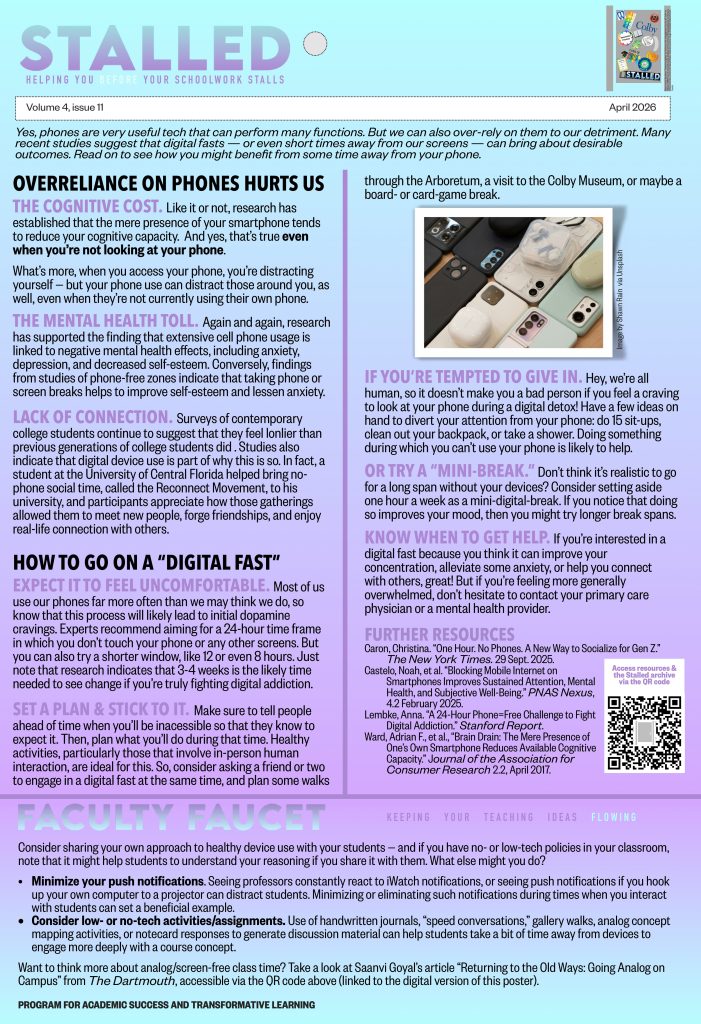
THE COGNITIVE COST. Like it or not, research has established that the mere presence of your smartphone tends to reduce your cognitive capacity.  And yes, that’s true even when you’re not looking at your phone.

What’s more, when you access your phone, you’re distracting yourself — but your phone use can distract those around you, as well, even when they’re not currently using their own phone.

THE MENTAL HEALTH TOLL. Again and again, research has supported the finding that extensive cell phone usage is linked to negative mental health effects, including anxiety, depression, and decreased self-esteem. Conversely, findings from studies of phone-free zones indicate that taking phone or screen breaks helps to improve self-esteem and lessen anxiety.

LACK OF CONNECTION. Surveys of contemporary college students continue to suggest that they feel lonlier than previous generations of college students did . Studies also indicate that digital device use is part of why this is so. In fact, a student at the University of Central Florida helped bring no-phone social time, called the Reconnect Movement, to his university, and participants appreciate how those gatherings allowed them to meet new people, forge friendships, and enjoy real-life connection with others.

HOW TO GO ON A “DIGITAL FAST”

EXPECT IT TO FEEL UNCOMFORTABLE.Most of us use our phones far more often than we may think we do, so know that this process will likely lead to initial dopamine cravings. Experts recommend aiming for a 24-hour time frame in which you don’t touch your phone or any other screens. But you can also try a shorter window, like 12 or even 8 hours. Just note that research indicates that 3-4 weeks is the likely time needed to see change if you’re truly fighting digital addiction.

SET A PLAN & STICK TO IT. Make sure to tell people ahead of time when you’ll be inacessible so that they know to expect it. Then, plan what you’ll do during that time. Healthy activities, particularly those that involve in-person human interaction, are ideal for this. So, consider asking a friend or two to engage in a digital fast at the same time, and plan some walks through the Arboretum, a visit to the Colby Museum, or maybe a board- or card-game break.

IF YOU’RE TEMPTED TO GIVE IN. Hey, we’re all human, so it doesn’t make you a bad person if you feel a craving to look at your phone during a digital detox! Have a few ideas on hand to divert your attention from your phone: do 15 sit-ups, clean out your backpack, or take a shower. Doing something during which you can’t use your phone is likely to help.

OR TRY A “MINI-BREAK.” Don’t think it’s realistic to go for a long span without your devices? Consider setting aside one hour a week as a mini-digital-break. If you notice that doing so improves your mood, then you might try longer break spans.

KNOW WHEN TO GET HELP. If you’re interested in a digital fast because you think it can improve your concentration, alleviate some anxiety, or help you connect with others, great! But if you’re feeling more generally overwhelmed, don’t hesitate to contact your primary care physician or a mental health provider.

FURTHER RESOURCES 

Caron, Christina. “One Hour. No Phones. A New Way to Socialize for Gen Z.” The New York Times. 29 Sept. 2025.

Castelo, Noah, et al. “Blocking Mobile Internet on Smartphones Improves Sustained Attention, Mental Health, and Subjective Well-Being.” PNAS Nexus, 4.2 February 2025.

Lembke, Anna. “A 24-Hour Phone=Free Challenge to Fight Digital Addiction.” Stanford Report. 

Ward, Adrian F., et al., “Brain Drain: The Mere Presence of One’s Own Smartphone Reduces Available Cognitive Capacity.” Journal of the Association for Consumer Research 2.2, April 2017.

FACULTY FAUCET

Consider sharing your own approach to healthy device use with your students — and if you have no- or low-tech policies in your classroom, note that it might help students to understand your reasoning if you share it with them. What else might you do?

  • Minimize your push notifications. Seeing professors constantly react to iWatch notifications, or seeing push notifications if you hook up your own computer to a projector can distract students. Minimizing or eliminating such notifications during times when you interact with students can set a beneficial example.  
  • Consider low- or no-tech activities/assignments. Use of handwritten journals,  “speed converstations,” gallery walks, analog concept mapping activities, or notecard responses to generate discussion material can help students take a bit of time away from devices to engage more deeply with a course concept. 

Want to think more about analog/screen-free class time? Take a look at Saanvi Goyal’s article “Returning to the Old Ways: Going Analog on Campus” from The Dartmouth.
Restorative practices (4.10)

We share equal responsibility for the well-being of every member … We seek to build relationships and restore them when they are damaged. … We accept responsibility for our actions and words, and commit ourselves to the education, personal growth and/or relational repair which are a consequence.” Each of these statements is included in Colby’s list of community values. Did you know that when you put your energy into abiding by these values you are also engaging with restorative practices?

WHAT ARE RESTORATIVE PRACTICES?

DEEP ROOTS. Restorative practices are a way of being in the world that prioritizes the importance of human relationships and connection, recognizes the inherent value of each member of a community, and creates opportunities to repair relational harm when it occurs through accountability rather than punishment. These practices have deep roots in the wisdom and practices of cultures across the world, including here in the homelands of the Wabanaki peoples.

RESTORATIVE PRACTICES AS OPPORTUNITIES. These practices also foster opportunities for social and emotional learning and skills that are essential for living in community, including self-awareness, self-management, social awareness, relationship management, and responsible decision-making.

WHAT THESE PRACTICES LOOK LIKE

FOR INDIVIDUALS. At the personal level, restorative practices might take the form of cultivating a mindset that prioritizes relationships, empathy, and openness and curiosity about others’ experiences. They could also look like practicing skills such as reflective listening, asking open-ended questions, and seeking to understand others’ perspectives. 

FOR GROUPS.  At the group level, restorative practices include building and deepening a sense of community and belonging, including community-building and support circles or other conversations and activities that focus on the shared experiences of or within a group. In instances where a member of a group has been harmed or caused harm, restorative practices can be used to address these harms through such techniques as restorative dialog, harm repair circles or conferences, and – in cases where someone has been excluded from the group for a period of time – community reintegration activities.  

FOR COMMUNITIES. Restorative communities make a community-wide commitment to restorative ways of being and using restorative practices. This includes Colby, as evidenced by its statement of community values and its active use of restorative practices across campus to build community and repair harm.

RESTORATIVE PRACTICE IS FOR ALL

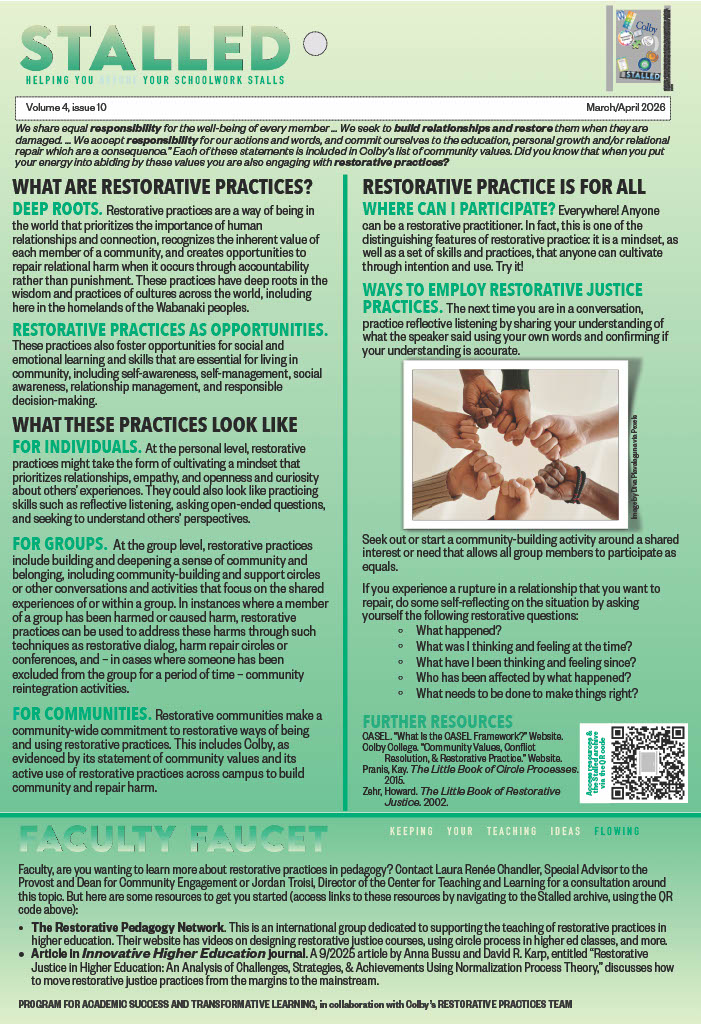
WHERE CAN I PARTICIPATE? Everywhere! Anyone can be a restorative practitioner. In fact, this is one of the distinguishing features of restorative practice: it is a mindset, as well as a set of skills and practices, that anyone can cultivate through intention and use. Try it!

WAYS TO EMPLOY RESTORATIVE JUSTICE PRACTICES. The next time you are in a conversation, practice reflective listening by sharing your understanding of what the speaker said using your own words and confirming if your understanding is accurate.

Seek out or start a community-building activity around a shared interest or need that allows all group members to participate as equals.

If you experience a rupture in a relationship that you want to repair, do some self-reflecting on the situation by asking yourself the following restorative questions:

  • What happened?
  • What was I thinking and feeling at the time?
  • What have I been thinking and feeling since?
  • Who has been affected by what happened?
  • What needs to be done to make things right?

FURTHER RESOURCES 

CASEL. “What Is the CASEL Framework?” Website.

Colby College. “Community Values, Conflict Resolution, & Restorative Practice.” Website.

Pranis, Kay. The Little Book of Circle Processes. 2015.

Zehr, Howard. The Little Book of Restorative Justice. 2002.

FACULTY FAUCET 

Faculty, are you wanting to learn more about restorative practices in pedagogy? Contact Laura Renée Chandler, Special Advisor to the Provost and Dean for Community Engagement or Jordan Troisi, Director of the Center for Teaching and Learning for a consultation around this topic. But here are some resources to get you started:

Breaking down projects (4.9)

When you’re assigned a project, it can sometimes feel overwhelming. One way to lessen that feeling is to break down what you need to do into manageable pieces. This poster gives you some guidance on how to do just that.

HOW TO BREAK DOWN PROJECTS

IDENTIFY KEY DATES. Look at all project due dates. Is there a rough draft or work-in-progress due date? If so, you’ll need to plan to have as full a draft of your project as possible by that date. If there is not a rough draft/work-in-progress date, then work backwards from the final project’s due date. You’ll want to finish your draft with enough time to fact-check, edit, proofread, and check that you have completed all expected aspects of the project task. Or, if it’s a presentation, you’ll need plenty of time to practice.

THINK ABOUT THE STEPS. Think about all pieces of the task, brainstorming all steps that you can think of. Make sure to consult the assignment instructions, if your instructor has provided any, because that can help you identify the steps you need to complete.

These steps can include meeting with a librarian, conducting research (which most likely takes several sessions), assembling data, outlining a report or essay, creating visuals, writing part of a text (thinking about which parts should be written first), meeting with your group (if it’s a group project), and checking the formatting of a text or object that you produce.

BE REALLY SPECIFIC. When you look at your task list, have you been clear about what you have to do with each step? If you’ve used vague terms like “work on” something, or “do” something, that’s a sign that you might not have really clarified what those steps are. If you aren’t clear in your step identification, you might struggle later to complete the tasks. 

So, if you find that you can’t clearly articulate what each task entails, visit your professor’s office hours as soon as you can so that you can acheive clarity about what you need to do with each step of the project. 

ORDER THE STEPS. Some tasks must be done before other tasks, and sometimes it’s quite clear which should come first. Those tasks are relatively easy to put in order.  

However, some tasks might not be put in order so easily. If you’re struggling to figure out task order, talk to your professor as soon as you can — their office hours are ideal for this — so that you can put the steps in good order.

SCHEDULE YOUR STEPS

ESTIMATE TIME PER STEP. How long will it take to complete each task or step? Give your estimations some careful thought, and factor in at least a bit more time for each task than you think you’d need, just to be safe.

REALLY BREAK IT DOWN. If your time estimation for a task is longer than about an hour, think critically about whether you need to break that task down further. Remember, you’ll need to complete these tasks in the time between your classes, in the evenings, and on weekends. So, you need to be realistic about how long you truly have to complete each task.

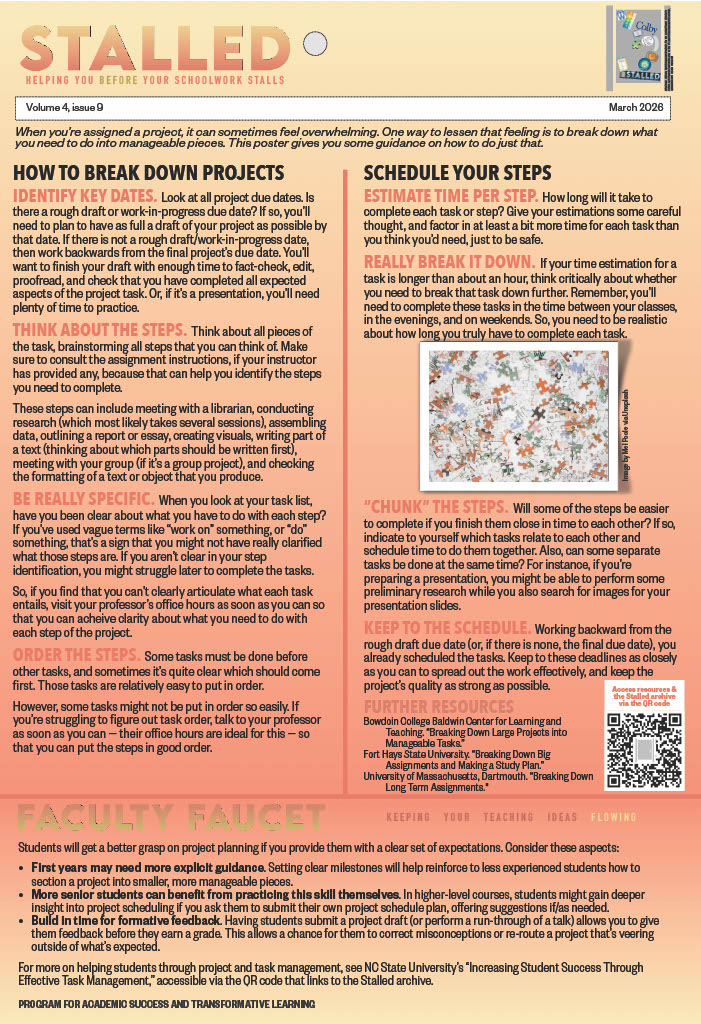
“CHUNK” THE STEPS. Will some of the steps be easier to complete if you finish them close in time to each other? If so, indicate to yourself which tasks relate to each other and schedule time to do them together. Also, can some separate tasks be done at the same time? For instance, if you’re preparing a presentation, you might be able to perform some preliminary research while you also search for images for your presentation slides. 

KEEP TO THE SCHEDULE. Working backward from the rough draft due date (or, if there is none, the final due date), you already scheduled the tasks. Keep to these deadlines as closely as you can to spread out the work effectively, and keep the project’s quality as strong as possible.

FURTHER RESOURCES 

Bowdoin College Baldwin Center for Learning and Teaching. “Breaking Down Large Projects into Manageable Tasks.”

Fort Hays State University. “Breaking Down Big Assignments and Making a Study Plan.” 

University of Massachusetts, Dartmouth. “Breaking Down Long Term Assignments.”

FACULTY FAUCET

Students will get a better grasp on project planning if you provide them with a clear set of expectations. Consider these aspects: 

  • First years may need more explicit guidance. Setting clear milestones will help reinforce to less experienced students how to section a project into smaller, more manageable pieces.  
  • More senior students can benefit from practicing this skill themselves. In higher-level courses, students might gain deeper insight into project scheduling if you ask them to submit their own project schedule plan, offering suggestions if/as needed.
  • Build in time for formative feedback. Having students submit a project draft (or perform a run-through of a talk) allows you to give them feedback before they earn a grade. This allows a chance for them to correct misconceptions or re-route a project that’s veering outside of what’s expected.

For more on helping students through project and task management, see NC State University’s “Increasing Student Success Through Effective Task Management.”

© 2026 Stalled

Theme by Anders Noren — Up ↑