Helping you before your schoolwork stalls

Month: March 2025

The Colby Museum (3.10)

The Colby Museum boasts a world-class collection of American art, and offers students a range of opportunities to get involved in the arts. You might visit the museum as part of a class, independently, or as part of a club/other organization, and there are lots of other ways to take advantage of what this unique resource offers, regardless of your major. For more information, email: [email protected]
VISITING THE MUSEUM 

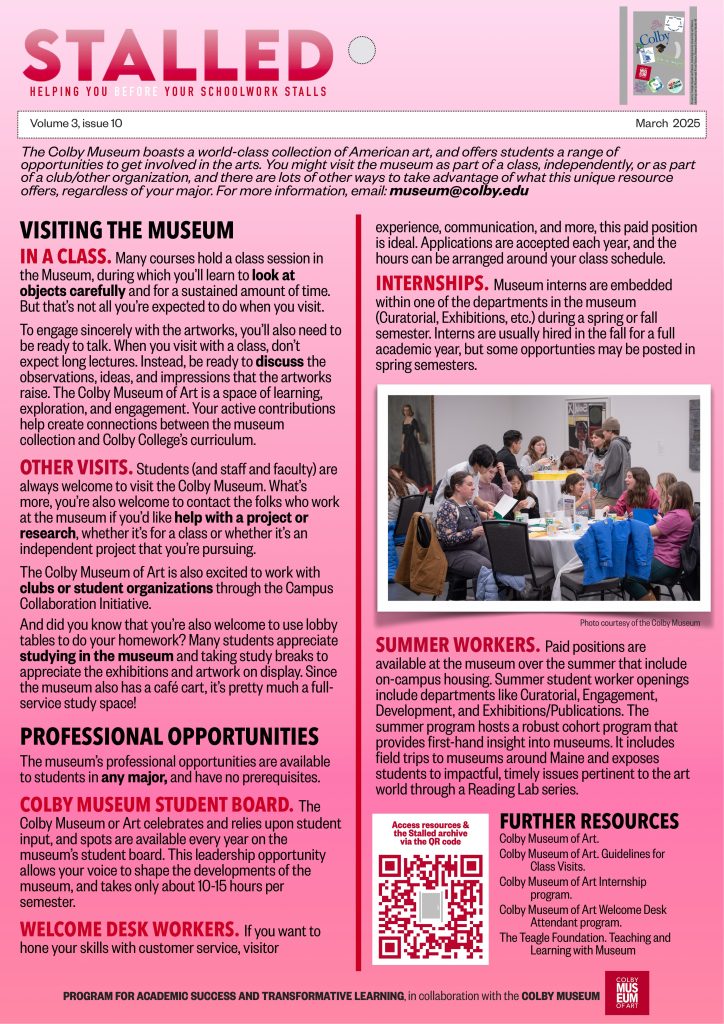
IN A CLASS. Many courses hold a class session in the Museum, during which you’ll learn to look at objects carefully and for a sustained amount of time. But that’s not all you’re expected to do when you visit.

To engage sincerely with the artworks, you’ll also need to be ready to talk. When you visit with a class, don’t expect long lectures. Instead, be ready to discuss the observations, ideas, and impressions that the artworks raise. The Colby Museum of Art is a space of learning, exploration, and engagement. Your active contributions help create connections between the museum collection and Colby College’s curriculum.

OTHER VISITS. Students (and staff and faculty) are always welcome to visit the Colby Museum. What’s more, you’re also welcome to contact the folks who work at the museum if you’d like help with a project or research, whether it’s for a class or whether it’s an independent project that you’re pursuing. 

The Colby Museum of Art is also excited to work with clubs or student organizations through the Campus Collaboration Initiative. 

And did you know that you’re also welcome to use lobby tables to do your homework? Many students appreciate studying in the museum and taking study breaks to appreciate the exhibitions and artwork on display. Since the museum also has a café cart, it’s pretty much a full-service study space!

PROFESSIONAL OPPORTUNITIES

The museum’s professional opportunities are available to students in any major, and have no prerequisites.

COLBY MUSEUM STUDENT BOARD. The Colby Museum or Art celebrates and relies upon student input, and spots are available every year on the museum’s student board. This leadership opportunity allows your voice to shape the developments of the museum, and takes only about 10-15 hours per semester.

WELCOME DESK WORKERS. If you want to hone your skills with customer service, visitor experience, communication, and more, this paid position is ideal. Applications are accepted each year, and the hours can be arranged around your class schedule.

INTERNSHIPS. Museum interns are embedded within one of the departments in the museum (Curatorial, Exhibitions, etc.) during a spring or fall semester. Interns are usually hired in the fall for a full academic year, but some opportunties may be posted in spring semesters.

SUMMER WORKERS. Paid positions are available at the museum over the summer that include on-campus housing. Summer student worker openings include departments like Curatorial, Engagement, Development, and Exhibitions/Publications. The summer program hosts a robust cohort program that provides first-hand insight into museums. It includes field trips to museums around Maine and exposes students to impactful, timely issues pertinent to the art world through a Reading Lab series. 

FURTHER RESOURCES 

Colby Museum of Art.

Colby Museum of Art. Guidelines for Class Visits.

Colby Museum of Art Internship program. 

Colby Museum of Art Welcome Desk Attendant program.

The Teagle Foundation. Teaching and Learning with Museum Exhibitions
The Research Lifecycle (3.9)

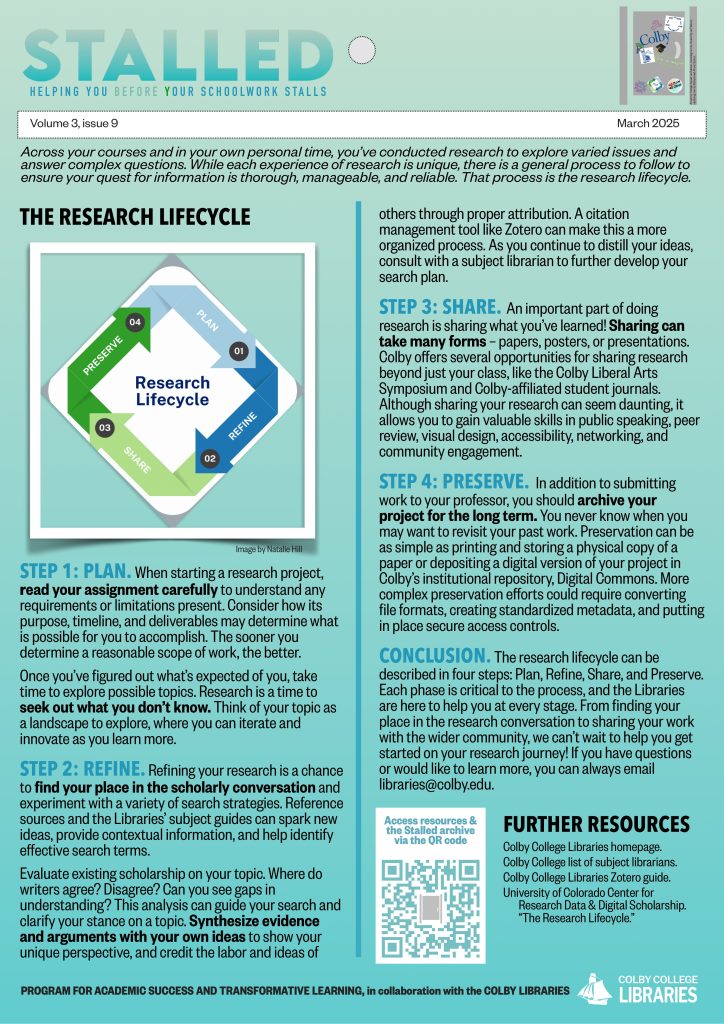
Across your courses and in your own personal time, you’ve conducted research to explore varied issues and answer complex questions. While each experience of research is unique, there is a general process to follow to ensure your quest for information is thorough, manageable, and reliable. That process is the research lifecycle.

THE RESEARCH LIFECYCLE

STEP 1: PLAN. When starting a research project, read your assignment carefully to understand any requirements or limitations present. Consider how its purpose, timeline, and deliverables may determine what is possible for you to accomplish. The sooner you determine a reasonable scope of work, the better.

Once you’ve figured out what’s expected of you, take time to explore possible topics. Research is a time to seek out what you don’t know. Think of your topic as a landscape to explore, where you can iterate and innovate as you learn more.

STEP 2: REFINE. Refining your research is a chance to find your place in the scholarly conversation and experiment with a variety of search strategies. Reference sources and the Libraries’ subject guides can spark new ideas, provide contextual information, and help identify effective search terms.

Evaluate existing scholarship on your topic. Where do writers agree? Disagree? Can you see gaps in understanding? This analysis can guide your search and clarify your stance on a topic. Synthesize evidence and arguments with your own ideas to show your unique perspective, and credit the labor and ideas of others through proper attribution. A citation management tool like Zotero can make this a more organized process. As you continue to distill your ideas, consult with a subject librarian to further develop your search plan.

STEP 3: SHARE.An important part of doing research is sharing what you’ve learned! Sharing can take many forms – papers, posters, or presentations. Colby offers several opportunities for sharing research beyond just your class, like the Colby Liberal Arts Symposium and Colby-affiliated student journals. Although sharing your research can seem daunting, it allows you to gain valuable skills in public speaking, peer review, visual design, accessibility, networking, and community engagement.

STEP 4: PRESERVE.  In addition to submitting work to your professor, you should archive your project for the long term. You never know when you may want to revisit your past work. Preservation can be as simple as printing and storing a physical copy of a paper or depositing a digital version of your project in Colby’s institutional repository, Digital Commons. More complex preservation efforts could require converting file formats, creating standardized metadata, and putting in place secure access controls.

CONCLUSION. The research lifecycle can be described in four steps: Plan, Refine, Share, and Preserve. Each phase is critical to the process, and the Libraries are here to help you at every stage. From finding your place in the research conversation to sharing your work with the wider community, we can’t wait to help you get started on your research journey! If you have questions or would like to learn more, you can always email [email protected]. 

FURTHER RESOURCES 

Colby College Libraries homepage.

Colby College list of subject librarians.

Colby College Libraries Zotero guide.

University of Colorado Center for Research Data & Digital Scholarship. “The Research Lifecycle.”

© 2026 Stalled

Theme by Anders Noren — Up ↑