Across your courses and in your own personal time, you’ve conducted research to explore varied issues and answer complex questions. While each experience of research is unique, there is a general process to follow to ensure your quest for information is thorough, manageable, and reliable. That process is the research lifecycle.
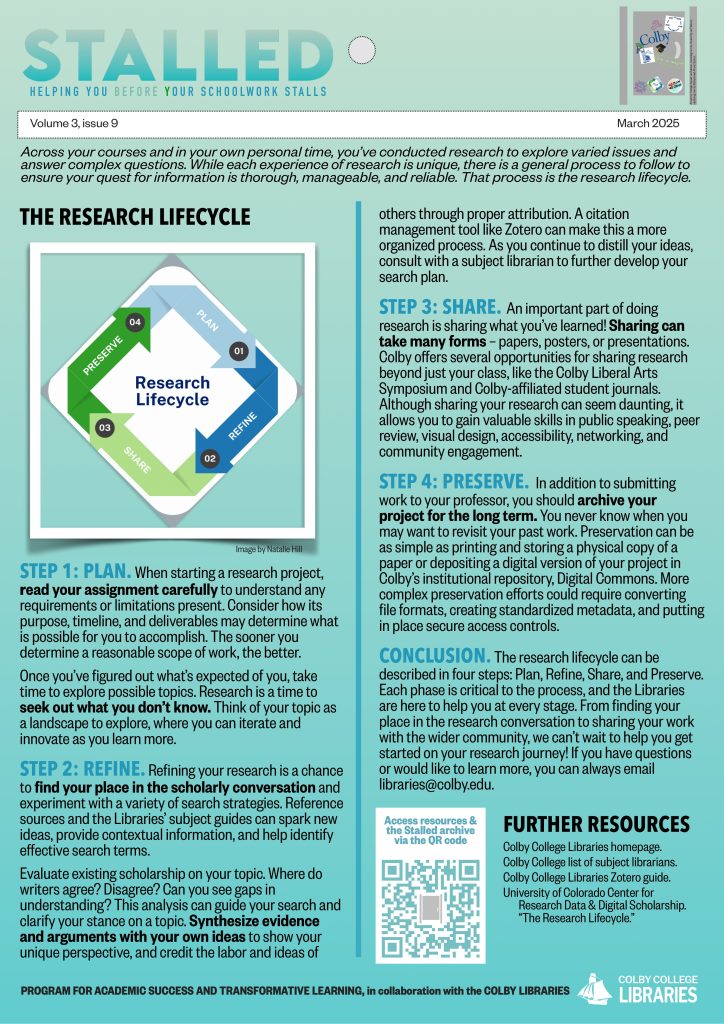
THE RESEARCH LIFECYCLE
STEP 1: PLAN. When starting a research project, read your assignment carefully to understand any requirements or limitations present. Consider how its purpose, timeline, and deliverables may determine what is possible for you to accomplish. The sooner you determine a reasonable scope of work, the better.
Once you’ve figured out what’s expected of you, take time to explore possible topics. Research is a time to seek out what you don’t know. Think of your topic as a landscape to explore, where you can iterate and innovate as you learn more.
STEP 2: REFINE. Refining your research is a chance to find your place in the scholarly conversation and experiment with a variety of search strategies. Reference sources and the Libraries’ subject guides can spark new ideas, provide contextual information, and help identify effective search terms.
Evaluate existing scholarship on your topic. Where do writers agree? Disagree? Can you see gaps in understanding? This analysis can guide your search and clarify your stance on a topic. Synthesize evidence and arguments with your own ideas to show your unique perspective, and credit the labor and ideas of others through proper attribution. A citation management tool like Zotero can make this a more organized process. As you continue to distill your ideas, consult with a subject librarian to further develop your search plan.
STEP 3: SHARE.An important part of doing research is sharing what you’ve learned! Sharing can take many forms – papers, posters, or presentations. Colby offers several opportunities for sharing research beyond just your class, like the Colby Liberal Arts Symposium and Colby-affiliated student journals. Although sharing your research can seem daunting, it allows you to gain valuable skills in public speaking, peer review, visual design, accessibility, networking, and community engagement.
STEP 4: PRESERVE. In addition to submitting work to your professor, you should archive your project for the long term. You never know when you may want to revisit your past work. Preservation can be as simple as printing and storing a physical copy of a paper or depositing a digital version of your project in Colby’s institutional repository, Digital Commons. More complex preservation efforts could require converting file formats, creating standardized metadata, and putting in place secure access controls.
CONCLUSION. The research lifecycle can be described in four steps: Plan, Refine, Share, and Preserve. Each phase is critical to the process, and the Libraries are here to help you at every stage. From finding your place in the research conversation to sharing your work with the wider community, we can’t wait to help you get started on your research journey! If you have questions or would like to learn more, you can always email [email protected].
FURTHER RESOURCES
Colby College Libraries homepage.
Colby College list of subject librarians.
Colby College Libraries Zotero guide.
University of Colorado Center for Research Data & Digital Scholarship. “The Research Lifecycle.”