Helping you before your schoolwork stalls

Category: Demystifying academia (Page 1 of 2)

Emails and emailing (5.2)

We know that emailing is not something that all students do often before they arrive at Colby. But email is the main way that most professors, deans, and other folks at Colby keep you informed about what you need to know. So here are some email hacks to keep you informed and help you communicate professionally.
ESSENTIAL EMAIL INFO 

CHECK IT FREQUENTLY. So much information will come your way in the form of an email! And — here’s the kicker — people will assume that you read your mail and therefore know that information that’s in your emails. So, set a calendar reminder to check your email at least twice a week. But checking more frequently is better (we suggest checking email every day).

Frequent email checks mean that you’ll get the information you need as soon as possible. In short, checking your email regularly keeps you well-informed and spares you from missing deadlines (which can cause you all kinds of problems)!

WHAT INFO COMES VIA EMAIL? Many of your professors will use Moodle’s communication tool to let folks in their class know about updates to assignments, shifts in dates for class assignments and tests, and so much more. Those Moodle messages appear in your email. Other professors might skip Moodle altogether and simply email students directly. In both cases, your professors will expect you to have read the information that they sent you. If you haven’t read those emails, you could miss deadlines, misunderstand their expectations, and otherwise struggle needlessly.

But it’s not just your professors who’ll send you email, it’s also your class deans and campus administrators. Class deans are facilitators of your academic success, so information from them can keep you on track to register for classes, let you know about important deadlines, and inform you about opportunities unique to those in your graduating class. Checking your email regularly means you’ll also be better informed about grants, internships, and programming that develops your skills or pertains to your interests.

HOW TO WRITE EMAILS

WHY DO I CARE? Keep in mind that email is still the main communicative channel for most employers and graduate schools, so learning good email habits now will make you a better prepared employee and/or a grad students who starts their program with clear, professional communication skills. Even in the short term, the way that you present yourself in an email can shape the way a professor sees you. Concise, respectful emails leave a better impression on their recipient than vague or meandering ones.

CHECK FIRST. Are you emailing a question to a professor? Check the course syllabus and Moodle page first — those resources will provide the answers to lots of questions!

CLARITY IS KING. Email functions best when its recipient can read it swiftly and understand it immediately. That involves using a subject line that succinctly conveys the topic or purpose. A clear subject line can help professors or other recipients prioritize and respond to messages. Your professors and college administrators receive far more emails each day than you might realize. So, writing a clear subject line helps them know when your situation is pressing versus when you’re simply informing them of something that doesn’t require a response.

Getting to your point quickly is also helpful. That means that you do not need to include overly personal information, “sob stories,” or any other superfluous information. Be polite and concise.

ONE AND DONE. Try to include everything you need in one email. If you send emails in a successive chain, it becomes easy for information or requests to be overlooked. So don’t hit “send” too quickly — think about whether your email includes everything it should. 

If your email has a lot of information, and that information is all really necessary, then use bullet points and/or bolding of key points to make reading easier.

FURTHER RESOURCES 

Purdue University Online Writing Lab. “Email Etiquette for Students.”

University of North Carolina at Charlotte’s Writing Center. “Effective Email Communication.”

University of Wisconsin, Madison Writing Center. “Advice for Students Writing a Professional Email.”

FACULTY FAUCET

Is there anything in the advice above to students that doesn’t fully cover what you expect from students’ emails? Provide a document on your course Moodle page that establishes any guidelines that you want students to observe when they email you. An email template might also be helpful for students, particularly when teaching an introductory-level course when students might have limited email experience.

If you do create such a document, consider adding a note that you expect students to check the rest of the Moodle page, including your course syllabus, before sending you an email. Are there issues that you’d prefer to discuss only in office hours? If so, it’s helpful to clarify those for students in that document, as well.
Course feedback (4.6)

You fill out a questionnaire on each course you take, every semester. They’re incredibly important for the campus community, in particular the written comments that students provide. So be sure to complete them for all of your courses! But what is the point of course evaluations, and what is your role with them? Here’s a quick primer.

YOUR VOICE MATTERS — A LOT!

COURSE PLANNING. One of the purposes of student feedback on courses is to provide professors with insight on the student experience in their courses. Faculty members rely on student input so that they can continously improve the learning experience in their course — but without your input, this can’t happen.

STUDENT PERSPECTIVES. You might not be an expert on teaching, but only you have expertise regarding your own individual learning. Sharing your insights is essential for professors to know what your unique experience in the course was. While the questionnaire asks your input in terms of a scale, one student’s “strong agree” as to whether an instructor assigned work that promoted their learning might reflect the same intensity as someone else’s “agree.” So, in addition to registering your impressions via the questions asking if you agree or disagree, written feedback that clarifies your opinion is crucial — that’s why every question leaves space for you to elaborate in writing.

WHO SEES COURSE FEEDBACK?

PROFESSORS. The professor whose class you took has access to the feedback that students provide on the course, though they are only given access to it after grades have been filed for that course. They have no way to see the identity of what student made any comment or ranking response (like “strongly agree,” “agree,”“disagree,” or “strongly disagree”).

ADMINISTRATORS. These surveys are used as part of assessments about faculty retention, promotion, & tenure. That means that administrators and the tenure & promotion committee also see survey responses. They take these surveys seriously, so you should, too. 

WHAT’S STUDENTS’ ROLE?

THINK IN TERMS OF GOALS. Input you provide should focus on how the course contributed to your learning. That means that you might have found the class hard or easy, but it might’ve still helped you advance your knowledge or skills. So, think about what the goals of the course were (often expressed on a syllabus as “learning outcomes”), and judge as fairly as you can to what extent the course helped you achieve those goals.

BE CONSTRUCTIVE & CONCRETE. Your written comments are incredibly important. Anchoring your feedback in specifics of the course helps faculty to know in a more granular way what works well and what might beneficially be altered. Practical feedback helps you avoid personal comments about the professor, too. Current research indicates that students can reveal bias (based on such things as gender identity or race) through these kinds of surveys, which often happens when comments express students’ general feelings about a course or about the professor’s personality.

THIS CAN HELP YOU, TOO! Reflecting on the course gives you the opportunity to think about your own learning. How far have you come since the course began? How do the subject matter and skills you learned in this course relate to the rest of your coursework? Thinking about your progress can help you make better decisions about how to proceed in future courses, and taking stock of your learning experiences can help you choose a major, minor, or even a career path.

FORWARD THINKING. Your advice will be most useful if you think about what should be preserved and also what might be productively changed in future runs of the course. So, if the course takes place at 8:00 AM, which is something that your professor can’t control, expressing dissatisfaciton with the class time won’t help future versions of the course (which might be scheduled at a different time of day).

FURTHER RESOURCES 

Heffernan, Troy. “Sexism, Racism, Prejudice, and Bias: A Literature Review & Synthesis Surrounding Student Evaluations of Courses and Teaching.” Assessment & Evaluation in Higher Ed, 2021.

Stanford University Academic Advising. “Why Should I Fill Out My Course Evaluations?” 

Preparing to come to Colby (digital-only edition)

Welcome to Colby! And welcome to “Stalled,” a poster series that provides suggestions to help you maximize your academic success. Why is it called “Stalled?” We hope to give you advice before your schoolwork stalls. Also, you’ll find these posters in the bathrooms stalls of academic buildings several times each semester! 

PREPARING TO COME TO COLBY 

SCHEDULE IT IN. You’ve received your Fall ’25 class schedule over the summer. So, schedule all class times in your calendar. We suggest that you familiarize yourself with Google Calendar, since Colby uses Google’s suite of software. If you need help, see the Stalled poster from February 2024 on Google Calendar by using the QR code or link to the Stalled archive at the bottom of this poster.

BE READY TO STUDY. To know how much time to devote to each class, you need to know that every 1 hour of class time requires 2-3 hours of study/work time. So, if you have a 3-hour class, expect to spend about 9 hours a week studying, doing homework, and completing assignments for that one class. It’s a good idea to schedule that work/study time on your calendar so that you know that you’re giving each class its due attention. 

READ ORIENATATION MATERIAL. You’ll have a lot of information given to you during your orientation, so be ready to organize that material. Know that you’ll receive some paper resources during orientation, so have a binder or large plastic envelope to store it in. And bring a notebook to take notes during orientation sessions.

COMPLETE ONLINE ORIENTATION. Colby’s online orientation is created to get you ready for in-person orientation, because we know that leaving home for college is a big transition! So be sure to complete the online orientation tasks so that you can make the most of the in-person orientation.

WHAT TO DO WHEN ON CAMPUS

GET TO KNOW THE CAMPUS. During orientation, explore spots on campus like the Harold Alfond Athletics and Recreation Center and Miller Library. Make sure also to find the classrooms for each of your courses, once they’ve been assigned later this summer. Need help finding a room or building? Ask your orientation leader!

MEET PEOPLE. Orientation is a great time to get to know your fellow first-year students! You’ll also have opportunities to meet other students, staff members, and faculty. Ask fellow new students about what classes they’ll be taking, and ask folks who’ve been around Colby longer about Colby traditions, their favorite spots on campus, or which cafeteria they like best.

UPDATE! Once you know when your major tests happen and assignments are due (which you’ll find out when Fall ’25 starts), add them to your Google calendar. Then, be sure to schedule work and study time for them. Yes, we do recommend blocking off time in your calendar to study for exams (hint: a regular study session for each class will be more effective, and less stressful, than trying to cram right before an exam!). Be sure to change your calendar right away if any changes to those dates are announced in any of your classes.

DON’T OVERDO IT.It would be easy to overpack your schedule with lots of club meetings, sports events, performances, and other activities. Such events are great ways to meet people and develop your knowledge, so do take advantage of them! But pay attention to your energy levels and available time, and don’t do so many things that your schoolwork — or self-care — suffers.

FURTHER RESOURCES 

Every issue of Stalled contains resources and/or related references, as well as a link to the Stalled archive.

Cherry, K. “How to Start a Conversation.” VeryWellMind, 2023. 

Colby College. Campus Interactive Map.

Colby College First-Year Experience. Orientation.

Colby College. Office of Campus Life. 

Google. Get Started with Google Calendar.

Stalled archive, listed by subject.

University of Pittsburgh. Time Management Calculator.

The Research Lifecycle (3.9)

Across your courses and in your own personal time, you’ve conducted research to explore varied issues and answer complex questions. While each experience of research is unique, there is a general process to follow to ensure your quest for information is thorough, manageable, and reliable. That process is the research lifecycle.

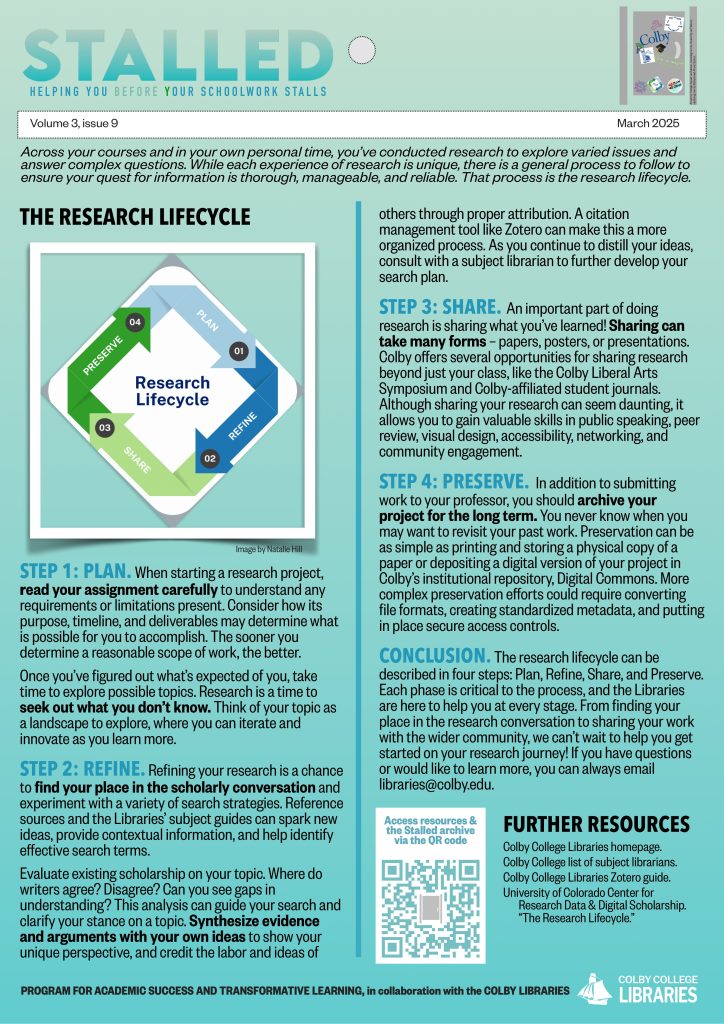
THE RESEARCH LIFECYCLE

STEP 1: PLAN. When starting a research project, read your assignment carefully to understand any requirements or limitations present. Consider how its purpose, timeline, and deliverables may determine what is possible for you to accomplish. The sooner you determine a reasonable scope of work, the better.

Once you’ve figured out what’s expected of you, take time to explore possible topics. Research is a time to seek out what you don’t know. Think of your topic as a landscape to explore, where you can iterate and innovate as you learn more.

STEP 2: REFINE. Refining your research is a chance to find your place in the scholarly conversation and experiment with a variety of search strategies. Reference sources and the Libraries’ subject guides can spark new ideas, provide contextual information, and help identify effective search terms.

Evaluate existing scholarship on your topic. Where do writers agree? Disagree? Can you see gaps in understanding? This analysis can guide your search and clarify your stance on a topic. Synthesize evidence and arguments with your own ideas to show your unique perspective, and credit the labor and ideas of others through proper attribution. A citation management tool like Zotero can make this a more organized process. As you continue to distill your ideas, consult with a subject librarian to further develop your search plan.

STEP 3: SHARE.An important part of doing research is sharing what you’ve learned! Sharing can take many forms – papers, posters, or presentations. Colby offers several opportunities for sharing research beyond just your class, like the Colby Liberal Arts Symposium and Colby-affiliated student journals. Although sharing your research can seem daunting, it allows you to gain valuable skills in public speaking, peer review, visual design, accessibility, networking, and community engagement.

STEP 4: PRESERVE.  In addition to submitting work to your professor, you should archive your project for the long term. You never know when you may want to revisit your past work. Preservation can be as simple as printing and storing a physical copy of a paper or depositing a digital version of your project in Colby’s institutional repository, Digital Commons. More complex preservation efforts could require converting file formats, creating standardized metadata, and putting in place secure access controls.

CONCLUSION. The research lifecycle can be described in four steps: Plan, Refine, Share, and Preserve. Each phase is critical to the process, and the Libraries are here to help you at every stage. From finding your place in the research conversation to sharing your work with the wider community, we can’t wait to help you get started on your research journey! If you have questions or would like to learn more, you can always email [email protected]. 

FURTHER RESOURCES 

Colby College Libraries homepage.

Colby College list of subject librarians.

Colby College Libraries Zotero guide.

University of Colorado Center for Research Data & Digital Scholarship. “The Research Lifecycle.”

Declaring/changing majors (3.8)

Choosing a major is important, so this edition of Stalled is here to help you get a sense of the logistics around declaring or changing your major. Make sure to stay in touch with your advisor(s) about the courses you need to fulfill your major!

DECLARING & CHANGING MAJORS

THE SPECIFICS. First-year students will be able to declare a major beginning on February 19, 2025, and the deadline to do so is March 21, 2025. You can have one or two majors. Or, if you prefer, you can have one major and two minors.

Any student looking to change their major must also do so by that same March 21 deadline. 

HOW DO I DECLARE MY MAJOR? Access the MyColby portal and navigate to the “Academics” section. In the menu to the left, you’ll see the “Initial Major Declaration” option. Click that, and follow the directions there to declare your major!

DO I HAVE TO DECLARE? Students have to declare a major before they select their courses for their junior year.  But no, first-years are not required to declare a major if they don’t yet know what they want to pursue. And that is abolutely okay! Lots of people take their time in figuring out what they want as a major, and it’s nothing unusual.

HOW DO I CHANGE MY MAJOR OR MINOR? If you decide that you want to change from one major to another, or if you want to change your minor, you should first talk to your advisor or your class dean. 

Why is that your first step? Changing a major (and, in some cases, a minor) will shift your required classes. We want to ensure that there is a pathway for you to complete all graduation requirements within the eight-semester time frame. Advisors and class deans know how to navigate those kinds of concerns.

But if you do decide that a major or minor change is right for you, there is a form that you will need from the registrar’s office — see the “Further Resources” section of this poster for a link (you can access all of those resources via the QR code on this poster).

HOW DO I PICK A MAJOR? Get the perspectives of people who are knowledgeable about the major you’re interested in. Talk to students who major in the department you’re considering. What do they say about what it’s like? To get a full picture, you should also to talk to a faculty member in that department, or the department chair, to find out about course requirements and opportunities that are open only to majors. To experience what courses in the major are like, contact a faculty member and ask to sit in on a class session (just note that some rooms will not have space for guests, so be understanding if the faculty member has to say no to your request).

DECLARING A MAJOR MATTERS

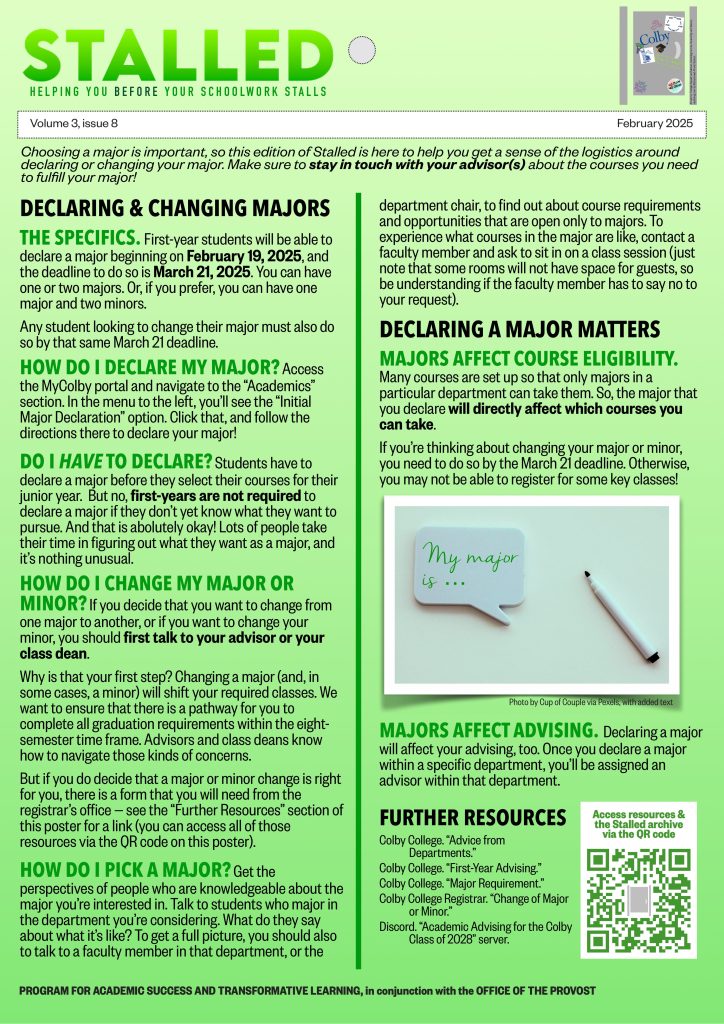
MAJORS AFFECT COURSE ELIGIBILITY. Many courses are set up so that only majors in a particular department can take them. So, the major that you declare will directly affect which courses you can take. 

If you’re thinking about changing your major or minor, you need to do so by the March 21 deadline. Otherwise, you may not be able to register for some key classes!

MAJORS AFFECT ADVISING. Declaring a major will affect your advising, too. Once you declare a major within a specifc department, you’ll be assigned an advisor within that department.

FURTHER RESOURCES 

Colby College. “Advice from Departments.”

Colby College. “First-Year Advising.”

Colby College. “Major Requirement.”

Colby College Registrar. “Change of Major or Minor.”

Discord. “Academic Advising for the Colby Class of 2028” server.

What professors do (3.6)

Students don’t always understand all the workings of a college. Yet understanding how higher education works can help you better navigate your education. So, this month’s poster is meant to help you understand more about what your professors do — for instance, did you know that teaching is NOT the only (or even the biggest) part of their job?

WAIT—PROFESSORS DO MORE THAN TEACH?!

SCHOLAR-TEACHERS. Professors have different job duties than your high school teachers did — though yes, teaching takes up about 40% of their work time.

However, half — or more! — of professors’ work time is devoted to research. Research can look very different for professors in different departments. For instance, English professors might travel to libraries that hold rare manuscripts, letters, or other materials, and their research can involve constructing and writing analysis of literary texts that they publish. Biologists’ research can involve laboratory experiments or field observations, and they, too, must write and publish their findings. Even though the forms of research differ based on the kind of work in which each individual professor specializes, research and dissemination of their work is a large and very time-demanding part of a professor’s job.

Disseminating scholarly research can happen in a variety of ways, including publishing articles in academic journals, publishing books, and presenting work at academic conferences. Conference presentations take much time and care to construct, and publishing papers usually takes even more time. Books? Those usually take years to write, and quite a while to publish, too.

SERVICE. An additional job requirement for professors is service. This aspect of their job can be very different for each professor, but service can involve duties like being a member of various campus committees; holding office in regional, national, or international scholarly organizations; or public service that relates to the professor’s areas of scholarly focus. However, many other types of service exist, as well.

WHY DOES THIS MATTER TO YOU?

PATIENCE. If teaching tends to be about 40% of a professor’s job, and if they spend 9 hours a week in class time, 4 in office hours, and 3 hours creating lectures and class activities, it doesn’t take much math skill to know that they don’t have as much time as they would like to feedback your work and get it back to you. Keep in mind, too, that many professors spend more time on teaching tasks than what these example hours suggest.

So, if you don’t receive speedy comments on work that you’ve turned in, give your professor the benefit of the doubt and some patience—they have probably been working hard on research and service. It’s also likely that they’re trying to balance their work with the other parts of their life (like parenting, caring for aging parents, cleaning house, doing laundry, grocery shopping, etc.*).

UNDERSTANDING. Knowing what your professors’ jobs really entail can help you value their work and time, and additionally, it can help you understand better what to expect from them. They want to help you, but they have to set limits to complete all their weekly work.

Additionally, if you are considering going to graduate school, you should understand the demands on your professors so that you can better navigate your work toward an advanced degree.

It’s especially crucial to understand what professors do if you are considering becoming a professor someday. Teaching is an extremely important component of this job, but a love of research in your chosen field is also  an essential component of professorship.

FURTHER RESOURCES 

Roney, Lisa. “What Do Professors Do All Day?” University of Central Florida, 2017.

Shepherd, Marshall. “Professors Are Often Asked ‘What Do You Teach?’ But They Do Far More.” Forbes, 2018.

Pitt Career Center. “The 19 Steps to Becoming a College Professor.” University of Pittsburgh. 2023.

AI and academic integrity (3.3)

You’ve probably heard discussions around how certain kinds of artificial intelligence (AI) should or shouldn’t be used in coursework, and how it relates to academic integrity. There’s no one “right” approach that applies to all courses, so you need to know what each of your professors expects regarding the use of AI in their class.

ACADEMIC INTEGRITY MATTERS 

WHAT COLBY AFFIRMS. You’ve almost certainly seen the “Colby Affirmation.” It sets forth how academic integrity and social accountability are cornerstones of a Colby education because they keep the quality of education as high as possible. 

That means that academic integrity is essential in providing you with knowledge, skills, and awareness that you’ll need for graduate study as well as for your career. If our academic integrity standards are low, there’s no way to ensure that you know what you need to succeed in whatever you pursue when you leave Colby. You owe it to yourself to learn as much as you can while you’re here.

RESPECT FOR OTHERS. We’re all part of a community here at Colby, and the hard work of professors, staff, and other students deserves the respect of our community. When you protect academic integrity, you respect the work, talent, and dedication of others who educate Colby students, as well as those who came to Colby to receive a world-class education. Academic integrity helps foster a climate of trust. What’s more, academic integrity gives your future employer, coworkers, and clients a truly skilled professional (yes, that’s you!).

AI AND ACADEMIC INTEGRITY

AI IS A TOOL. Like any tool, there are reasons to use generative AI. Your professors will decide if it’s a tool that will help you acheive the goals of a particular assignment. If a professor allows you to use generative AI, think critically about what it, as a tool, allows you to do and to learn.  

But like all tools, generative AI might not help your learning in every assignment. If the tool does your work for you, or prevents you from practicing skills that you need for your future, then using it is not consistent with academic integrity.

AI ISN’T PERFECT. Professors have to weigh the potential benefits of allowing students to use AI against any potential drawbacks. Some professors are skeptical about students using AI because copyright issues exist concerning the data on which AI has been trained, there are questions about a lack of diversity in the data being used in generative AI, and AI requires massive energy to run its applications (producing increased emissions in the process), just to name a few concerns.

So, if a professor restricts the use of generative AI or doesn’t allow it, that choice may well be a result of your professor’s commitment to educating you as ethically and responsibly as possible — another essential facet of academic integrity.

WHAT CAN YOU DO?

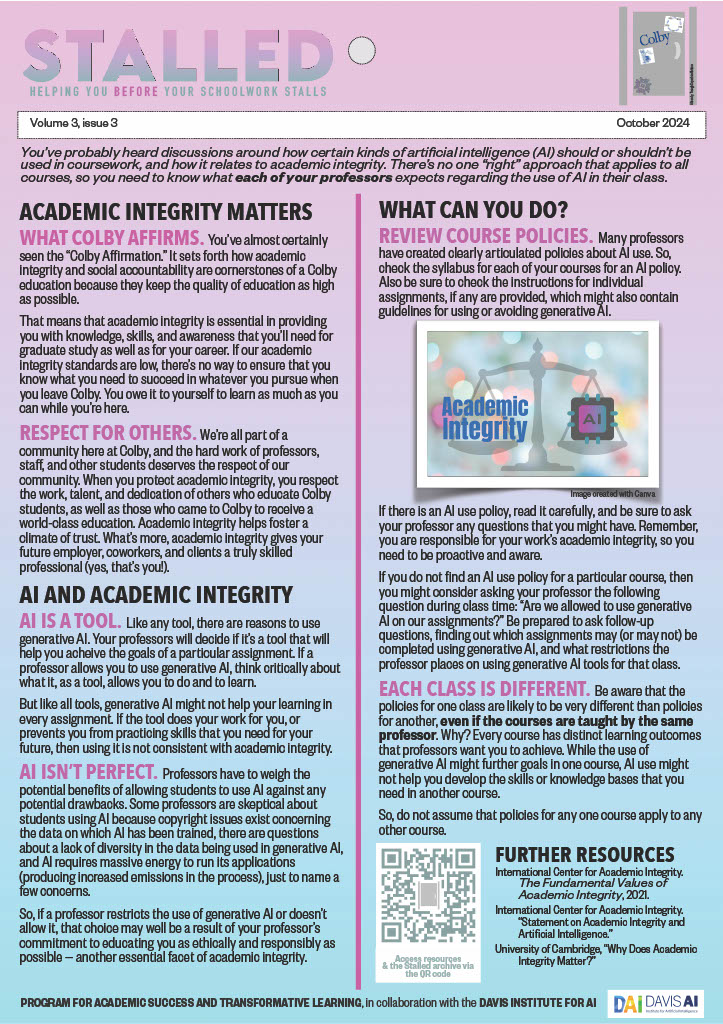
REVIEW COURSE POLICIES. Many professors have created clearly articulated policies about AI use. So, check the syllabus for each of your courses for an AI policy. Also be sure to check the instructions for individual assignments, if any are provided, which might also contain guidelines for using or avoiding generative AI. 

If there is an AI use policy, read it carefully, and be sure to ask your professor any questions that you might have. Remember, you are responsible for your work’s academic integrity, so you need to be proactive and aware. 

If you do not find an AI use policy for a particular course, then you might consider asking your professor the following question during class time: “Are we allowed to use generative AI on our assignments?” Be prepared to ask follow-up questions, finding out which assignments may (or may not) be completed using generative AI, and what restrictions the professor places on using generative AI tools for that class.

EACH CLASS IS DIFFERENT. Be aware that the policies for one class are likely to be very different than policies for another, even if the courses are taught by the same professor. Why? Every course has distinct learning outcomes that professors want you to achieve. While the use of generative AI might further goals in one course, AI use might not help you develop the skills or knowledge bases that you need in another course.

So, do not assume that policies for any one course apply to any other course.

FURTHER RESOURCES 

International Center for Academic Integrity. The Fundamental Values of Academic Integrity, 2021.

International Center for Academic Integrity. “Statement on Academic Integrity and Artificial Intelligence.”

University of Cambridge, “Why Does Academic Integrity Matter?”

The Study Cycle (3.2)

You might have good study skills, but did you know that there are researchers who study the science of learning? They recommend regular use of the study cycle, which is described below. Try it to give yourself the best chance for academic success, and build the study cycle into your semester plans!

WHAT IS THE STUDY CYCLE?

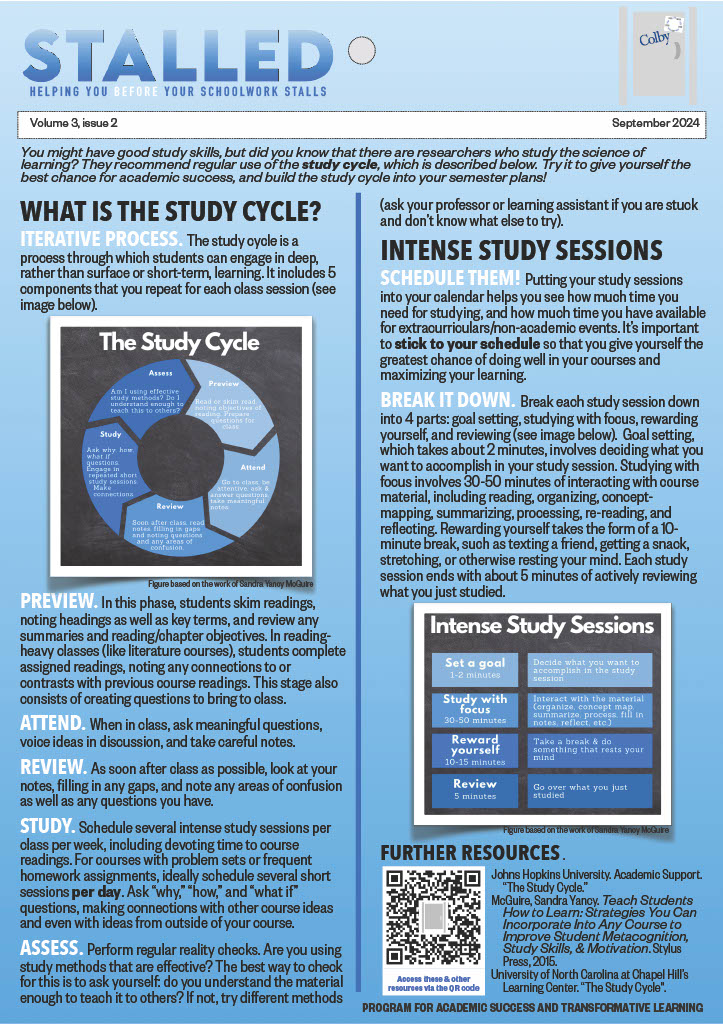
ITERATIVE PROCESS. The study cycle is a process through which students can engage in deep, rather than surface or short-term, learning. It includes 5 components that you repeat for each class session (see image on poster).

PREVIEW. In this phase, students skim readings, noting headings as well as key terms, and review any summaries and reading/chapter objectives. In reading-heavy classes (like literature courses), students complete assigned readings, noting any connections to or contrasts with previous course readings. This stage also consists of creating questions to bring to class.

ATTEND. When in class, ask meaningful questions, voice ideas in discussion, and take careful notes.

REVIEW. As soon after class as possible, look at your notes, filling in any gaps, and note any areas of confusion as well as any questions you have.

STUDY. Schedule several intense study sessions per class per week, including devoting time to course readings. For courses with problem sets or frequent homework assignments, ideally schedule several short sessions per day. Ask “why,” “how,” and “what if” questions, making connections with other course ideas and even with ideas from outside of your course.

ASSESS. Perform regular reality checks. Are you using study methods that are effective? The best way to check for this is to ask yourself: do you understand the material enough to teach it to others? If not, try different methods (ask your professor or learning assistant if you are stuck and don’t know what else to try).

INTENSE STUDY SESSIONS

SCHEDULE THEM! Putting your study sessions into your calendar helps you see how much time you need for studying, and how much time you have available for extracurriculars/non-academic events. It’s important to stick to your schedule so that you give yourself the greatest chance of doing well in your courses and maximizing your learning.

BREAK IT DOWN. Break each study session down into 4 parts: goal setting, studying with focus, rewarding yourself, and reviewing (see image on poster).  Goal setting, which takes about 2 minutes, involves deciding what you want to accomplish in your study session. Studying with focus involves 30-50 minutes of interacting with course material, including reading, organizing, concept-mapping, summarizing, processing, re-reading, and reflecting. Rewarding yourself takes the form of a 10-minute break, such as texting a friend, getting a snack, stretching, or otherwise resting your mind. Each study session ends with about 5 minutes of actively reviewing what you just studied.

FURTHER RESOURCES

Johns Hopkins University. Academic Support.“The Study Cycle.” 

McGuire, Sandra Yancy. Teach Students How to Learn: Strategies You Can Incorporate Into Any Course to Improve Student Metacognition, Study Skills, & Motivation. Stylus Press, 2015.

University of North Carolina at Chapel Hill’s Learning Center. “The Study Cycle“.

How College Differs from High School (3.1)

It’s not always easy to know the differences between high school and college, particularly when you’re new to college — but it can be the case even when you’ve been at college a while. So, here’s information about some key ways that college differs from high school in terms of student responsibilities. Head’s up: you have more responsibility for yourself than most students do in high school!

COLLEGE CLASSWORK

Some of your assumptions about college classes might not be accurate, and it’s important to understand the key ways that classwork in college differs from high school.

TIME MANAGEMENT. You’re in charge of setting up your own schedule, as well as budgeting enough time to complete all of your projects and assignments. Your professors will expect that you can manage your time well enough to meet deadlines and be prepared. Need some advice on time management? Use the link below to access the Stalled poster on “time management” for useful resources. 

GRADES IN PROGRESS. Your professors will submit your grade in the course at the end of each semester, but you are responsible for knowing how you’re doing as the semester goes along. Need help? Use the free grade calculator in the resources linked to the digital form of this poster (accessible via a link below).

ACCELERATED WORK. Many high school classes span an entire academic year. At college, a class lasts only a semester. So, that means that every class period will emphasize new material, skills, or practice, and missing even one class can make mastery of future knowledge and skills much more difficult. It also means that projects like reports, papers, and other tasks will need to be completed while you are engaging in other work for the same class (as well as work for your other classes, too).  To help yourself out, make a regular schedule for your classwork and be sure to stick to it (use the links below to find the Stalled poster on Google Calendar tips).

MORE WORK OUT OF CLASS. During class, professors deliver information and students engage in discussion and other activities. But a lot of your learning (arguably, most of it) will happen outside of class, and that means that you’re responsible for more of your own learning than in high school. You’ll need to do the reading and homework, and professors will expect you to come to class with questions to help them clear up any confusion as well as to push your understanding of the topics and ideas. Your professors will help show you how to learn, but you are responsible for your own learning.

PROVIDING FOR YOURSELF

In many instances, high school is a place where students are given supplies. In contrast, students are almost always expected to provide their own supplies in college. 

TEXTBOOKS. Students need to find their own copies of their textbooks, since the library does not hold copies of all textbooks for all classes. The Colby Bookstore (in the Cotter Union) has required textbooks for courses available for sale. However, note that some professors might suggest, rather than require, some books, and those might not be available for sale in the bookstore.

SUPPLIES. It’s students’ responsibility to provide study supplies for themselves. So, that means that if you want items like pens, notecards, paper, colored pencils, sticky notes, or other study supplies, you have to buy them (from the Colby Bookstore or from another online or physical store). 

PRINTING. Black and white printing is free, while color copies cost $0.20 per page. Upon coming to Colby, each student is given $10 on the printing balance of their ColbyCard. It’s a good idea to ask your CA and upperclass students in your classes where you can find printers that are close to your dorm or classrooms.

FURTHER RESOURCES 

“Google Calendar Tips.” Stalled.

Grade Calculator.

Macalaster College. “Differences Between High School and College.”

Pink, Daniel. “Daily When Tracker.”

“Time Management.” Stalled.

University of Tennessee at Chattanooga. “How Can the Flowtime Technique Help Me?”

First-Year Orientation (digital-only edition)

Welcome to Colby! And welcome to “Stalled,” a poster series that provides suggestions to help you maximize your academic success. Why is it called “Stalled?” We hope to give you advice before your schoolwork stalls. Also, you’ll find these posters in the bathrooms stalls of academic buildings several times each semester! 

PLAN YOUR SEMESTER

SCHEDULE IT IN. You will have received your fall ’24 class schedule over the summer. This allows you to block off all class times in your calendar. We suggest that you familiarize yourself with Google Calendar, since Colby uses Google’s suite of software. If you need help, see the Stalled poster from February 2024 on Google Calendar by using the QR code or link to the Stalled archive at the bottom of this poster.

BE READY TO STUDY. To know how much time to devote to each class, you need to know that every 1 hour of class time requires 2-3 hours of study/work time. So, if you have a 3-hour class, expect to spend about 9 hours a week studying, doing homework, and completing assignments for that one class. It’s a good idea to schedule that work/study time on your calendar so that you know that you’re giving each class its due attention. 

DON’T OVERDO IT. It would be easy to overpack your schedule with lots of club meetings, sports meets, performances, and other activities. Such events are great ways to meet people and develop your knowledge, so do take advantage of them! But pay attention to your energy levels and available time, and don’t do so many things that your schoolwork or self-care suffers.

UPDATE! Once you know when your major tests happen and assignments are due (which you’ll find out when Fall ’24 starts), add them to your Google calendar. Then, be sure to schedule work and study time for them — and change your calendar right away if any changes to those dates are announced in any of your classes.

MAKE THE MOST OF ORIENTATION

TAKE NOTES. Orientation is exciting and jam-packed, and you will receive a LOT of information in a short amount of time. So be sure to take notes. Come to each session with paper and something to write with (when feasible, you might also bring a digital means of notetaking). Keep those notes in one spot, such as one dedicated orientation notebook. That way, you can refer back later to the information you received when there is anything that you have forgetten.

ASK QUESTIONS. Orientation exists because you don’t yet know what it’s like to be a Colby student, so no one expects you to know everything on arrival. To make the most of it, be ready and willing to ask whatever questions you have. Know that if you have a question, it’s likely that other incoming students will benefit from hearing the answer, too — which means that asking questions is a way to help more than just yourself.

GET TO KNOW THE CAMPUS. During orientation, explore spots on campus like the Harold Alfond Athletics and Recreation Center and Miller Library. Make sure also to find the classrooms for each of your courses, once they’ve been assigned later this summer. Need help finding a room or building? Ask your orientation leader or another new student!

MEET PEOPLE. Orientation is a great time to get to know your fellow first-year students! But you’ll also have opportunities to meet other students, staff members, and faculty. Ask fellow new students about what classes they’ll be taking, and ask folks who’ve been around Colby longer about Colby traditions, their favorite spots on campus, or things that new Colby students should know.

FURTHER RESOURCES 

Every issue of Stalled contains resources and/or related references, as well as a link to the Stalled archive.

Cherry, K. “How to Start a Conversation.” VeryWellMind, 2023. 

Colby College. Campus Interactive Map.

Colby College. Office of Campus Life. 

Google. Get Started with Google Calendar.

Pot, J. “Why Writing by Hand Is Better for Remembering Things.” Popular Science, 2024.

Stalled archive, listed by subject.

University of Pittsburgh. Time Management Calculator.

« Older posts

© 2026 Stalled

Theme by Anders Noren — Up ↑