Stalled

Helping you before your schoolwork stalls

Colby Global Education Opportunities (5.3)

The key to having a successful global learning experience is to spend time researching possibilities, thinking about your goals, considering your plans, and talking to others. How do you do that? Read on!

SO YOU WANT TO STUDY ABROAD?

WHAT WE ARE.Global Education Opportunities (GEO) is here to help you plan and make the most of your study abroad experience. We encourage you to speak to returned study abroad/away participants, GEO advisors, your academic advisor(s), and your career advisor to build a study abroad plan that works for you. The more people you speak with, the more research you do, and the more thought you invest in choosing your program, the  better your experience will be.

WHAT WE DO. We begin working with students no later than the fall of sophomore year to plan for an away/abroad experience in their junior year or senior fall. We hold regular events and have a proposal cycle wherein students submit their proposed study abroad/away plans to be approved by GEO before applying to their program. GEO is part of DavisConnects and collaborates closely with the Career Design Advisors, Industry and Community Partnerships, Fellowships, and Funding teams.

KEY DATES & DEADLINES  

  • September: GEO Information Sessions. Learn about our process and how to get started. 
  • September: GEO Study Abroad Fair. Meet with representatives from study abroad programs across disciplines & around the world. 
  • November 15: Students submit their Initial Plan to GEO. This lets us know you want to study abroad or away and which semester you intend to go.
  • February 20: Students submit their Study Abroad Proposal to GEO. We review your proposed plan and approve you to apply to your chosen program or university.
  • February – October: Students apply externally to study abroad opportunities and domestic programs.

OTHER GLOBAL EXPERIENCES. If you’re not able to study abroad or away for a full semester or academic year, we still encourage you to explore other possibilities for short-term global experiences during Jan Plan or summer. Some other opportunities you can explore include: international internships, independent study or research projects abroad, or enrolling in a faculty-led Jan Plan course.

SO … WHERE DO I GO? We can’t tell you, but we can help you discover the answer! Colby students can choose from over 270 approved programs in more than 70 countries worldwide. We also work with students, faculty, and our off-campus partners to expand study abroad opportunities for students around the world. If you have an idea, we want to hear it! You can make an appointment with a GEO advisor on Handshake.

STUDY ABROAD: MYTHS & FACTS

MYTH: I can’t afford to study abroad.

FACT: Your financial aid at Colby is portable to study abroad/away experiences. This can be further supplemented by scholarships, grants, and financial aid from a variety of sources. We partner closely with Student Financial Services to help all students find opportunities that are financially feasible; cost should not be a barrier even for students with high financial aid. 

MYTH: I have to know the language in order to study in my country of choice.

FACT: Colby has a language policy for study abroad, which states that students must complete the 127 course in the language taught here at Colby if they wish to study abroad in a country where that language is spoken. With the exception of primarily English-speaking countries (think Australia, Ireland, etc.) students must also take the local language where they study at the appropriate level. Students who have a strong academic motivation to study in a country where they have no prior language experience and aren’t able to meet the requirement before going abroad can submit a language petition. 

MYTH: My grades from abroad don’t matter.

FACT: Colby students must take classes for a letter grade while studying abroad/away (no pass/fail permitted!) Those grades will appear on your transcript, but unless you’re on a Colby-administered program (like Bigelow or Salamanca), they won’t factor into your Colby GPA. So you’ll still see the letter, but your grades won’t impact your Colby GPA. 

FACULTY FAUCET

GEO relies on faculty as key partners in this process and you help us set students up for success while away from Colby. Your department page may include specific guidance on study abroad/away for students (and if it doesn’t, we’d love to collaborate to help you develop it!). Faculty advising is particularly helpful as students explore the following questions: 

  • Which semester should I study abroad or away? The sequencing of courses offered in their major or minor can be critical!
  • What requirements (if any) should I fulfill while abroad? Strategizing with their academic advisors to ensure their study abroad plans will not prevent them from completing their major or graduation requirements within the allotted eight semesters – or fewer, for transfer or dual-degree students – is essential.
  • Where should I go? Your expertise and perspectives on your field is important in helping students understand what locations or programs would be most complementary to their academic paths and professional interests. 

We also gather feedback from faculty on study abroad opportunities, destinations, and our processes. We are happy to visit your classroom or host discipline-specific events for your students, and we can occasionally facilitate faculty site visits. Please reach out  to Roger Adkins, Director; Ally Hawkins, Associate Director; or Sue Forbes, Administrative and Program Coordinator if you’d like to collaborate. 
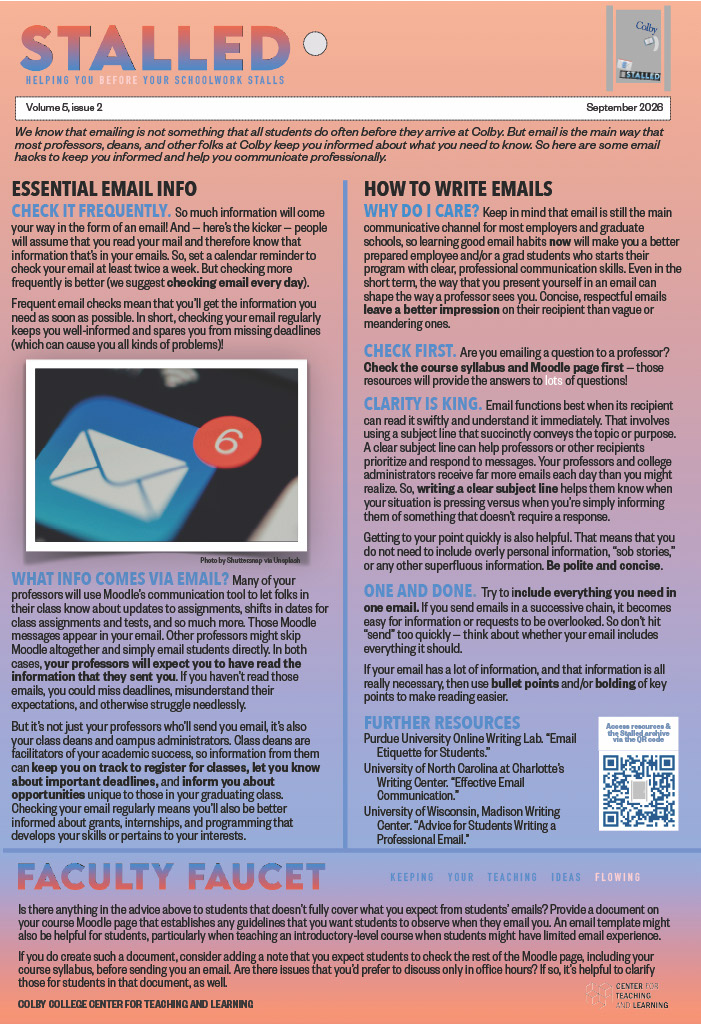
Emails and emailing (5.2)

We know that emailing is not something that all students do often before they arrive at Colby. But email is the main way that most professors, deans, and other folks at Colby keep you informed about what you need to know. So here are some email hacks to keep you informed and help you communicate professionally.

ESSENTIAL EMAIL INFO 

CHECK IT FREQUENTLY. So much information will come your way in the form of an email! And — here’s the kicker — people will assume that you read your mail and therefore know that information that’s in your emails. So, set a calendar reminder to check your email at least twice a week. But checking more frequently is better (we suggest checking email every day).

Frequent email checks mean that you’ll get the information you need as soon as possible. In short, checking your email regularly keeps you well-informed and spares you from missing deadlines (which can cause you all kinds of problems)!

WHAT INFO COMES VIA EMAIL? Many of your professors will use Moodle’s communication tool to let folks in their class know about updates to assignments, shifts in dates for class assignments and tests, and so much more. Those Moodle messages appear in your email. Other professors might skip Moodle altogether and simply email students directly. In both cases, your professors will expect you to have read the information that they sent you. If you haven’t read those emails, you could miss deadlines, misunderstand their expectations, and otherwise struggle needlessly.

But it’s not just your professors who’ll send you email, it’s also your class deans and campus administrators. Class deans are facilitators of your academic success, so information from them can keep you on track to register for classes, let you know about important deadlines, and inform you about opportunities unique to those in your graduating class. Checking your email regularly means you’ll also be better informed about grants, internships, and programming that develops your skills or pertains to your interests.

HOW TO WRITE EMAILS

WHY DO I CARE? Keep in mind that email is still the main communicative channel for most employers and graduate schools, so learning good email habits now will make you a better prepared employee and/or a grad students who starts their program with clear, professional communication skills. Even in the short term, the way that you present yourself in an email can shape the way a professor sees you. Concise, respectful emails leave a better impression on their recipient than vague or meandering ones.

CHECK FIRST. Are you emailing a question to a professor? Check the course syllabus and Moodle page first — those resources will provide the answers to lots of questions!

CLARITY IS KING. Email functions best when its recipient can read it swiftly and understand it immediately. That involves using a subject line that succinctly conveys the topic or purpose. A clear subject line can help professors or other recipients prioritize and respond to messages. Your professors and college administrators receive far more emails each day than you might realize. So, writing a clear subject line helps them know when your situation is pressing versus when you’re simply informing them of something that doesn’t require a response.

Getting to your point quickly is also helpful. That means that you do not need to include overly personal information, “sob stories,” or any other superfluous information. Be polite and concise.

ONE AND DONE. Try to include everything you need in one email. If you send emails in a successive chain, it becomes easy for information or requests to be overlooked. So don’t hit “send” too quickly — think about whether your email includes everything it should. 

If your email has a lot of information, and that information is all really necessary, then use bullet points and/or bolding of key points to make reading easier.

FURTHER RESOURCES 

Purdue University Online Writing Lab. “Email Etiquette for Students.”

University of North Carolina at Charlotte’s Writing Center. “Effective Email Communication.”

University of Wisconsin, Madison Writing Center. “Advice for Students Writing a Professional Email.”

FACULTY FAUCET

Is there anything in the advice above to students that doesn’t fully cover what you expect from students’ emails? Provide a document on your course Moodle page that establishes any guidelines that you want students to observe when they email you. An email template might also be helpful for students, particularly when teaching an introductory-level course when students might have limited email experience.

If you do create such a document, consider adding a note that you expect students to check the rest of the Moodle page, including your course syllabus, before sending you an email. Are there issues that you’d prefer to discuss only in office hours? If so, it’s helpful to clarify those for students in that document, as well.

Reading for class (5.1)

Why do professors tell you to read before class when they spend class time lecturing about what you’re supposed to read? And why might you need to read after some class periods? It turns out that reading before class or after class makes a difference on your academic success— read on to find out why.

HOW TO APPROACH CLASS READINGS

KNOW THE PURPOSE. Why did the professor assign this specific reading? Are you adding to your knowledge base? Taking a deep dive into a topic? Experiencing a range of opinions on a contested idea? Is there some other reason? Knowing why you’re reading helps you understand how to approach a text. 

Once you have a handle on the purpose, read strategically. The suggestions below may initially seem like they’ll take more time, but because they help you avoid the read, re-read, and re-read some more approach, they will actually save you time. 

STEM READING STRATEGY. For most STEM reading, as well as a lot of social science reading, the “STREAM” approach will help you get the most out of texts. Survey or skim the entire text, paying attention to headings, highlighted information, and bolded words. Think of 2 or more questions that you expect the reading to answer. Read the first paragraph. Explain that first paragraph to yourself in your own words. Annotate the text, adding a summary of the paragraph (and any questions you have). Move on, reading the next paragraph and repeating the read-annotate sequence until you’re done with the text.

ARTS & HUMANITIES READING STRATEGIES. Approach these texts differently from STEM class texts.  For non-fiction, read the abstract or introduction first, identify the main argument and evidence that will support that claim, and make note of those items. Identify connections between this and other texts you’ve read for class, such as does this text oppose previous claims, support what you’ve already read, or add complexities to earlier readings?  If you’re reading theory or philosophy, these are often “lenses” through which you can see events or ideas in different ways, so think about how they help you have a new perspective. Make note of questions you have — and yes, your professors expect you to have lots of questions.

If you’re reading fiction, who created it, under what conditions, and what were the prevailing ideas/historical occurrences when it was written? To what genre does it belong, and what do you know about that genre? Which characters seem to express or embody “big ideas,” and what are those ideas?  If the professor provides focus passages, think about why those passages could be important, and come to class with some ideas about their impact. If your prof doesn’t, select some passages that you think express ideas that are key themes of the text.

WHEN SHOULD YOU READ FOR CLASS?

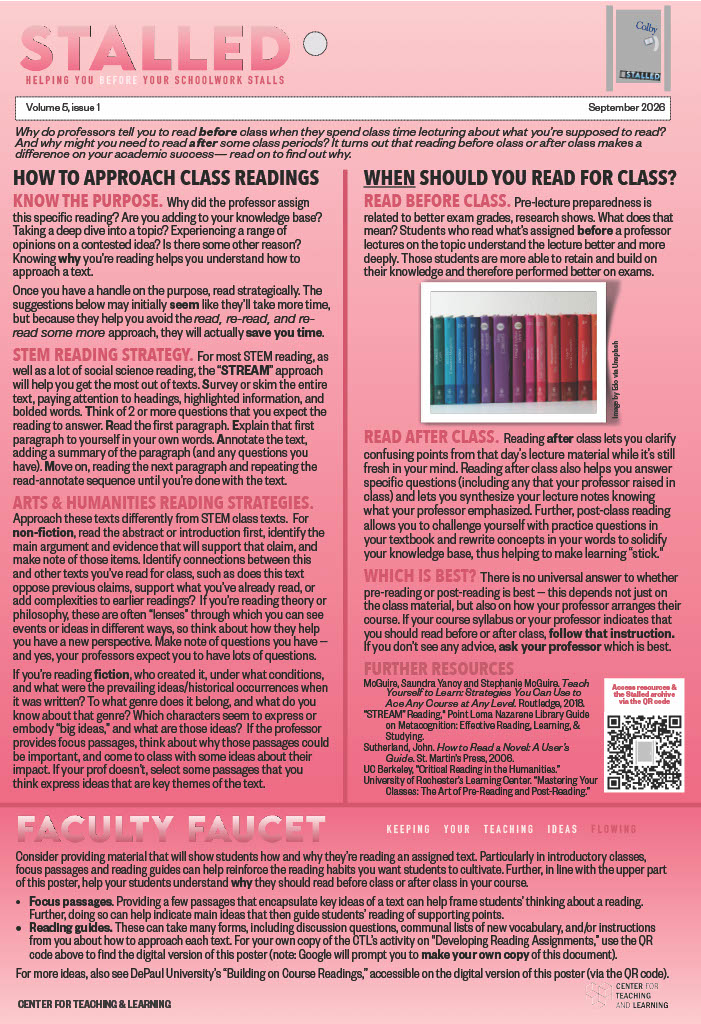
READ BEFORE CLASS. Pre-lecture preparedness is related to better exam grades, research shows. What does that mean? Students who read what’s assigned before a professor lectures on the topic understand the lecture better and more deeply. Those students are more able to retain and build on their knowledge and therefore performed better on exams.

READ AFTER CLASS. Reading after class lets you clarify confusing points from that day’s lecture material while it’s still fresh in your mind. Reading after class also helps you answer specific questions (including any that your professor raised in class) and lets you synthesize your lecture notesknowing what your professor emphasized. Further, post-class reading allows you to challenge yourself with practice questions in your textbook and rewrite concepts in your words to solidify your knowledge base, thus helping to make learning “stick.”

WHICH IS BEST? There is no universal answer to whether pre-reading or post-reading is best — this depends not just on the class material, but also on how your professor arranges their course. If your course syllabus or your professor indicates that you should read before or after class, follow that instruction. If you don’t see any advice, ask your professor which is best. 

FURTHER RESOURCES 

McGuire, Saundra Yancy and Stephanie McGuire. Teach Yourself to Learn: Strategies You Can Use to Ace Any Course at Any Level. Routledge, 2018.

“STREAM” Reading,” Point Loma Nazarene Library Guide on Metacognition: Effective Reading, Learning, & Studying.

Sutherland, John. How to Read a Novel: A User’s Guide. St. Martin’s Press, 2006.

UC Berkeley, “Critical Reading in the Humanities.”

University of Rochester’s Learning Center. “Mastering Your Classes: The Art of Pre-Reading and Post-Reading.”

FACULTY FAUCET

Consider providing material that will show students how and why they’re reading an assigned text. Particularly in introductory classes, focus passages and reading guides can help reinforce the reading habits you want students to cultivate. Further, in line with the upper part of this poster, help your students understand why they should read before class or after class in your course.

  • Focus passages. Providing a few passages that encapsulate key ideas of a text can help frame students’ thinking about a reading. Further, doing so can help indicate main ideas that then guide students’ reading of supporting points.  
  • Reading guides. These can take many forms, including discussion questions, communal lists of new vocabulary, and/or instructions from you about how to approach each text. For your own copy of the CTL’s activity on “Developing Reading Assignments,” click this link (note: Google will prompt you to make your own copy of this document).

For more ideas, also see DePaul University’s “Building on Course Readings.”

Why office hours matter (digital-only edition, Summer ’26)

Welcome to Colby! And welcome to “Stalled,” a poster series that provides suggestions to help you maximize your academic success. Why is it called “Stalled?” We hope to give you advice before your schoolwork stalls. Also, you’ll find these posters in the bathrooms stalls of academic buildings several times each semester. This digital-only edition provides information on a topic that all liberal arts college students should know about: office hours. 

Why should I go to office hours?

Most students don’t start college with a clear understanding of the purpose of office hours. Here’s some information to help you make the most of them!

WHAT ARE OFFICE HOURS? Every professor holds weekly office hours so that students know when to find them for one-on-one conversations. Some professors require students to attend office hours, but it’s generally understood that you should go even if office hours are not required. Some professors may ask you to schedule a time to visit them in office hours, so be sure to check your course’s syllabus for details (and for the location of your professors’ offices).

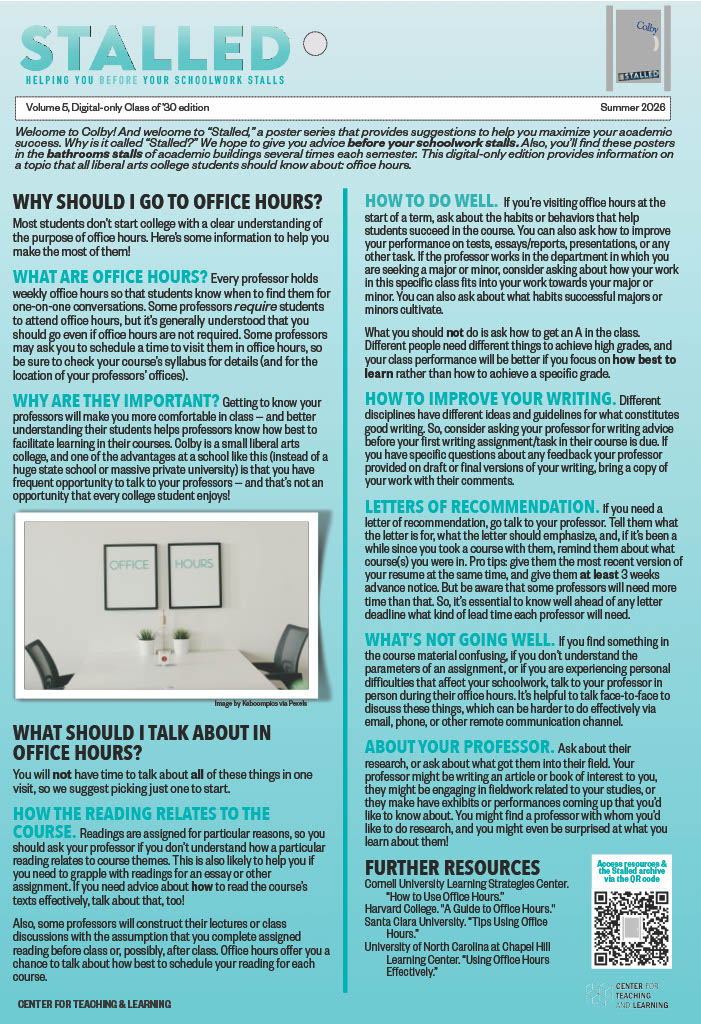
WHY ARE THEY IMPORTANT? Getting to know your professors will make you more comfortable in class — and better understanding their students helps professors know how best to facilitate learning in their courses. Colby is a small liberal arts college, and one of the advantages at a school like this (instead of a huge state school or massive private university) is that you have frequent opportunity to talk to your professors — and that’s not an opportunity that every college student enjoys!

WHAT SHOULD I TALK ABOUT IN OFFICE HOURS?

You will not have time to talk about all of these things in one visit, so we suggest picking just one to start.

HOW THE READING RELATES TO THE COURSE. Readings are assigned for particular reasons, so you should ask your professor if you don’t understand how a particular reading relates to course themes. This is also likely to help you if you need to grapple with readings for an essay or other assignment. If you need advice about how to read the course’s texts effectively, talk about that, too!

Also, some professors will construct their lectures or class discussions with the assumption that you complete assigned reading before class or, possibly, after class. Office hours offer you a chance to talk about how best to schedule your reading for each course.

HOW TO DO WELL. If you’re visiting office hours at the start of a term, ask about the habits or behaviors that help students succeed in the course. You can also ask how to improve your performance on tests, essays/reports, presentations, or any other task. If the professor works in the department in which you are seeking a major or minor, consider asking about how your work in this specific class fits into your work towards your major or minor. You can also ask about what habits successful majors or minors cultivate.

What you should not do is ask how to get an A in the class. Different people need different things to achieve high grades, and your class performance will be better if you focus on how best tolearn rather than how to achieve a specific grade.

HOW TO IMPROVE YOUR WRITING. Different disciplines have different ideas and guidelines for what constitutes good writing. So, consider asking your professor for writing advice before your first writing assignment/task in their course is due. If you have specific questions about any feedback your professor provided on draft or final versions of your writing, bring a copy of your work with their comments.

LETTERS OF RECOMMENDATION. If you need a letter of recommendation, go talk to your professor. Tell them what the letter is for, what the letter should emphasize, and, if it’s been a while since you took a course with them, remind them about what course(s) you were in. Pro tips: give them the most recent version of your resume at the same time, and give them at least 3 weeks advance notice. But be aware that some professors will need more time than that. So, it’s essential to know well ahead of any letter deadline what kind of lead time each professor will need.

WHAT’S NOT GOING WELL. If you find something in the course material confusing, if you don’t understand the parameters of an assignment, or if you are experiencing personal difficulties that affect your schoolwork, talk to your professor in person during their office hours. It’s helpful to talk face-to-face to discuss these things, which can be harder to do effectively via email, phone, or other remote communication channel.

ABOUT YOUR PROFESSOR. Ask about their research, or ask about what got them into their field. Your professor might be writing an article or book of interest to you, they might be engaging in fieldwork related to your studies, or they make have exhibits or performances coming up that you’d like to know about. You might find a professor with whom you’d like to do research, and you might even be surprised at what you learn about them!

FURTHER RESOURCES 

Cornell University Learning Strategies Center. “How to Use Office Hours.”

Harvard College. “A Guide to Office Hours.”

Santa Clara University. “Tips Using Office Hours.”

University of North Carolina at Chapel Hill Learning Center. “Using Office Hours Effectively.”

Reducing phone time (4.11)

Yes, phones are very useful tech that can perform many functions. But we can also over-rely on them to our detriment. Many recent studies suggest that digital fasts — or even short times away from our screens — can bring about desirable outcomes. Read on to see how you might benefit from some time away from your phone.

OVERRELIANCE ON PHONES HURTS US

THE COGNITIVE COST. Like it or not, research has established that the mere presence of your smartphone tends to reduce your cognitive capacity.  And yes, that’s true even when you’re not looking at your phone.

What’s more, when you access your phone, you’re distracting yourself — but your phone use can distract those around you, as well, even when they’re not currently using their own phone.

THE MENTAL HEALTH TOLL. Again and again, research has supported the finding that extensive cell phone usage is linked to negative mental health effects, including anxiety, depression, and decreased self-esteem. Conversely, findings from studies of phone-free zones indicate that taking phone or screen breaks helps to improve self-esteem and lessen anxiety.

LACK OF CONNECTION. Surveys of contemporary college students continue to suggest that they feel lonlier than previous generations of college students did . Studies also indicate that digital device use is part of why this is so. In fact, a student at the University of Central Florida helped bring no-phone social time, called the Reconnect Movement, to his university, and participants appreciate how those gatherings allowed them to meet new people, forge friendships, and enjoy real-life connection with others.

HOW TO GO ON A “DIGITAL FAST”

EXPECT IT TO FEEL UNCOMFORTABLE.Most of us use our phones far more often than we may think we do, so know that this process will likely lead to initial dopamine cravings. Experts recommend aiming for a 24-hour time frame in which you don’t touch your phone or any other screens. But you can also try a shorter window, like 12 or even 8 hours. Just note that research indicates that 3-4 weeks is the likely time needed to see change if you’re truly fighting digital addiction.

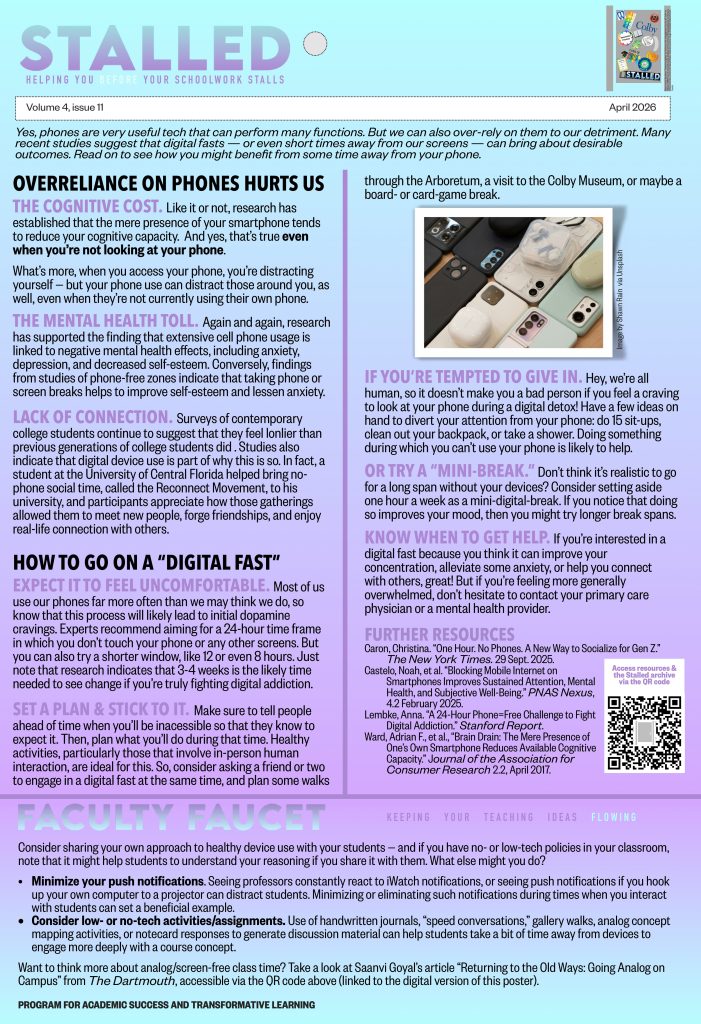
SET A PLAN & STICK TO IT. Make sure to tell people ahead of time when you’ll be inacessible so that they know to expect it. Then, plan what you’ll do during that time. Healthy activities, particularly those that involve in-person human interaction, are ideal for this. So, consider asking a friend or two to engage in a digital fast at the same time, and plan some walks through the Arboretum, a visit to the Colby Museum, or maybe a board- or card-game break.

IF YOU’RE TEMPTED TO GIVE IN. Hey, we’re all human, so it doesn’t make you a bad person if you feel a craving to look at your phone during a digital detox! Have a few ideas on hand to divert your attention from your phone: do 15 sit-ups, clean out your backpack, or take a shower. Doing something during which you can’t use your phone is likely to help.

OR TRY A “MINI-BREAK.” Don’t think it’s realistic to go for a long span without your devices? Consider setting aside one hour a week as a mini-digital-break. If you notice that doing so improves your mood, then you might try longer break spans.

KNOW WHEN TO GET HELP. If you’re interested in a digital fast because you think it can improve your concentration, alleviate some anxiety, or help you connect with others, great! But if you’re feeling more generally overwhelmed, don’t hesitate to contact your primary care physician or a mental health provider.

FURTHER RESOURCES 

Caron, Christina. “One Hour. No Phones. A New Way to Socialize for Gen Z.” The New York Times. 29 Sept. 2025.

Castelo, Noah, et al. “Blocking Mobile Internet on Smartphones Improves Sustained Attention, Mental Health, and Subjective Well-Being.” PNAS Nexus, 4.2 February 2025.

Lembke, Anna. “A 24-Hour Phone=Free Challenge to Fight Digital Addiction.” Stanford Report. 

Ward, Adrian F., et al., “Brain Drain: The Mere Presence of One’s Own Smartphone Reduces Available Cognitive Capacity.” Journal of the Association for Consumer Research 2.2, April 2017.

FACULTY FAUCET

Consider sharing your own approach to healthy device use with your students — and if you have no- or low-tech policies in your classroom, note that it might help students to understand your reasoning if you share it with them. What else might you do?

  • Minimize your push notifications. Seeing professors constantly react to iWatch notifications, or seeing push notifications if you hook up your own computer to a projector can distract students. Minimizing or eliminating such notifications during times when you interact with students can set a beneficial example.  
  • Consider low- or no-tech activities/assignments. Use of handwritten journals,  “speed converstations,” gallery walks, analog concept mapping activities, or notecard responses to generate discussion material can help students take a bit of time away from devices to engage more deeply with a course concept. 

Want to think more about analog/screen-free class time? Take a look at Saanvi Goyal’s article “Returning to the Old Ways: Going Analog on Campus” from The Dartmouth.

Restorative practices (4.10)

We share equal responsibility for the well-being of every member … We seek to build relationships and restore them when they are damaged. … We accept responsibility for our actions and words, and commit ourselves to the education, personal growth and/or relational repair which are a consequence.” Each of these statements is included in Colby’s list of community values. Did you know that when you put your energy into abiding by these values you are also engaging with restorative practices?

WHAT ARE RESTORATIVE PRACTICES?

DEEP ROOTS. Restorative practices are a way of being in the world that prioritizes the importance of human relationships and connection, recognizes the inherent value of each member of a community, and creates opportunities to repair relational harm when it occurs through accountability rather than punishment. These practices have deep roots in the wisdom and practices of cultures across the world, including here in the homelands of the Wabanaki peoples.

RESTORATIVE PRACTICES AS OPPORTUNITIES. These practices also foster opportunities for social and emotional learning and skills that are essential for living in community, including self-awareness, self-management, social awareness, relationship management, and responsible decision-making.

WHAT THESE PRACTICES LOOK LIKE

FOR INDIVIDUALS. At the personal level, restorative practices might take the form of cultivating a mindset that prioritizes relationships, empathy, and openness and curiosity about others’ experiences. They could also look like practicing skills such as reflective listening, asking open-ended questions, and seeking to understand others’ perspectives. 

FOR GROUPS.  At the group level, restorative practices include building and deepening a sense of community and belonging, including community-building and support circles or other conversations and activities that focus on the shared experiences of or within a group. In instances where a member of a group has been harmed or caused harm, restorative practices can be used to address these harms through such techniques as restorative dialog, harm repair circles or conferences, and – in cases where someone has been excluded from the group for a period of time – community reintegration activities.  

FOR COMMUNITIES. Restorative communities make a community-wide commitment to restorative ways of being and using restorative practices. This includes Colby, as evidenced by its statement of community values and its active use of restorative practices across campus to build community and repair harm.

RESTORATIVE PRACTICE IS FOR ALL

WHERE CAN I PARTICIPATE? Everywhere! Anyone can be a restorative practitioner. In fact, this is one of the distinguishing features of restorative practice: it is a mindset, as well as a set of skills and practices, that anyone can cultivate through intention and use. Try it!

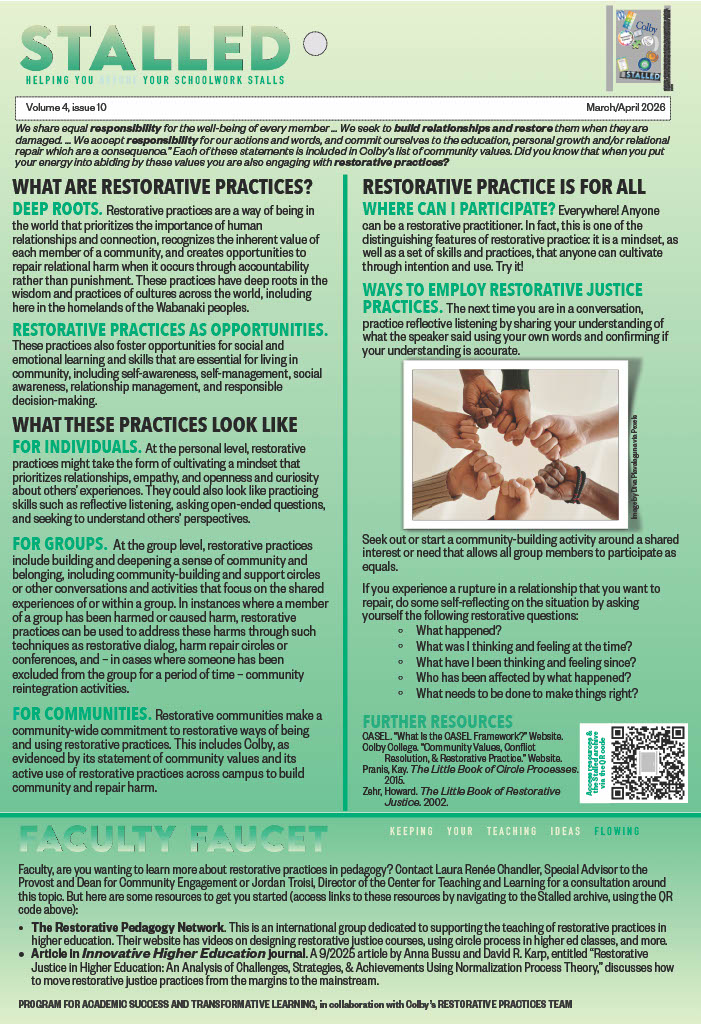
WAYS TO EMPLOY RESTORATIVE JUSTICE PRACTICES. The next time you are in a conversation, practice reflective listening by sharing your understanding of what the speaker said using your own words and confirming if your understanding is accurate.

Seek out or start a community-building activity around a shared interest or need that allows all group members to participate as equals.

If you experience a rupture in a relationship that you want to repair, do some self-reflecting on the situation by asking yourself the following restorative questions:

  • What happened?
  • What was I thinking and feeling at the time?
  • What have I been thinking and feeling since?
  • Who has been affected by what happened?
  • What needs to be done to make things right?

FURTHER RESOURCES 

CASEL. “What Is the CASEL Framework?” Website.

Colby College. “Community Values, Conflict Resolution, & Restorative Practice.” Website.

Pranis, Kay. The Little Book of Circle Processes. 2015.

Zehr, Howard. The Little Book of Restorative Justice. 2002.

FACULTY FAUCET 

Faculty, are you wanting to learn more about restorative practices in pedagogy? Contact Laura Renée Chandler, Special Advisor to the Provost and Dean for Community Engagement or Jordan Troisi, Director of the Center for Teaching and Learning for a consultation around this topic. But here are some resources to get you started:

Breaking down projects (4.9)

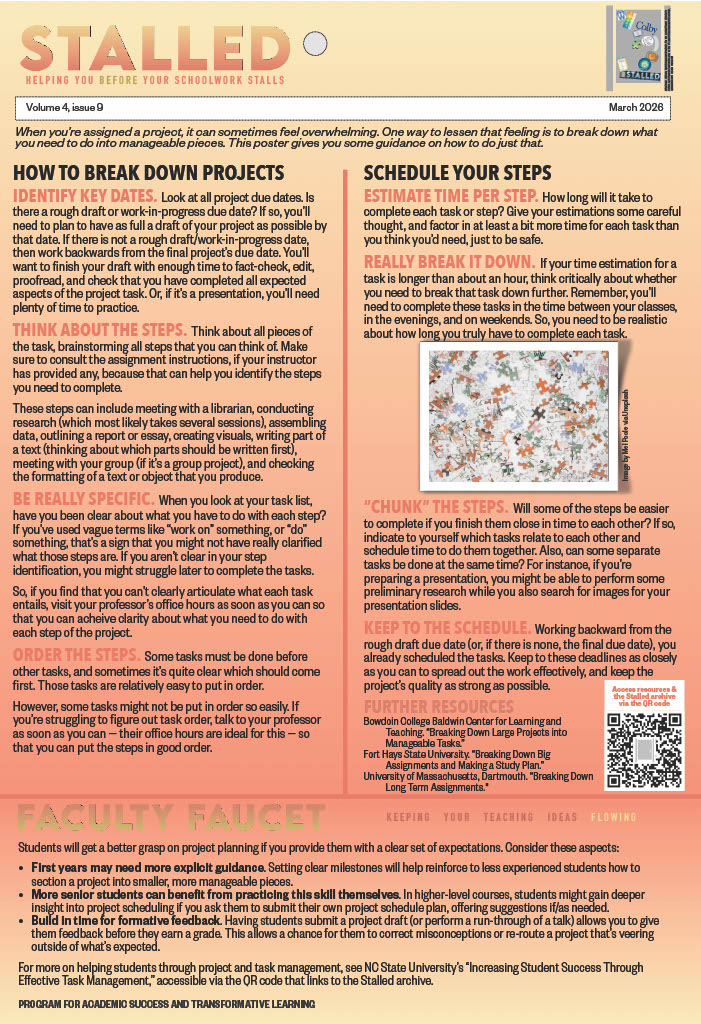
When you’re assigned a project, it can sometimes feel overwhelming. One way to lessen that feeling is to break down what you need to do into manageable pieces. This poster gives you some guidance on how to do just that.

HOW TO BREAK DOWN PROJECTS

IDENTIFY KEY DATES. Look at all project due dates. Is there a rough draft or work-in-progress due date? If so, you’ll need to plan to have as full a draft of your project as possible by that date. If there is not a rough draft/work-in-progress date, then work backwards from the final project’s due date. You’ll want to finish your draft with enough time to fact-check, edit, proofread, and check that you have completed all expected aspects of the project task. Or, if it’s a presentation, you’ll need plenty of time to practice.

THINK ABOUT THE STEPS. Think about all pieces of the task, brainstorming all steps that you can think of. Make sure to consult the assignment instructions, if your instructor has provided any, because that can help you identify the steps you need to complete.

These steps can include meeting with a librarian, conducting research (which most likely takes several sessions), assembling data, outlining a report or essay, creating visuals, writing part of a text (thinking about which parts should be written first), meeting with your group (if it’s a group project), and checking the formatting of a text or object that you produce.

BE REALLY SPECIFIC. When you look at your task list, have you been clear about what you have to do with each step? If you’ve used vague terms like “work on” something, or “do” something, that’s a sign that you might not have really clarified what those steps are. If you aren’t clear in your step identification, you might struggle later to complete the tasks. 

So, if you find that you can’t clearly articulate what each task entails, visit your professor’s office hours as soon as you can so that you can acheive clarity about what you need to do with each step of the project. 

ORDER THE STEPS. Some tasks must be done before other tasks, and sometimes it’s quite clear which should come first. Those tasks are relatively easy to put in order.  

However, some tasks might not be put in order so easily. If you’re struggling to figure out task order, talk to your professor as soon as you can — their office hours are ideal for this — so that you can put the steps in good order.

SCHEDULE YOUR STEPS

ESTIMATE TIME PER STEP. How long will it take to complete each task or step? Give your estimations some careful thought, and factor in at least a bit more time for each task than you think you’d need, just to be safe.

REALLY BREAK IT DOWN. If your time estimation for a task is longer than about an hour, think critically about whether you need to break that task down further. Remember, you’ll need to complete these tasks in the time between your classes, in the evenings, and on weekends. So, you need to be realistic about how long you truly have to complete each task.

“CHUNK” THE STEPS. Will some of the steps be easier to complete if you finish them close in time to each other? If so, indicate to yourself which tasks relate to each other and schedule time to do them together. Also, can some separate tasks be done at the same time? For instance, if you’re preparing a presentation, you might be able to perform some preliminary research while you also search for images for your presentation slides. 

KEEP TO THE SCHEDULE. Working backward from the rough draft due date (or, if there is none, the final due date), you already scheduled the tasks. Keep to these deadlines as closely as you can to spread out the work effectively, and keep the project’s quality as strong as possible.

FURTHER RESOURCES 

Bowdoin College Baldwin Center for Learning and Teaching. “Breaking Down Large Projects into Manageable Tasks.”

Fort Hays State University. “Breaking Down Big Assignments and Making a Study Plan.” 

University of Massachusetts, Dartmouth. “Breaking Down Long Term Assignments.”

FACULTY FAUCET

Students will get a better grasp on project planning if you provide them with a clear set of expectations. Consider these aspects: 

  • First years may need more explicit guidance. Setting clear milestones will help reinforce to less experienced students how to section a project into smaller, more manageable pieces.  
  • More senior students can benefit from practicing this skill themselves. In higher-level courses, students might gain deeper insight into project scheduling if you ask them to submit their own project schedule plan, offering suggestions if/as needed.
  • Build in time for formative feedback. Having students submit a project draft (or perform a run-through of a talk) allows you to give them feedback before they earn a grade. This allows a chance for them to correct misconceptions or re-route a project that’s veering outside of what’s expected.

For more on helping students through project and task management, see NC State University’s “Increasing Student Success Through Effective Task Management.”

Colby Student Wellness (4.8)

College life can be hectic. How can we find time to take care of ourselves and stay well? Sometimes we feel guilty when using time to relax and recharge, as if our time “should” be dedicated elsewhere. In actuality, taking small steps to sustain our wellbeing each day can prevent burnout and give us more energy and contentment in the long run.

WELLBEING FROM THE GROUND UP

NOURISH YOUR FOUNDATION. Our ability to give our best to activities and relationships arises from our state of emotional and physical wellbeing. When we are well-rested, connected with support systems, and nourished in body and mind, we are better able to channel our energy to meet the demands of the moment. When we neglect these basic needs, stress, illness, and burnout can follow.

MINI WELLNESS BREAKS. Between classes, clubs, sports, and jobs, it is a lot to juggle. When exploring a new wellness practice, it can be wise to start small. Sometimes a few well-spent minutes are all we need to recenter and find calm. A short walk, some deep breathing, and stretching our bodies all can help us feel less frazzled. What follows are three more simple practices that nourish wellbeing through appreciation for: the world around us (awe), our community & people (gratitude), and ourselves (hygge).

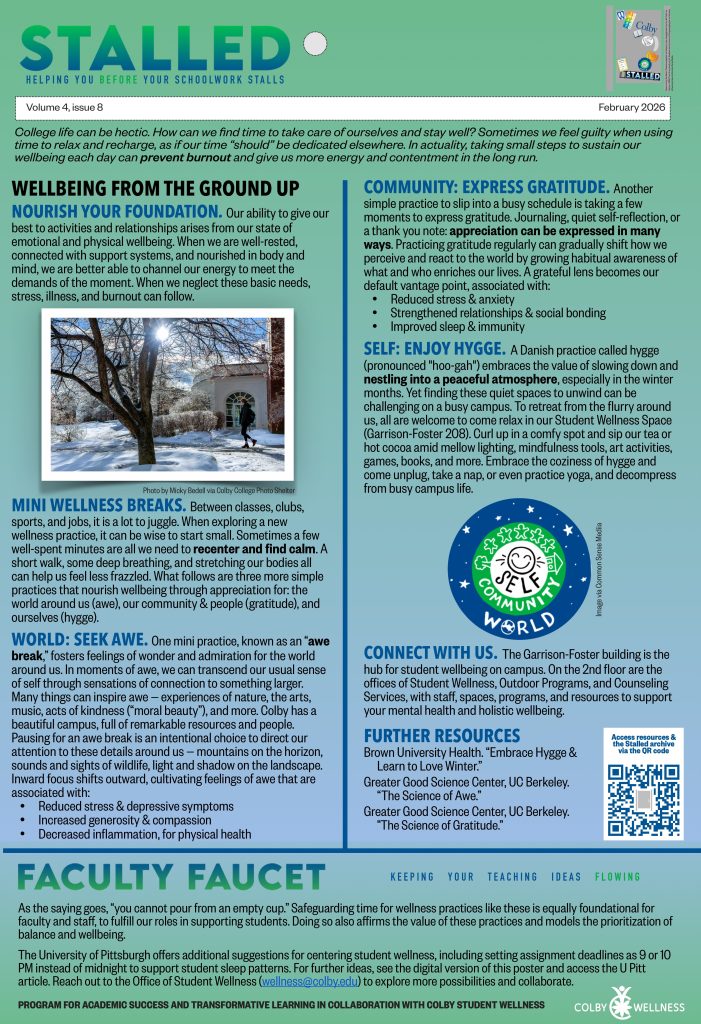
WORLD: SEEK AWE. One mini practice, known as an “awe break,” fosters feelings of wonder and admiration for the world around us. In moments of awe, we can transcend our usual sense of self through sensations of connection to something larger. Many things can inspire awe — experiences of nature, the arts, music, acts of kindness (“moral beauty”), and more. Colby has a beautiful campus, full of remarkable resources and people. Pausing for an awe break is an intentional choice to direct our attention to these details around us — mountains on the horizon, sounds and sights of wildlife, light and shadow on the landscape. Inward focus shifts outward, cultivating feelings of awe that are associated with:

  • Reduced stress & depressive symptoms
  • Increased generosity & compassion
  • Decreased inflammation, for physical health  

COMMUNITY: EXPRESS GRATITUDE. Another simple practice to slip into a busy schedule is taking a few moments to express gratitude. Journaling, quiet self-reflection, or a thank you note: appreciation can be expressed in many ways. Practicing gratitude regularly can gradually shift how we perceive and react to the world by growing habitual awareness of what and who enriches our lives. A grateful lens becomes our default vantage point, associated with: 

  • Reduced stress & anxiety
  • Strengthened relationships & social bonding
  • Improved sleep & immunity

SELF: ENJOY HYGGE. A Danish practice called hygge (pronounced “hoo-gah”) embraces the value of slowing down and nestling into a peaceful atmosphere, especially in the winter months. Yet finding these quiet spaces to unwind can be challenging on a busy campus. To retreat from the flurry around us, all are welcome to come relax in our Student Wellness Space (Garrison-Foster 208). Curl up in a comfy spot and sip our tea or hot cocoa, amid mellow lighting, mindfulness tools, art activities, games, books, and more. Embrace the coziness of hygge and come unplug, take a nap, or even practice yoga, and decompress from busy campus life.

CONNECT WITH US. The Garrison-Foster building is the hub for student wellbeing on campus. On the 2nd floor are the offices of Student Wellness, Outdoor Education, and Counseling Services, with staff, spaces, programs, and resources to support your mental health and holistic wellbeing.

FURTHER RESOURCES 

Brown University Health. “Embrace Hygge & Learn to Love Winter.”

Greater Good Science. “The Science of Awe.”

Greater Good Science. “The Science of Gratitude.”

FACULTY FAUCET

As the saying goes, “you cannot pour from an empty cup.” Safeguarding time for wellness practices like these is equally foundational for faculty and staff, to fulfill our roles in supporting students. Doing so also affirms the value of these practices and models the prioritization of balance and wellbeing. Reach out to the Office of Student Wellness ([email protected]) to explore ideas and collaborate.

The University of Pittsburgh makes some suggestions about how faculty can help foster student wellness, including setting assignment due dates as 9 or 10 PM instead of midnight to encourage healthy sleep patterns. For more ideas, see the U Pitt article “10 Ways Faculty and Staff Can Promote Student Wellbeing.”

Active studying (4.7)

Have you ever spent a lot of time studying but you the material didn’t really stick with you? That often happens when a study technique is passive instead of active. To engage more actively in your studying — and increase your chances of truly retaining information — try these active studying techniques instead!

ACTIVE VS. PASSIVE STUDYING

ACTIVE STUDY LEADS TO LEARNING. Passive studying does not require you to think deeply about course material, whereas active study strategies require deep engagement. As a result, active studying allows for more long-lasting learning and true understanding of concepts. 

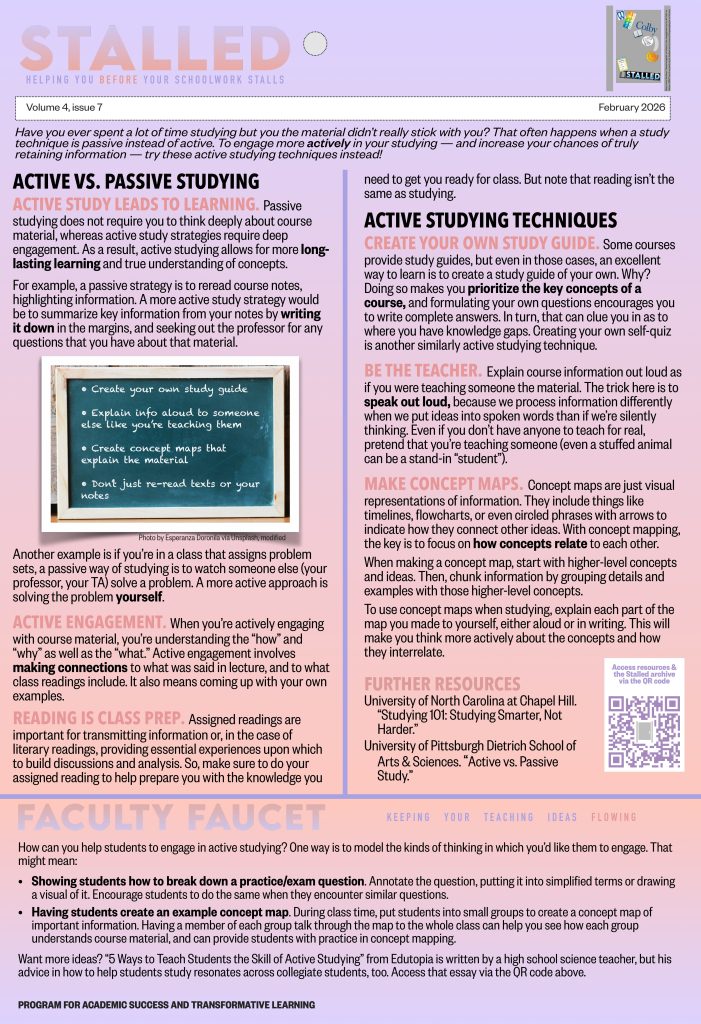
For example, a passive strategy is to reread course notes, highlighting information. A more active study strategy would be to summarize key information from your notes by writing it down in the margins, and seeking out the professor for any questions that you have about that material.

Another example is if you’re in a class that assigns problem sets, a passive way of studying is to watch someone else (your professor, your TA) solve a problem. A more active approach is solving the problem yourself.

ACTIVE ENGAGEMENT. When you’re actively engaging with course material, you’re understanding the “how” and “why” as well as the “what.” Active engagement involves making connections to what was said in lecture, and to what class readings include. It also means coming up with your own examples.

READING IS CLASS PREP. Assigned readings are important for transmitting information or, in the case of literary readings, providing essential experiences upon which to build discussions and analysis. So, make sure to do your assigned reading to help prepare you with the knowledge you need to get you ready for class. But note that reading isn’t the same as studying.  

ACTIVE STUDYING TECHNIQUES

CREATE YOUR OWN STUDY GUIDE. Some courses provide study guides, but even in those cases, an excellent way to learn is to create a study guide of your own. Why? Doing so makes you prioritize the key concepts of a course, and formulating your own questions encourages you to write complete answers. In turn, that can clue you in as to where you have knowledge gaps. Creating your own self-quiz is another similarly active studying technique.

BE THE TEACHER. Explain course information out loud as if you were teaching someone the material. The trick here is to speak out loud, because we process information differently when we put ideas into spoken words than if we’re silently thinking. Even if you don’t have anyone to teach for real, pretend that you’re teaching someone (even a stuffed animal can be a stand-in “student”).

MAKE CONCEPT MAPS. Concept maps are just visual representations of information. They include things like timelines, flowcharts, or even circled phrases with arrows to indicate how they connect other ideas. With concept mapping, the key is to focus on how concepts relate to each other.

When making a concept map, start with higher-level concepts and ideas. Then, chunk information by grouping details and examples with those higher-level concepts.

To use concept maps when studying, explain each part of the map you made to yourself, either aloud or in writing. This will make you think more actively about the concepts and how they interrelate.

FURTHER RESOURCES 

University of North Carolina at Chapel Hill. “Studying 101: Studying Smarter, Not Harder.”

University of Pittsburgh Dietrich School of Arts & Sciences. “Active vs. Passive Study.”

FACULTY FAUCET

How can you help students to engage in active studying? One way is to model the kinds of thinking in which you’d like them to engage. That might mean:

  • Showing students how to break down a practice/exam question. Annotate the question, putting it into simplified terms or drawing a visual of it. Encourage students to do the same when they encounter similar questions. 
  • Having students create an example concept map. During class time, put students into small groups to create a concept map of important information. Having a member of each group talk through the map to the whole class can help you see how each group understands course material, and can provide students with practice in concept mapping.

Want more ideas? “5 Ways to Teach Students the Skill of Active Studying” from Edutopia is written by a high school science teacher, but his advice in how to help students study resonates across collegiate students, too. Access that essay via the QR code above.

Course feedback (4.6)

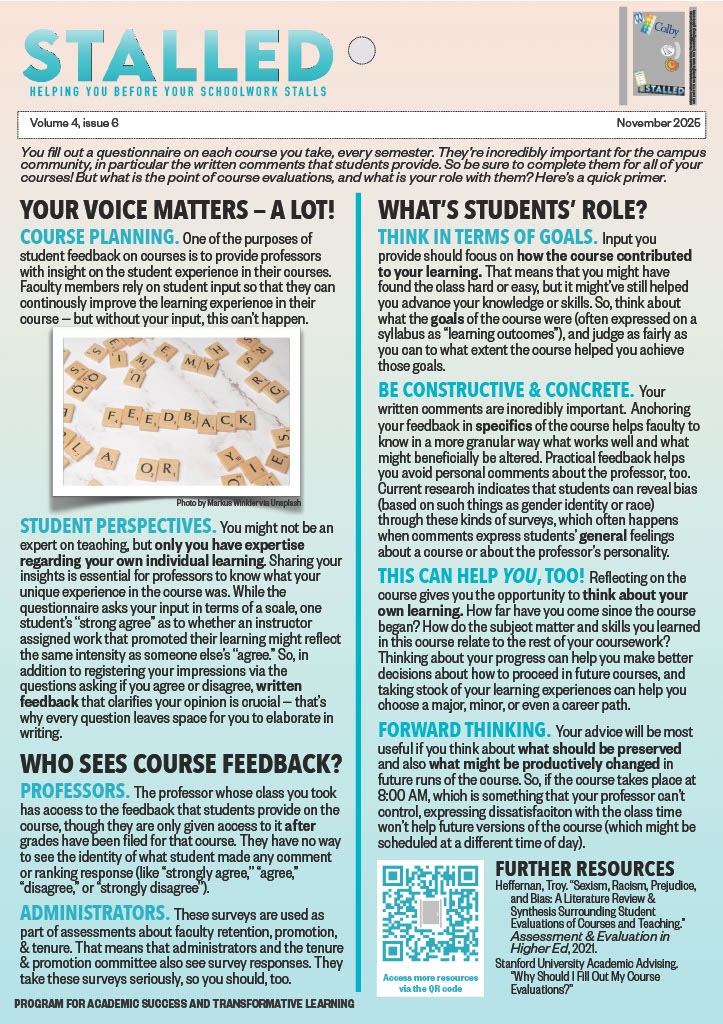
You fill out a questionnaire on each course you take, every semester. They’re incredibly important for the campus community, in particular the written comments that students provide. So be sure to complete them for all of your courses! But what is the point of course evaluations, and what is your role with them? Here’s a quick primer.

YOUR VOICE MATTERS — A LOT!

COURSE PLANNING. One of the purposes of student feedback on courses is to provide professors with insight on the student experience in their courses. Faculty members rely on student input so that they can continously improve the learning experience in their course — but without your input, this can’t happen.

STUDENT PERSPECTIVES. You might not be an expert on teaching, but only you have expertise regarding your own individual learning. Sharing your insights is essential for professors to know what your unique experience in the course was. While the questionnaire asks your input in terms of a scale, one student’s “strong agree” as to whether an instructor assigned work that promoted their learning might reflect the same intensity as someone else’s “agree.” So, in addition to registering your impressions via the questions asking if you agree or disagree, written feedback that clarifies your opinion is crucial — that’s why every question leaves space for you to elaborate in writing.

WHO SEES COURSE FEEDBACK?

PROFESSORS. The professor whose class you took has access to the feedback that students provide on the course, though they are only given access to it after grades have been filed for that course. They have no way to see the identity of what student made any comment or ranking response (like “strongly agree,” “agree,”“disagree,” or “strongly disagree”).

ADMINISTRATORS. These surveys are used as part of assessments about faculty retention, promotion, & tenure. That means that administrators and the tenure & promotion committee also see survey responses. They take these surveys seriously, so you should, too. 

WHAT’S STUDENTS’ ROLE?

THINK IN TERMS OF GOALS. Input you provide should focus on how the course contributed to your learning. That means that you might have found the class hard or easy, but it might’ve still helped you advance your knowledge or skills. So, think about what the goals of the course were (often expressed on a syllabus as “learning outcomes”), and judge as fairly as you can to what extent the course helped you achieve those goals.

BE CONSTRUCTIVE & CONCRETE. Your written comments are incredibly important. Anchoring your feedback in specifics of the course helps faculty to know in a more granular way what works well and what might beneficially be altered. Practical feedback helps you avoid personal comments about the professor, too. Current research indicates that students can reveal bias (based on such things as gender identity or race) through these kinds of surveys, which often happens when comments express students’ general feelings about a course or about the professor’s personality.

THIS CAN HELP YOU, TOO! Reflecting on the course gives you the opportunity to think about your own learning. How far have you come since the course began? How do the subject matter and skills you learned in this course relate to the rest of your coursework? Thinking about your progress can help you make better decisions about how to proceed in future courses, and taking stock of your learning experiences can help you choose a major, minor, or even a career path.

FORWARD THINKING. Your advice will be most useful if you think about what should be preserved and also what might be productively changed in future runs of the course. So, if the course takes place at 8:00 AM, which is something that your professor can’t control, expressing dissatisfaciton with the class time won’t help future versions of the course (which might be scheduled at a different time of day).

FURTHER RESOURCES 

Heffernan, Troy. “Sexism, Racism, Prejudice, and Bias: A Literature Review & Synthesis Surrounding Student Evaluations of Courses and Teaching.” Assessment & Evaluation in Higher Ed, 2021.

Stanford University Academic Advising. “Why Should I Fill Out My Course Evaluations?” 

« Older posts

© 2026 Stalled

Theme by Anders Noren — Up ↑