Helping you before your schoolwork stalls

Category: communication

Emails and emailing (5.2)

We know that emailing is not something that all students do often before they arrive at Colby. But email is the main way that most professors, deans, and other folks at Colby keep you informed about what you need to know. So here are some email hacks to keep you informed and help you communicate professionally.
ESSENTIAL EMAIL INFO 

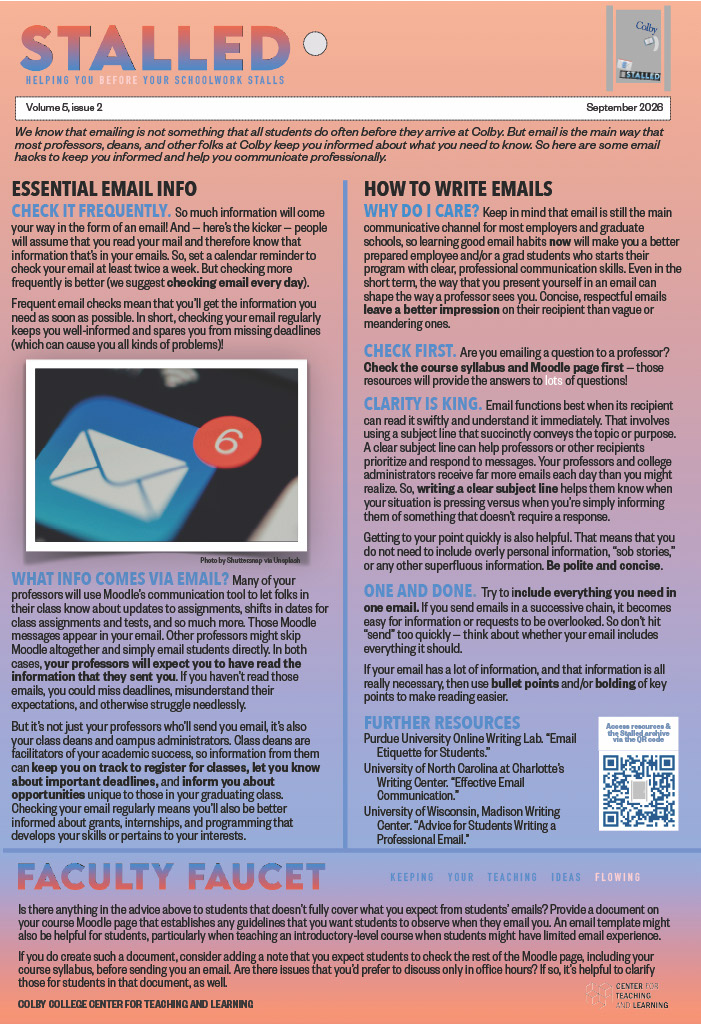
CHECK IT FREQUENTLY. So much information will come your way in the form of an email! And — here’s the kicker — people will assume that you read your mail and therefore know that information that’s in your emails. So, set a calendar reminder to check your email at least twice a week. But checking more frequently is better (we suggest checking email every day).

Frequent email checks mean that you’ll get the information you need as soon as possible. In short, checking your email regularly keeps you well-informed and spares you from missing deadlines (which can cause you all kinds of problems)!

WHAT INFO COMES VIA EMAIL? Many of your professors will use Moodle’s communication tool to let folks in their class know about updates to assignments, shifts in dates for class assignments and tests, and so much more. Those Moodle messages appear in your email. Other professors might skip Moodle altogether and simply email students directly. In both cases, your professors will expect you to have read the information that they sent you. If you haven’t read those emails, you could miss deadlines, misunderstand their expectations, and otherwise struggle needlessly.

But it’s not just your professors who’ll send you email, it’s also your class deans and campus administrators. Class deans are facilitators of your academic success, so information from them can keep you on track to register for classes, let you know about important deadlines, and inform you about opportunities unique to those in your graduating class. Checking your email regularly means you’ll also be better informed about grants, internships, and programming that develops your skills or pertains to your interests.

HOW TO WRITE EMAILS

WHY DO I CARE? Keep in mind that email is still the main communicative channel for most employers and graduate schools, so learning good email habits now will make you a better prepared employee and/or a grad students who starts their program with clear, professional communication skills. Even in the short term, the way that you present yourself in an email can shape the way a professor sees you. Concise, respectful emails leave a better impression on their recipient than vague or meandering ones.

CHECK FIRST. Are you emailing a question to a professor? Check the course syllabus and Moodle page first — those resources will provide the answers to lots of questions!

CLARITY IS KING. Email functions best when its recipient can read it swiftly and understand it immediately. That involves using a subject line that succinctly conveys the topic or purpose. A clear subject line can help professors or other recipients prioritize and respond to messages. Your professors and college administrators receive far more emails each day than you might realize. So, writing a clear subject line helps them know when your situation is pressing versus when you’re simply informing them of something that doesn’t require a response.

Getting to your point quickly is also helpful. That means that you do not need to include overly personal information, “sob stories,” or any other superfluous information. Be polite and concise.

ONE AND DONE. Try to include everything you need in one email. If you send emails in a successive chain, it becomes easy for information or requests to be overlooked. So don’t hit “send” too quickly — think about whether your email includes everything it should. 

If your email has a lot of information, and that information is all really necessary, then use bullet points and/or bolding of key points to make reading easier.

FURTHER RESOURCES 

Purdue University Online Writing Lab. “Email Etiquette for Students.”

University of North Carolina at Charlotte’s Writing Center. “Effective Email Communication.”

University of Wisconsin, Madison Writing Center. “Advice for Students Writing a Professional Email.”

FACULTY FAUCET

Is there anything in the advice above to students that doesn’t fully cover what you expect from students’ emails? Provide a document on your course Moodle page that establishes any guidelines that you want students to observe when they email you. An email template might also be helpful for students, particularly when teaching an introductory-level course when students might have limited email experience.

If you do create such a document, consider adding a note that you expect students to check the rest of the Moodle page, including your course syllabus, before sending you an email. Are there issues that you’d prefer to discuss only in office hours? If so, it’s helpful to clarify those for students in that document, as well.
Restorative practices (4.10)

We share equal responsibility for the well-being of every member … We seek to build relationships and restore them when they are damaged. … We accept responsibility for our actions and words, and commit ourselves to the education, personal growth and/or relational repair which are a consequence.” Each of these statements is included in Colby’s list of community values. Did you know that when you put your energy into abiding by these values you are also engaging with restorative practices?

WHAT ARE RESTORATIVE PRACTICES?

DEEP ROOTS. Restorative practices are a way of being in the world that prioritizes the importance of human relationships and connection, recognizes the inherent value of each member of a community, and creates opportunities to repair relational harm when it occurs through accountability rather than punishment. These practices have deep roots in the wisdom and practices of cultures across the world, including here in the homelands of the Wabanaki peoples.

RESTORATIVE PRACTICES AS OPPORTUNITIES. These practices also foster opportunities for social and emotional learning and skills that are essential for living in community, including self-awareness, self-management, social awareness, relationship management, and responsible decision-making.

WHAT THESE PRACTICES LOOK LIKE

FOR INDIVIDUALS. At the personal level, restorative practices might take the form of cultivating a mindset that prioritizes relationships, empathy, and openness and curiosity about others’ experiences. They could also look like practicing skills such as reflective listening, asking open-ended questions, and seeking to understand others’ perspectives. 

FOR GROUPS.  At the group level, restorative practices include building and deepening a sense of community and belonging, including community-building and support circles or other conversations and activities that focus on the shared experiences of or within a group. In instances where a member of a group has been harmed or caused harm, restorative practices can be used to address these harms through such techniques as restorative dialog, harm repair circles or conferences, and – in cases where someone has been excluded from the group for a period of time – community reintegration activities.  

FOR COMMUNITIES. Restorative communities make a community-wide commitment to restorative ways of being and using restorative practices. This includes Colby, as evidenced by its statement of community values and its active use of restorative practices across campus to build community and repair harm.

RESTORATIVE PRACTICE IS FOR ALL

WHERE CAN I PARTICIPATE? Everywhere! Anyone can be a restorative practitioner. In fact, this is one of the distinguishing features of restorative practice: it is a mindset, as well as a set of skills and practices, that anyone can cultivate through intention and use. Try it!

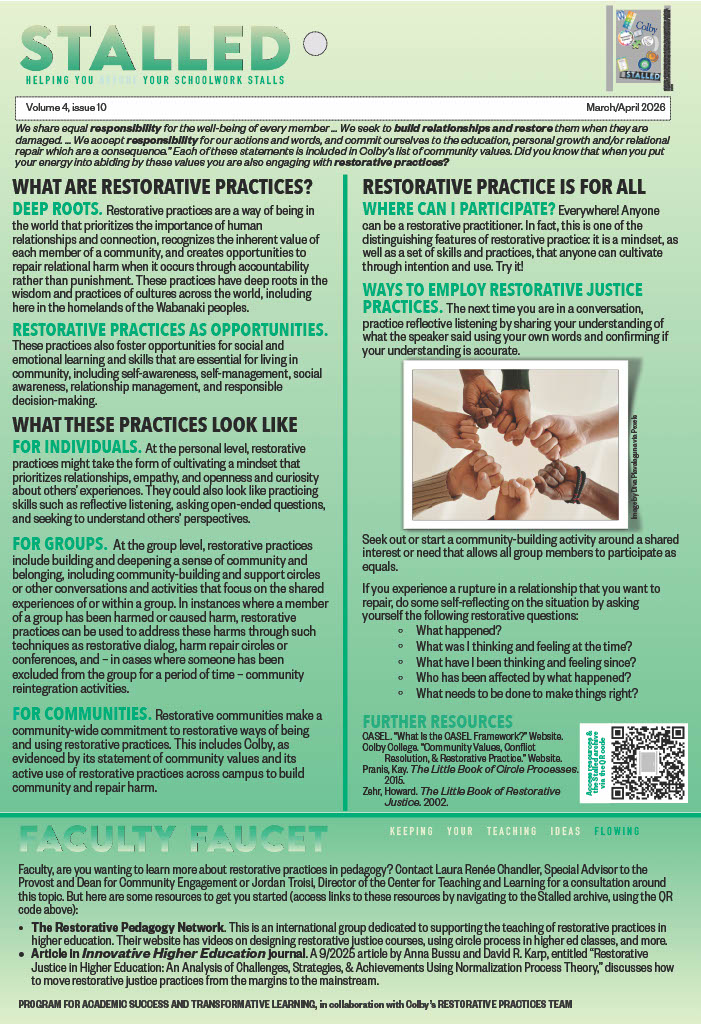
WAYS TO EMPLOY RESTORATIVE JUSTICE PRACTICES. The next time you are in a conversation, practice reflective listening by sharing your understanding of what the speaker said using your own words and confirming if your understanding is accurate.

Seek out or start a community-building activity around a shared interest or need that allows all group members to participate as equals.

If you experience a rupture in a relationship that you want to repair, do some self-reflecting on the situation by asking yourself the following restorative questions:

  • What happened?
  • What was I thinking and feeling at the time?
  • What have I been thinking and feeling since?
  • Who has been affected by what happened?
  • What needs to be done to make things right?

FURTHER RESOURCES 

CASEL. “What Is the CASEL Framework?” Website.

Colby College. “Community Values, Conflict Resolution, & Restorative Practice.” Website.

Pranis, Kay. The Little Book of Circle Processes. 2015.

Zehr, Howard. The Little Book of Restorative Justice. 2002.

FACULTY FAUCET 

Faculty, are you wanting to learn more about restorative practices in pedagogy? Contact Laura Renée Chandler, Special Advisor to the Provost and Dean for Community Engagement or Jordan Troisi, Director of the Center for Teaching and Learning for a consultation around this topic. But here are some resources to get you started:

Group presentations (3.12)

Successful presentations involve a lot of planning and careful thought, and presenting in groups offers some additional challenges. These suggestions on planning and execution can help enhance your next group presentation. And be sure to schedule time for the whole group to practice at least 2 full run-throughs!

GROUP PRESENTATION PLANNING

CLEARLY DELEGATE TASKS. Every presentation should be carefully planned, but planning takes on added importance when you’re working in a group. One way to allocate tasks fairly is to create a shared planning document.Using a platform like Google Docs allows all members of the group access to the same document. 

On this document, list all tasks that must be undertaken to complete the creation of the presentation. Be specific, and include everything from research and the creation of tables and figures to slide creation and editing. Specify the different parts of the presentation, and allocate the tasks as fairly as you can, based on equality of workload and taking into account different skills and interests. Indicate the name of the person who will complete each task, and create a column with checkboxes to indicate when a task is done. If a task has to be completed by a certain date, indicate that date on the same document (a table is a good format in which to create this list).

Keeping a shared planning document helps everyone know the progress of all parts of the presentation. Additionally, if anyone becomes sick, or if the initial allocation of tasks demanded more work of some group members, this document will allow the group to re-allocate tasks when/if needed. 

Remember, too, that all group members should speak for roughly the same amount of time (unless the instructor specifies otherwise), so you’ll need to divide up the speaking roles for the group members fairly.

VISUAL UNITY. Before anyone creates any slides for the presentation (if the presentation will have visuals), decide as a group on what the slides should look like. Aim for consistency across all of the slides. Together, decide:

  • Is there a shared template that everyone should use, and if so, does everyone have access to it?
  • What color palette will the group use? If figures need to be created, make sure the people creating them know what colors should be used.
  • About how much text should appear on any one slide? Remember not to crowd the slides with too much text.
  • If animations are used, which type(s)?
  • What font will the group use?
  • Will the group use a particular kind of illustration style (icons, background, photographs, other)?

PRESENTING IN A GROUP

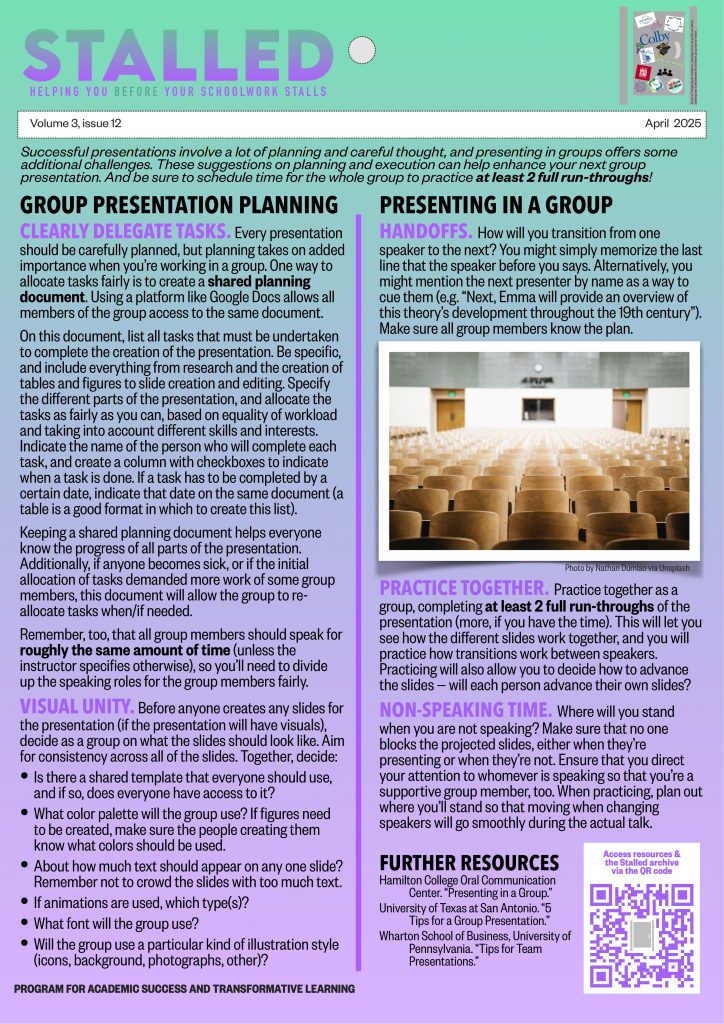
HANDOFFS. How will you transition from one speaker to the next? You might simply memorize the last line that the speaker before you says. Alternatively, you might mention the next presenter by name as a way to cue them (e.g. “Next, Emma will provide an overview of this theory’s development throughout the 19th century”). Make sure all group members know the plan.

PRACTICE TOGETHER. Practice together as a group, completing at least 2 full run-throughs of the presentation (more, if you have the time). This will let you see how the different slides work together, and you will practice how transitions work between speakers. Practicing will also allow you to decide how to advance the slides — will each person advance their own slides?

NON-SPEAKING TIME. Where will you stand when you are not speaking? Make sure that no one blocks the projected slides, either when they’re presenting or when they’re not. Ensure that you direct your attention to whomever is speaking so that you’re a supportive group member, too. When practicing, plan out where you’ll stand so that moving when changing speakers will go smoothly during the actual talk.

FURTHER RESOURCES 

Hamilton College Oral Communication Center. “Presenting in a Group.”

University of Texas at San Antonio. “5 Tips for a Group Presentation.”

Wharton School of Business, University of Pennsylvania. “Tips for Team Presentations.”

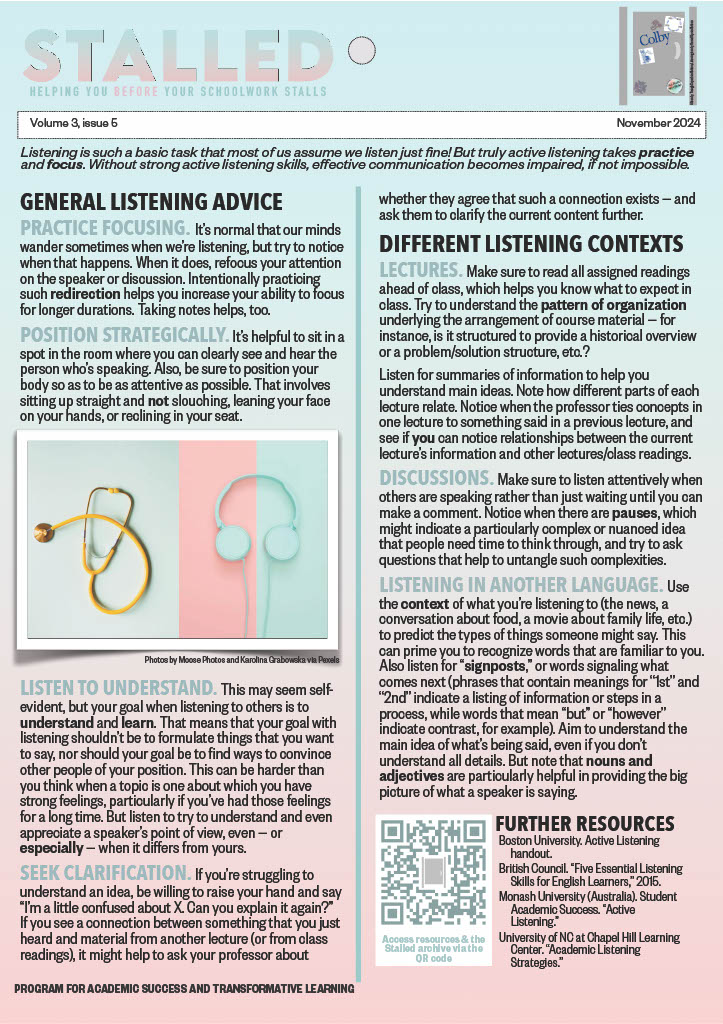
Active listening (3.5)

Listening is such a basic task that most of us assume we listen just fine! But truly active listening takes practice and focus. Without strong active listening skills, effective communication becomes impaired, if not impossible.

GENERAL LISTENING ADVICE

PRACTICE FOCUSING. It’s normal that our minds wander sometimes when we’re listening, but try to notice when that happens. When it does, refocus your attention on the speaker or discussion. Intentionally practicing such redirection helps you increase your ability to focus for longer durations. Taking notes helps, too. 

POSITION STRATEGICALLY. It’s helpful to sit in a spot in the room where you can clearly see and hear the person who’s speaking. Also, be sure to position your body so as to be as attentive as possible. That involves sitting up straight and not slouching, leaning your face on your hands, or reclining in your seat.

LISTEN TO UNDERSTAND. This may seem self-evident, but your goal when listening to others is to understand and learn. That means that your goal with listening shouldn’t be to formulate things that you want to say, nor should your goal be to find ways to convince other people of your position. This can be harder than you think when a topic is one about which you have strong feelings, particularly if you’ve had those feelings for a long time. But listen to try to understand and even appreciate a speaker’s point of view, even — or especially — when it differs from yours.

SEEK CLARIFICATION. If you’re struggling to understand an idea, be willing to raise your hand and say “I’m a little confused about X. Can you explain it again?”  If you see a connection between something that you just heard and material from another lecture (or from class readings), it might help to ask your professor about whether they agree that such a connection exists — and ask them to clarify the current content further.

DIFFERENT LISTENING CONTEXTS

LECTURES. Make sure to read all assigned readings ahead of class, which helps you know what to expect in class. Try to understand the pattern of organization underlying the arrangement of course material — for instance, is it structured to provide a historical overview or a problem/solution structure, etc.? 

Listen for summaries of information to help you understand main ideas. Note how different parts of each lecture relate. Notice when the professor ties concepts in one lecture to something said in a previous lecture, and see if you can notice relationships between the current lecture’s information and other lectures/class readings.

DISCUSSIONS. Make sure to listen attentively when others are speaking rather than just waiting until you can make a comment. Notice when there are pauses, which might indicate a particularly complex or nuanced idea that people need time to think through, and try to ask questions that help to untangle such complexities.

LISTENING IN ANOTHER LANGUAGE. Use the context of what you’re listening to (the news, a conversation about food, a movie about family life, etc.) to predict the types of things someone might say. This can prime you to recognize words that are familiar to you. Also listen for “signposts,” or words signaling what comes next (phrases that contain meanings for “1st” and “2nd” indicate a listing of information or steps in a process, while words that mean “but” or “however” indicate contrast, for example). Aim to understand the main idea of what’s being said, even if you don’t understand all details. But note that nouns and adjectives are particularly helpful in providing the big picture of what a speaker is saying. 

FURTHER RESOURCES 

Boston University. Active Listening handout.

British Council. “Five Essential Listening Skills for English Learners,” 2015.

Monash University (Australia). Student Academic Success. “Active Listening.”

University of NC at Chapel Hill Learning Center. “Academic Listening Strategies

Presentation Q&A sessions (2.10)

You’ve researched, planned, and delivered a presentation. But how do you handle the question and answer (Q & A) period afterwards? Read on for advice on Q & A time during poster sessions and after presentations.

WHY HAVE Q&A AFTER A TALK?

ACADEMIC DIALOGUE. Giving a presentation is usually unidirectional: the speaker talks and the audience listens. Yet academia is built upon lively discussion as a fundament of learning. So, engaging an audience’s questions and ideas draws more perspectives into the discussion, and provides more opportunity for developing your ideas and your work.

PRACTICE FOR PROFESSIONAL LIFE. Whether you deliver conference presentations in graduate school or give work-in-progress presentations in professional meetings, you’re all but certain to need practice in engaging with an audience. Doing so now gives you opportunities to learn different strategies and to test a variety of approaches.

STRATEGIES FOR ANSWERING

PREPARE IN ADVANCE. As you’re planning your presentation, think about the kinds of questions you might receive. What might non-experts want to know more about? What might experts be likely to ask you about? Also, if you have to cut material from your talk (as many folks do when trying to keep to an alloted time), save that material, including slides if there are any. Have that material handy during your Q&A session, and be ready to use it/display it if you receive a question on it. This will help you feel more in control, and it will help show your audience how thorough you are.

If you’re presenting a poster, know that people might break into your brief poster talk with questions before your talk is finished. So, practice giving your talk while friends or classmates break in with questions at different points in the talk. This will give you practice so that experiencing similar interruptions during the actual event won’t feel unfamiliar.

LISTEN CAREFULLY, ANSWER CONCISELY.It’s important to engage fully with the questions you receive so that your audience can learn and you can receive useful information and ideas from your audience. So, it’s essential to listen carefully to your audience’s questions and comments. If you didn’t hear a question completely, or if you’re not sure that you understand it, you should ask the questioner to repeat themselves, or you could ask “I’m not sure I’m understanding your question fully — could you perhaps restate it?”

When giving your answers, aim to answer the question fully, but also concisely. Additionally, feel free to direct questioners to useful secondary sources if you sense that they want to learn more about the topic.

WHEN YOU DON’T KNOW THE ANSWER.Everyone receives questions that they cannot answer at some time, so expect questions of this type — and don’t feel like you’ve done someone wrong if anyone asks you a question to which you don’t know the answer. Ahead of time, prepare what you’ll do when this happens. Some strategies include thanking the speaker for their question and stating how you appreciate that they’ve pointed out an area of further study. Additionally, if the question falls outside the scope of your work, you can politely say so. 

WHEN WORKING IN A GROUP

EVERYONE SHOULD SPEAK. If your group divides its talk into different parts, the person to answer should be whomever delivered the part that’s related to the question. But it’s expected that every member of a presentation group should participate in the Q& A. 

YOU CAN ADD TO SOMEONE’S ANSWER. As mentioned above, it’s customary for all members of a group to answer questions. But audience members might not have questons about all parts of a talk, so some presenters might not know what to do to participate in the Q&A. Yet you can build onto what a group-mate says to answer a question, adding detail or explaining further. 

FURTHER RESOURCES 

Hanke, Stacey. “The Best Way to Answer Questions After a Presentation or a Meeting.” Entrepreneur, October 8, 2018.

Webb, Caroline. “How to Nail the Q&A After Your Presentation.” Harvard Business Review. January 24, 2020.

Office hours (2.2)

Stalled poster 2.2 (text is pasted below)

If you don’t really know what office hours are, you’re not alone! Take the Stalled challenge: go to office hours with each one of your professors at least once this semester!

WHY SHOULD I GO TO OFFICE HOURS?

Most students don’t start college with a clear understanding of the purpose of office hours. Here are some tips to help you make the most of them!

WHAT ARE OFFICE HOURS? Every professor holds weekly office hours so that students know when to find them for one-on-one conversations. Some professors require students to attend office hours, but you should go even if office hours are not required. Some professors may ask you to schedule a time to go to office hours, so be sure to check your course’s syllabus for details (and for the location of your professors’ offices).

BUT WHY GO? Getting to know your professors will make you more comfortable in class — and it helps them know how best to facilitate learning in their courses by better understanding their students.

WHAT SHOULD I TALK ABOUT IN OFFICE HOURS?

You won’t have time to talk about all of these things in one visit, so we suggest picking just one to start.

HOW THE READING RELATES TO THE COURSE.Readings are assigned for particular reasons, so you should ask your professor if you don’t understand how a particular reading relates to course themes. This is also likely to help you if you need to grapple with readings in an essay or other assignment. If you need advice about how to read the course’s texts effectively, talk about that, too!

HOW TO DO WELL.If you’re visiting office hours at the start of a term, ask about the habits or behaviors that help students succeed in the course. You can also ask how to improve your performance on tests, essays/reports, presentations, or any other task. If the professor works in the department in which you are seeking a major or minor, consider asking about how your work in this specific class fits into your work towards your major or minor. You can also ask about what habits successful majors or minors cultivate.

What you should not do is ask how to get an A in the class. Different people need different things to achieve high grades, and your class performance will be better if you focus on how best to learn rather than how to achieve a specific grade.

HOW TO IMPROVE YOUR WRITING. Different disciplines have different ideas and guidelines about what constitutes good writing. So, consider asking your professor for writing advice before your first writing task in their course is due. If you have specific questions about any feedback your professor provided on draft or final versions of your writing, bring a copy of your work with their comments.

LETTERS OF RECOMMENDATION. If you need a letter of recommendation, go talk to your professor. Tell them what the letter is for, what the letter should emphasize, and, if it’s been a while since you took a course with them, remind them about what course(s) you were in. Pro tips: give them the most recent version of your resume at the same time, and give them at least 2-3 weeks advance notice.

WHAT’S NOT GOING WELL. If you find something in the course material confusing, if you don’t understand the parameters of an assignment, or if you are experiencing personal difficulties that affect your schoolwork, talk to your professor in person during their office hours. It’s helpful to talk face-to-face to discuss these things, which can be harder to do effectively via email, phone, or other communication channel.

ABOUT THEM! Ask about their research, or ask about what got them into their field. You might find a professor with whom you’d like to do research, and you might even be surprised at what you learn!

FURTHER RESOURCES 

Cornell University Learning Strategies Center. “How to Use Office Hours.”

University of North Carolina at Chapel Hill Learning Center. “Using Office Hours Effectively

How to read syllabi, and how & why to email professors (2.1)

Stalled poster 2.1 (text is pasted below)

You receive a syllabus for each of your classes — but do you know how to read a syllabus so as to understand what you’re expected to learn? And do you have questions about emailing your instructors? This edition of Stalled is here to help you!

HOW TO READ SYLLABI

UNDERSTAND THE COURSE GOALS. Have you seen “learning objectives” on a syllabus before? These are the skills and content knowledge that the professors expect you to achieve by the time the course ends. These are the goals that the class tasks are built to help you reach, so think about how you can showcase those skills and knowledge bases in your assignments and other contributions to class.

Every course syllabus is different, so make sure to read each one carefully, but here are some of the most common elements and why they’re important.

KNOW WHAT YOU’LL DO IN CLASS. Many syllabi include schedules so that you know what will happen during the different class sessions. This can help you prepare for class (and can serve as a starting point for creating study guides for exams).

WHAT TYPE OF COURSE IT IS. The assignment types can help you understand what type of course you’re in: is the course based on completing readings and participating in discussions? If so, you’ll need to stay on top of the reading assignments. Is the course problem-set and exam based? Then you’ll need to ensure that you build the skills necessary to complete problems and also understand the difference between different kinds of problems.

GRADE CALCULATION. What are the graded elements of the course? Are some assignments/elements worth more than others in the calculation of the course grade? If so, that can give you a hint as to what the instructor sees as important. If dates for exams or assignments are provided, put those in your (digital or paper) calendar. In particular, put the dates of all final exams in your calendar as soon as you can. Don’t have a calendar? Use Google Calendar!

FURTHER RESOURCES

University of California, Berkeley. “6 Ways to Use Your Syllabus for Success.”

University of Waterloo Writing and Communication Centre. “Reading Your Syllabus For Success.”

HOW & WHY TO EMAIL PROFESSORS

Email is a key way to communicate with faculty, and professors have expectations for emails. Here’s what you need to know!

NAMES MATTER. In conversation and in written communication, it’s a good idea to address faculty as “Doctor” or “Professor” (respectful titles for a terminal-degree-holder who teaches at the collegiate level). If they want you to call them something different, they’ll let you know.

End with your full name, since several students may share the same or similar first names. If you’re speaking face-to-face, introduce yourself by name the first time you talk (and maybe the next few times, too, since professors have lots of students!). 

BE CONCISE. Your professor is an intellectual mentor to you, which places you in the role of mentee. One of the things that that means is that you should be mindful of their time, plan and prepare what you’ll discuss (either via email or in person), and aim to be clear and concise. So: no long-winded sob stories — get straight to the point, and your profs will appreciate that you’ve shown respect for their time.

WHY EMAIL? Speaking to your professor face-to-face is often preferable so that you can have a discussion about issues like how to strengthen your work in a class or how to develop your skills and knowledge in the course subject. 

However, when emergencies arise or something happens before you can meet your professor in their office hours, email is the best way to reach them (unless they have specified a different mode of communication). Email professors when you have an illness that will prevent you from attending class, for example.

FURTHER RESOURCES

Columbia University School of Professional Studies. “How to Talk to Faculty.”

Wood, Sarah. “7 Guidelines for College Student-Professor Interactions.” U.S. News and World Report (July 5, 2022).

How to plan & lead a class discussion (1.6)

Stalled poster 1.6 (text is pasted below)

Has a professor assigned you to lead a discussion during class? Here’s help for creating and fostering a good class discussion.

PLANNING A DISCUSSION

  • Create a list of key concepts and themes. You can use these to formulate questions and find connections within the content.

  • Create two lists of questions, one that you keep to yourself for asking questions to start the discussion (and move it along if there are lulls), and another list that you give to classmates to inspire their thinking. This will help keep the conversation flowing.

  • Feel free to plan a few minutes to ask your classmates to create their own questions. They may have noticed different aspects of the topic/assigned reading than you did.

  • Know your goal for the discussion. Are you hoping to inspire an in-class debate? Do you want to create a mind-map of interrelated ideas? Do you want a range of points of view represented? Or do you have another goal?


LEADING A DISCUSSION
  • Help your classmates by listing key points on the board, which will clue them in about what you plan to discuss. It also helps you know which topics still need to be covered.

  • Bring a list of questions you can ask so that you can move the discussion along at the start (and if there is a lull). Remember, “why” and “how” questions generate discussion better than yes/no questions.

  • Follow up interesting statements with supplemental questions. But make sure to address those questions to the whole class (not only the person who made the statement).

  • Don’t be afraid to let there be silence! People often need a few moments to formulate responses, so let those silences unfold.

Managing fear of public speaking (1.5)

Stalled poster 1.5 (text is pasted below)


If you have fears about speaking in public, you’re in good company, because most college students feel this way. Just in time for CLAS and end-of-term presentations, here are suggestions on how to manage that fear.

KNOW YOUR AUDIENCE. Speaking tasks may feel like they are all about you, but the real focus is how to deliver benefit to your audience. So think about what your audience needs, and remember that the focus is on the talk’s content, not really on you.

BUT YOU MATTER, TOO! Take care of your physical self. Don’t eat immediately before your talk, but do eat something with protein on the talk day. Use the restroom beforehand, and keep a bottle of water handy when you’re speaking, too.

YOU’RE IN GOOD COMPANY. Notable public figures — including Thomas Jefferson, Mahatma Gandhi, and even Beyoncé — have had public speaking anxiety. But they achieved success in spite of their fears — and so can you!

PRACTICE, PRACTICE, PRACTICE! Practice is key to a good talk, and it is also helpful in easing fear. How?

  • Planning well ahead of your deadline makes it likelier that your talk will have good structure and content, which in turn often reduces speakers’ anxiety.

  • Practicing lets you discover difficult words to pronounce, giving you time to learn them (or find alternatives).

  • Practicing a talk makes you know the content better, allowing you to speak more freely (helping your delivery) and helping you feel more in control.

  • Practicing with your visuals gives you a chance to troubleshoot them, correcting mistakes and giving you time to make changes as needed.

  • Practicing gives a clearer sense of your talk’s timing, which provides more control over the pacing and delivery of the talk.


EYE CONTACT? Do you have a hard time looking audience members in the eye? If eye contact is uncomfortable, you can give the same impression of being attentive to the audience by looking at people’s ears instead.

TAKE A BREATH. Deep breathing can help calm anxiety (even the Mayo Clinic says so!). Take deep, slow breaths in through your nose, and exhale slowly through your mouth. Do this several times before you take the stage to help control your heart rate and calm yourself down.

© 2026 Stalled

Theme by Anders Noren — Up ↑