Helping you before your schoolwork stalls

Category: mental health

Reducing phone time (4.11)

Yes, phones are very useful tech that can perform many functions. But we can also over-rely on them to our detriment. Many recent studies suggest that digital fasts — or even short times away from our screens — can bring about desirable outcomes. Read on to see how you might benefit from some time away from your phone.
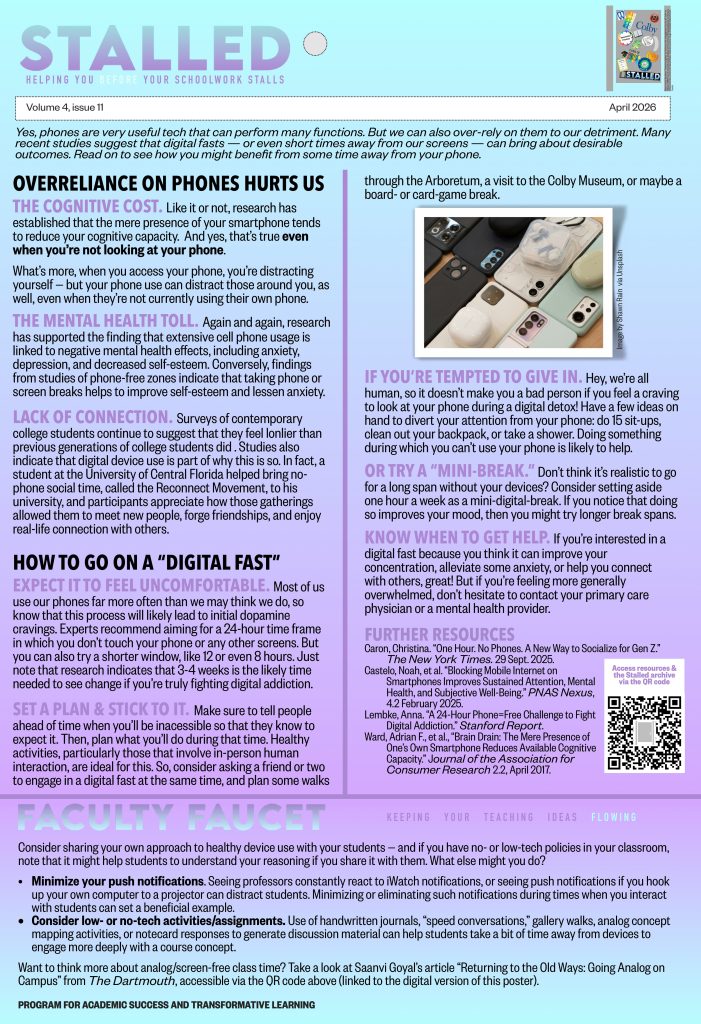
OVERRELIANCE ON PHONES HURTS US

THE COGNITIVE COST. Like it or not, research has established that the mere presence of your smartphone tends to reduce your cognitive capacity.  And yes, that’s true even when you’re not looking at your phone.

What’s more, when you access your phone, you’re distracting yourself — but your phone use can distract those around you, as well, even when they’re not currently using their own phone.

THE MENTAL HEALTH TOLL. Again and again, research has supported the finding that extensive cell phone usage is linked to negative mental health effects, including anxiety, depression, and decreased self-esteem. Conversely, findings from studies of phone-free zones indicate that taking phone or screen breaks helps to improve self-esteem and lessen anxiety.

LACK OF CONNECTION. Surveys of contemporary college students continue to suggest that they feel lonlier than previous generations of college students did . Studies also indicate that digital device use is part of why this is so. In fact, a student at the University of Central Florida helped bring no-phone social time, called the Reconnect Movement, to his university, and participants appreciate how those gatherings allowed them to meet new people, forge friendships, and enjoy real-life connection with others.

HOW TO GO ON A “DIGITAL FAST”

EXPECT IT TO FEEL UNCOMFORTABLE.Most of us use our phones far more often than we may think we do, so know that this process will likely lead to initial dopamine cravings. Experts recommend aiming for a 24-hour time frame in which you don’t touch your phone or any other screens. But you can also try a shorter window, like 12 or even 8 hours. Just note that research indicates that 3-4 weeks is the likely time needed to see change if you’re truly fighting digital addiction.

SET A PLAN & STICK TO IT. Make sure to tell people ahead of time when you’ll be inacessible so that they know to expect it. Then, plan what you’ll do during that time. Healthy activities, particularly those that involve in-person human interaction, are ideal for this. So, consider asking a friend or two to engage in a digital fast at the same time, and plan some walks through the Arboretum, a visit to the Colby Museum, or maybe a board- or card-game break.

IF YOU’RE TEMPTED TO GIVE IN. Hey, we’re all human, so it doesn’t make you a bad person if you feel a craving to look at your phone during a digital detox! Have a few ideas on hand to divert your attention from your phone: do 15 sit-ups, clean out your backpack, or take a shower. Doing something during which you can’t use your phone is likely to help.

OR TRY A “MINI-BREAK.” Don’t think it’s realistic to go for a long span without your devices? Consider setting aside one hour a week as a mini-digital-break. If you notice that doing so improves your mood, then you might try longer break spans.

KNOW WHEN TO GET HELP. If you’re interested in a digital fast because you think it can improve your concentration, alleviate some anxiety, or help you connect with others, great! But if you’re feeling more generally overwhelmed, don’t hesitate to contact your primary care physician or a mental health provider.

FURTHER RESOURCES 

Caron, Christina. “One Hour. No Phones. A New Way to Socialize for Gen Z.” The New York Times. 29 Sept. 2025.

Castelo, Noah, et al. “Blocking Mobile Internet on Smartphones Improves Sustained Attention, Mental Health, and Subjective Well-Being.” PNAS Nexus, 4.2 February 2025.

Lembke, Anna. “A 24-Hour Phone=Free Challenge to Fight Digital Addiction.” Stanford Report. 

Ward, Adrian F., et al., “Brain Drain: The Mere Presence of One’s Own Smartphone Reduces Available Cognitive Capacity.” Journal of the Association for Consumer Research 2.2, April 2017.

FACULTY FAUCET

Consider sharing your own approach to healthy device use with your students — and if you have no- or low-tech policies in your classroom, note that it might help students to understand your reasoning if you share it with them. What else might you do?

  • Minimize your push notifications. Seeing professors constantly react to iWatch notifications, or seeing push notifications if you hook up your own computer to a projector can distract students. Minimizing or eliminating such notifications during times when you interact with students can set a beneficial example.  
  • Consider low- or no-tech activities/assignments. Use of handwritten journals,  “speed converstations,” gallery walks, analog concept mapping activities, or notecard responses to generate discussion material can help students take a bit of time away from devices to engage more deeply with a course concept. 

Want to think more about analog/screen-free class time? Take a look at Saanvi Goyal’s article “Returning to the Old Ways: Going Analog on Campus” from The Dartmouth.
Joy of learning (4.4)

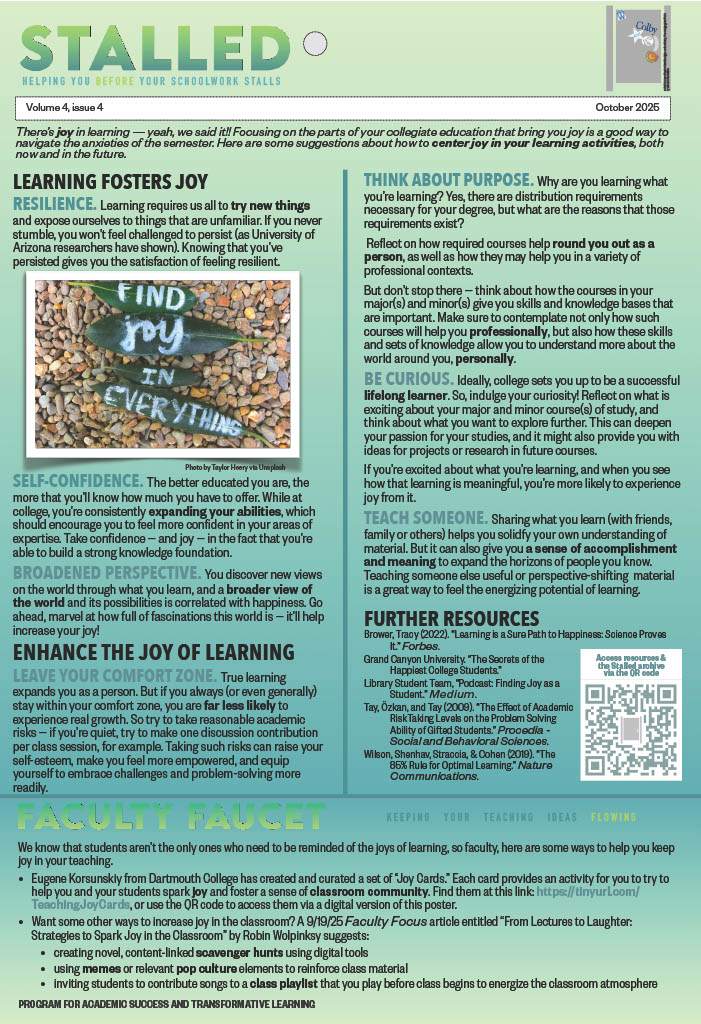
There’s joy in learning — yeah, we said it!! Focusing on the parts of your collegiate education that bring you joy is a good way to navigate the anxieties of the semester. Here are some suggestions about how to center joy in your learning activities, both now and in the future.

LEARNING FOSTERS JOY

RESILIENCE. Learning requires us all to try new things and expose ourselves to things that are unfamiliar. If you never stumble, you won’t feel challenged to persist (as University of Arizona researchers have shown). Knowing that you’ve persisted gives you the satisfaction of feeling resilient.

SELF-CONFIDENCE. The better educated you are, the more that you’ll know how much you have to offer. While at college, you’re consistently expanding your abilities, which should encourage you to feel more confident in your areas of expertise. Take confidence — and joy — in the fact that you’re able to build a strong knowledge foundation.

BROADENED PERSPECTIVE. You discover new views on the world through what you learn, and a broader view of the world and its possibilities is correlated with happiness. Go ahead, marvel at how full of fascinations this world is — it’ll help increase your joy!

ENHANCE THE JOY OF LEARNING 

LEAVE YOUR COMFORT ZONE. True learning expands you as a person. But if you always (or even generally) stay within your comfort zone, you are far less likely to experience real growth. So try to take reasonable academic risks — if you’re quiet, try to make one discussion contribution per class session, for example. Taking such risks can raise your self-esteem, make you feel more empowered, and equip yourself to embrace challenges and problem-solving more readily.

THINK ABOUT PURPOSE. Why are you learning what you’re learning? Yes, there are distribution requirements necessary for your degree, but what are the reasons that those requirements exist?

 Reflect on how required courses help round you out as a person, as well as how they may help you in a variety of professional contexts. 

But don’t stop there — think about how the courses in your major(s) and minor(s) give you skills and knowledge bases that are important. Make sure to contemplate not only how such courses will help you professionally, but also how these skills and sets of knowledge allow you to understand more about the world around you, personally.

BE CURIOUS. Ideally, college sets you up to be a successful lifelong learner. So, indulge your curiosity! Reflect on what is exciting about your major and minor course(s) of study, and think about what you want to explore further. This can deepen your passion for your studies, and it might also provide you with ideas for projects or research in future courses. 

If you’re excited about what you’re learning, and when you see how that learning is meaningful, you’re more likely to experience joy from it.

TEACH SOMEONE. Sharing what you learn (with friends, family or others) helps you solidfy your own understanding of material. But it can also give you a sense of accomplishment and meaning to expand the horizons of people you know. Teaching someone else useful or perspective-shifting  material is a great way to feel the energizing potential of learning.

FURTHER RESOURCES 

Brower, Tracy (2022). “Learning is a Sure Path to Happiness: Science Proves It.” Forbes.

Grand Canyon University. “The Secrets of the Happiest College Students.”

Library Student Team, “Podcast: Finding Joy as a Student.” Medium.

Tay, Özkan, and Tay (2009). “The Effect of Academic RiskTaking Levels on the Problem Solving Ability of Gifted Students.” Procedia – Social and Behavioral Sciences.

Wilson, Shenhav, Straccia, & Cohen (2019). “The 85% Rule for Optimal Learning.” Nature Communications.

FACULTY FAUCET

We know that students aren’t the only ones who need to be reminded of the joys of learning, so faculty, here are some ways to help you keep joy in your teaching. 

  • Eugene Korsunskiy from Dartmouth College has created and curated a set of “Joy Cards.” Each card provides an activity for you to try to help you and your students spark joy and foster a sense of classroom community. Find them at this link: https://tinyurl.com/TeachingJoyCards.
  • Want some other ways to increase joy in the classroom? A 9/19/25 Faculty Focus article entitled “From Lectures to Laughter: Strategies to Spark Joy in the Classroom” by Robin Wolpinksy suggests: 
    • creating novel, content-linked scavenger hunts using digital tools
    • using memes or relevant pop culture elements to reinforce class material
    • inviting students to contribute songs to a class playlist that you play before class begins to energize the classroom atmosphere

What to do when you feel overwhelmed (2.5)

Frustration with your workload, difficulty from non-academic struggles, crying over a tough assignment: there are situations that can make any of us feel overwhelmed. If you find yourself feeling that way, here are some things to keep in mind and and a few actions to try.

NOTE YOUR FRAME OF MIND

TAKE A BREATH. If you are feeling emotional (frustrated, angry, sad), it’s harder for you to work, but attempting to stifle emotions entirely can be counterproductive. It is worth remembering that your emotions are valid, so give yourself a few moments to feel those emotions rather than suppressing them.

FOCUS ON THE GOOD. Voltaire is credited as saying “the best is the enemy of the good,” which means that we threaten the quality of our work when we insist on perfection. Perfection is not a realistic goal, because it really isn’t achievable (by anyone, not just you – this is true of Olympians, Nobel prize winners, and everyone else). Instead, focus on doing good work. This can help take some of the emotional pressure off of yourself by providing a realistic goal. 

REFRAME THE ISSUE. In the moment, an undesired grade or difficulty in a course can loom large. But these things are, in the grand scheme of the entirety of your life, relatively small. Almost no one remembers the grade they earned on each essay or report in college, and that’s because no one grade – even a bad grade for an entire course – can define you. We all miss the mark from time to time, but it doesn’t hold people back from full and happy lives, and it is helpful to remind yourself of this to reground your perspective.

WHAT CAN I DO?

CONSULT THE CALENDAR. Take a look at the next two weeks on your calendar. What are the immediate tasks that you need to complete? Write a list in order of their due dates. Then, take a look at the rest of the term. For any big assignments due at the end of the term, break them down into steps (e.g. for a report, that might include: research/data gathering, drafting sections of the report, editing, and proofreading). Then, work backwards from the due date to figure out when each step should be done. Add those steps to your calendar. Smaller tasksare more manageable, and once you have a small piece of a task done, you will feel better and more in control of your workload.

TALK IT OUT. It might not always seem so, but most students feel overwhelmed from time to time. So, talk to riends, classmates, or roommates about what you are feeling. Sometimes, just knowing that you are not alone in feeling this way can lighten your emotional load – and you could well be lightening your friend’s emotional load, too, with this kind of conversation. 

FIND THE HELP YOU NEED. Campus Counselling Services is a good place to go for more coping strategies. You can reach them at 207-859-4490, and their services are free for Colby students. 

You can also talk to someone in the Dean of Studies office, such as your Class Dean, for help finding resources to put you on more solid academic footing.

In the event of a mental health emergency, call 207-859-4490 (if calling after hours, then press “0”).

FURTHER RESOURCES 

Engineering Expectations. “What to Do If You Are Overwhelmed in College.”

Finkelstein-Fox, Lucy: Crystal L. Park; and Kristen E. Riley. “Mindfulness and Emotion Regulation: Promoting Well-Being During the Transition to College.” Anxiety, Stress, & Coping vol. 31, no. 6 (2018): 639-653. 

LeBlanc, Nicole J. and Luana Marques. “Anxiety in College: What We Know and How to Cope.” Harvard Health Blog. August 27, 2019.  

Purdue University Global. “The College Student’s Guide to Stress Management.” Updated July 2, 2020.  

University of North Carolina at Chapel Hill. “College Stress.” 

Wallis, Ashley. “How to Avoid College Burnout.” Southern New Hampshire University. June 16, 2021.  

Campus resources for students (1.4)

Stalled poster 1.4 (text is pasted below)


Colby has many resources for students, and you might not be familiar with all of them. These are a few of the key resources that you should know.

CLASS DEANS. There is a dean for each class year, and they are invaluable resources. If you have a problem and are unsure where to turn, contact your class dean first. They know the most usual issues that students face in the different stages of their time at Colby, but they are pros with handling unusual situations, too. They can also connect you to a Learning Consultant if one-on-one academic support is needed.

ACCOMMODATIONS. Colby’s Office for Student Access and Disability Services helps students get the academic accommodations they need to ensure equitable education opportunities.

MAKING CONNECTIONS. Davis Connects connects students with internships, research opportunities, and information about graduate school and career opportunities. But they also help connect you to off-campus study as well as connect you to funding for those experiences.

PUGH CENTER. A place that fosters inclusion and equity, the Pugh Center is a multicultural common ground and home to many clubs/organizations, programs, and support services.

EMOTIONAL SUPPORT. Make sure to access counseling services when you need them — that’s why Colby has a counselor team! But don’t forget that Colby also has compassionate support in its Office of Religious and Spiritual Life.

FIRST-GEN STUDENTS. Colby’s First-Generation-to-College/Low-Income Program for Student Success supports students and their families throughout their Colby career.

INTERNATIONAL STUDENTS. The Office of Student Financial Services helps with issues relating to immigration, taxes, and student employment, and the Pugh Center (see above) provides cultural activities.

STUDENT SUCCESS FUND. If financial hardship interferes with your path to academic success, meet with the Student Success and Support Case Manager to discuss the Student Success Fund.

If links are broken, search on Colby’s website to find contact info for any of these resources.

© 2026 Stalled

Theme by Anders Noren — Up ↑