Many students fear making mistakes. Yet taking responsible academic risks involves accepting that you will make mistakes. Mistakes are not only helpful for learning, they may be essential for learning. How can you help yourself to see mistakes as valuable learning experiences? That’s what this edition of Stalled is all about!
ACADEMIC RISKS TEACH US
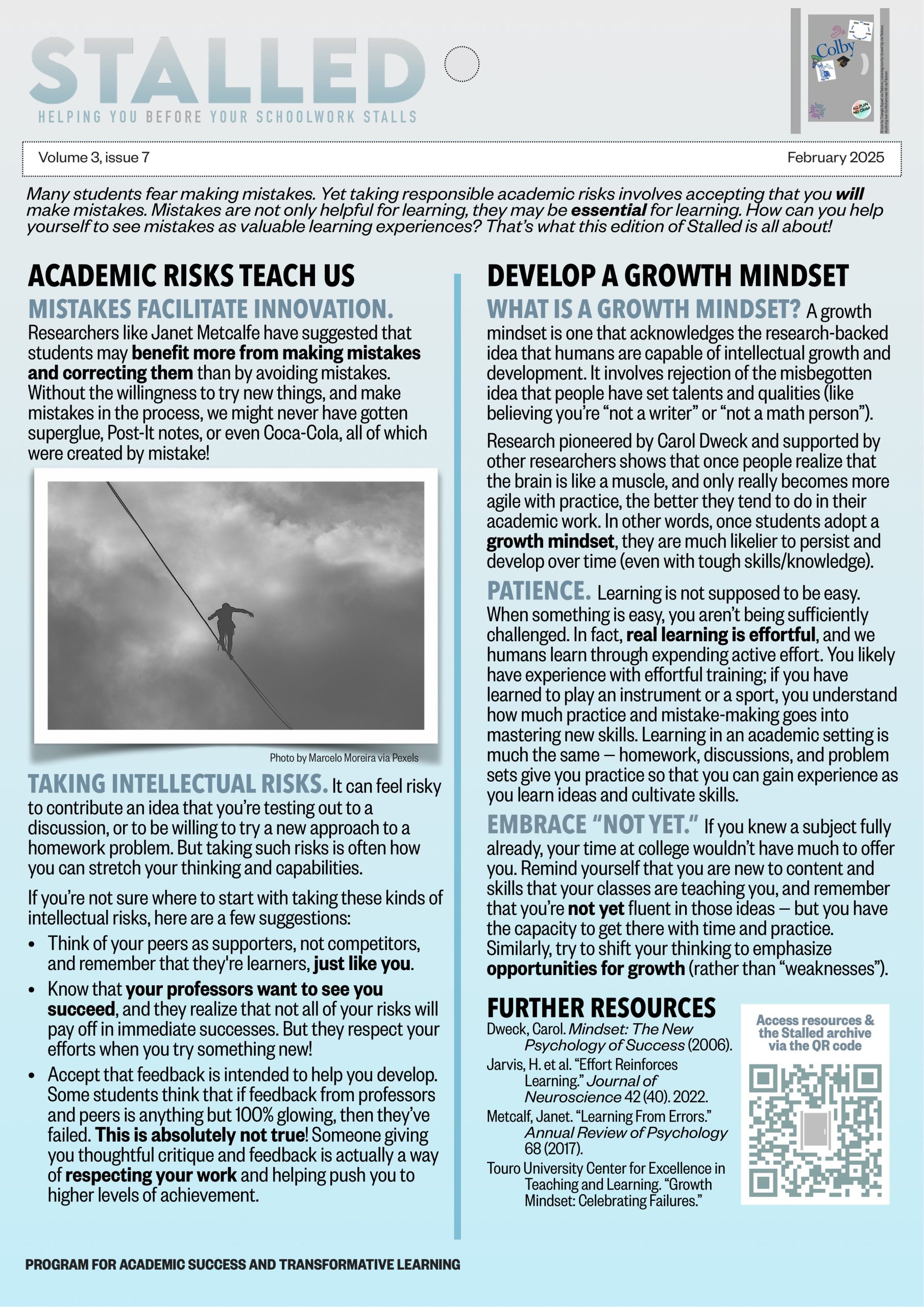
MISTAKES FACILITATE INNOVATION. Researchers like Janet Metcalfe have suggested that students may benefit more from making mistakes and correcting them than by avoiding mistakes. Without the willingness to try new things, and make mistakes in the process, we might never have gotten superglue, Post-It notes, or even Coca-Cola, all of which were created by mistake!
TAKING INTELLECTUAL RISKS. It can feel risky to contribute an idea that you’re testing out to a discussion, or to be willing to try a new approach to a homework problem. But taking such risks is often how you can stretch your thinking and capabilities.
If you’re not sure where to start with taking these kinds of intellectual risks, here are a few suggestions:
- Think of your peers as supporters, not competitors, and remember that they’re learners, just like you.
- Know that your professors want to see you succeed, and they realize that not all of your risks will pay off in immediate successes. But they respect your efforts when you try something new!
- Accept that feedback is intended to help you develop. Some students think that if feedback from professors and peers is anything but 100% glowing, then they’ve failed. This is absolutely not true! Someone giving you thoughtful critique and feedback is actually a way of respecting your work and helping push you to higher levels of achievement.
DEVELOP A GROWTH MINDSET
WHAT IS A GROWTH MINDSET? A growth mindset is one that acknowledges the research-backed idea that humans are capable of intellectual growth and development. It involves rejection of the misbegotten idea that people have set talents and qualities (like believing you’re “not a writer” or “not a math person”).
Research pioneered by Carol Dweck and supported by other researchers shows that once people realize that the brain is like a muscle, and only really becomes more agile with practice, the better they tend to do in their academic work. In other words, once students adopt a growth mindset, they are much likelier to persist and develop over time (even with tough skills/knowledge).
PATIENCE. Learning is not supposed to be easy. When something is easy, you aren’t being sufficiently challenged. In fact, real learning is effortful, and we humans learn through expending active effort. You likely have experience with effortful training; if you have learned to play an instrument or a sport, you understand how much practice and mistake-making goes into mastering new skills. Learning in an academic setting is much the same — homework, discussions, and problem sets give you practice so that you can gain experience as you learn ideas and cultivate skills.
EMBRACE “NOT YET.” If you knew a subject fully already, your time at college wouldn’t have much to offer you. Remind yourself that you are new to content and skills that your classes are teaching you, and remember that you’re not yet fluent in those ideas — but you have the capacity to get there with time and practice. Similarly, try to shift your thinking to emphasize opportunities for growth (rather than “weaknesses”).
FURTHER RESOURCES
Dweck, Carol. Mindset: The New Psychology of Success (2006).
Jarvis, H. et al. “Effort Reinforces Learning.” Journal of Neuroscience 42 (40). 2022.
Metcalf, Janet. “Learning From Errors.” Annual Review of Psychology 68 (2017).
Touro University Center for Excellence in Teaching and Learning. “Growth Mindset: Celebrating Failures.”