Helping you before your schoolwork stalls

Category: metacognition

Academic risk-taking (3.7)

Many students fear making mistakes. Yet taking responsible academic risks involves accepting that you will make mistakes. Mistakes are not only helpful for learning, they may be essential for learning. How can you help yourself to see mistakes as valuable learning experiences? That’s what this edition of Stalled is all about!
ACADEMIC RISKS TEACH US

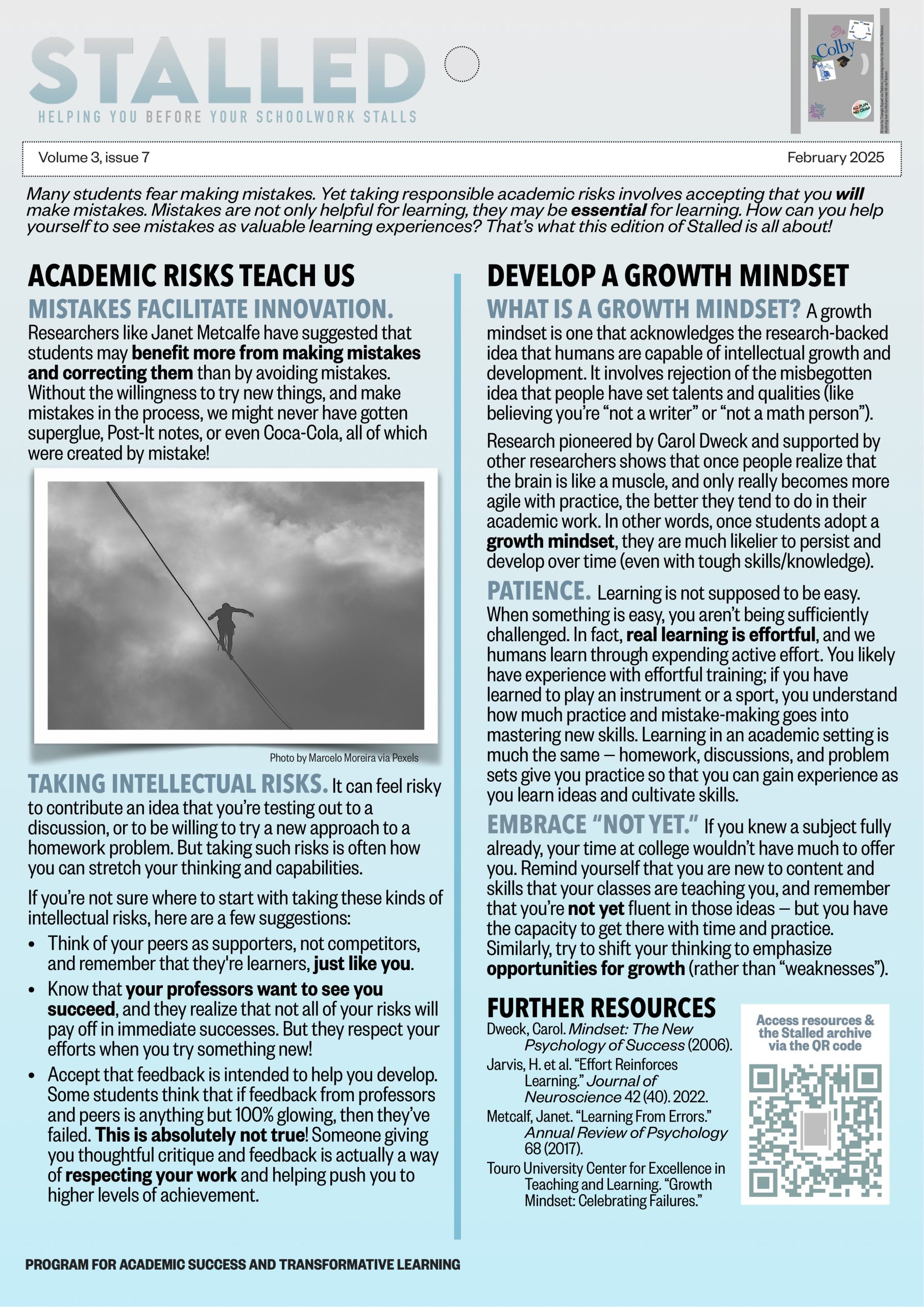
MISTAKES FACILITATE INNOVATION. Researchers like Janet Metcalfe have suggested that students may benefit more from making mistakes and correcting them than by avoiding mistakes. Without the willingness to try new things, and make mistakes in the process, we might never have gotten superglue, Post-It notes, or even Coca-Cola, all of which were created by mistake! 

TAKING INTELLECTUAL RISKS. It can feel risky to contribute an idea that you’re testing out to a discussion, or to be willing to try a new approach to a homework problem. But taking such risks is often how you can stretch your thinking and capabilities. 

If you’re not sure where to start with taking these kinds of intellectual risks, here are a few suggestions:

  • Think of your peers as supporters, not competitors, and remember that they’re learners, just like you.
  • Know that your professors want to see you succeed, and they realize that not all of your risks will pay off in immediate successes. But they respect your efforts when you try something new!
  • Accept that feedback is intended to help you develop. Some students think that if feedback from professors and peers is anything but 100% glowing, then they’ve failed. This is absolutely not true! Someone giving you thoughtful critique and feedback is actually a way of respecting your work and helping push you to higher levels of achievement.

DEVELOP A GROWTH MINDSET

WHAT IS A GROWTH MINDSET? A growth mindset is one that acknowledges the research-backed idea that humans are capable of intellectual growth and development. It involves rejection of the misbegotten idea that people have set talents and qualities (like believing you’re “not a writer” or “not a math person”). 

Research pioneered by Carol Dweck and supported by other researchers shows that once people realize that the brain is like a muscle, and only really becomes more agile with practice, the better they tend to do in their academic work. In other words, once students adopt a growth mindset, they are much likelier to persist and develop over time (even with tough skills/knowledge).

PATIENCE. Learning is not supposed to be easy. When something is easy, you aren’t being sufficiently challenged. In fact, real learning is effortful, and we humans learn through expending active effort. You likely have experience with effortful training; if you have learned to play an instrument or a sport, you understand how much practice and mistake-making goes into mastering new skills. Learning in an academic setting is much the same — homework, discussions, and problem sets give you practice so that you can gain experience as you learn ideas and cultivate skills.

EMBRACE “NOT YET.” If you knew a subject fully already, your time at college wouldn’t have much to offer you. Remind yourself that you are new to content and skills that your classes are teaching you, and remember that you’re not yet fluent in those ideas — but you have the capacity to get there with time and practice. Similarly, try to shift your thinking to emphasize opportunities for growth (rather than “weaknesses”).

FURTHER RESOURCES 

Dweck, Carol. Mindset: The New Psychology of Success (2006).

Jarvis, H. et al. “Effort Reinforces Learning.” Journal of Neuroscience 42 (40). 2022.

Metcalf, Janet. “Learning From Errors.” Annual Review of Psychology 68 (2017).

Touro University Center for Excellence in Teaching and Learning. “Growth Mindset: Celebrating Failures.”
Active listening (3.5)

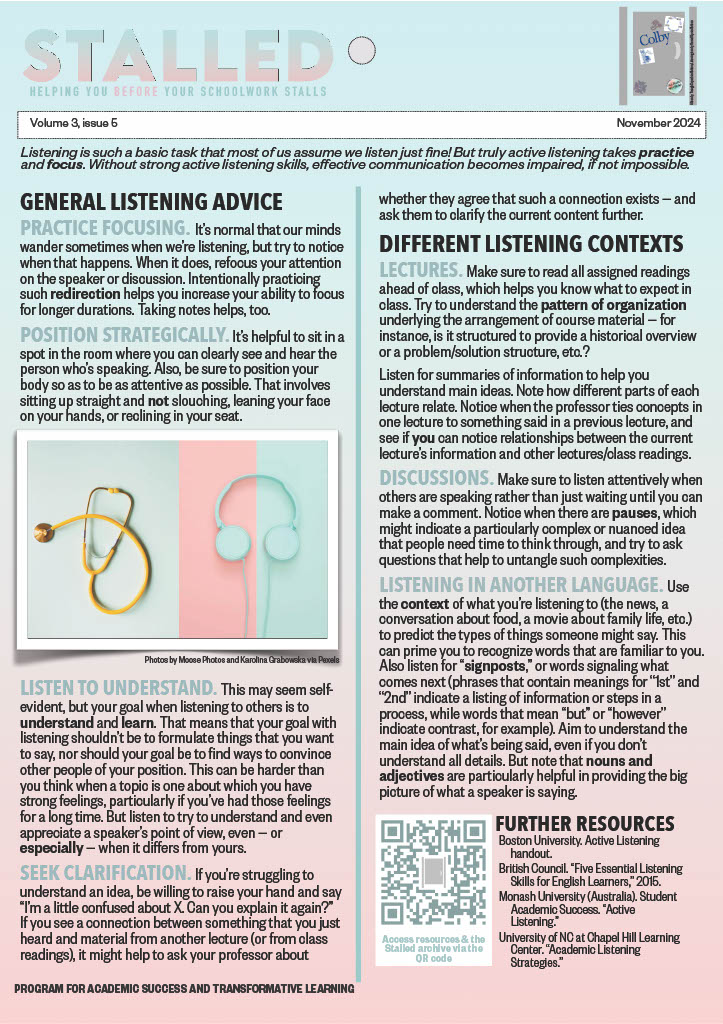
Listening is such a basic task that most of us assume we listen just fine! But truly active listening takes practice and focus. Without strong active listening skills, effective communication becomes impaired, if not impossible.

GENERAL LISTENING ADVICE

PRACTICE FOCUSING. It’s normal that our minds wander sometimes when we’re listening, but try to notice when that happens. When it does, refocus your attention on the speaker or discussion. Intentionally practicing such redirection helps you increase your ability to focus for longer durations. Taking notes helps, too. 

POSITION STRATEGICALLY. It’s helpful to sit in a spot in the room where you can clearly see and hear the person who’s speaking. Also, be sure to position your body so as to be as attentive as possible. That involves sitting up straight and not slouching, leaning your face on your hands, or reclining in your seat.

LISTEN TO UNDERSTAND. This may seem self-evident, but your goal when listening to others is to understand and learn. That means that your goal with listening shouldn’t be to formulate things that you want to say, nor should your goal be to find ways to convince other people of your position. This can be harder than you think when a topic is one about which you have strong feelings, particularly if you’ve had those feelings for a long time. But listen to try to understand and even appreciate a speaker’s point of view, even — or especially — when it differs from yours.

SEEK CLARIFICATION. If you’re struggling to understand an idea, be willing to raise your hand and say “I’m a little confused about X. Can you explain it again?”  If you see a connection between something that you just heard and material from another lecture (or from class readings), it might help to ask your professor about whether they agree that such a connection exists — and ask them to clarify the current content further.

DIFFERENT LISTENING CONTEXTS

LECTURES. Make sure to read all assigned readings ahead of class, which helps you know what to expect in class. Try to understand the pattern of organization underlying the arrangement of course material — for instance, is it structured to provide a historical overview or a problem/solution structure, etc.? 

Listen for summaries of information to help you understand main ideas. Note how different parts of each lecture relate. Notice when the professor ties concepts in one lecture to something said in a previous lecture, and see if you can notice relationships between the current lecture’s information and other lectures/class readings.

DISCUSSIONS. Make sure to listen attentively when others are speaking rather than just waiting until you can make a comment. Notice when there are pauses, which might indicate a particularly complex or nuanced idea that people need time to think through, and try to ask questions that help to untangle such complexities.

LISTENING IN ANOTHER LANGUAGE. Use the context of what you’re listening to (the news, a conversation about food, a movie about family life, etc.) to predict the types of things someone might say. This can prime you to recognize words that are familiar to you. Also listen for “signposts,” or words signaling what comes next (phrases that contain meanings for “1st” and “2nd” indicate a listing of information or steps in a process, while words that mean “but” or “however” indicate contrast, for example). Aim to understand the main idea of what’s being said, even if you don’t understand all details. But note that nouns and adjectives are particularly helpful in providing the big picture of what a speaker is saying. 

FURTHER RESOURCES 

Boston University. Active Listening handout.

British Council. “Five Essential Listening Skills for English Learners,” 2015.

Monash University (Australia). Student Academic Success. “Active Listening.”

University of NC at Chapel Hill Learning Center. “Academic Listening Strategies

Structured Study Sessions (3.4)

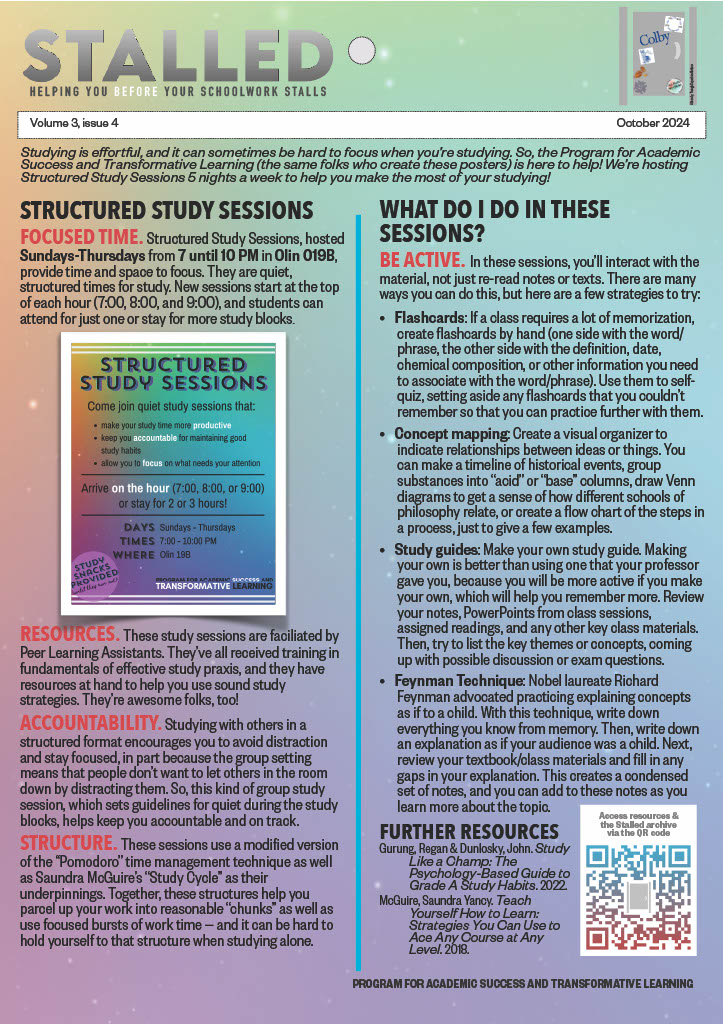
Studying is effortful, and it can sometimes be hard to focus when you’re studying. So, the Program for Academic Success and Transformative Learning (the same folks who create these posters) is here to help! We’re hosting Structured Study Sessions 5 nights a week to help you make the most of your studying!

INTENSE STUDY SESSIONS

FOCUSED TIME. Structured Study Sessions, hosted Sundays-Thursdays from 7 until 10 PM in Olin 019B, provide time and space to focus. They are quiet, structured times for study. New sessions start at the top of each hour (7:00, 8:00, and 9:00), and students can attend for just one or stay for more study blocks.

RESOURCES. These study sessions are faciliated by Peer Learning Assistants. They’ve all received training in fundamentals of effective study praxis, and they have resources at hand to help you use sound study strategies. They’re awesome folks, too!

ACCOUNTABILITY. Studying with others in a structured format encourages you to avoid distraction and stay focused, in part because the group setting means that people don’t want to let others in the room down by distracting them. So, this kind of group study session, which sets guidelines for quiet during the study blocks, helps keep you accountable on better on track.

STRUCTURE. These sessions use a modified version of the “Pomodoro” time management technique as well as Saundra McGuire’s “Study Cycle” as their underpinnings. Together, these structures help you parcel up your work into reasonable “chunks” as well as use focused bursts of work time — and it can be hard to hold yourself to that structure when studying alone.

WHAT DO I DO IN THESE SESSIONS?

BE ACTIVE. In these sessions, you’ll interact with the material, not just re-read notes or texts. There are many ways you can do this, but here are a few strategies to try:

  • Flashcards: If a class requires a lot of memorization, create flashcards by hand (one side with the word/phrase, the other side with the definition, date, chemical composition, or other information you need to associate with the word/phrase). Use them to self-quiz, setting aside any flashcards that you couldn’t remember so that you can practice further with them.
  • Concept mapping: Create a visual organizer to indicate relationships between ideas or things. You can make a timeline of historical events, group substances into “acid” or “base” columns, draw Venn diagrams to get a sense of how different schools of philosophy relate, or create a flow chart of the steps in a process, just to give a few examples.
  • Study guides: Make your own study guide. Making your own is better than using one that your professor gave you, because you will be more active if you make your own, which will help you remember more. Review your notes, PowerPoints from class sessions, assigned readings, and any other key class materials. Then, try to list the key themes or concepts, coming up with possible discussion or exam questions.
  • Feynman Technique: Nobel laureate Richard Feynman advocated practicing explaining concepts as if to a child. With this technique, write down everything you know from memory. Then, write down an explanation as if your audience was a child. Next, review your textbook/class materials and fill in any gaps in your explanation. This creates a condensed set of notes, and you can add to these notes as you learn more about the topic.

FURTHER RESOURCES 

Gurung, Regan & Dunlosky, John. Study Like a Champ: The Psychology-Based Guide to Grade A Study Habits. 2022.

McGuire, Saundra Yancy. Teach Yourself How to Learn: Strategies You Can Use to Ace Any Course at Any Level. 2018.

Academic integrity violations (2.9)

We’ve all heard that academic integrity is something respected and valued at Colby. But what kinds of things violate academic integrity? And what should you do to uphold academic integrity? Read on to learn more.

WHAT’S ACADEMIC INTEGRITY?

NEGLIGENCE vs. DISHONESTY. Academic negligence is a minor unintentional slip-up in academic ethical behavior even though the student should have known better. Colby students should not receive more than one report of academic negligence. 

Academic dishonesty is a significant ethical violation, characterized by willful transgression against academic integrity.  A finding of academic dishonesty results in up to an F in a course (for a 1st report) and a letter in the student’s disciplinary file for 6 years after leaving Colby. But expulsion from the College can result, as well.

SOME INTEGRITY VIOLATIONS. This list is not exhaustive, but is instead intended to help show the range of behaviors that are violations against academic integrity. So, avoid the following:

  • Submitting someone else’s work as your own (including work done by classmates/aquaintances/family members, published material, or material found on the internet)
  • Submitting AI-produced work as your own, and/or not citing AI-generated material even when such material is allowed in assignments
  • Plagiarizing in any way
  • Creating work to be submitted by someone else as their own
  • Giving or receiving answers during an exam or quiz
  • Using unauthorized notes  or materials on an exam or quiz
  • Looking at someone else’s work during an exam or quiz (with or without their knowledge)
  • Obtaining or sharing an unauthorized copy of a test in advance of its scheduled dissemination
  • Using tech inappropriately during assessments or tests, including (but not limited to) accessing Moodle
  • Working with another student/students on an assignment when that is not expressly allowed
  • Stealing or destroying the work of other students
  • Stealing ideas from other students and presenting them as your own
  • Falsifying or fabricating data, references, or citations
  • Turning in work created for another class (unless the professor of the current class explicitly says this is OK)
  • Misrepresenting facts to faculty or administrators
  • Including into an assignment any material that you did not create without citing its source—including not only text but also images, tables, and figures

WHAT YOU SHOULD DO

WHEN IN DOUBT, FIND OUT. Different courses have different guidelines, so it’s imperative to take a good look at the syllabus for each of your courses so that you’ll know what is and isn’t allowed. Also be sure to check assignment instructions, since some professors may have different rules for each assignment.

If you’re still unsure, talk to your professor, either by asking questions in class or by going to their office hours. Also, view the video tutorial/tests from Indiana University linked to the digital version of this poster (via the QR code) to check your plagiarism knowledge. 

REMEMBER WHAT’S IMPORTANT. Most students who are tempted to transgress against academic integrity are worried about their grades. So it’s worthwhile to remember that the consequences for dishonesty are far worse than just a bad grade on an exam or project. Planning ahead and keeping in mind that faculty design courses and assignments to prepare you for post-Colby life will help remove that temptation.

FURTHER RESOURCES 

Colby College . “Academic Integrity.”

Colby College Library Guides. Avoiding Plagiarism: Academic Honesty. Colby College Student Handbook. “Academic Integrity.”

Durranit, Anayat. “What International Students Should Know About Academic Integrity.” US News and World Report (2023).

Indiana University. “How to Recognize Plagiarism: Tutorials and Tests

Exam wrappers & feedback analysis (2.4)

You can use grades and feedback on assignments to identify strengths and areas of opportunity. Performing an “exam wrapper” or “feedback analysis” activity helps you strategize how to facilitate successful learning. Access your own copy of a template to complete these activities through the QR code at the bottom of this poster.

“EXAM WRAPPER” STEPS

RATIONALE. What was the goal of the module or part of class covered by the exam? The course’s learning objectives (on the syllabus) can give you insight into what your professor wants you to learn in class. In turn, that can help you organize your future studying. 

REFLECTION. Examine your own studying habits leading up to the exam. This can allow you to identify successful study strategies as well as to find (and replace) strategies that were not successful for you.

COMPARISON. Using the graded/feedbacked version of your exam, identify the areas where you were less successful. Are they similar kinds of problems, do they come from the same chapter of the textbook, or is there some other pattern to them? If there is a pattern, this can help you identify areas to practice. If there is no discernable pattern, then examining your study practices can help you find alternate practices going forward.

ADJUSTMENT. Given your above analysis of your exam results, what steps will you take to improve your learning in future exams/assignments?

CONSULT YOUR PROFESSOR

LISTEN. If your professor talks about the exam results in class, note any areas that they see as needing improvement. Were there particular questions/problems that many people found difficult? Pay attention to what the prof says to help students improve. 

ASK. After analyzing your exam performance and study approach, if you still aren’t sure why your exam was less successful than you expected, visit your professor in their office hours. Show them your exam wrapper work, and ask for help in understanding what next steps would be likeliest to lead to improved learning. 

FEEDBACK ANALYSIS STEPS 

PREPARE. It can be daunting to receive feedback, so before you read your feedback, remind yourself that your professor is trying to help learn as much as possible. So prepare for reading the feedback by reminding yourself that the feedback is constructive, and is about your assignment, not about you as a person. 

SCAN. Read all of the feedback quickly, without lingering on any comment. What stands out? 

ANALYZE. Do particular errors repeat (missing topic sentences, problems with sources, etc.)? Do some text/assignment areas have more issues than others?

PRIORITIZE. Rather than address all feedback completely, prioritize what you will improve upon in future work. Either start with the most important feedback, or start with the bigger, more “global” concerns, prioritizing 2-3 areas of focus so that you don’t diffuse your efforts too much.

REFLECT. What can you do in future assignments to increase your skills? If you find yourself struggling to identify beneficial areas of focus, talk to your professor in their office hours (bring your feedbacked assignment and your feedback analysis with you).

FURTHER RESOURCES 

Lovett, Marsha C. “Make Exams Worth More Than the Grade: Using Exam Wrappers to Promote Metacognition.” In Kaplan, M., Silver, N, Lavaque-Manty, D., & Meizlish, D.’s Using Reflection and Metacognition to Improve Student Learning. Stylus Publishing: Sterling, VA, 2013, 18-52.

University of Denver Office of Teaching & Learning. “Assignment/Exam Wrappers.”

Access your own copy of a tool for guiding you through your own “exam wrapper” or feedback analysis via the poster’s QR code.

© 2026 Stalled

Theme by Anders Noren — Up ↑