Helping you before your schoolwork stalls

Category: studying (Page 1 of 2)

Reading for class (5.1)

Why do professors tell you to read before class when they spend class time lecturing about what you’re supposed to read? And why might you need to read after some class periods? It turns out that reading before class or after class makes a difference on your academic success— read on to find out why.
HOW TO APPROACH CLASS READINGS

KNOW THE PURPOSE. Why did the professor assign this specific reading? Are you adding to your knowledge base? Taking a deep dive into a topic? Experiencing a range of opinions on a contested idea? Is there some other reason? Knowing why you’re reading helps you understand how to approach a text. 

Once you have a handle on the purpose, read strategically. The suggestions below may initially seem like they’ll take more time, but because they help you avoid the read, re-read, and re-read some more approach, they will actually save you time. 

STEM READING STRATEGY. For most STEM reading, as well as a lot of social science reading, the “STREAM” approach will help you get the most out of texts. Survey or skim the entire text, paying attention to headings, highlighted information, and bolded words. Think of 2 or more questions that you expect the reading to answer. Read the first paragraph. Explain that first paragraph to yourself in your own words. Annotate the text, adding a summary of the paragraph (and any questions you have). Move on, reading the next paragraph and repeating the read-annotate sequence until you’re done with the text.

ARTS & HUMANITIES READING STRATEGIES. Approach these texts differently from STEM class texts.  For non-fiction, read the abstract or introduction first, identify the main argument and evidence that will support that claim, and make note of those items. Identify connections between this and other texts you’ve read for class, such as does this text oppose previous claims, support what you’ve already read, or add complexities to earlier readings?  If you’re reading theory or philosophy, these are often “lenses” through which you can see events or ideas in different ways, so think about how they help you have a new perspective. Make note of questions you have — and yes, your professors expect you to have lots of questions.

If you’re reading fiction, who created it, under what conditions, and what were the prevailing ideas/historical occurrences when it was written? To what genre does it belong, and what do you know about that genre? Which characters seem to express or embody “big ideas,” and what are those ideas?  If the professor provides focus passages, think about why those passages could be important, and come to class with some ideas about their impact. If your prof doesn’t, select some passages that you think express ideas that are key themes of the text.

WHEN SHOULD YOU READ FOR CLASS?

READ BEFORE CLASS. Pre-lecture preparedness is related to better exam grades, research shows. What does that mean? Students who read what’s assigned before a professor lectures on the topic understand the lecture better and more deeply. Those students are more able to retain and build on their knowledge and therefore performed better on exams.

READ AFTER CLASS. Reading after class lets you clarify confusing points from that day’s lecture material while it’s still fresh in your mind. Reading after class also helps you answer specific questions (including any that your professor raised in class) and lets you synthesize your lecture notesknowing what your professor emphasized. Further, post-class reading allows you to challenge yourself with practice questions in your textbook and rewrite concepts in your words to solidify your knowledge base, thus helping to make learning “stick.”

WHICH IS BEST? There is no universal answer to whether pre-reading or post-reading is best — this depends not just on the class material, but also on how your professor arranges their course. If your course syllabus or your professor indicates that you should read before or after class, follow that instruction. If you don’t see any advice, ask your professor which is best. 

FURTHER RESOURCES 

McGuire, Saundra Yancy and Stephanie McGuire. Teach Yourself to Learn: Strategies You Can Use to Ace Any Course at Any Level. Routledge, 2018.

“STREAM” Reading,” Point Loma Nazarene Library Guide on Metacognition: Effective Reading, Learning, & Studying.

Sutherland, John. How to Read a Novel: A User’s Guide. St. Martin’s Press, 2006.

UC Berkeley, “Critical Reading in the Humanities.”

University of Rochester’s Learning Center. “Mastering Your Classes: The Art of Pre-Reading and Post-Reading.”

FACULTY FAUCET

Consider providing material that will show students how and why they’re reading an assigned text. Particularly in introductory classes, focus passages and reading guides can help reinforce the reading habits you want students to cultivate. Further, in line with the upper part of this poster, help your students understand why they should read before class or after class in your course.

  • Focus passages. Providing a few passages that encapsulate key ideas of a text can help frame students’ thinking about a reading. Further, doing so can help indicate main ideas that then guide students’ reading of supporting points.  
  • Reading guides. These can take many forms, including discussion questions, communal lists of new vocabulary, and/or instructions from you about how to approach each text. For your own copy of the CTL’s activity on “Developing Reading Assignments,” click this link (note: Google will prompt you to make your own copy of this document).

For more ideas, also see DePaul University’s “Building on Course Readings.”
Breaking down projects (4.9)

When you’re assigned a project, it can sometimes feel overwhelming. One way to lessen that feeling is to break down what you need to do into manageable pieces. This poster gives you some guidance on how to do just that.

HOW TO BREAK DOWN PROJECTS

IDENTIFY KEY DATES. Look at all project due dates. Is there a rough draft or work-in-progress due date? If so, you’ll need to plan to have as full a draft of your project as possible by that date. If there is not a rough draft/work-in-progress date, then work backwards from the final project’s due date. You’ll want to finish your draft with enough time to fact-check, edit, proofread, and check that you have completed all expected aspects of the project task. Or, if it’s a presentation, you’ll need plenty of time to practice.

THINK ABOUT THE STEPS. Think about all pieces of the task, brainstorming all steps that you can think of. Make sure to consult the assignment instructions, if your instructor has provided any, because that can help you identify the steps you need to complete.

These steps can include meeting with a librarian, conducting research (which most likely takes several sessions), assembling data, outlining a report or essay, creating visuals, writing part of a text (thinking about which parts should be written first), meeting with your group (if it’s a group project), and checking the formatting of a text or object that you produce.

BE REALLY SPECIFIC. When you look at your task list, have you been clear about what you have to do with each step? If you’ve used vague terms like “work on” something, or “do” something, that’s a sign that you might not have really clarified what those steps are. If you aren’t clear in your step identification, you might struggle later to complete the tasks. 

So, if you find that you can’t clearly articulate what each task entails, visit your professor’s office hours as soon as you can so that you can acheive clarity about what you need to do with each step of the project. 

ORDER THE STEPS. Some tasks must be done before other tasks, and sometimes it’s quite clear which should come first. Those tasks are relatively easy to put in order.  

However, some tasks might not be put in order so easily. If you’re struggling to figure out task order, talk to your professor as soon as you can — their office hours are ideal for this — so that you can put the steps in good order.

SCHEDULE YOUR STEPS

ESTIMATE TIME PER STEP. How long will it take to complete each task or step? Give your estimations some careful thought, and factor in at least a bit more time for each task than you think you’d need, just to be safe.

REALLY BREAK IT DOWN. If your time estimation for a task is longer than about an hour, think critically about whether you need to break that task down further. Remember, you’ll need to complete these tasks in the time between your classes, in the evenings, and on weekends. So, you need to be realistic about how long you truly have to complete each task.

“CHUNK” THE STEPS. Will some of the steps be easier to complete if you finish them close in time to each other? If so, indicate to yourself which tasks relate to each other and schedule time to do them together. Also, can some separate tasks be done at the same time? For instance, if you’re preparing a presentation, you might be able to perform some preliminary research while you also search for images for your presentation slides. 

KEEP TO THE SCHEDULE. Working backward from the rough draft due date (or, if there is none, the final due date), you already scheduled the tasks. Keep to these deadlines as closely as you can to spread out the work effectively, and keep the project’s quality as strong as possible.

FURTHER RESOURCES 

Bowdoin College Baldwin Center for Learning and Teaching. “Breaking Down Large Projects into Manageable Tasks.”

Fort Hays State University. “Breaking Down Big Assignments and Making a Study Plan.” 

University of Massachusetts, Dartmouth. “Breaking Down Long Term Assignments.”

FACULTY FAUCET

Students will get a better grasp on project planning if you provide them with a clear set of expectations. Consider these aspects: 

  • First years may need more explicit guidance. Setting clear milestones will help reinforce to less experienced students how to section a project into smaller, more manageable pieces.  
  • More senior students can benefit from practicing this skill themselves. In higher-level courses, students might gain deeper insight into project scheduling if you ask them to submit their own project schedule plan, offering suggestions if/as needed.
  • Build in time for formative feedback. Having students submit a project draft (or perform a run-through of a talk) allows you to give them feedback before they earn a grade. This allows a chance for them to correct misconceptions or re-route a project that’s veering outside of what’s expected.

For more on helping students through project and task management, see NC State University’s “Increasing Student Success Through Effective Task Management.”

Active studying (4.7)

Have you ever spent a lot of time studying but you the material didn’t really stick with you? That often happens when a study technique is passive instead of active. To engage more actively in your studying — and increase your chances of truly retaining information — try these active studying techniques instead!

ACTIVE VS. PASSIVE STUDYING

ACTIVE STUDY LEADS TO LEARNING. Passive studying does not require you to think deeply about course material, whereas active study strategies require deep engagement. As a result, active studying allows for more long-lasting learning and true understanding of concepts. 

For example, a passive strategy is to reread course notes, highlighting information. A more active study strategy would be to summarize key information from your notes by writing it down in the margins, and seeking out the professor for any questions that you have about that material.

Another example is if you’re in a class that assigns problem sets, a passive way of studying is to watch someone else (your professor, your TA) solve a problem. A more active approach is solving the problem yourself.

ACTIVE ENGAGEMENT. When you’re actively engaging with course material, you’re understanding the “how” and “why” as well as the “what.” Active engagement involves making connections to what was said in lecture, and to what class readings include. It also means coming up with your own examples.

READING IS CLASS PREP. Assigned readings are important for transmitting information or, in the case of literary readings, providing essential experiences upon which to build discussions and analysis. So, make sure to do your assigned reading to help prepare you with the knowledge you need to get you ready for class. But note that reading isn’t the same as studying.  

ACTIVE STUDYING TECHNIQUES

CREATE YOUR OWN STUDY GUIDE. Some courses provide study guides, but even in those cases, an excellent way to learn is to create a study guide of your own. Why? Doing so makes you prioritize the key concepts of a course, and formulating your own questions encourages you to write complete answers. In turn, that can clue you in as to where you have knowledge gaps. Creating your own self-quiz is another similarly active studying technique.

BE THE TEACHER. Explain course information out loud as if you were teaching someone the material. The trick here is to speak out loud, because we process information differently when we put ideas into spoken words than if we’re silently thinking. Even if you don’t have anyone to teach for real, pretend that you’re teaching someone (even a stuffed animal can be a stand-in “student”).

MAKE CONCEPT MAPS. Concept maps are just visual representations of information. They include things like timelines, flowcharts, or even circled phrases with arrows to indicate how they connect other ideas. With concept mapping, the key is to focus on how concepts relate to each other.

When making a concept map, start with higher-level concepts and ideas. Then, chunk information by grouping details and examples with those higher-level concepts.

To use concept maps when studying, explain each part of the map you made to yourself, either aloud or in writing. This will make you think more actively about the concepts and how they interrelate.

FURTHER RESOURCES 

University of North Carolina at Chapel Hill. “Studying 101: Studying Smarter, Not Harder.”

University of Pittsburgh Dietrich School of Arts & Sciences. “Active vs. Passive Study.”

FACULTY FAUCET

How can you help students to engage in active studying? One way is to model the kinds of thinking in which you’d like them to engage. That might mean:

  • Showing students how to break down a practice/exam question. Annotate the question, putting it into simplified terms or drawing a visual of it. Encourage students to do the same when they encounter similar questions. 
  • Having students create an example concept map. During class time, put students into small groups to create a concept map of important information. Having a member of each group talk through the map to the whole class can help you see how each group understands course material, and can provide students with practice in concept mapping.

Want more ideas? “5 Ways to Teach Students the Skill of Active Studying” from Edutopia is written by a high school science teacher, but his advice in how to help students study resonates across collegiate students, too. Access that essay via the QR code above.

Spaced practice (4.2)

We get it — a lot of people cram. But did you know that research indicates that cramming does not help you remember information in the long term? Instead, try spaced practice, which helps you remember concepts and information in a more long-lasting way. And it prevents you from engaging in unhealthy all-night cram sessions!

WHAT IS SPACED PRACTICE?

IT SPACES OUT YOUR STUDYING. In a nutshell, spaced practice (some people call it “distributed practice”) is the opposite of cramming. It involves regular, frequent study sessions that expose your brain to the information you need many times over a long period. Cramming (sometimes called “massed practice”) has been shown to lead to poorer retention — which means that you’ll remember material better, and for longer, if you engage in many shorter study sessions that are spaced out over time than you will if you try to study in one big chunk immediately before an exam.

IT REQUIRES PLANNING. Spaced practice works best when you do it regularly. So, if you have a class on Tuesdays and Thursdays, schedule a short study session for that class on each Monday, Wednesday and Friday. You want to review information from each class, but not immediately — remember, the idea is to space out your practice so that you keep ideas and information in your mind. 

How long should you schedule each study session? That depends on the complexity of the material as well as the time that’s available in your schedule. For some classes, regular sessions of 10-15 minutes might be enough.

WHAT IF I FORGET THINGS? You’re human, so you will forget some of what you learn. But with spaced practice, you’ll refresh your memory, giving yourself repeated exposure to course information. That will help you in the long term.

HOW DOES SPACED PRACTICE WORK?

THINK OF LEARNING A SPORT. If you play basketball, did you learn to shoot baskets by having only one shooting practice session? If you play tennis, did you cultivate a great backhand by only practicing it during one session? Studying is similar — you have to have many practice sessions for the same skill or content to get good at it, and you have to space that practice out rather than do it all at once to build up your ability. 

PRACTICE. Study by self-quizzing, creating concept maps, or otherwise making your study time active. End study sessions with a review of what you’ve covered, and start new study sessions by testing yourself on material that you’ve previously learned.

Remember, “practice” means different things for different courses. It might mean doing more example problems for economics or chemistry classes, but it might mean formulating questions about difficult theoretical texts in an English or philosophy class.

PLAN. Some people like to study in one-hour increments, while others like their practice sessions to last two hours or longer. You may need to experiment with the length of your study sessions to see what works for you — but make sure to build in breaks. Those are good opportunities to move around, stretch, and give yourself a small reward (like time spent with friends, playing video games for 20 minutes, or enjoying a snack).  This helps keep you refreshed.

It will help you to set up regular practice (or study) sessions for each of your courses so that you frequently review the information for each course. That’s what will allow you to feel more confident when taking a test, and what will give you a better starting point for an essay- or report-writing assignment.

FURTHER RESOURCES 

Gurung, Regan A.R. and Dunlosky, John. “Ch. 4: Spacing It Out” in Study Like a Champ: The Psychology-Based Guide to Grade A Study Habits (2022).

University of Arizona, Office of Academic Affairs. “Spaced Practice.”

University of Iowa, Learning at Iowa. “Spaced Practice vs. Massed Practice: Why Cramming Doesn’t Work

FACULTY FAUCET

We know that it’s important to circle back to concepts and ideas repeatedly throughout varying periods of time for effective learning. Consider starting or ending class with:

  • A quick online quiz (try the Poll Everywhere add-on to Google slides, or use Mentimeter)
  • An exit ticket (brief question or task to help you gauge students’ understanding of new material or skills)
  • Simply asking students to recall material or skills covered previously in the course. 

This kind of review is especially important for novice learners who are building their knowledge base, but it helps all students to reinforce their learning. See advice on spaced practice from the University of Arizona (use the QR code to access via the digital version of this poster).

Note-taking strategies (4.1)

Note-taking can be a way for you to process course content. Notes taken in class can also be a tool to help you check your understanding of key information — if you have questions or confusions, record them in your notes, and then use them when attending office hours as a way to organize questions you have for your professor.

IN-CLASS NOTE-TAKING AIDS 

TOOLS. Whether you take notes digitally or by hand, use highlighters to flag key points. Then, using a different color, highlight things that confuse you or about which you need more information. Being consistent (using the same color for “key points” in all your notes) makes it easier to find info later.

If you take notes digitally, familiarize yourself with the highlighting/color tools of your software before using it in class. If you take notes by hand, bring highlighters (ideally of at least 2 colors) to each class session.

JUST ASK! While not writing every word that your prof says is a good start, different classes necessitate different note-taking approaches. Ask your professors — and if you have them, Learning Assistants or Teaching Assistants — about useful strategies for note-taking in each specific course.

NOTE-TAKING METHODS

ALL-PURPOSE NOTES. There’s already been a Stalled poster on the Cornell Method, which is a useful all-purpose note-taking method. Other methods include:

  • Outline method: Taking notes in outline form. This method has you identifying main ideas, supporting points, and examples/details, and indenting the support and examples/details under each main idea.
  • Writing on slides: When your professor provides slides ahead of time, taking notes on (paper or digital copies of) the slides can help you capture details effectively because key ideas are already provided for you.

NOTES FOR SPECIFIC PURPOSES. Some classes require different approaches to notes, including:

  • Duke Method: For classes with lots of dense content, this method provides a structure so as to organize material after class (and thus clarify what you do and don’t know, and give a good summary of what the class covered). This method has you take notes on one page (the left page of a paper notebook) while leaving the next page blank (the right page, if using a paper notebook). If using digital notes, add a blank page after each full page of notes. After class, use the blank page to write a short summary of the material and record questions for future classes, or to bring to office hours.
  • Concept maps: These work well when a topic is dense and has many connections to other ideas or theories covered in the course. Concept maps (also called mind maps) are visual representations of ideas that has a note-taker indicate a complex topic or idea at the center of the page and then draw circles, connected by lines, to subcategories and details. Many corporations and organizations use mind mapping in their project planning, so becoming familiar with this method can help prepare you professionally! See the Stanford University concept map resource in the “Further Resources” section of this poster (access it via the QR code).

SMALLER-SCALE STRATEGIES

DEVELOP YOUR OWN SYMBOLS. Using abbreviations and acronyms helps you take notes more quickly. Also, use symbols and visual indicators consistently. Symbols should be different enough from each other that they are easy to tell apart. For instance, an arrow → can indicate a connection or consequence. Underlining can indicate a term that you don’t know.

ORGANIZE FOR REVIEW. It’s useful to draw a line across the page when a new topic is introduced, or you might draw a box around different topics. You also want to leave room in your notes so that you can add to them later, record questions, and add connections as they occur to you. Adding these kinds of elements to digital notes is easy, and handwritten notes just need you to leave space open for these types of additions.

FURTHER RESOURCES 

Barnard College. “Note-Taking Guide.”

Cornell University. “Cornell Note Taking System.”

Stalled. “ Cornell Method Note Taking.”

Stanford University Center for Teaching & Learning. “Concept Mapping.”

University of Portsmouth. “Helpful Abbreviations for Speedy Note-Taking.”

FACULTY FAUCET

Consider including a section on your syllabus on note-taking, explaining how students should approach note-taking in that specific course. Also: 

  • If you provide slides with detailed information, encourage students to take notes during lectures on information not covered on the slides as well as their response to the information on the slides instead of simply duplicating information. 
  • For a discussion-based course, consider carving out 5 minutes at the end of each class to allow students to capture their thoughts and questions about the classroom conversation into their notes. 

Finally, consider spending time in class or via electronic communication to explain what students should do with their notes when studying for an exam or creating a project. The Cornell Method (see resources above) is a classic note-taking structure that works well for many students!

The Colby Museum (3.10)

The Colby Museum boasts a world-class collection of American art, and offers students a range of opportunities to get involved in the arts. You might visit the museum as part of a class, independently, or as part of a club/other organization, and there are lots of other ways to take advantage of what this unique resource offers, regardless of your major. For more information, email: [email protected]

VISITING THE MUSEUM 

IN A CLASS. Many courses hold a class session in the Museum, during which you’ll learn to look at objects carefully and for a sustained amount of time. But that’s not all you’re expected to do when you visit.

To engage sincerely with the artworks, you’ll also need to be ready to talk. When you visit with a class, don’t expect long lectures. Instead, be ready to discuss the observations, ideas, and impressions that the artworks raise. The Colby Museum of Art is a space of learning, exploration, and engagement. Your active contributions help create connections between the museum collection and Colby College’s curriculum.

OTHER VISITS. Students (and staff and faculty) are always welcome to visit the Colby Museum. What’s more, you’re also welcome to contact the folks who work at the museum if you’d like help with a project or research, whether it’s for a class or whether it’s an independent project that you’re pursuing. 

The Colby Museum of Art is also excited to work with clubs or student organizations through the Campus Collaboration Initiative. 

And did you know that you’re also welcome to use lobby tables to do your homework? Many students appreciate studying in the museum and taking study breaks to appreciate the exhibitions and artwork on display. Since the museum also has a café cart, it’s pretty much a full-service study space!

PROFESSIONAL OPPORTUNITIES

The museum’s professional opportunities are available to students in any major, and have no prerequisites.

COLBY MUSEUM STUDENT BOARD. The Colby Museum or Art celebrates and relies upon student input, and spots are available every year on the museum’s student board. This leadership opportunity allows your voice to shape the developments of the museum, and takes only about 10-15 hours per semester.

WELCOME DESK WORKERS. If you want to hone your skills with customer service, visitor experience, communication, and more, this paid position is ideal. Applications are accepted each year, and the hours can be arranged around your class schedule.

INTERNSHIPS. Museum interns are embedded within one of the departments in the museum (Curatorial, Exhibitions, etc.) during a spring or fall semester. Interns are usually hired in the fall for a full academic year, but some opportunties may be posted in spring semesters.

SUMMER WORKERS. Paid positions are available at the museum over the summer that include on-campus housing. Summer student worker openings include departments like Curatorial, Engagement, Development, and Exhibitions/Publications. The summer program hosts a robust cohort program that provides first-hand insight into museums. It includes field trips to museums around Maine and exposes students to impactful, timely issues pertinent to the art world through a Reading Lab series. 

FURTHER RESOURCES 

Colby Museum of Art.

Colby Museum of Art. Guidelines for Class Visits.

Colby Museum of Art Internship program. 

Colby Museum of Art Welcome Desk Attendant program.

The Teagle Foundation. Teaching and Learning with Museum Exhibitions

Academic risk-taking (3.7)

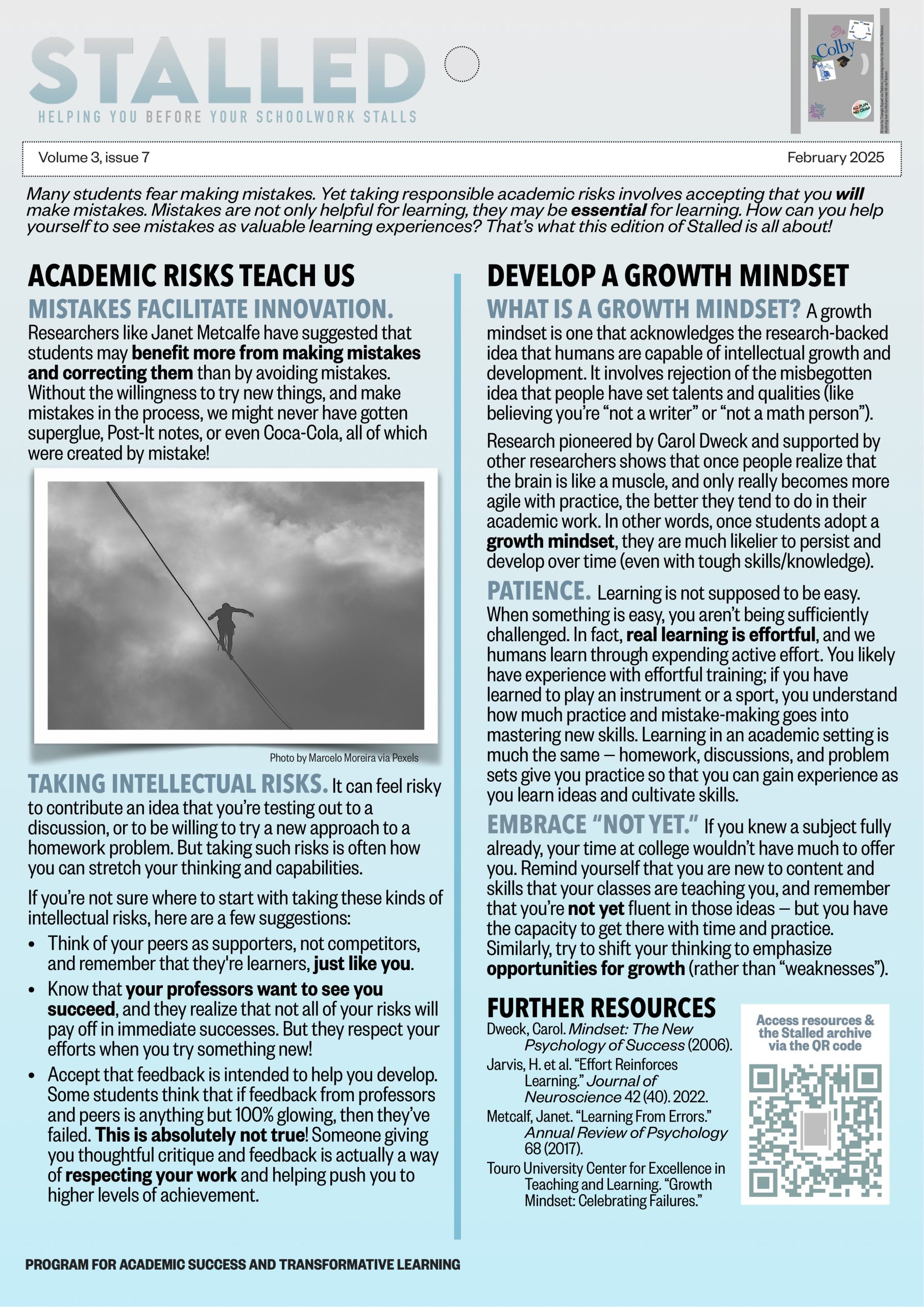
Many students fear making mistakes. Yet taking responsible academic risks involves accepting that you will make mistakes. Mistakes are not only helpful for learning, they may be essential for learning. How can you help yourself to see mistakes as valuable learning experiences? That’s what this edition of Stalled is all about!

ACADEMIC RISKS TEACH US

MISTAKES FACILITATE INNOVATION. Researchers like Janet Metcalfe have suggested that students may benefit more from making mistakes and correcting them than by avoiding mistakes. Without the willingness to try new things, and make mistakes in the process, we might never have gotten superglue, Post-It notes, or even Coca-Cola, all of which were created by mistake! 

TAKING INTELLECTUAL RISKS. It can feel risky to contribute an idea that you’re testing out to a discussion, or to be willing to try a new approach to a homework problem. But taking such risks is often how you can stretch your thinking and capabilities. 

If you’re not sure where to start with taking these kinds of intellectual risks, here are a few suggestions:

  • Think of your peers as supporters, not competitors, and remember that they’re learners, just like you.
  • Know that your professors want to see you succeed, and they realize that not all of your risks will pay off in immediate successes. But they respect your efforts when you try something new!
  • Accept that feedback is intended to help you develop. Some students think that if feedback from professors and peers is anything but 100% glowing, then they’ve failed. This is absolutely not true! Someone giving you thoughtful critique and feedback is actually a way of respecting your work and helping push you to higher levels of achievement.

DEVELOP A GROWTH MINDSET

WHAT IS A GROWTH MINDSET? A growth mindset is one that acknowledges the research-backed idea that humans are capable of intellectual growth and development. It involves rejection of the misbegotten idea that people have set talents and qualities (like believing you’re “not a writer” or “not a math person”). 

Research pioneered by Carol Dweck and supported by other researchers shows that once people realize that the brain is like a muscle, and only really becomes more agile with practice, the better they tend to do in their academic work. In other words, once students adopt a growth mindset, they are much likelier to persist and develop over time (even with tough skills/knowledge).

PATIENCE. Learning is not supposed to be easy. When something is easy, you aren’t being sufficiently challenged. In fact, real learning is effortful, and we humans learn through expending active effort. You likely have experience with effortful training; if you have learned to play an instrument or a sport, you understand how much practice and mistake-making goes into mastering new skills. Learning in an academic setting is much the same — homework, discussions, and problem sets give you practice so that you can gain experience as you learn ideas and cultivate skills.

EMBRACE “NOT YET.” If you knew a subject fully already, your time at college wouldn’t have much to offer you. Remind yourself that you are new to content and skills that your classes are teaching you, and remember that you’re not yet fluent in those ideas — but you have the capacity to get there with time and practice. Similarly, try to shift your thinking to emphasize opportunities for growth (rather than “weaknesses”).

FURTHER RESOURCES 

Dweck, Carol. Mindset: The New Psychology of Success (2006).

Jarvis, H. et al. “Effort Reinforces Learning.” Journal of Neuroscience 42 (40). 2022.

Metcalf, Janet. “Learning From Errors.” Annual Review of Psychology 68 (2017).

Touro University Center for Excellence in Teaching and Learning. “Growth Mindset: Celebrating Failures.”

Structured Study Sessions (3.4)

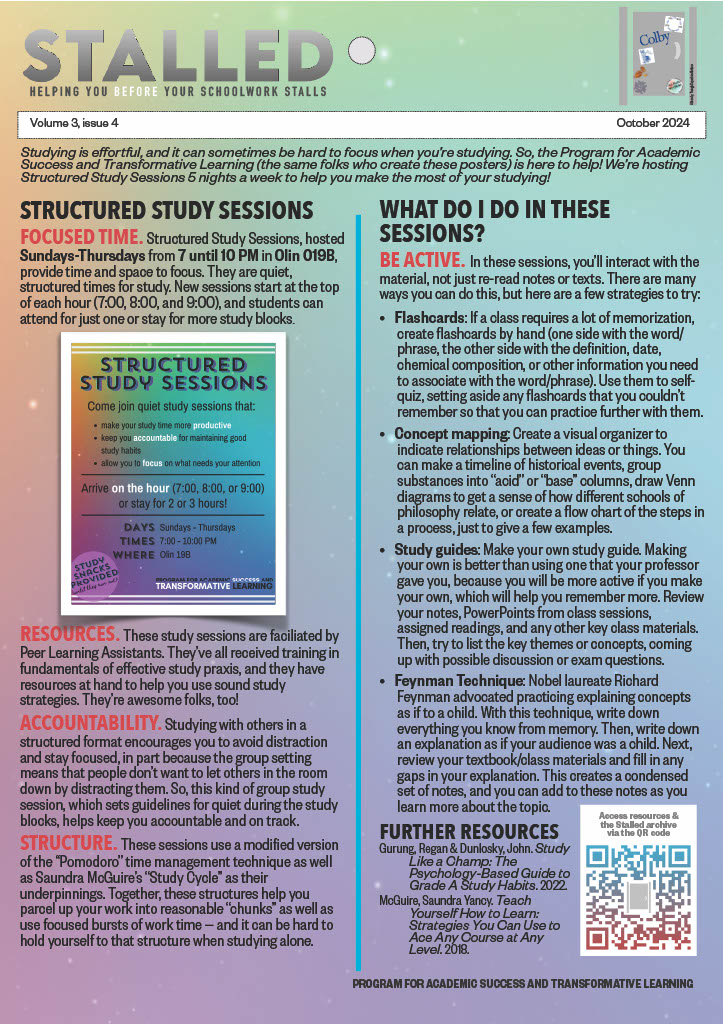
Studying is effortful, and it can sometimes be hard to focus when you’re studying. So, the Program for Academic Success and Transformative Learning (the same folks who create these posters) is here to help! We’re hosting Structured Study Sessions 5 nights a week to help you make the most of your studying!

INTENSE STUDY SESSIONS

FOCUSED TIME. Structured Study Sessions, hosted Sundays-Thursdays from 7 until 10 PM in Olin 019B, provide time and space to focus. They are quiet, structured times for study. New sessions start at the top of each hour (7:00, 8:00, and 9:00), and students can attend for just one or stay for more study blocks.

RESOURCES. These study sessions are faciliated by Peer Learning Assistants. They’ve all received training in fundamentals of effective study praxis, and they have resources at hand to help you use sound study strategies. They’re awesome folks, too!

ACCOUNTABILITY. Studying with others in a structured format encourages you to avoid distraction and stay focused, in part because the group setting means that people don’t want to let others in the room down by distracting them. So, this kind of group study session, which sets guidelines for quiet during the study blocks, helps keep you accountable on better on track.

STRUCTURE. These sessions use a modified version of the “Pomodoro” time management technique as well as Saundra McGuire’s “Study Cycle” as their underpinnings. Together, these structures help you parcel up your work into reasonable “chunks” as well as use focused bursts of work time — and it can be hard to hold yourself to that structure when studying alone.

WHAT DO I DO IN THESE SESSIONS?

BE ACTIVE. In these sessions, you’ll interact with the material, not just re-read notes or texts. There are many ways you can do this, but here are a few strategies to try:

  • Flashcards: If a class requires a lot of memorization, create flashcards by hand (one side with the word/phrase, the other side with the definition, date, chemical composition, or other information you need to associate with the word/phrase). Use them to self-quiz, setting aside any flashcards that you couldn’t remember so that you can practice further with them.
  • Concept mapping: Create a visual organizer to indicate relationships between ideas or things. You can make a timeline of historical events, group substances into “acid” or “base” columns, draw Venn diagrams to get a sense of how different schools of philosophy relate, or create a flow chart of the steps in a process, just to give a few examples.
  • Study guides: Make your own study guide. Making your own is better than using one that your professor gave you, because you will be more active if you make your own, which will help you remember more. Review your notes, PowerPoints from class sessions, assigned readings, and any other key class materials. Then, try to list the key themes or concepts, coming up with possible discussion or exam questions.
  • Feynman Technique: Nobel laureate Richard Feynman advocated practicing explaining concepts as if to a child. With this technique, write down everything you know from memory. Then, write down an explanation as if your audience was a child. Next, review your textbook/class materials and fill in any gaps in your explanation. This creates a condensed set of notes, and you can add to these notes as you learn more about the topic.

FURTHER RESOURCES 

Gurung, Regan & Dunlosky, John. Study Like a Champ: The Psychology-Based Guide to Grade A Study Habits. 2022.

McGuire, Saundra Yancy. Teach Yourself How to Learn: Strategies You Can Use to Ace Any Course at Any Level. 2018.

The Study Cycle (3.2)

You might have good study skills, but did you know that there are researchers who study the science of learning? They recommend regular use of the study cycle, which is described below. Try it to give yourself the best chance for academic success, and build the study cycle into your semester plans!

WHAT IS THE STUDY CYCLE?

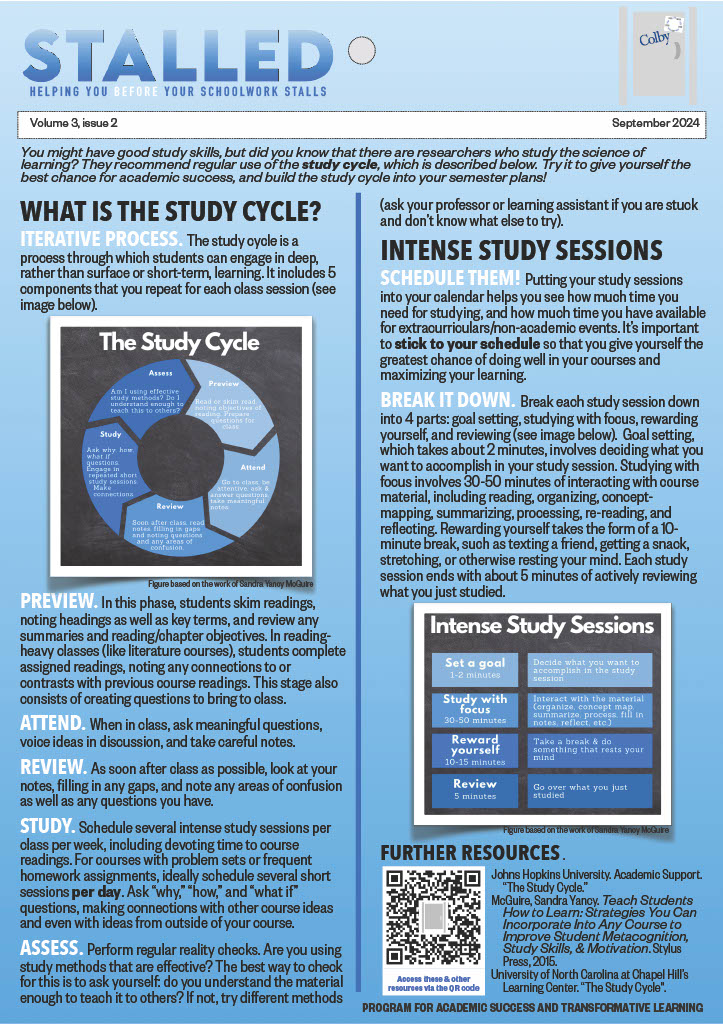
ITERATIVE PROCESS. The study cycle is a process through which students can engage in deep, rather than surface or short-term, learning. It includes 5 components that you repeat for each class session (see image on poster).

PREVIEW. In this phase, students skim readings, noting headings as well as key terms, and review any summaries and reading/chapter objectives. In reading-heavy classes (like literature courses), students complete assigned readings, noting any connections to or contrasts with previous course readings. This stage also consists of creating questions to bring to class.

ATTEND. When in class, ask meaningful questions, voice ideas in discussion, and take careful notes.

REVIEW. As soon after class as possible, look at your notes, filling in any gaps, and note any areas of confusion as well as any questions you have.

STUDY. Schedule several intense study sessions per class per week, including devoting time to course readings. For courses with problem sets or frequent homework assignments, ideally schedule several short sessions per day. Ask “why,” “how,” and “what if” questions, making connections with other course ideas and even with ideas from outside of your course.

ASSESS. Perform regular reality checks. Are you using study methods that are effective? The best way to check for this is to ask yourself: do you understand the material enough to teach it to others? If not, try different methods (ask your professor or learning assistant if you are stuck and don’t know what else to try).

INTENSE STUDY SESSIONS

SCHEDULE THEM! Putting your study sessions into your calendar helps you see how much time you need for studying, and how much time you have available for extracurriculars/non-academic events. It’s important to stick to your schedule so that you give yourself the greatest chance of doing well in your courses and maximizing your learning.

BREAK IT DOWN. Break each study session down into 4 parts: goal setting, studying with focus, rewarding yourself, and reviewing (see image on poster).  Goal setting, which takes about 2 minutes, involves deciding what you want to accomplish in your study session. Studying with focus involves 30-50 minutes of interacting with course material, including reading, organizing, concept-mapping, summarizing, processing, re-reading, and reflecting. Rewarding yourself takes the form of a 10-minute break, such as texting a friend, getting a snack, stretching, or otherwise resting your mind. Each study session ends with about 5 minutes of actively reviewing what you just studied.

FURTHER RESOURCES

Johns Hopkins University. Academic Support.“The Study Cycle.” 

McGuire, Sandra Yancy. Teach Students How to Learn: Strategies You Can Incorporate Into Any Course to Improve Student Metacognition, Study Skills, & Motivation. Stylus Press, 2015.

University of North Carolina at Chapel Hill’s Learning Center. “The Study Cycle“.

How College Differs from High School (3.1)

It’s not always easy to know the differences between high school and college, particularly when you’re new to college — but it can be the case even when you’ve been at college a while. So, here’s information about some key ways that college differs from high school in terms of student responsibilities. Head’s up: you have more responsibility for yourself than most students do in high school!

COLLEGE CLASSWORK

Some of your assumptions about college classes might not be accurate, and it’s important to understand the key ways that classwork in college differs from high school.

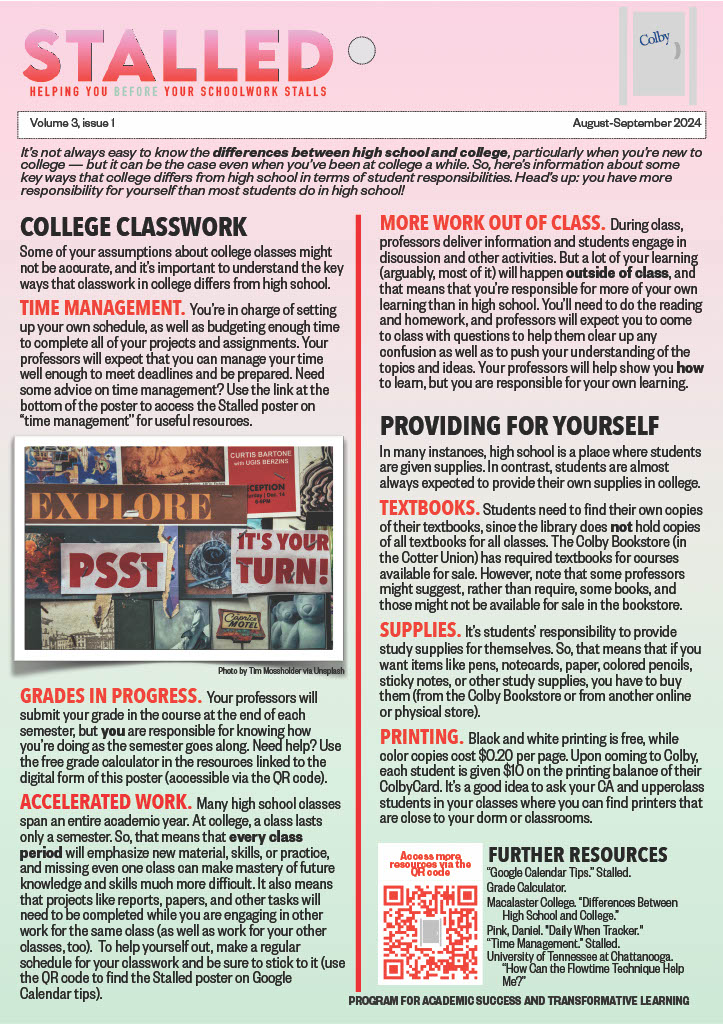
TIME MANAGEMENT. You’re in charge of setting up your own schedule, as well as budgeting enough time to complete all of your projects and assignments. Your professors will expect that you can manage your time well enough to meet deadlines and be prepared. Need some advice on time management? Use the link below to access the Stalled poster on “time management” for useful resources. 

GRADES IN PROGRESS. Your professors will submit your grade in the course at the end of each semester, but you are responsible for knowing how you’re doing as the semester goes along. Need help? Use the free grade calculator in the resources linked to the digital form of this poster (accessible via a link below).

ACCELERATED WORK. Many high school classes span an entire academic year. At college, a class lasts only a semester. So, that means that every class period will emphasize new material, skills, or practice, and missing even one class can make mastery of future knowledge and skills much more difficult. It also means that projects like reports, papers, and other tasks will need to be completed while you are engaging in other work for the same class (as well as work for your other classes, too).  To help yourself out, make a regular schedule for your classwork and be sure to stick to it (use the links below to find the Stalled poster on Google Calendar tips).

MORE WORK OUT OF CLASS. During class, professors deliver information and students engage in discussion and other activities. But a lot of your learning (arguably, most of it) will happen outside of class, and that means that you’re responsible for more of your own learning than in high school. You’ll need to do the reading and homework, and professors will expect you to come to class with questions to help them clear up any confusion as well as to push your understanding of the topics and ideas. Your professors will help show you how to learn, but you are responsible for your own learning.

PROVIDING FOR YOURSELF

In many instances, high school is a place where students are given supplies. In contrast, students are almost always expected to provide their own supplies in college. 

TEXTBOOKS. Students need to find their own copies of their textbooks, since the library does not hold copies of all textbooks for all classes. The Colby Bookstore (in the Cotter Union) has required textbooks for courses available for sale. However, note that some professors might suggest, rather than require, some books, and those might not be available for sale in the bookstore.

SUPPLIES. It’s students’ responsibility to provide study supplies for themselves. So, that means that if you want items like pens, notecards, paper, colored pencils, sticky notes, or other study supplies, you have to buy them (from the Colby Bookstore or from another online or physical store). 

PRINTING. Black and white printing is free, while color copies cost $0.20 per page. Upon coming to Colby, each student is given $10 on the printing balance of their ColbyCard. It’s a good idea to ask your CA and upperclass students in your classes where you can find printers that are close to your dorm or classrooms.

FURTHER RESOURCES 

“Google Calendar Tips.” Stalled.

Grade Calculator.

Macalaster College. “Differences Between High School and College.”

Pink, Daniel. “Daily When Tracker.”

“Time Management.” Stalled.

University of Tennessee at Chattanooga. “How Can the Flowtime Technique Help Me?”

« Older posts

© 2026 Stalled

Theme by Anders Noren — Up ↑