Managing your time helps you fit your work into your schedule while preserving time for healthy pursuits and self care. Different people find different time management techniques helpful, so here are two of the most popular techniques. Try both, and continue using the one that works best for you. Ask friends what technique they use!
POMODORO TECHNIQUE
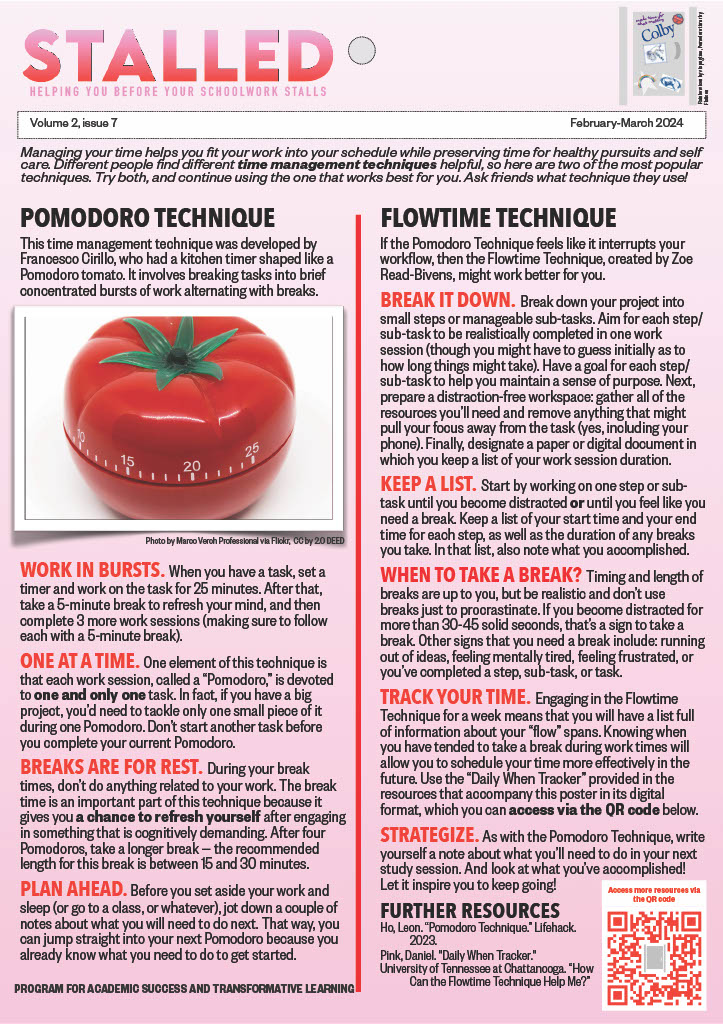
This time management technique was developed by Francesco Cirillo, who had a kitchen timer shaped like a Pomodoro tomato. It involves breaking tasks into brief concentrated bursts of work alternating with breaks.
WORK IN BURSTS.When you have a task, set a timer and work on the task for 25 minutes. After that, take a 5-minute break to refresh your mind, and then complete 3 more work sessions (making sure to follow each with a 5-minute break).
ONE AT A TIME.One element of this technique is that each work session, called a “Pomodoro,” is devoted to one and only one task. In fact, if you have a big project, you’d need to tackle only one small piece of it during one Pomodoro. Don’t start another task before you complete your current Pomodoro.
BREAKS ARE FOR REST.During your break times, don’t do anything related to your work. The break time is an important part of this technique because it gives you a chance to refresh yourself after engaging in something that is cognitively demanding. After four Pomodoros, take a longer break — the recommended length for this break is between 15 and 30 minutes.
PLAN AHEAD. Before you set aside your work and sleep (or go to a class, or whatever), jot down a couple of notes about what you will need to do next. That way, you can jump straight into your next Pomodoro because you already know what you need to do to get started.
FLOWTIME TECHNIQUE
If the Pomodoro Technique feels like it interrupts your workflow, then the Flowtime Technique, created by Zoe Read-Bivens, might work better for you.
BREAK IT DOWN. Break down your project into small steps or manageable sub-tasks. Aim for each step/sub-task to be realistically completed in one work session (though you might have to guess initially as to how long things might take). Have a goal for each step/sub-task to help you maintain a sense of purpose. Next, prepare a distraction-free workspace: gather all of the resources you’ll need and remove anything that might pull your focus away from the task (yes, including your phone). Finally, designate a paper or digital document in which you keep a list of your work session duration.
KEEP A LIST. Start by working on one step or sub-task until you become distracted or until you feel like you need a break. Keep a list of your start time and your end time for each step, as well as the duration of any breaks you take. In that list, also note what you accomplished.
WHEN TO TAKE A BREAK? Timing and length of breaks are up to you, but be realistic and don’t use breaks just to procrastinate. If you become distracted for more than 30-45 solid seconds, that’s a sign to take a break. Other signs that you need a break include: running out of ideas,, feeling mentally tired, feeling frustrated, or you’ve completed a step, sub-task, or task.
TRACK YOUR TIME. Engaging in the Flowtime Technique for a week means that you will have a list full of information about your “flow” spans. Knowing when you have tended to take a break during work times will allow you to schedule your time more effectively in the future. Use the “Daily When Tracker,” which you can access via the link below in the “Further Resources” section.
STRATEGIZE. As with the Pomodoro Technique, write yourself a note about what you’ll need to do in your next study session. And look at what you’ve accomplished! Let it inspire you to keep going!
FURTHER RESOURCES
Ho, Leon. “Pomodoro Technique.” Lifehack. 2023.
Pink, Daniel. “Daily When Tracker.”
University of Tennessee at Chattanooga. “How Can the Flowtime Technique Help Me?“