Have you ever spent a lot of time studying but you the material didn’t really stick with you? That often happens when a study technique is passive instead of active. To engage more actively in your studying — and increase your chances of truly retaining information — try these active studying techniques instead!
ACTIVE VS. PASSIVE STUDYING
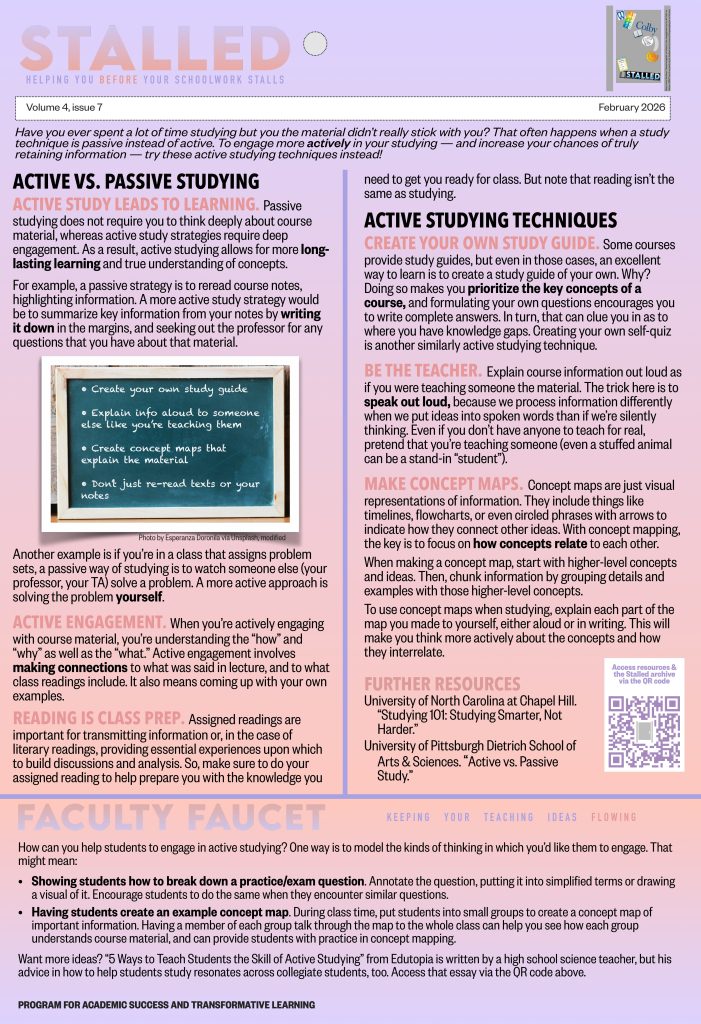
ACTIVE STUDY LEADS TO LEARNING. Passive studying does not require you to think deeply about course material, whereas active study strategies require deep engagement. As a result, active studying allows for more long-lasting learning and true understanding of concepts.
For example, a passive strategy is to reread course notes, highlighting information. A more active study strategy would be to summarize key information from your notes by writing it down in the margins, and seeking out the professor for any questions that you have about that material.
Another example is if you’re in a class that assigns problem sets, a passive way of studying is to watch someone else (your professor, your TA) solve a problem. A more active approach is solving the problem yourself.
ACTIVE ENGAGEMENT. When you’re actively engaging with course material, you’re understanding the “how” and “why” as well as the “what.” Active engagement involves making connections to what was said in lecture, and to what class readings include. It also means coming up with your own examples.
READING IS CLASS PREP. Assigned readings are important for transmitting information or, in the case of literary readings, providing essential experiences upon which to build discussions and analysis. So, make sure to do your assigned reading to help prepare you with the knowledge you need to get you ready for class. But note that reading isn’t the same as studying.
ACTIVE STUDYING TECHNIQUES
CREATE YOUR OWN STUDY GUIDE. Some courses provide study guides, but even in those cases, an excellent way to learn is to create a study guide of your own. Why? Doing so makes you prioritize the key concepts of a course, and formulating your own questions encourages you to write complete answers. In turn, that can clue you in as to where you have knowledge gaps. Creating your own self-quiz is another similarly active studying technique.
BE THE TEACHER. Explain course information out loud as if you were teaching someone the material. The trick here is to speak out loud, because we process information differently when we put ideas into spoken words than if we’re silently thinking. Even if you don’t have anyone to teach for real, pretend that you’re teaching someone (even a stuffed animal can be a stand-in “student”).
MAKE CONCEPT MAPS. Concept maps are just visual representations of information. They include things like timelines, flowcharts, or even circled phrases with arrows to indicate how they connect other ideas. With concept mapping, the key is to focus on how concepts relate to each other.
When making a concept map, start with higher-level concepts and ideas. Then, chunk information by grouping details and examples with those higher-level concepts.
To use concept maps when studying, explain each part of the map you made to yourself, either aloud or in writing. This will make you think more actively about the concepts and how they interrelate.
FURTHER RESOURCES
University of North Carolina at Chapel Hill. “Studying 101: Studying Smarter, Not Harder.”
University of Pittsburgh Dietrich School of Arts & Sciences. “Active vs. Passive Study.”
FACULTY FAUCET
How can you help students to engage in active studying? One way is to model the kinds of thinking in which you’d like them to engage. That might mean:
- Showing students how to break down a practice/exam question. Annotate the question, putting it into simplified terms or drawing a visual of it. Encourage students to do the same when they encounter similar questions.
- Having students create an example concept map. During class time, put students into small groups to create a concept map of important information. Having a member of each group talk through the map to the whole class can help you see how each group understands course material, and can provide students with practice in concept mapping.
Want more ideas? “5 Ways to Teach Students the Skill of Active Studying” from Edutopia is written by a high school science teacher, but his advice in how to help students study resonates across collegiate students, too. Access that essay via the QR code above.