Parce meo , seu quis bona
seu colis umbrosi deuia montis
neu
incolumem custos hunc mihi
Sed procul abducit
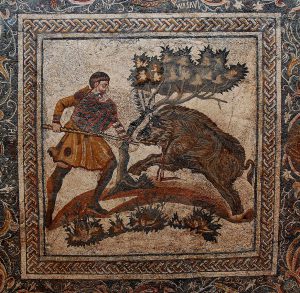
A Roman mosaic of a man hunting a boar (c. 326-400 CE) o
Quis furor est, quae mens, densos indagine colles
claudentem teneras
Quidue iuuat furtim latebras
candidaque hamatis crura notare
Sed tamen, ut tecum
ipsa ego per montes retia torta feram,
ipsa ego uelocis quaeram uestigia cerui
et demam celeri ferrea uincla
Tunc
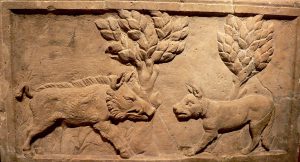
A Roman relief of a wild boar and a hunting dog (c. 200-300 CE)
tunc
ne ueneris cupidae gaudia
Nunc sine me
caste puer, casta retia tange
et, quaecumque meo furtim subrepit
At tu
et celer in nostros ipse recurre sinus.
What case is iuueni ?
Dative from iuuenis , iuuenis
Why is iuueni a dative?
The verb parco, parcere, peperci, parsum takes the dative
What case is pascua ?
Accusative neuter plural from pascuum , pascui
Why is pascua accusative?
Direct object of colis .
Although aper is the nominative form of aper, aperi , it functions as a vocative.
What case is tibi ?
Dative
What kind of dative is it?
Dative of possession
What form is sit ?
3rd sg. present active subjunctive from sum, esse, fui, futurus
Why is sit in the subjunctive?
Optative or Jussive subjunctive
What form is acuisse ?
Perfect active infinitive from acuo, acuere, acui, acutus
Why do we have an infinitive here?
It is a substantive clause, with the infinitive serving as subject
What form is seruet ?
3rd sg. present active subjunctive from seruo, seruare, seruaui, seruatus
Why is seruet in the subjunctive?
Optative or Jussive subjunctive
What kind of word do we have here?
A gerund (verbal noun) from venor, venari, venatus .
What case is it in?
Genitive singular.
So, what kind of genitive is it?
Objective, after cura. Objective genitives commonly occur after nouns and adjectives that express feeling or longing.
Diana of Versailles (1st or 2nd century CE) copy of an original Greek bronze by Leochares (c. 325) Diana, the Roman counterpart to the Greek goddess Artemis, is the goddess of the hunt. She is sometimes refered to as Delia due to her birthplace of Delos, a small island off the coast of Greece.
What case is cura ?
Ablative from cura, curae
Why do we have an ablative here?
Ablative of means
What form is pereant ?
3rd pl. present active subjunctive from pereo, perire, periui, peritum
Why is pereant in the subjunctive?
Jussive subjunctive
What form is laedere ?
Present active infinitive laedo, laedere, laesi, laesus
Why is laedere in the infinitive?
Complementary Infinitive after uelle
What form is uelle ?
Present active infinitive uolo, uelle, uolui, –
Why is uelle in the infinitive?
Part of an accusative (claudentem ) and infinitive construction; an indirect statement introduced by the idea of thought implied by mens .
What form is intrare ?
Present active infinitive from intro, intrare, intraui, intratus
Why do we have an infinitive here?
Strictly speaking, it is the subject of iuuat
What declension is rubis ?
Ablative from rubus, rubi
Why is rubis in the ablative?
Ablative of means
What form is liceat ?
3rd sg, present active subjunctive from the impersonal verb licet
Why is liceat in the subjunctive?
It is in a purpose clause, introduced by ut .
Cerinthus is the lover of Sulpica who she refers to in a number of her poems.
The Awakening of Adonis (1899) John William Waterhouse
What form is uagari ?
Present infinitive deponent from uagor, uagari, uagatus sum
Why do we have an infinitive here? We just had a similar case…
It is the subject of liceat!
What form do we have in cani ?
Dative singular.
What kind of dative is it?
Dative of disadvantage
What form is mihi ?
Dative from ego, mei
Why is mihi in the dative?
The verb placeo, placere, placui, placitum takes the dative
What form is placeant ?
3rd pl. present active subjunctive from the verb placeo, placere, placui, placitum
Why is placeant in the subjunctive?
It is the verb in an ideal or contrary to fact conditional.
What form is arguar ?
1st sg. present passive subjunctive from the verb arguo, arguere, argui, argutus
Why is arguar in the subjunctive?
It is the verb in the protasis of the contrary to fact or ideal conditional, signaled by si .
What form is ueniat ?
3rd sg. present active subjunctive from the verb uenio, uenire, ueni, uentum
Why is ueniat in the subjunctive?
It is in a concessive clause introduced by licet (meaning “although” or “granted that”).
What form is turbet ?
3rd sg. present active subjunctive from the verb turbo, turbare, turbaui, turbatus
Why is turbet in the subjunctive?
Negative purpose clause
What form is sit ?
3rd sg. present active subjunctive from sum, esse, fui, futurus
Why is sit in the subjunctive?
Jussive subjunctive
What case is lege ?
Ablative singular.
What kind of ablative is it?
Ablative of manner, which is typically accompanied by an adjective (e.g. magna celeritate ), and/or with cum (e.g. cum cura ). Exceptions are words like dolo, vi, casu, ioco, ordine, and words that denote mind, condition, or intention, like modo, more, ritu, ratione, animo, consilio, and lege
Due to the laws of Diana, prior to the hunt hunters were not allowed to have sex.
What case is manu ?
Ablative from manus, manus
Why is manu in the ablative?
Ablative of means
What form is amori ?
Dative masculine singluar from amos, amoris
Why is amori a dative?
Dative after a compound verb, subrepit
What form is incidat ?
3rd sg. present active subjunctive from incido, incidere, incidi, incasum
Why is incidat in the subjunctive?
Jussive subjective
What form is diripienda ?
Gerundive nominative feminine singular from diripio, diripere, diripui, direptus
How is the gerundive being used here?
diripienda serves as a predicate adjective here.
What form is uenandi ? This should seem very familiar (see line 5)!
A gerund (verbal noun) from venor, venari, venatus .
What case is it in?
Genitive singular.
So, what kind of genitive is it?
Objective, after studium , this time! Remember, objective genitives commonly occur after nouns and adjectives that express feeling or longing.