nec mirum: maculae pares utrisque,
impressae resident nec eluentur:
morbosi pariter, gemelli utrique,
non hic quam ille magis vorax ,
pulcre convenit improbis cinaedis.
Homosexuality was socially acceptable, even welcomed, in many Greek city states but it was frowned upon in Rome. It has been argued that the obscure Lex Scantinia harshly penalized freeborn men who played the “passive” role, and any man who made sexual advances to a freeborn boy. This repressive attitude did not stop Vergil from immortalizing the love and self-sacrificing devotion of Nisus and Euryalus in the Aeneid, even alluding to Catullus in his description of Euryalus’ death. 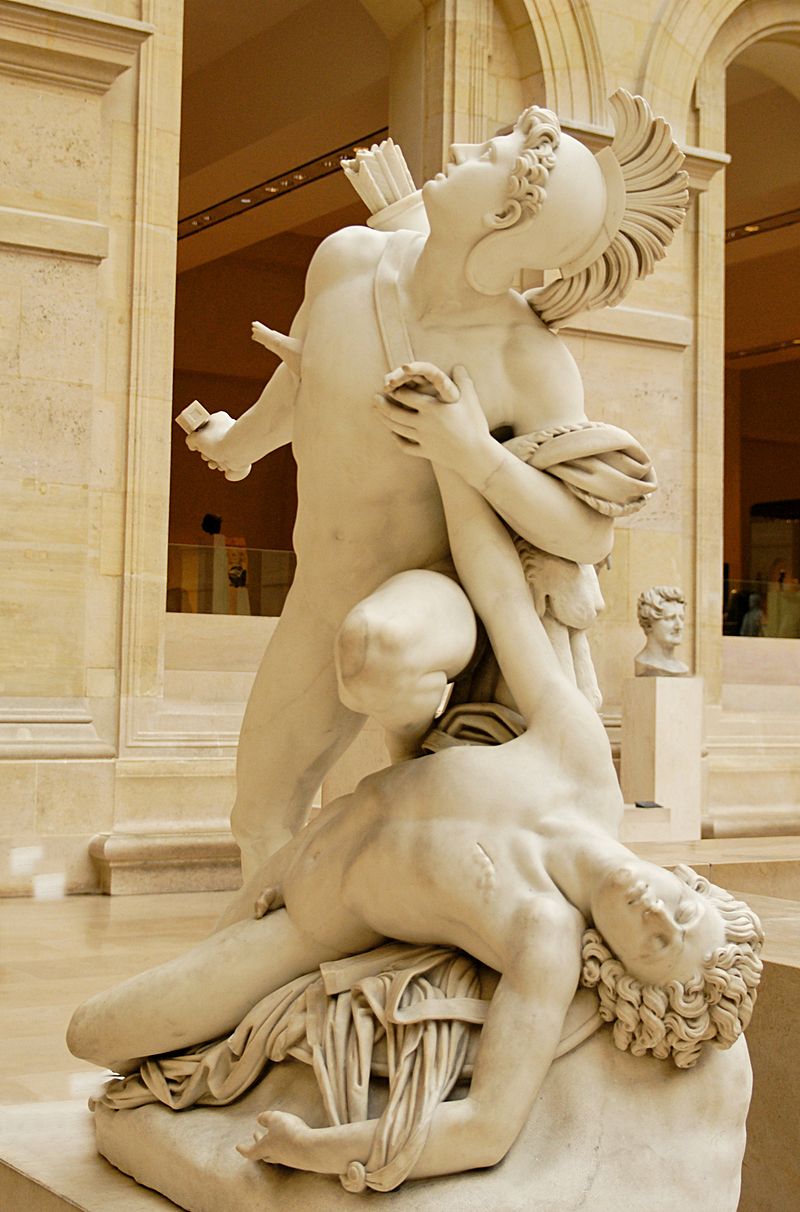 Nisus and Euryalus (1827) Jean-Baptiste Roman.
Nisus and Euryalus (1827) Jean-Baptiste Roman.Catullus hated Caesar’s favorite, elsewhere giving him the nickname mentula (penis). The poet who had signally failed to enrich himself through service in the provinces seems incensed by the extravagance and luxurious lifestyle of Mamurra who became vastly wealthy while serving Caesar in Britain, Gaul, and other provinces.
Catullus pairs this word with cinaedus in poem 16, in which he threatens (presumably in jest) to punish his friends Furius and Aurelius for assuming that he is as promiscuous as his poems. Quinn explains that pathicus means is qui irrumatur, while cinaedus means is qui pedicatur.
The sneering disdain of this poem with its accusations of sodomy, literary pretentiousness, and promiscuity with women must have caused a scandal, even though Rome was famous for its licentia, freedom of speech. According to Suetonius (Jul. 73), Caesar recognized that Catullus’ verses would be an enduring stain on him, but nevertheless invited Catullus to dinner when the poet belatedly asked for forgiveness. Suetonius also records that there were various rumors that Julius Caesar had been “deflowered” by King Nicomedes of Bithynia, leading to him having the nasty nickname “the Queen of Bithynia” (Jul. 49).
Mamurra was a native of Formiae, about 73 miles as the Cornix (crow) flies.
There may be a play here betweem “lecticula” a writing couch, and “lectulus” a cosy bed, which is a diminutive of “lectus” a bed. Lecticulus then can give the sense of a “little, wittle bed.” Each side of the British Museum’s Warren Cup, possibly first century a.d., depicts two men copulating on a bed.
Each side of the British Museum’s Warren Cup, possibly first century a.d., depicts two men copulating on a bed.This unique diminutive of “eruditus” adds to the mockery of their literary pretensions, Mamurra as a poet, and Caesar as a grammarian, historian, and poet. The juxtaposion of two words with diminutive forms conveys the depth of Catullus’ contempt.
In poem 29, Catullus, outraged, asked whether Mamurra would go around the beds of of every man. According to Suetonius (Jul. 50-52), Caesar’s reputation as an adulterer was also well-established. If the rumors about Caesar are true then it makes him an even bigger hypocrite for divorcing his wife with the phrase, “Caesar’s wife must be above suspicion.”(Cicero, Letters to Atticus 1.13; Plutarch, Caesar 9-10; Cassius Dio, Roman History 37.45; Suetonius, Jul. 6.2)
There are two ways of interpreting this phrase. Either Caesar and Mamurra are friendly rivals (in pursuit of) little girls OR they are sharers and rivals of the girls, i.e. they had sex sometimes with the girls, and sometimes with each other. Note the presence of yet another diminutive. Pompeian fresco depicting two men and a woman copulating. Just such a threesome is described in poem 56.
Pompeian fresco depicting two men and a woman copulating. Just such a threesome is described in poem 56.