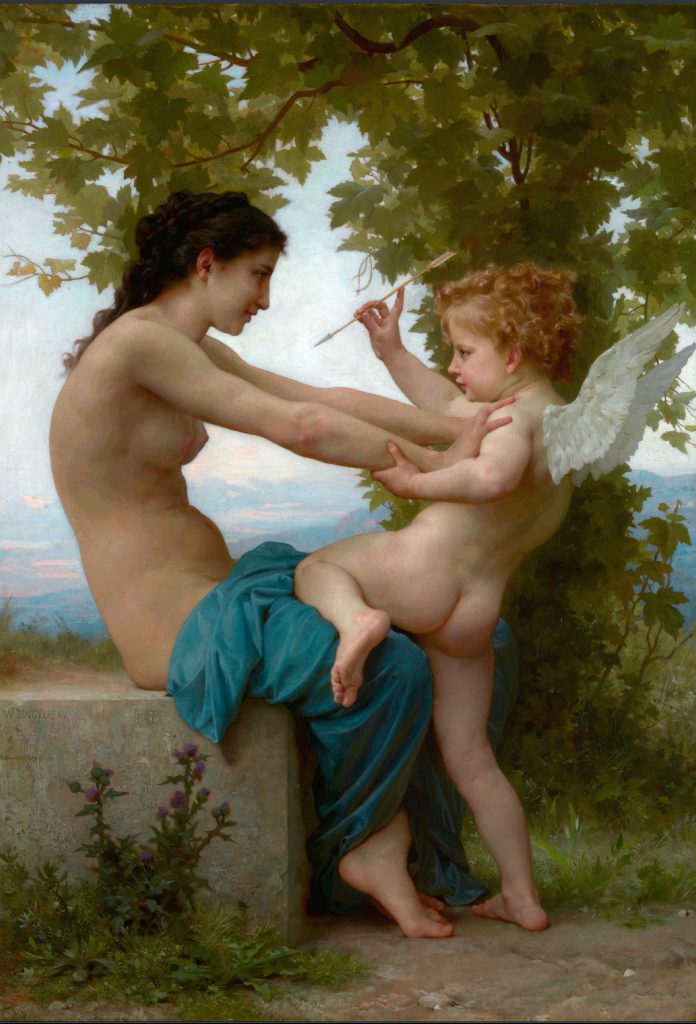
A Young Girl Defending Herself Against Eros (1880) William-Adolphe Bouguereau Arma gravi
edere, materia
par erat inferior versus—
dicitur atque unum surripuisse pedem.
‘Quis tibi, saeve puer, dedit hoc in carmina
quid, si
ventilet accensas flava Minerva faces?
quis
sunt
cur opus adfectas,
an,
vix etiam
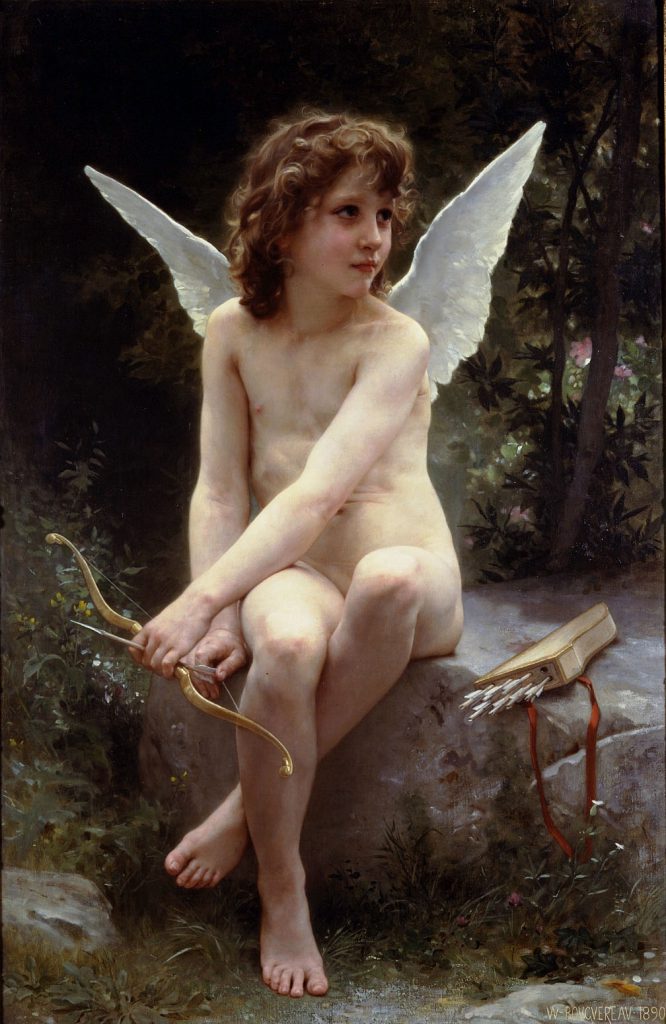
Love On The Look Out (1890) William-Adolphe Bouguereau cum bene surrexit
attenuat nervos proximus ille meos;
nec
aut puer aut longas compta puella
legit in exitium spicula facta meum,
lunavitque
‘quod’ que ‘
uror, et in vacuo pectore regnat Amor.
Sex
ferrea cum vestris bella valete
Musa, per undenos
What word does this come from?
Numerus, numeri (m)
What form is this noun?
Ablative, singular, masculine
Why do we have the ablative here?
Ablative of means or manner
What verb does this come from?
Convenio, convenire, conveni, conventum
What form is this verb?
Ablative, singular, feminine, present active participle
Why do we have the ablative here?
Ablative in an ablative absolute with materia
What word does this come from?
Modus, modi (m)
What form is this noun?
Dative, plural, masculine
Why do we have the dative here?
Dative with the compound verb conveniente
What verb does this come from?
Rideo, ridere, risi, risus
What form is this verb?
Perfect active infinitive
Why do we have an infinitive here?
If the verb of saying, knowing, thinking, or perceiving is in the passive, Indirect Discourse in Latin allows a personal construction, as here with the subject in the nominative (Cupid is said to have laughed), or an impersonal construction with the subject of the infinitive in the accusative, e.g. risisse Cupidinem dicitur (it is said that Cupid laughed).
What word does this come from?
Ius, iuris (n)
What form is this noun?
Genitive, singular, neuter
Why do we have the genitive here?
Partitive genitive after hoc
The name Pierides is frequently used to identify the Muses, whose most ancient place of worship was situated in Pieria, a district of Macedonia, in the north of Greece. An alternative explanation is that their father was not Jupiter/Zeus but King Pierus of Emathia, and that this name is a patronymic. The Muses were goddesses of literature, science, and the arts, including poetry, whom writers would invoke for knowledge and inspiration. In the Metamorphoses , Ovid recounts the Muses’ competition with the nine (other?) daughters of Pierus, who were also dubbed the Pierides by later writers, a practice that has sometimes led to confusion.
What verb does this come from?
Praeripio, praeripere, praeripui, praereptus
What form is this verb?
Third person, singular, present, active, subjunctive
Why do we have a subjunctive here?
Subjunctive in the protasis of an unreal or contrary to fact conditional
What word does this come from?
Minerva, Minervae (f)
What form is this noun?
Genitive or dative
Why do we have a genitive or dative here?
Genitive of possession or dative of disadvantage
What verb does this come from?
Probo, probare, probavi, probatus
What form is this verb?
Third person, singular, present, active, subjunctive
Why do we have a subjunctive here?
Deliberative or potential subjunctive
What verb does this come from?
Regno, regnare, regnavi, regnatus
What form is this verb?
Present active infinitive
Why do we have an infinitive here?
Infinitive in an indirect statement introduced by probet
What word does this come from?
Lex, legis (f)
What form is this noun?
Ablative, singular, feminine
Why do we have the ablative here?
Ablative of manner
The quivered virgin refers to the goddess Diana.
Diana the Huntress (Unknown) Guillaume Seignac
What verb does this come from?
Colo, colere, colui, cultus
What form is this verb?
Present passive infinitive
Why do we have an infinitive here?
Infinitive in an indirect statement introduced by probet
What word does this come from?
Crinis, crinis (m)
What form is this noun?
Ablative, plural, masculine
Why do we have the ablative here?
Ablative of respect
What word does this come from?
Cuspis, cuspidis (f)
What form is this noun?
Ablative, singular, feminine
Why do we have the ablative here?
Ablative of means
What verb does this come from?
Instruo, instruere, instruxi, instructus
What form is this verb?
Third person, singular, present, active, subjunctive
Why do we have the subjunctive here?
Deliberative or potential subjunctive
What verb does this come from?
Moveo, movere, movi, motus
What form is this verb?
Ablative, singular, masculine, present active participle
Why do we have the ablative here?
Ablative in an ablative absolute with Marte
What word does this come from?
Tu, tui (personal/definite pronoun)
What form is this pronoun?
Dative, singular, masculine
Why do we have the dative here?
Dative of possession
What word does this come from?
Ambitiosus, ambitiosa, ambitiosum (adjective)
What form is this adjective?
Vocative, singular, masculine
Why do we have the vocative here?
Vocative agreeing with puer in the previous line
It is best to add an id and an est here, making the translation “or is that which is everywhere yours?”
Tempe is an indeclinable neuter plural noun referring to valleys in Boeotia, a region of central Greece, that are sacred to Apollo and the Muses.
Apollo and the Muses (1826) Heinrich Maria Hess
What word does this come from?
Phoebus, Phoebi (m)
What form is this noun?
Dative, singular, masculine
Why do we have the dative here?
Dative of reference after tuta.
What word does this come from?
Versus, versūs (m)
What form is this noun?
Ablative, singular, masculine
Why do we have the ablative here?
Ablative of means
What word does this come from?
Ego, mei (personal/definite pronoun)
What form is this pronoun?
Dative, singular, masculine
Why do we have the dative here?
Dative of possession
What word does this come from?
Levis, levis, leve (adjective)
What form is this adjective?
Dative, plural, masculine, comparative adjective
Why do we have the dative here?
Dative after the adjective apta. Adjectives of fitness, nearness, likeness, inclination, and their opposites, are followed by the dative.
Why do we have an accusative here?
It is an accusative of respect. This type of accusative occurs chiefly in poetry, after both verbs and adjectives, is not a direct object, and usually refers to a part of the body.
What verb does this come from?
Queror, queri, questus sum
What form is this verb?
First person, singular, pluperfect, deponent (active), indicative
What verb does this come from?
Solvo, solvere, solvi, solutus
What form is this verb?
Ablative, singular, feminine, perfect passive participle
Why do we have an ablative here?
Ablative in an ablative absolute with pharetra
What word does this come from?
Genu, genūs (n)
What form is this noun?
Ablative, singular, masculine
Why do we have the ablative here?
Ablative of means or place where.
What verb does this come from?
Cano, canere, cecini, cantus
What form is this verb?
Second person, singular, present, active, subjunctive
Why do we have a subjunctive here?
Relative clause of characteristic, or purpose.
Why do we have the accusative here?
Accusative of exclamation
What word does this come from?
Ego, mei (personal/definite pronoun)
What form is this pronoun?
Dative, singular, masculine
Why do we have the dative here?
Sympathetic dative
What verb does this come from?
Surgo, surgere, surrexi, surrectus
What form is this verb?
Third person, singular, present, active, subjunctive
Why do we have a subjunctive here?
Jussive subjunctive
What word does this come from? Hint: you already met it in line 2!
Modus, modi (m)
What form is this noun?
Ablative, plural, masculine
Why do we have the ablative here?
Ablative of accompaniment
What verb does this come from?
Cingo, cingere, cinxi, cinctus
What form is this verb?
Present passive imperative
Why do we have a present passive imperative here?
Ovid is treating cingere like a greek middle imperative, effectively making tempora its direct object, and therefore accusative. It would be translated as “surround”
What verb does this come from?
Flaveo, flavere, -, –
What form is this verb?
Accusative, plural, neuter, present active participle
Why do we have the accusative here?
It agrees with tempora , which is accusative, governed by cingere .
What word does this come from?
Myrtus, myrti (f)
What form is this noun?
Ablative, singular, feminine
Why do we have the ablative here?
Ablative of means. Though scanning this line, we can see that litorea agrees with myrto.
What verb does this come from?
Emodulor, emodulari, emodulatus sum
What form is this verb?
Vocative, singular, feminine, gerundive (future passive participle)
Why do we have the vocative here?
Emodulanda is a gerundive of necessity that describes Musa