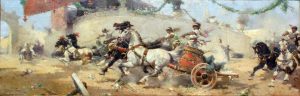
The meta is a conical column at the end of the chariot racing circus, a turning-post or goal.
The Chariot Race in the Circus Maximus (1890) Alfredo Tominz
The Paeligni were an ancient tribe of central Italy whose territory lay inland on the eastward slopes of the Apennines.
Siquis, siquis, siquid (indefinite pronoun, sometimes written as two words: si quis). It plays the same role as aliquis but after nisi, si, and ne, the ali– prefix is typically omitted
Gentis, which comes from the feminine word, gens, gentis in the previous line
The Roman Social War (91-88 B.C) was a civil war, but instead of being between parties within Rome, it was between the city and region immediately surrounding Rome and her Italian allies. As the empire expanded, the allies wanted more rights of Roman citizenship and sought input into foreign policy. A Roman politician named Drusus proposed such reforms but was assassinated, and his reforms were tabled, thus triggering the Social War. Rome’s Latin allies remained faithful, but most of the rest of Italy revolted and declared themselves a new country, named Italia. The war was short and there were numerous skirmishes and few pitched battles, the main two being Tolenus, a Roman loss, and a battle during the siege of Asculum, a Roman victory which resulted in the fall of an important city of the Italian Allies. Instead of continuing to fight, however, Rome made significant concessions, including the granting of Roman citizenship to selected towns, granting it as a reward for military service, and also granting it, in selected cases to other individuals who were willing to pay to travel to Rome in order to vote. These concessions effectively satisfied the Italians and hostilities ceased.
culte is describing puer, whom Ovid is directly speaking to, along with the parens later in the line. Of course, Cupid and his mother are “cultivated” because they are sophisticated but also because they are the focus of many cults.
Amathus is a town in the southern part of Cyprus and is sacred to Venus, who is hence called Amathusia.
Gravis, gravis, grave (adjective). The use of this adjective recalls the first line of Amores 1.1, in which it was used to describe the meter of epic. Here, it seems to foreshadow Ovid’s plan to work on his (now lost) tragedy, Medea.
Graviore is describing thyrso, which is an ablative of means
Lyaeus is the relaxer, unbender, and deliverer from care. A surname of Bacchus, the god of wine and ritual madness. He is also the patron god of tragedy, and thus Ovid turns to him as he prepares to abandon elegy for tragedy.
Priestess of Bacchus (1894) William-Adolphe Bouguereau
The adjective superstes, superstitis rather than a subjunctive from Supersto, superstare, supersteti, superstates. This word agrees with opus and is in the vocative case.