Qui te, Cerinthe, dies dedit, hic sanctus
atque inter festos semper erit:
seruitium et dederunt regna superba tibi.
Vror ego ante alias: iuuat hoc, Cerinthe, quod uror, 5
si de nobis mutuus ignis adest;
mutuus amor, per te dulcissima furta
perque tuos oculos per que rogo.
si modo, cum de me cogitat, ille calet. 10
Quod si forte alios iam nunc amores,
tunc precor infidos, sancte, relinque focos.
Nec tu iniusta, Venus: uel aeque
uinctus uterque uel mea uincla leua;
sed potius ualida uterque , 15
Optat idem iuuenis quod nos, sed tectius optat:
nam pudet haec illum uerba palam.
At tu, , quoniam deus omnia sentis,
adnue: quid refert, clamne palamne . 20
What form is mihi?
Dative feminine singular from ego, mei
Why is mihi in the dative?
Dative of advantage.
What form is mihi?
Dative feminine singular from ego, mei
Why is mihi in the dative?
Dative of judging, or possibly agent.
What form is habendus?
Nominative masculine singular gerundive from habeo, habere, habui, habitus
Why is habendus in the gerundive?
Passive periphrastic with erit
What form is nascente?
Present deponent participle ablative masculine singular from nascor, nasci, natus sum
Why is nascente in the ablative?
Ablative absolute
Personification of the Fates, the Roman equivalent to the Greek Moirai.
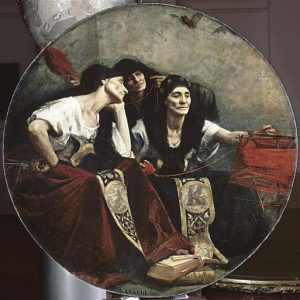
Les Parques (~1885) Alfred Agache
Syncopated form of cecinerunt, 3pl perfect active indicative form of cano, canere, cecini, cantus.
What form is tibi?
Dative masculine singular
Why is tibi a dative?
adsum takes the dative
What form is adsit?
3sg present active subjunctive from adsum, adesse, adfui, adfuturus
Why is adsit a subjunctive?
Jussive subjunctive
In Rome, the Genius is similar to a guardian spirit. This spirit was born with each man and attends to that man’s needs throughout his time on Earth.
Corrected by some editors to magne. Other editors explain this form as the vocative of the old Latin word, manus, meaning good.
What form is uotis?
Dative neuter plural from uotum, uoti
Why is uotis a dative?
faueto takes the dative
2sg future active imperative form of faueo, fauere, faui, factus.
What form is suspiret?
3sg present active subjunctive from suspiro, suspirare, suspiraui, suspiratus
Why is suspiret a subjunctive?
Subjunctive in a future less vivid conditional
What form is sis?
2sg present active subjunctive from sum, esse, fui, futurus
Why is sis a subjunctive?
Jussive subjunctive
What form is seruiat?
3sg present active subjunctive from seruio, seruire, seruiui, seruitus
Why is seruiat a subjunctive?
Jussive subjunctive
What form is tibi?
Dative masculine singular from tu, tui
Why is tibi a dative?
seruo takes the dative
What form is teneamur?
1pl present passive subjunctive from teneo, tenere, tenui, tentus
Why is teneamur a subjunctive?
Hortatory subjunctive
What form is catena?
Ablative feminine singular from catena, catenae
Why is catena an ablative? (Consider what ablatives can come after a passive verb.)
Ablative of instrument
What form is queat?
3sg subjunctive present active from queo, quire, quiui, quitus
Why is queat a subjunctive?
relative clause of result or purpose.
What form is soluisse?
Perfect active infinitive from soluo, soluere, solui, solutus
Why is soluisse an infinitive?
Complementary infinitive with queat
What form is dicere?
Present active infinitive from dico, dicere, dixi, dictus
Why is dicere an infinitive?
It is a substantive clause, with the infinitive serving as subject
Personification of birth, best thought of as some sort of birth spirit.
What form is roget?
3sg present active subjunctive from rogo, rogare, rogaui, rogatus
Why is roget a subjunctive?
Indirect question