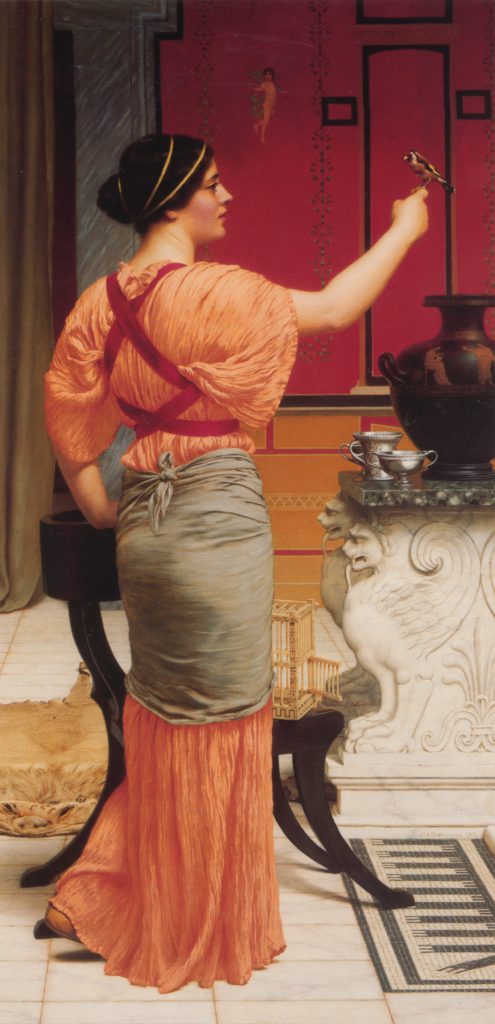
Lesbia with her sparrow (1916) John William Godward. Siqua
est homini, cum se cogitat esse pium,
nec sanctam
divum ad
multa parata manent in longa aetate, Catulle,
ex hoc ingrato gaudia amore tibi.
nam quaecumque homines bene cuiquam aut dicere possunt
aut facere, haec a te dictaque factaque sunt.
omnia quae ingratae perierunt credita menti.
quare iam te cur amplius
quin tu animo offirmas atque istinc teque reducis,
et
difficile est longum subito deponere amorem,
difficile est, verum hoc qua lubet
una salus haec est. hoc est tibi
hoc
o di, si vestrum est misereri, aut si quibus umquam
extremam iam ipsa in morte tulistis opem,
me miserum aspicite et, si vitam puriter egi,
eripite hanc pestem perniciemque
quae mihi subrepens imos ut torpor in artus
expulit ex omni pectore laetitias.
non iam illud quaero, contra me ut
aut, quod non potis est, esse pudica velit:
ipse valere opto et taetrum hunc deponere morbum.
o di, reddite mi hoc pro pietate mea.
What kind of word is formed from a verb stem plus –nt-?
Present participle active
What case is amanti?
Dative
What kind of dative is often paired with the verb to be?
Dative of possession
What verb form ends in –sse?
Perfect infinitive
Why do we have an infinitive here?
It continues the indirect statement from the previous line.
What form has a stem that ends in –nd-?
Gerund and gerundive.
How can you tell that fallendos is a gerundive?
The gerund is a verbal noun, and is only found in the singular neuter. The gerundive is a verbal adjective, and has singular and plural, and masculine, feminine, and neuter endings.
Does it agree with another word in the phrase?
Homines
What verb form is this?
Perfect participle deponent
If you add esse to a perfect participle, what do you get?
Perfect infinitive. The esse in perfect infinitives, deponent or passive, is frequently omitted.
What case does abutor take?
Ablative
Excruciare is 1st conjugation, so what form do we have here?
Present subjunctive active (2nd singular)
What kind of subjunctive is typically found in a direct question?
Deliberative
What are the possible cases for this phrase?
Dative or ablative
Is the phrase affected by the verb or a preposition, or is it (absolutely) cut off from the rest of the sentence?
Cut off => Ablative absolute
Efficere is 5th conjugation – so what form do we have here?
Present subjunctive active (2nd singular)
What kind of subjunctive do we have here?
Jussive
This question should look familiar, but What form has a stem that ends in –nd-?
Gerund and gerundive. The gerund is a verbal noun, and is only found in the singular neuter. The gerundive is a verbal adjective, and has singular and plural, and masculine, feminine, and neuter endings.
What conjugation is formed by the gerundive with the verb to be?
Passive Periphrastic. The passive periphrastic consists of the gerundive (a passive verbal adjective) plus sum. It is in essence the “gerundive of obligation,” as this construction carries a sense of duty or necessity, generally expressed in English with “must” or “should.”
So, if we take tibi with pervincendum , what kind of dative is it?
Dative of agent
Facere is 5th conjugation – so what form do we have here? It should seem familiar by now! Compare efficias in line 14.
Present subjunctive active (2nd singular)
What kind of subjunctive do we have here?
Yes, once again, it is Jussive.
What kind of dative is this? Hint: note verb eripere . This combination should recall Catullus 51.5…
Dative of disadvantage
Diligere is 3rd conjugation – so what form do we have here?
Present Subjunctive
Why is the verb in the subjunctive? Note the presence of ut . Hint: what does the main verb mean?
It is in an indirect command introduced by quaero .