
Lesbia mi viro mala plurima dicit:
haec fatuo maxima laetitia est.
mule, nihil sentis? si oblita ,
sana esset: nunc quod et obloquitur,
non solum meminit, sed, quae acrior est res,
irata est. hoc est, uritur et loquitur.
What kind of word is formed from a verb stem plus –nt-?
Present participle active
What case is praesente?
Ablative singular
Does anything agree with it?
viro
What construction frequently pairs a noun and a participle in the ablative case?
Ablative absolute
What form do we have here?
3rd singlar, imperfect subjunctive.
Why is the verb in the subjunctive here?
It is part of a contrary to fact conditional sentence. Note that in conditional sentences, the present subjunctive refers to future time, the imperfect subjunctive refers to present time (or sometimes past), and the pluperfect subjunctive refers to past time.
The verb gannire is regularly used to describe the snarling of a dog.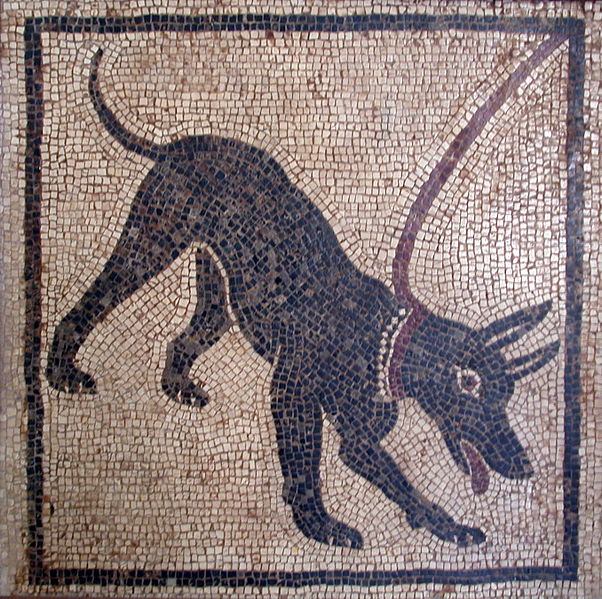 Dog Mosaic, House of Orpheus, Pompeii. While Catullus’ poems may not be able to soothe the savagery in Lesbia’s heart, he tells himself that her viciousness is proof that she cares about him!
Dog Mosaic, House of Orpheus, Pompeii. While Catullus’ poems may not be able to soothe the savagery in Lesbia’s heart, he tells himself that her viciousness is proof that she cares about him!