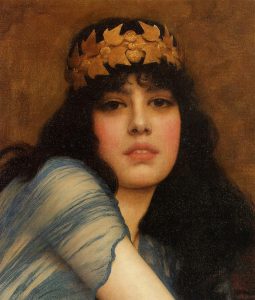
Head of a girl (1896) John William Godward. Cynthia’s eyes and her unflinching gaze captured the poet’s heart
suis miserum me cepit ,
contactum nullis ante cupidinibus.
tum deiecit lumina fastus
et caput pressit Amor ,
donec me docuit castas odisse puellas 5
improbus, et nullo vivere .
ei mihi, iam toto furor hic non deficit anno,
cum tamen adversos cogor habere deos.
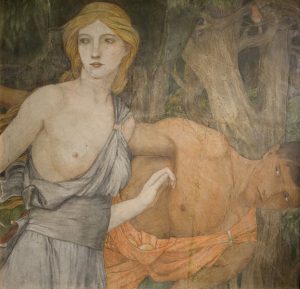
‘Atalanta and Milanion’ – detail of the fresco Atlanta’s Race (1922) by John Dickson Batten.
Milanion nullos , Tulle, labores
saevitiam durae contudit . 10
nam modo Partheniis amens errabat in antris,
rursus in hirsutas ibat et ille feras;
ille etiam percussus vulnere rami
saucius Arcadiis rupibus ingemuit.
ergo velocem potuit domuisse puellam: 15
tantum in amore fides et valent.
The Magic Circle (1886) John William Waterhouse
in me tardus Amor non ullas cogitat artes,
nec meminit notas, ut prius, ire vias.
at vos, est fallacia lunae
et labor in magicis sacra piare focis, 20
en agedum dominae mentem convertite nostrae,
et facite illa meo magis!
tunc ego Manes et sidera
ducere carminibus.
aut vos, qui sero lapsum revocatis, amici, 25
quaerite non sani auxilia.
Venus and Cupid (1878) Evelyn de Morgan
fortiter et ferrum saevos patiemur et ignes,
modo libertas quae ira .
ferte per extremas gentes et ferte per undas,
qua non ulla meum femina iter. 30
vos remanete, quibus facili deus annuit aure,
et in tuto semper amore pares.
nam me nostra Venus exercet amaras,
et nullo vacuus defit Amor.
hoc, moneo, vitate malum: sua quemque 35
cura, neque assueto mutet torum.
si quis monitis tardas adverterit aures,
heu referet quanto verba mea!
Placing the name of his beloved as first word in the first line ensured that his first book of poetry itself would be called Cynthia. This constitutes one of several clues that his beloved is a scripta puella, a written girl, i.e. someone invented and given characteristics that would permit him to write particular kinds of poems.
In a later poem (3.15.3-10), Propertius says that Lycinna was the first to initiate him into the joys of love, a woman who did not seek gifts in return for her favors. Lycinna (1918) John William Godward. Godward gives his portrait of Propertius’ first love a gentle and melancholy air.
Propertius here uses a metaphor from the arena; the victorious gladiator put his foot on his fallen foe’s neck or head to hold him in place while waiting for the crowd’s verdict. Pollice Verso (1872) Jean-Léon Gérome. (With the Thumb Turned Down)
Dative or ablative but context makes ablative more likely (nothing to prompt a dative). And the dative of nullus is nulli; nullo probably agrees with consilio, hence ablative!
Iasis, Iasidos f. A daughter or descendant of Iasius, an early king of Argos. The term most often is applied to Atalanta, but in the plural it refers to Argive women generally.
The centaur Hylaeus attempted to assault Atalanta, and Milanion was wounded when he tried to stop him. Centaurs were notorious for their lust, violence, and general bad behavior. Battle of the Centaurs and Lapiths (1853) William Bouguereau
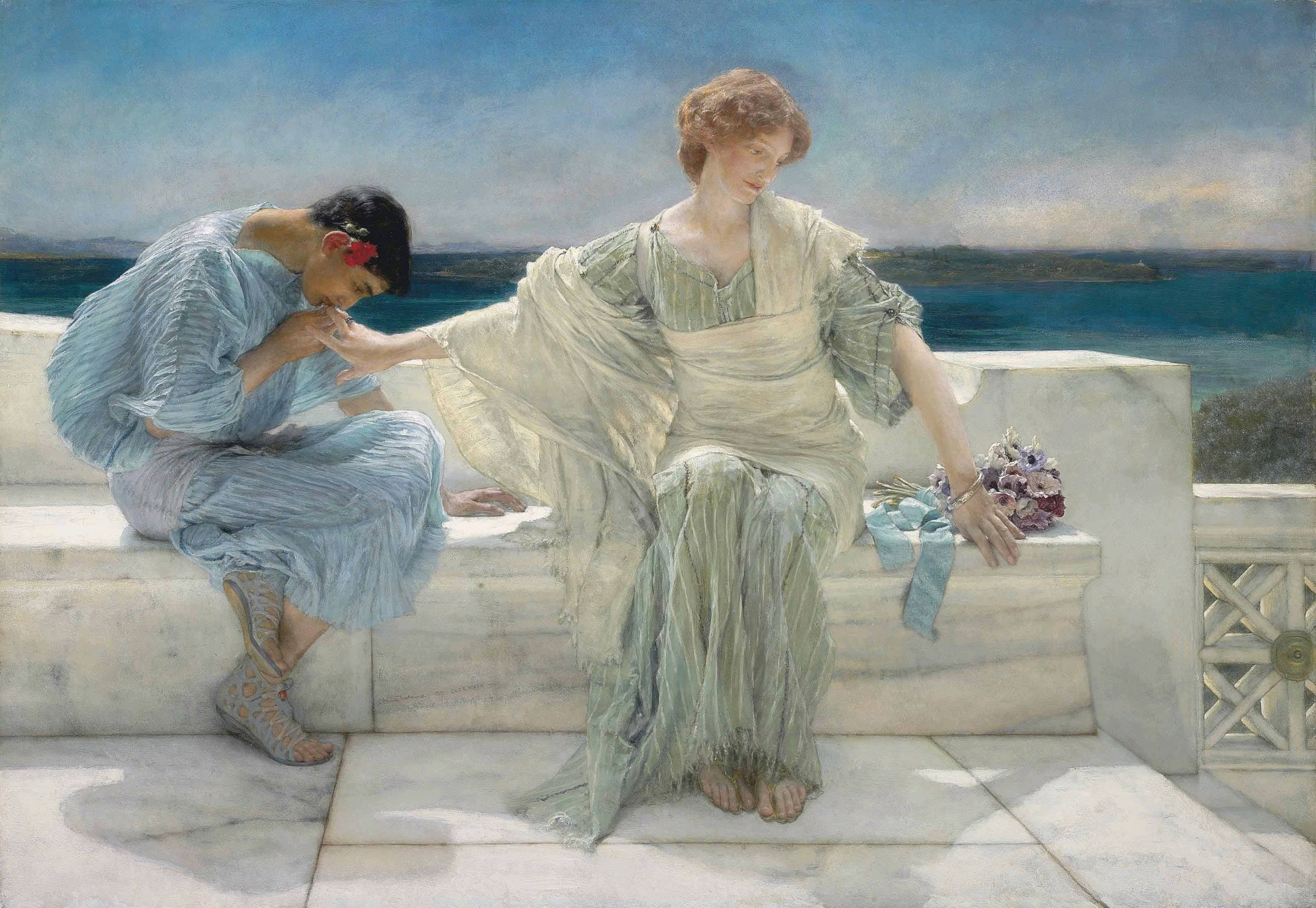
The plaintive hope that benefacta will result in a benefit for the lover recalls Catullus 76.1. Of course it is not at all clear from either Catullus or Propertius that benefacta give rise to any benefits! Ask Me No More (1906) Lawrence Alma-Tadema
As an illustration of their power, and perhaps to enlist one aspect of the triple or tri-form goddess Diana-Selene-Hecate to their rites. Hecate is the goddess of witchcraft but she is one with Diana and Selene (the moon). Remember, too, that Cynthia’s name associates her with Apollo and Diana, who were born on Mount Cynthus.
As an alternative to a simple imperative, particularly in colloquial Latin, the subjunctive (with or without ut) sometimes follows cura, fac, or velim.
1st person singular, perfect subjunctive active or future perfect indicative active, but there is no reason to have a future perfect here, and a perfect subjunctive makes sense.
It is part of an indirect statement in which the subject, vos, can be deduced from vobis.
The manuscript tradition is corrupt here, but two emendations have gained popularity: Cytaeines and Cytinaeis. The first alternative makes it a genitive from Cytaeine, -es f. a woman of Cyta or Cytaea, the birthplace of Medea in Colchis. Medea’s powers as a witch are frequently cited by Roman poets. The second alternative derives the word from the adjective Cytinaeus, -a, -um, of Cytina, a city of Thessaly, hence Thessalian. Thessaly was just about as strongly associated with witchcraft as Colchis.
Potential subjunctive, OR simply the verb in a clause subordinate to another clause with a subjunctive verb.
In prose, we would expect the genitive of gerund here, freedom of speaking, but the infinitive after a substantive is not uncommon in poetry. Cp. Propertius 3.15.4: et data libertas noscere amoris iter. In addition, sit libertas is practically equivalent to liceat, which is regularly followed by an infinitive.


 Lycinna (1918) John William Godward. Godward gives his portrait of Propertius’ first love a gentle and melancholy air.
  Pollice Verso (1872) Jean-Léon Gérome. (With the Thumb Turned Down)
  Battle of the Centaurs and Lapiths (1853) William Bouguereau
  Ask Me No More (1906) Lawrence Alma-Tadema