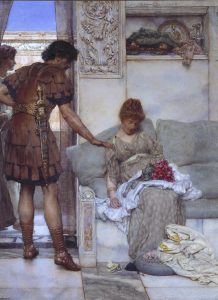
A Silent Greeting: Lawrence Alma Tadema, 1889 Castra Macer sequitur: tenero quid
sit comes et collo fortiter arma
et seu longa uirum terrae uia seu uaga ducent
ure, puer, quaeso, tua qui ferus otia liquit, 5
atque iterum erronem sub tua signa
quod si militibus parces, erit hic quoque miles,
ipse
castra
et
magna loquor, sed magnifice mihi magna
excutiunt clausae fortia uerba fores.
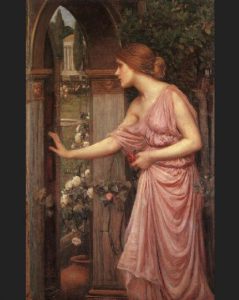
Psyche Entering Cupid’s Garden: John William Waterhouse, 1903 iuraui quotiens
cum bene iuraui, pes tamen ipse redit.
acer Amor, fractas utinam tua tela sagittas, 15
si licet, extinctas
tu miserum torques, tu me mihi dira
cogis et insana mente
iam mala
spes fouet et
spes alit agricolas, spes sulcis credit aratis
semina quae
haec laqueo uolucres, haec captat harundine pisces,
cum tenues hamos abdidit ante
Wild Blossoms: Edward Poynter, 1880 spes etiam ualida solatur compede
crura sonant ferro, sed canit inter opus:
spes facilem
ei mihi, ne
parce, per immatura tuae precor ossa sororis:
sic bene sub tenera parua
illa
et
illius ad tumulum fugiam supplexque sedebo
et mea
non feret usque suum te propter
illius ut uerbis,
Between Hope and Fear: Sir Lawrence Alma Tadema, 1876. ne tibi neglecti
maestaque sopitae
qualis ab excelsa praeceps delapsa
uenit ad infernos sanguinolenta lacus. 40
non ego sum
nec lacrimis oculos digna est
lena nocet
lena necat miserum
Idleness: John William Godward, 1900 occulto portans itque reditque
saepe, ego cum dominae dulces a limine duro
agnosco uoces, haec negat
saepe, ubi nox mihi
nuntiat aut aliquas
tunc morior
quisue meam
tunc
What kind of verb is fio, fieri, factus sum ?
An irregular semi-deponent
What person and time has the ending -et ?
3rd person singular future indicative active
What conjugation is gero, gerere, gessi, gestus ?
3rd conjugation
What form would have the ending -at ?
3rd person singular present subjunctive active
What type of subjunctive is this?
Deliberative or Potential, and the same goes for sit earlier in the line. Tibullus switches back and forth between the future indicative and present subjunctive in these opening lines.
aequora is commonly used to refer to the sea and its flat (therefore “equal” or level) surface.
What noun is telis from?
telum, teli 2n
What form could telis be?
Dative or ablative plural
What form is it, and what is the usage?
Ablative of accompaniment
What form of voco, vocare, vocavi, vocatus would end in -a ?
Imperative singular
Taken as “shifting” in describing aquam. The epithet is frequently applied to the fickle lover (Catullus 72.6).
With this first person verb, Tibullus shifts the focus of the elegy from Macer to himself.
What verb is valeat from?
valeo, valere, valui, valitus
What form do we have here?
Third person singular present active subjunctive
What usage of the subjunctive is this?
Jussive subjunctive; as Tibullus sets out as a soldier, he literally implies “let Venus be/fare well…”
What form of the personal pronoun ego, mei is this?
Dative singular
What form of the dative is used in combination with a form of the verb sum, esse, fui ?
Dative of possession
What usage of the dative singular personal pronoun is this?
Dative of judging; while there is a form of sum, esse, fui nearby (that may imply dative of possession), here the sense is that Tibullus describes how he feels, as a soldier, about the tubas/trumpets of war
What form of loquor, loqui, locutus sum do we have here?
Perfect participle deponent, dative case, agreeing with mihi.
What usage of the dative is this?
Dative of reference.
What form of redio, redire, redivi, reditum do we have here?
Future active participle, accusative singular masculine
We must supply esse here; what form does that give us?
Future active infinitive
Why do we have an infinitive here?
Because it is part of an indirect statement
What form of aspicio, aspicere, aspexi, aspectus ends in -am ?
First person singular present active subjunctive or future indicative.
So, which is it?
The word utinam in the previous line tells us that it must be an Optative Subjunctive.
What type of infinitive is this?
Complementary infinitive with cogis , from the verb precor, precari, precatus sum .
Per Murgatroyd, some commentators refer this phrase to an angry execration of the gods by Tibullus, but the impious things Tibullus is compelled to say may instead be a cursing of Nemesis.
What form of finio, finire, finivi, finitus is this?
First person singular pluperfect active subjunctive
What is the usage of the subjunctive?
Subjunctive in a past contrary to fact condition where the si clause is unexpressed.
What form of sum, esse, fui, futurus is this?
An alternate version of the future active infinitive futurus, -a, -um esse (“about to be”)
Why do we have an infinitive here?
It is part of an indirect statement.
In what case is this phrase?
Ablative singular neuter.
What kind of ablative is it?
Ablative of manner because, as Harrington observes, “for the original seed is not itself returned to the sower with others at all, but comes back to him only by the ‘increase’.”
What form of reddo, reddere, reddidi, redditus is this?
3rd person singular present active subjunctive
What usage of the subjunctive is this? (hint: quae )
Subjunctive in relative clause of purpose.
Translated as “bait” here, this conveys the deceptive hope given to the fish who bite down on it.
Reclining Man – Max Martini Those bound in shackles could certainly use some hope.
The goddess Hope has promised Tibullus that the girl Nemesis will not be difficult with him. Unfortunately for Tibullus, Nemesis proves recalcitrant. It is revealed here that Nemesis, rather than love (Amor), is the cause of distress for Tibullus.
What verb is vincas from?
vinco, vincere, vici, victus 3
What form do we have here?
Second person singular present active subjunctive
What is the usage of the subjunctive?
Jussive subjunctive
This characteriation, “harsh girl,” is seen in other love poetry from Catullus and Propertius.
What verb do we have here?
quiesco, quiescere, quievi, quietus 3rd conjugation
What form would end in -at ?
Third person singular present active subjunctive
What usage of the subjunctive might this be?
Jussive subjunctive
What form of the personal pronoun ego, mei do we have here?
Dative singular
What usage of the dative is this?
Dative of judging
What noun is sepulcro from?
sepulcrum, sepulcri 2n
What form do we have here?
Dative or ablative singular
What form is it, and what is the usage?
Poetic dative of end of motion OR dative of advantage
What verb does madefacta come from?
madefio, madefieri, madefactus sum (irr. semi-deponent)
What form is this?
Perfect passive participle, accusative neuter plural
What word does it modify?
serta , the wreaths “having been soaked.”
What noun does lacrimis come from?
lacrima, lacrimae 1
What form is this?
Dative or ablative plural
What case and what usage is this?
Ablative of instrument
The verb queror, to complain, can be followed by the dative of the person spoken to OR by cum plus the ablative, or apud plus the accusative.
What form is flere ?
Present active infinitive of fleo, flere, flevi, fletus .
Why do we have an infinitive here?
It is part of an indirect statement: accusative plus infinitive construction.
We would normally expect an infinitive after veto , but here Tibullus uses the subjunctive – a permissible but much rarer construction.
What form of the personal pronoun ego, mei do we have here?
Dative singular.
Why do we have a dative here?
Dative is used after Special Adjectives: friendly to, unfriendly to, similar to, dissimilar to, equal to, suitable for, near to, dear to, pleasing to, etc.
What verb does mittant come from?
mitto, mittere, misi, missus 3
What form do we have here?
Third person plural present active subjunctive
What is the usage of the subjunctive?
In a negative purpose clause with ne
What form of sto, stare, steti, status is this?
Third person singular present active subjunctive
What usage of the subjunctive is this?
Subjunctive in negative purpose clause, like mittant in the previous line.
What cases could this be?
Ablative or nominative, feminine singular
What is more likely here?
Ablative, given the “ab” in the line.
What usage of the ablative might this be?
Ablative of separation, with compound verb “delapsa” or with “ab”
Tibullus gives us the only example of desino with a short final “o.” Elsewhere he also makes the final “o” of nescio short. Such shortenings for metrical purposes were rare before Ovid.
What forms could this be?
All feminine: Genitive sg, Dative sg, or Nominative pl.
What form is most likely here?
Genitive feminine singular.
What verb is renoventur from?
renovo, renovare, renovavi, renovatus 1
What form do we have here?
Third person plural present passive subjunctive
What is the usage of the subjunctive?
Again, a subjunctive in a negative purpose clause with ne
What form of the adjective tantus, -a, -um are possible here?
Nominative masculine plural, Genitive masculine/neuter singular
Which is most likely here, and what is its usage?
Genitive neuter singular, genitive of value.
What verb is ploret from?
ploro, plorare, ploravi, ploratus 1
What form do we have here?
Third singular present active subjunctive
What usage of the subjunctive is this?
In a result clause with tanti
What verb and form do we have here?
Present active infinitive of foedo, foedare, foedavi, foedatus.
What is the usage of the infinitive here?
Infinitive in indirect statement
nobis here acts as the object of the verb, because noceo, nocere, nocui, nocitum takes the dative.
Phryne, Greek for toad, was the nickname of a famous courtesan of the fourth century B.C.E., whose spectacular beauty allowed her to become incredibly wealthy. Her sallow complexion made her look yellow, hence the nickname. Various Greek and Roman courtesans adopted her name, hoping to be as successful as she had been in amassing wealth. The fact that this woman is now working as a procuress suggests that her hopes were not realized.
Phryne (1909) Antonio Parreiras.
What forms are possible for sinu ?
Ablative singular masculine (4th declension)
What usage of the ablative might this be?
Ablative of place where OR ablative of means.
Use an understood “illam/dominam” as the subject of “esse”. This accusative-infinitive construction is an indirect statement dependent on agnosco . Note that the poet-lover accuses the threshold rather than his mistress of being harsh, duro .
What noun does domi come from?
domus, domi 2f
What forms are possible?
Genitive or locative singular; nominative or vocative plural
Well, which is it?
Locative singular, translated as “at the house.” This is one of the very few usages of the locative case that Tibullus employs in his writings.
What verb do we have here?
promitto, promittere, promisi, promissus
What form is promissa est ?
Third person singular perfect passive indicative.
What verb is extimuisse from?
extimesco, extimescere, extimui
What form do we have here?
Perfect active infinitive
What is the usage of the infinitive?
Infinitive in indirect statement
What forms are possible here?
Dative or ablative plural
What form is it, and what are the most likely usages?
Ablative plural, ablative of cause OR ablative of means.
What form of the personal pronoun ego, mei is this?
Dative singular
What is the usage of the dative here?
Sympathetic dative
What verb is teneat from?
teneo, tenere, tenui, tentus 2
What form is this?
Third personal singular present active subjunctive
What is the usage of the subjunctive?
Subjunctive in indirect question
What form of the personal pronoun tu, tui is this?
Dative singular
What is the usage of the dative?
tibi acts as the object of the verb, as precor, precari, precatus sum takes the dative
What verb does vivas come from?
vivo, vivere, vixi, victus
What form do we have here?
Second person singular present active subjunctive
What is the usage of the subjunctive?
Jussive subjunctive or potential subjunctive introducing conditional clause
What verb does moverit come from?
moveo, movere, movi, motus
What form could this be?
Third person singular future perfect active indicative OR perfect active subjunctive
Which form is more likely, and what is the usage?
Perfect active subjunctive in protasis of hidden conditional.


 Phryne (1909) Antonio Parreiras.