Propertius speaks often of his friend Tullus in his first book of poems. Tullus is believed to be the nephew of Lucius Volcatius Tullus, who was Consul in 33 BC. This poem to Tullus seems to be an unusual combination of two types of poems. The first is the Propemptikon, a poem for sending someone off on a trip. The second is the Recusatio, a poem of refusal.
This possibly mythical chain of mountains lay, or was imagined, far to the north of Rome, in Scythia. It represented the northernmost extreme of the world, marked by brutal cold and heavy snow.
Ulterius is the comparative form of the adverb ultra, meaning beyond, farther off, or more. Here the poet uses it like a preposition governing the accusative case.
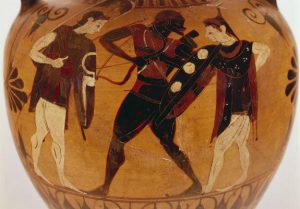
Propertius describes the people of Memnon, a king of Ethiopia described in accounts of the Trojan war as an incredibly skilled warrior (perhaps even rivaling Achilles himself) who died aiding the Trojans.
Memnon Departs for Troy (circa 550-525 B.C.E) Greek
Propertius uses an ablative here for the duration of time in a rather unusual way, as an accusative would be more conventionally appropriate. This is sometimes known as the “Propertian ablative of time” as it only seems to appear in Propertius’ writing.
When translating it is best to neglect this “an” until the rest has been translated, as its use here is confusing and nearly untranslatable, and the rest of the lines are much easier to interpret without first reading the “an”.