Stalled

Helping you before your schoolwork stalls

Page 5 of 5

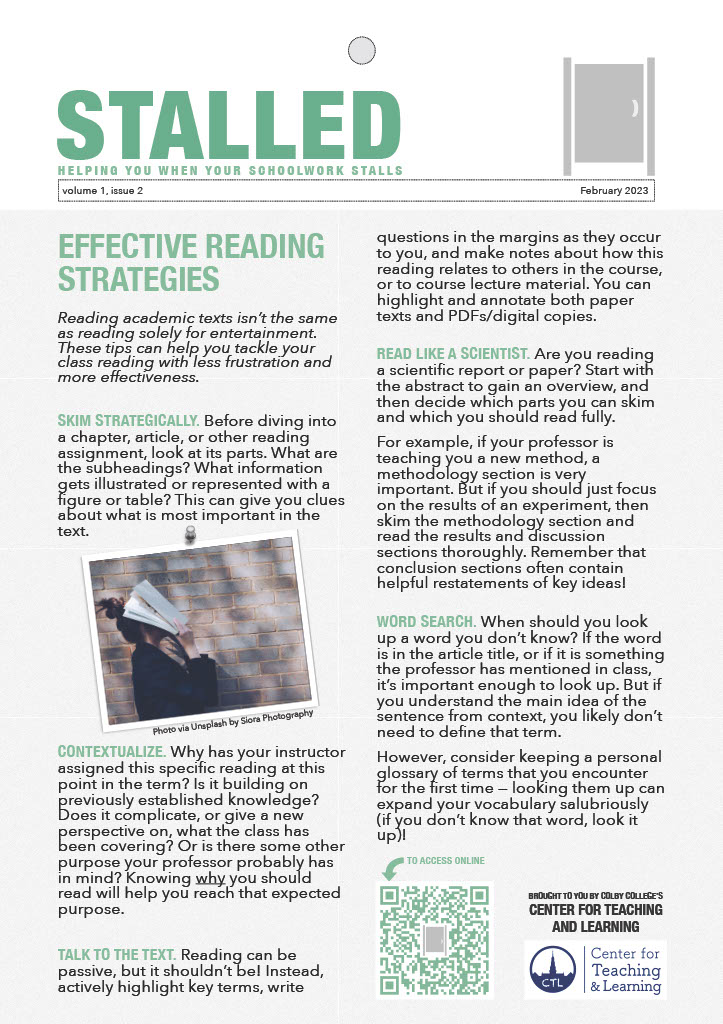
Managing fear of public speaking (1.5)

Stalled poster 1.5 (text is pasted below)


If you have fears about speaking in public, you’re in good company, because most college students feel this way. Just in time for CLAS and end-of-term presentations, here are suggestions on how to manage that fear.

KNOW YOUR AUDIENCE. Speaking tasks may feel like they are all about you, but the real focus is how to deliver benefit to your audience. So think about what your audience needs, and remember that the focus is on the talk’s content, not really on you.

BUT YOU MATTER, TOO! Take care of your physical self. Don’t eat immediately before your talk, but do eat something with protein on the talk day. Use the restroom beforehand, and keep a bottle of water handy when you’re speaking, too.

YOU’RE IN GOOD COMPANY. Notable public figures — including Thomas Jefferson, Mahatma Gandhi, and even Beyoncé — have had public speaking anxiety. But they achieved success in spite of their fears — and so can you!

PRACTICE, PRACTICE, PRACTICE! Practice is key to a good talk, and it is also helpful in easing fear. How?

  • Planning well ahead of your deadline makes it likelier that your talk will have good structure and content, which in turn often reduces speakers’ anxiety.

  • Practicing lets you discover difficult words to pronounce, giving you time to learn them (or find alternatives).

  • Practicing a talk makes you know the content better, allowing you to speak more freely (helping your delivery) and helping you feel more in control.

  • Practicing with your visuals gives you a chance to troubleshoot them, correcting mistakes and giving you time to make changes as needed.

  • Practicing gives a clearer sense of your talk’s timing, which provides more control over the pacing and delivery of the talk.


EYE CONTACT? Do you have a hard time looking audience members in the eye? If eye contact is uncomfortable, you can give the same impression of being attentive to the audience by looking at people’s ears instead.

TAKE A BREATH. Deep breathing can help calm anxiety (even the Mayo Clinic says so!). Take deep, slow breaths in through your nose, and exhale slowly through your mouth. Do this several times before you take the stage to help control your heart rate and calm yourself down.
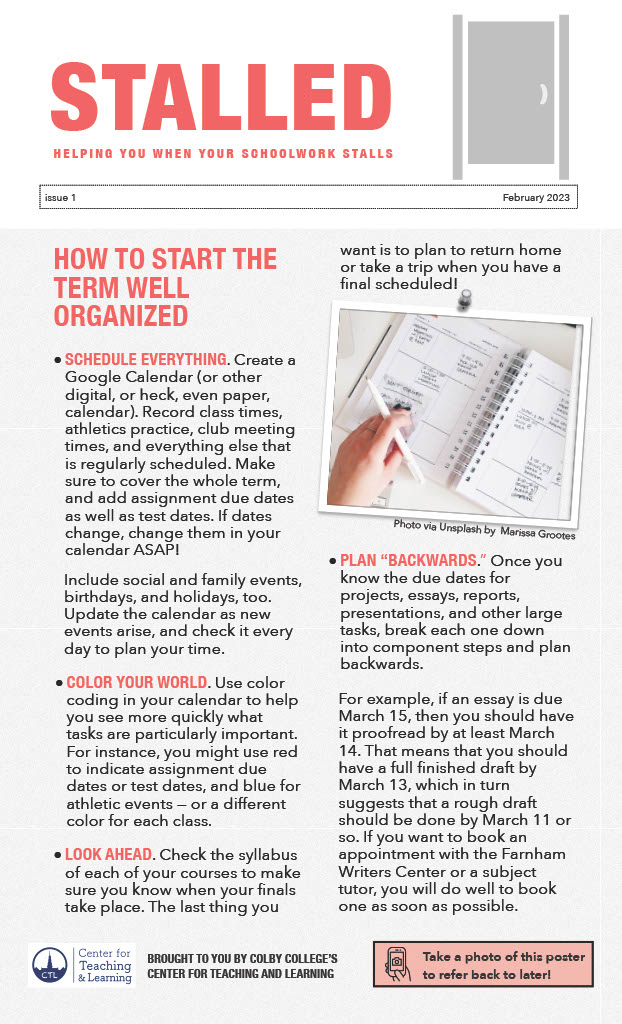
Campus resources for students (1.4)

Stalled poster 1.4 (text is pasted below)


Colby has many resources for students, and you might not be familiar with all of them. These are a few of the key resources that you should know.

CLASS DEANS. There is a dean for each class year, and they are invaluable resources. If you have a problem and are unsure where to turn, contact your class dean first. They know the most usual issues that students face in the different stages of their time at Colby, but they are pros with handling unusual situations, too. They can also connect you to a Learning Consultant if one-on-one academic support is needed.

ACCOMMODATIONS. Colby’s Office for Student Access and Disability Services helps students get the academic accommodations they need to ensure equitable education opportunities.

MAKING CONNECTIONS. Davis Connects connects students with internships, research opportunities, and information about graduate school and career opportunities. But they also help connect you to off-campus study as well as connect you to funding for those experiences.

PUGH CENTER. A place that fosters inclusion and equity, the Pugh Center is a multicultural common ground and home to many clubs/organizations, programs, and support services.

EMOTIONAL SUPPORT. Make sure to access counseling services when you need them — that’s why Colby has a counselor team! But don’t forget that Colby also has compassionate support in its Office of Religious and Spiritual Life.

FIRST-GEN STUDENTS. Colby’s First-Generation-to-College/Low-Income Program for Student Success supports students and their families throughout their Colby career.

INTERNATIONAL STUDENTS. The Office of Student Financial Services helps with issues relating to immigration, taxes, and student employment, and the Pugh Center (see above) provides cultural activities.

STUDENT SUCCESS FUND. If financial hardship interferes with your path to academic success, meet with the Student Success and Support Case Manager to discuss the Student Success Fund.

If links are broken, search on Colby’s website to find contact info for any of these resources.

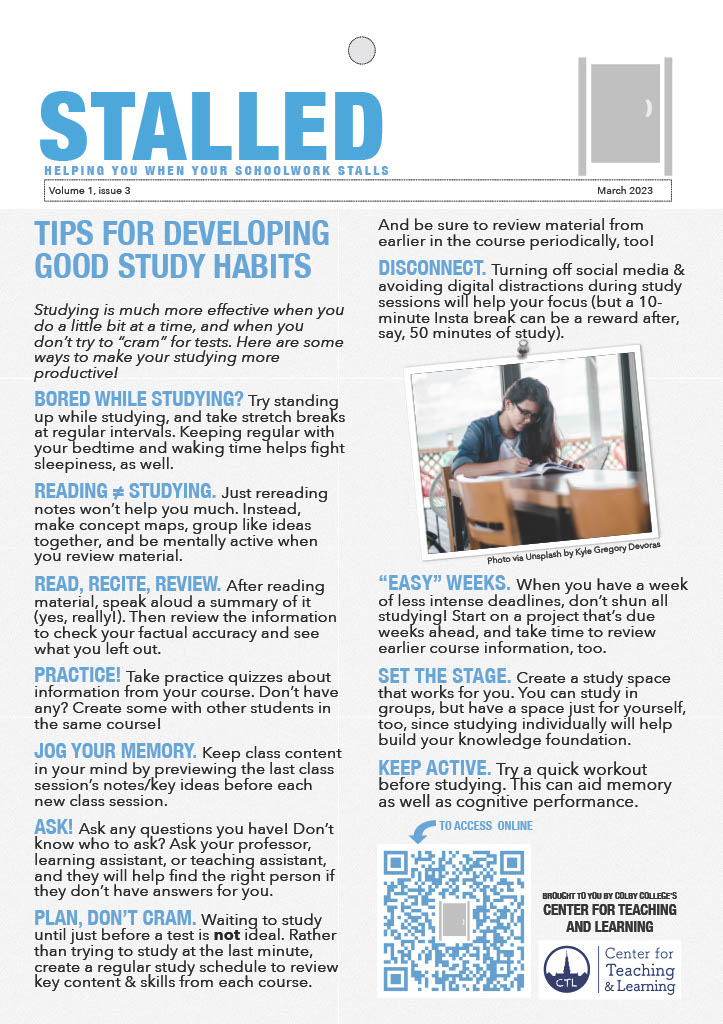
Tips for developing good study habits (1.3)

Stalled poster 1.3 (text is pasted below)

Studying is much more effective when you do a little bit at a time, and when you don’t try to “cram” for tests. Here are some ways to make your studying more productive!

BORED WHILE STUDYING? Try standing up while studying, and take stretch breaks at regular intervals. Keeping regular with your bedtime and waking time helps fight sleepiness, as well.

READING ≠ STUDYING. Just rereading notes won’t help you much. Instead, make concept maps, group like ideas together, and be mentally active when you review material.

READ, RECITE, REVIEW. After reading material, speak aloud a summary of it (yes. really!). Then review the information to check your factual accuracy and see what you left out.

PRACTICE! Take practice quizzes about information from your course. Don’t have any? Create some with other students in the same course!

JOG YOUR MEMORY. Keep class content in your mind by previewing the last class session’s notes/key ideas before each new class session.

ASK! Ask any questions you have! Don’t know who to ask? Ask your professor, learning assistant, or teaching assistant, and they will help you find the right person if they don’t have the answers for you.

PLAN, DON’T CRAM. Waiting to study until just before a test is not idea. Rather than trying to study at the last minute, create a regular study schedule to review key content & skills from each course. And be sure to review material from earlier in the course periodically, too!

DISCONNECT. Turning off social media & avoiding digital distractions during study sessions will help your focus (but a 10-minute Insta break can be a reward after, say, 50 minutes of study).

“EASY” WEEKS. When you have a week of less intense deadlines, don’t shun all studying! Start on a project that’s due weeks ahead, and take time to review earlier course information, too.

SET THE STAGE. Create a study space that works for you. You can study in groups, but have a space just for yourself, too, since studying individually will help build your knowledge foundation.

KEEP ACTIVE. Try a quick workout before studying. This can aid memory as well as cognitive performance.

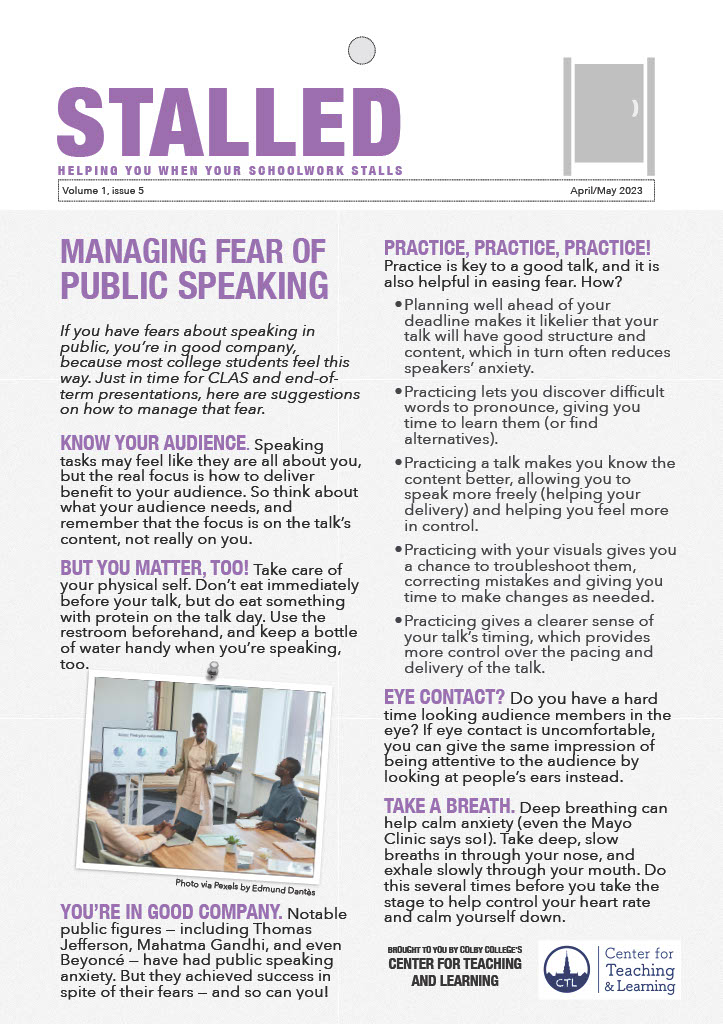
Effective reading strategies (1.2)

Stalled poster 1.2 (text is pasted below)

Reading academic texts isn’t the same as reading solely for entertainment. These tips can help you tackle your class reading with less frustration and more effectiveness.

SKIM STRATEGICALLY. Before diving into a chapter, article, or other reading assignment, look at its parts. What are the subheadings? What information gets illustrated or represented with a figure or table? This can give you clues about what is most important in the text.

CONTEXTUALIZE. Why has your instructor assigned this specific reading at this point in the term? Is it building on previously established knowledge? Does it complicate, or give a new perspective on, what the class has been covering? Or is there some other purpose your professor probably has in mind? Knowing why you should read will help you reach that expected purpose.

TALK TO THE TEXT. Reading can be passive, but it shouldn’t be! Instead, actively highlight key terms, write questions in the margins as they occur to you, and make notes about how this reading relates to others in the course, or to course lecture material. You can highlight and annotate both paper texts and PDFs/digital copies.

READ LIKE A SCIENTIST. Are you reading a scientific report or paper? Start with the abstract to gain an overview, and then decide which parts you can skim and which you should read fully.


For example, if your professor is teaching you a new method, a methodology section is very important. But if you should just focus on the results of an experiment, then skim the methodology section and read the results and discussion sections thoroughly. Remember that conclusion sections often contain helpful restatements of key ideas!

WORD SEARCH. When should you look up a word you don’t know? If the word is in the article title, or if it is something the professor has mentioned in class, it’s important enough to look up. But if you understand the main idea of the sentence from context, you likely don’t need to define that term.


However, consider keeping a personal glossary of terms that you encounter for the first time — looking them up can expand your vocabulary salubriously (if you don’t know that word, look it up)!

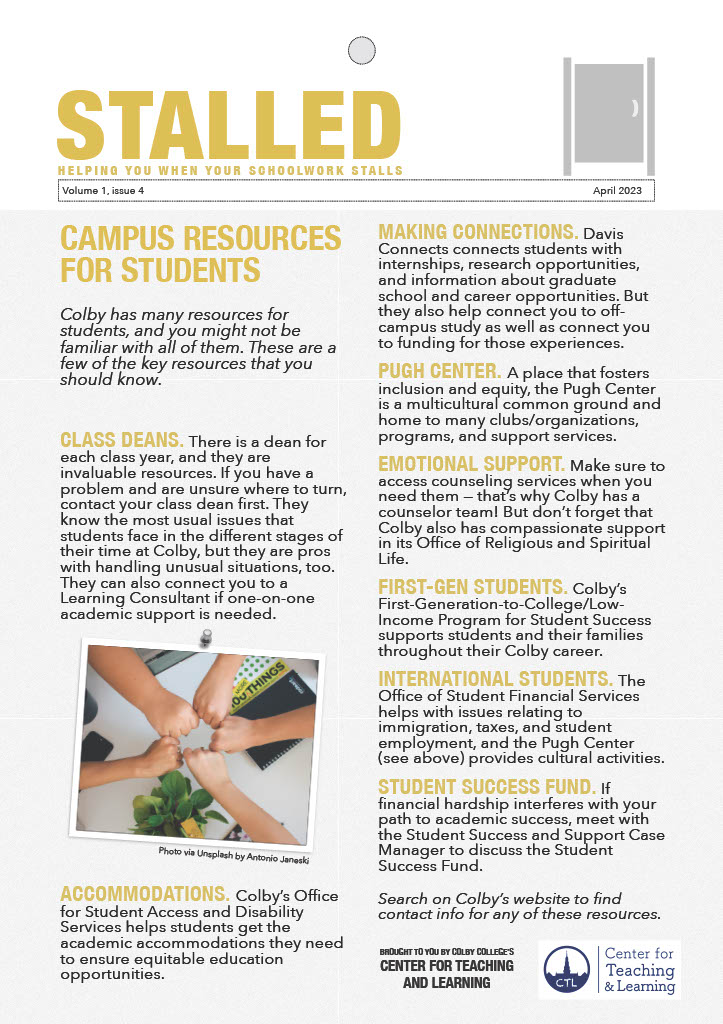
Start the term well organized (1.1)

Stalled poster 1.1 (text is pasted below)

SCHEDULE EVERYTHING. Create a Google Calendar (or other digital, or heck, even paper, calendar). Record class times, athletics practice, club meeting times, and everything else that is regularly scheduled. Make sure to cover the whole term, and add assignment due dates as well as test dates. If dates change, change them in your calendar ASAP!

Include social and family events, birthdays, and holidays, too. Update the calendar as new events arise, and check it every day to plan your time.

COLOR YOUR WORLD. Use color coding in your calendar to help you see more quickly what tasks are particularly important. For instance, you might use red to indicate assignment due dates or test dates, and blue for athletic events — or a different color for each class.

LOOK AHEAD. Check the syllabus of each of your courses to make sure you know when your finals take place. The last thing you want is to plan to return home or take a trip when you have a final scheduled!

PLAN “BACKWARDS.” Once you know the due dates for projects, essays, reports, presentations, and other large tasks, break each one down into component steps and plan backwards.

For example, if an essay is due March 15, then you should have it proofread by at least March 14. That means that you should have a full finished draft by March 13, which in turn suggests that a rough draft should be done by March 11 or so. If you want to book an appointment with the Farnham Writers Center or a subject tutor, you will do well to book one as soon as possible.

Newer posts »

© 2026 Stalled

Theme by Anders Noren — Up ↑