Helping you before your schoolwork stalls

Category: Uncategorized

Breaking down projects (4.9)

When you’re assigned a project, it can sometimes feel overwhelming. One way to lessen that feeling is to break down what you need to do into manageable pieces. This poster gives you some guidance on how to do just that.
HOW TO BREAK DOWN PROJECTS

IDENTIFY KEY DATES. Look at all project due dates. Is there a rough draft or work-in-progress due date? If so, you’ll need to plan to have as full a draft of your project as possible by that date. If there is not a rough draft/work-in-progress date, then work backwards from the final project’s due date. You’ll want to finish your draft with enough time to fact-check, edit, proofread, and check that you have completed all expected aspects of the project task. Or, if it’s a presentation, you’ll need plenty of time to practice.

THINK ABOUT THE STEPS. Think about all pieces of the task, brainstorming all steps that you can think of. Make sure to consult the assignment instructions, if your instructor has provided any, because that can help you identify the steps you need to complete.

These steps can include meeting with a librarian, conducting research (which most likely takes several sessions), assembling data, outlining a report or essay, creating visuals, writing part of a text (thinking about which parts should be written first), meeting with your group (if it’s a group project), and checking the formatting of a text or object that you produce.

BE REALLY SPECIFIC. When you look at your task list, have you been clear about what you have to do with each step? If you’ve used vague terms like “work on” something, or “do” something, that’s a sign that you might not have really clarified what those steps are. If you aren’t clear in your step identification, you might struggle later to complete the tasks. 

So, if you find that you can’t clearly articulate what each task entails, visit your professor’s office hours as soon as you can so that you can acheive clarity about what you need to do with each step of the project. 

ORDER THE STEPS. Some tasks must be done before other tasks, and sometimes it’s quite clear which should come first. Those tasks are relatively easy to put in order.  

However, some tasks might not be put in order so easily. If you’re struggling to figure out task order, talk to your professor as soon as you can — their office hours are ideal for this — so that you can put the steps in good order.

SCHEDULE YOUR STEPS

ESTIMATE TIME PER STEP. How long will it take to complete each task or step? Give your estimations some careful thought, and factor in at least a bit more time for each task than you think you’d need, just to be safe.

REALLY BREAK IT DOWN. If your time estimation for a task is longer than about an hour, think critically about whether you need to break that task down further. Remember, you’ll need to complete these tasks in the time between your classes, in the evenings, and on weekends. So, you need to be realistic about how long you truly have to complete each task.

“CHUNK” THE STEPS. Will some of the steps be easier to complete if you finish them close in time to each other? If so, indicate to yourself which tasks relate to each other and schedule time to do them together. Also, can some separate tasks be done at the same time? For instance, if you’re preparing a presentation, you might be able to perform some preliminary research while you also search for images for your presentation slides. 

KEEP TO THE SCHEDULE. Working backward from the rough draft due date (or, if there is none, the final due date), you already scheduled the tasks. Keep to these deadlines as closely as you can to spread out the work effectively, and keep the project’s quality as strong as possible.

FURTHER RESOURCES 

Bowdoin College Baldwin Center for Learning and Teaching. “Breaking Down Large Projects into Manageable Tasks.”

Fort Hays State University. “Breaking Down Big Assignments and Making a Study Plan.” 

University of Massachusetts, Dartmouth. “Breaking Down Long Term Assignments.”

FACULTY FAUCET

Students will get a better grasp on project planning if you provide them with a clear set of expectations. Consider these aspects: 

  • First years may need more explicit guidance. Setting clear milestones will help reinforce to less experienced students how to section a project into smaller, more manageable pieces.  
  • More senior students can benefit from practicing this skill themselves. In higher-level courses, students might gain deeper insight into project scheduling if you ask them to submit their own project schedule plan, offering suggestions if/as needed.
  • Build in time for formative feedback. Having students submit a project draft (or perform a run-through of a talk) allows you to give them feedback before they earn a grade. This allows a chance for them to correct misconceptions or re-route a project that’s veering outside of what’s expected.

For more on helping students through project and task management, see NC State University’s “Increasing Student Success Through Effective Task Management.”
Colby Student Wellness (4.8)

College life can be hectic. How can we find time to take care of ourselves and stay well? Sometimes we feel guilty when using time to relax and recharge, as if our time “should” be dedicated elsewhere. In actuality, taking small steps to sustain our wellbeing each day can prevent burnout and give us more energy and contentment in the long run.

WELLBEING FROM THE GROUND UP

NOURISH YOUR FOUNDATION. Our ability to give our best to activities and relationships arises from our state of emotional and physical wellbeing. When we are well-rested, connected with support systems, and nourished in body and mind, we are better able to channel our energy to meet the demands of the moment. When we neglect these basic needs, stress, illness, and burnout can follow.

MINI WELLNESS BREAKS. Between classes, clubs, sports, and jobs, it is a lot to juggle. When exploring a new wellness practice, it can be wise to start small. Sometimes a few well-spent minutes are all we need to recenter and find calm. A short walk, some deep breathing, and stretching our bodies all can help us feel less frazzled. What follows are three more simple practices that nourish wellbeing through appreciation for: the world around us (awe), our community & people (gratitude), and ourselves (hygge).

WORLD: SEEK AWE. One mini practice, known as an “awe break,” fosters feelings of wonder and admiration for the world around us. In moments of awe, we can transcend our usual sense of self through sensations of connection to something larger. Many things can inspire awe — experiences of nature, the arts, music, acts of kindness (“moral beauty”), and more. Colby has a beautiful campus, full of remarkable resources and people. Pausing for an awe break is an intentional choice to direct our attention to these details around us — mountains on the horizon, sounds and sights of wildlife, light and shadow on the landscape. Inward focus shifts outward, cultivating feelings of awe that are associated with:

  • Reduced stress & depressive symptoms
  • Increased generosity & compassion
  • Decreased inflammation, for physical health  

COMMUNITY: EXPRESS GRATITUDE. Another simple practice to slip into a busy schedule is taking a few moments to express gratitude. Journaling, quiet self-reflection, or a thank you note: appreciation can be expressed in many ways. Practicing gratitude regularly can gradually shift how we perceive and react to the world by growing habitual awareness of what and who enriches our lives. A grateful lens becomes our default vantage point, associated with: 

  • Reduced stress & anxiety
  • Strengthened relationships & social bonding
  • Improved sleep & immunity

SELF: ENJOY HYGGE. A Danish practice called hygge (pronounced “hoo-gah”) embraces the value of slowing down and nestling into a peaceful atmosphere, especially in the winter months. Yet finding these quiet spaces to unwind can be challenging on a busy campus. To retreat from the flurry around us, all are welcome to come relax in our Student Wellness Space (Garrison-Foster 208). Curl up in a comfy spot and sip our tea or hot cocoa, amid mellow lighting, mindfulness tools, art activities, games, books, and more. Embrace the coziness of hygge and come unplug, take a nap, or even practice yoga, and decompress from busy campus life.

CONNECT WITH US. The Garrison-Foster building is the hub for student wellbeing on campus. On the 2nd floor are the offices of Student Wellness, Outdoor Education, and Counseling Services, with staff, spaces, programs, and resources to support your mental health and holistic wellbeing.

FURTHER RESOURCES 

Brown University Health. “Embrace Hygge & Learn to Love Winter.”

Greater Good Science. “The Science of Awe.”

Greater Good Science. “The Science of Gratitude.”

FACULTY FAUCET

As the saying goes, “you cannot pour from an empty cup.” Safeguarding time for wellness practices like these is equally foundational for faculty and staff, to fulfill our roles in supporting students. Doing so also affirms the value of these practices and models the prioritization of balance and wellbeing. Reach out to the Office of Student Wellness ([email protected]) to explore ideas and collaborate.

The University of Pittsburgh makes some suggestions about how faculty can help foster student wellness, including setting assignment due dates as 9 or 10 PM instead of midnight to encourage healthy sleep patterns. For more ideas, see the U Pitt article “10 Ways Faculty and Staff Can Promote Student Wellbeing.”

Note-taking strategies (4.1)

Note-taking can be a way for you to process course content. Notes taken in class can also be a tool to help you check your understanding of key information — if you have questions or confusions, record them in your notes, and then use them when attending office hours as a way to organize questions you have for your professor.

IN-CLASS NOTE-TAKING AIDS 

TOOLS. Whether you take notes digitally or by hand, use highlighters to flag key points. Then, using a different color, highlight things that confuse you or about which you need more information. Being consistent (using the same color for “key points” in all your notes) makes it easier to find info later.

If you take notes digitally, familiarize yourself with the highlighting/color tools of your software before using it in class. If you take notes by hand, bring highlighters (ideally of at least 2 colors) to each class session.

JUST ASK! While not writing every word that your prof says is a good start, different classes necessitate different note-taking approaches. Ask your professors — and if you have them, Learning Assistants or Teaching Assistants — about useful strategies for note-taking in each specific course.

NOTE-TAKING METHODS

ALL-PURPOSE NOTES. There’s already been a Stalled poster on the Cornell Method, which is a useful all-purpose note-taking method. Other methods include:

  • Outline method: Taking notes in outline form. This method has you identifying main ideas, supporting points, and examples/details, and indenting the support and examples/details under each main idea.
  • Writing on slides: When your professor provides slides ahead of time, taking notes on (paper or digital copies of) the slides can help you capture details effectively because key ideas are already provided for you.

NOTES FOR SPECIFIC PURPOSES. Some classes require different approaches to notes, including:

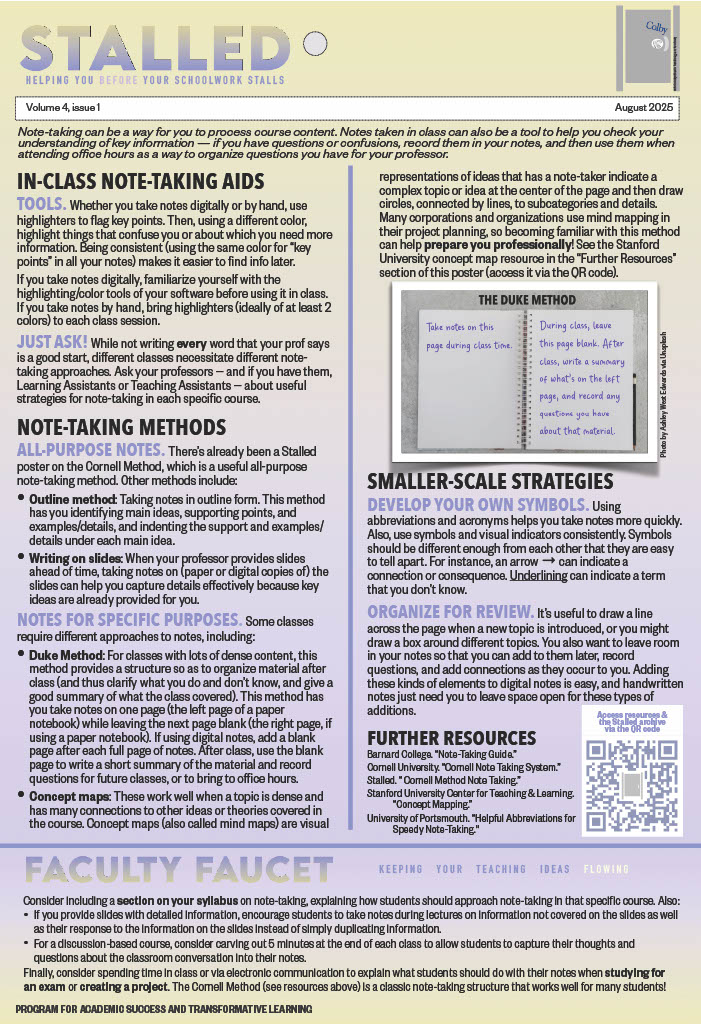
  • Duke Method: For classes with lots of dense content, this method provides a structure so as to organize material after class (and thus clarify what you do and don’t know, and give a good summary of what the class covered). This method has you take notes on one page (the left page of a paper notebook) while leaving the next page blank (the right page, if using a paper notebook). If using digital notes, add a blank page after each full page of notes. After class, use the blank page to write a short summary of the material and record questions for future classes, or to bring to office hours.
  • Concept maps: These work well when a topic is dense and has many connections to other ideas or theories covered in the course. Concept maps (also called mind maps) are visual representations of ideas that has a note-taker indicate a complex topic or idea at the center of the page and then draw circles, connected by lines, to subcategories and details. Many corporations and organizations use mind mapping in their project planning, so becoming familiar with this method can help prepare you professionally! See the Stanford University concept map resource in the “Further Resources” section of this poster (access it via the QR code).

SMALLER-SCALE STRATEGIES

DEVELOP YOUR OWN SYMBOLS. Using abbreviations and acronyms helps you take notes more quickly. Also, use symbols and visual indicators consistently. Symbols should be different enough from each other that they are easy to tell apart. For instance, an arrow → can indicate a connection or consequence. Underlining can indicate a term that you don’t know.

ORGANIZE FOR REVIEW. It’s useful to draw a line across the page when a new topic is introduced, or you might draw a box around different topics. You also want to leave room in your notes so that you can add to them later, record questions, and add connections as they occur to you. Adding these kinds of elements to digital notes is easy, and handwritten notes just need you to leave space open for these types of additions.

FURTHER RESOURCES 

Barnard College. “Note-Taking Guide.”

Cornell University. “Cornell Note Taking System.”

Stalled. “ Cornell Method Note Taking.”

Stanford University Center for Teaching & Learning. “Concept Mapping.”

University of Portsmouth. “Helpful Abbreviations for Speedy Note-Taking.”

FACULTY FAUCET

Consider including a section on your syllabus on note-taking, explaining how students should approach note-taking in that specific course. Also: 

  • If you provide slides with detailed information, encourage students to take notes during lectures on information not covered on the slides as well as their response to the information on the slides instead of simply duplicating information. 
  • For a discussion-based course, consider carving out 5 minutes at the end of each class to allow students to capture their thoughts and questions about the classroom conversation into their notes. 

Finally, consider spending time in class or via electronic communication to explain what students should do with their notes when studying for an exam or creating a project. The Cornell Method (see resources above) is a classic note-taking structure that works well for many students!

© 2026 Stalled

Theme by Anders Noren — Up ↑