You might have learned some notetaking skills in high school … but most students haven’t. Use these tips to help you create notes that will facilitate better learning and aid in using your time effectively.
TAKING NOTES IN CLASS
PREVIEW. In the syllabus or class schedule, many professors include topics for each session. Take a look at that to give you a sense of what the plan is for the session. Then, preview the readings assigned for that class session by skimming them. This will help you know what to expect, and it helps you formulate questions to ask during the class session. If your professor provides PowerPoint slides ahead of time, it can help to review those, too — but you can also compare your notes to the slides after class to see if you missed any key points.
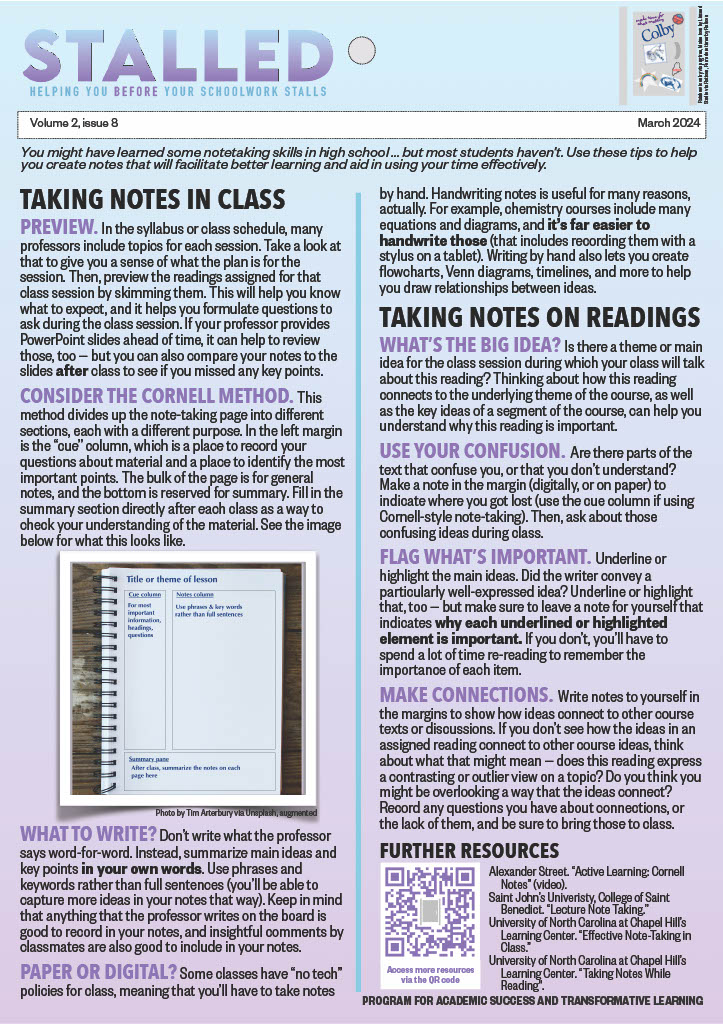
CONSIDER THE CORNELL METHOD. This method divides up the note-taking page into different sections, each with a different purpose. In the left margin is the “cue” column, which is a place to record your questions about material and a place to identify the most important points. The bulk of the page is for general notes, and the bottom is reserved for summary. Fill in the summary section directly after each class as a way to check your understanding of the material. See the image below for what this looks like.
WHAT TO WRITE? Don’t write what the professor says word-for-word. Instead, summarize main ideas and key points in your own words. Use phrases and keywords rather than full sentences (you’ll be able to capture more ideas in your notes that way). Keep in mind that anything that the professor writes on the board is good to record in your notes, and insightful comments by classmates are also good to include in your notes.
PAPER OR DIGITAL? Some classes have “no tech” policies for class, meaning that you’ll have to take notes by hand. Handwriting notes is useful for many reasons, actually. For example, chemistry courses include many equations and diagrams, and it’s far easier to handwrite those (that includes recording them with a stylus on a tablet). Writing by hand also lets you create flowcharts, Venn diagrams, timelines, and more to help you draw relationships between ideas.
TAKING NOTES ON READINGS
WHAT’S THE BIG IDEA? Is there a theme or main idea for the class session during which your class will talk about this reading? Thinking about how this reading connects to the underlying theme of the course, as well as the key ideas of a segment of the course, can help you understand why this reading is important.
USE YOUR CONFUSION. Are there parts of the text that confuse you, or that you don’t understand? Make a note in the margin (digitally, or on paper) to indicate where you got lost (use the cue column if using Cornell-style note-taking). Then, ask about those confusing ideas during class.
FLAG WHAT’S IMPORTANT. Underline or highlight the main ideas. Did the writer convey a particularly well-expressed idea? Underline or highlight that, too — but make sure to leave a note for yourself that indicates why each underlined or highlighted element is important. If you don’t, you’ll have to spend a lot of time re-reading to remember the importance of each item.
MAKE CONNECTIONS. Write notes to yourself in the margins to show how ideas connect to other course texts or discussions. If you don’t see how the ideas in an assigned reading connect to other course ideas, think about what that might mean — does this reading express a contrasting or outlier view on a topic? Do you think you might be overlooking a way that the ideas connect? Record any questions you have about connections, or the lack of them, and be sure to bring those to class.
FURTHER RESOURCES
Alexander Street. “Active Learning: Cornell Notes” (video).
Saint John’s UniverSIty, College of Saint Benedict. “Lecture Note Taking.”
University of North Carolina at Chapel Hill’s Learning Center. “Effective Note-Taking in Class.”
University of North Carolina at Chapel Hill’s Learning Center. “Taking Notes While Reading“.