Helping you before your schoolwork stalls

Category: Colby resources

Colby Global Education Opportunities (5.3)

The key to having a successful global learning experience is to spend time researching possibilities, thinking about your goals, considering your plans, and talking to others. How do you do that? Read on!
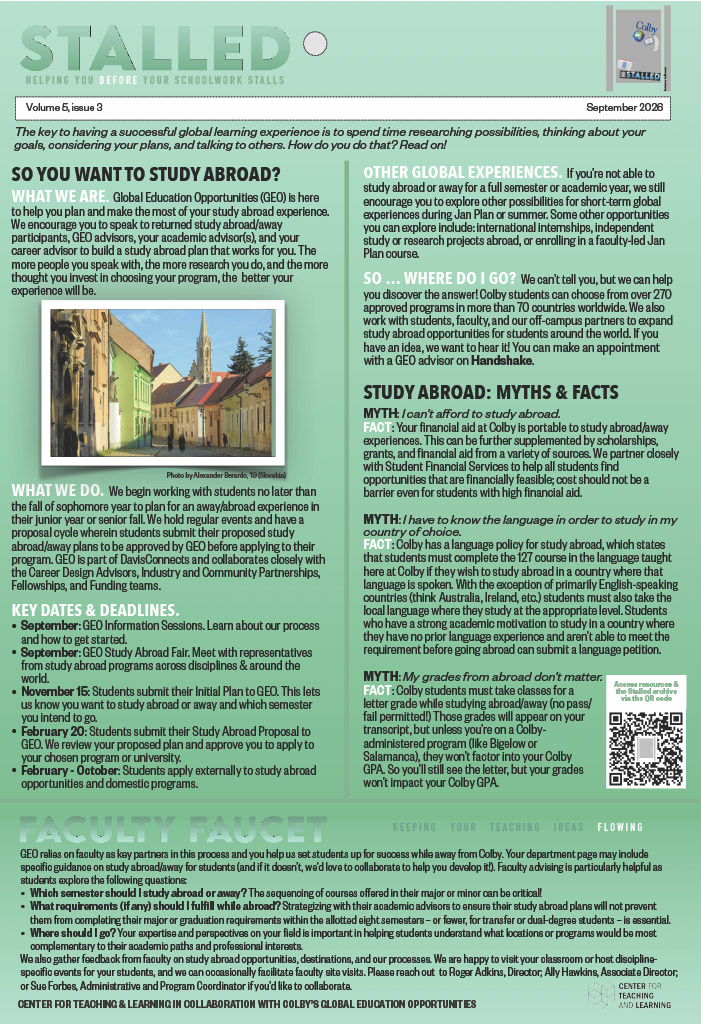
SO YOU WANT TO STUDY ABROAD?

WHAT WE ARE.Global Education Opportunities (GEO) is here to help you plan and make the most of your study abroad experience. We encourage you to speak to returned study abroad/away participants, GEO advisors, your academic advisor(s), and your career advisor to build a study abroad plan that works for you. The more people you speak with, the more research you do, and the more thought you invest in choosing your program, the  better your experience will be.

WHAT WE DO. We begin working with students no later than the fall of sophomore year to plan for an away/abroad experience in their junior year or senior fall. We hold regular events and have a proposal cycle wherein students submit their proposed study abroad/away plans to be approved by GEO before applying to their program. GEO is part of DavisConnects and collaborates closely with the Career Design Advisors, Industry and Community Partnerships, Fellowships, and Funding teams.

KEY DATES & DEADLINES  

  • September: GEO Information Sessions. Learn about our process and how to get started. 
  • September: GEO Study Abroad Fair. Meet with representatives from study abroad programs across disciplines & around the world. 
  • November 15: Students submit their Initial Plan to GEO. This lets us know you want to study abroad or away and which semester you intend to go.
  • February 20: Students submit their Study Abroad Proposal to GEO. We review your proposed plan and approve you to apply to your chosen program or university.
  • February – October: Students apply externally to study abroad opportunities and domestic programs.

OTHER GLOBAL EXPERIENCES. If you’re not able to study abroad or away for a full semester or academic year, we still encourage you to explore other possibilities for short-term global experiences during Jan Plan or summer. Some other opportunities you can explore include: international internships, independent study or research projects abroad, or enrolling in a faculty-led Jan Plan course.

SO … WHERE DO I GO? We can’t tell you, but we can help you discover the answer! Colby students can choose from over 270 approved programs in more than 70 countries worldwide. We also work with students, faculty, and our off-campus partners to expand study abroad opportunities for students around the world. If you have an idea, we want to hear it! You can make an appointment with a GEO advisor on Handshake.

STUDY ABROAD: MYTHS & FACTS

MYTH: I can’t afford to study abroad.

FACT: Your financial aid at Colby is portable to study abroad/away experiences. This can be further supplemented by scholarships, grants, and financial aid from a variety of sources. We partner closely with Student Financial Services to help all students find opportunities that are financially feasible; cost should not be a barrier even for students with high financial aid. 

MYTH: I have to know the language in order to study in my country of choice.

FACT: Colby has a language policy for study abroad, which states that students must complete the 127 course in the language taught here at Colby if they wish to study abroad in a country where that language is spoken. With the exception of primarily English-speaking countries (think Australia, Ireland, etc.) students must also take the local language where they study at the appropriate level. Students who have a strong academic motivation to study in a country where they have no prior language experience and aren’t able to meet the requirement before going abroad can submit a language petition. 

MYTH: My grades from abroad don’t matter.

FACT: Colby students must take classes for a letter grade while studying abroad/away (no pass/fail permitted!) Those grades will appear on your transcript, but unless you’re on a Colby-administered program (like Bigelow or Salamanca), they won’t factor into your Colby GPA. So you’ll still see the letter, but your grades won’t impact your Colby GPA. 

FACULTY FAUCET

GEO relies on faculty as key partners in this process and you help us set students up for success while away from Colby. Your department page may include specific guidance on study abroad/away for students (and if it doesn’t, we’d love to collaborate to help you develop it!). Faculty advising is particularly helpful as students explore the following questions: 

  • Which semester should I study abroad or away? The sequencing of courses offered in their major or minor can be critical!
  • What requirements (if any) should I fulfill while abroad? Strategizing with their academic advisors to ensure their study abroad plans will not prevent them from completing their major or graduation requirements within the allotted eight semesters – or fewer, for transfer or dual-degree students – is essential.
  • Where should I go? Your expertise and perspectives on your field is important in helping students understand what locations or programs would be most complementary to their academic paths and professional interests. 

We also gather feedback from faculty on study abroad opportunities, destinations, and our processes. We are happy to visit your classroom or host discipline-specific events for your students, and we can occasionally facilitate faculty site visits. Please reach out  to Roger Adkins, Director; Ally Hawkins, Associate Director; or Sue Forbes, Administrative and Program Coordinator if you’d like to collaborate. 
Mule Works (4.3)

The Colby Mule Works Innovation Lab is a free makerspace on the Street in Miller Library, where students from every discipline — regardless of experience level — may come together to explore interactive technologies, such as 3D printing, sewing, virtual reality & laser cutting, and use these tools to generate innovative forms of scholarship and creative expression.

WHAT IS MULE WORKS?

MAKE YOUR WORLD. Mule Works offers a wealth of maker tools to support your goals, whether academic or personal, artistic or technical. With lab computers boasting CAD, 3D modeling, and 2D design tools, a fleet of Bambu 3D printers – including one multi-color unit – a high-power laser cutter/engraver, Singer sewing machines, and a soldering station. Developing these skills can look great on a resume, or may inspire your entrepreneurial spirit! 

We’re not just tools! Mule Works offers free tutorials, materials, and supplies on a limited basis. Get started with little to no cost.

WHO CAN USE THE LAB? The lab is student-focused with a priority for academics, but we are open for anyone at Colby to explore. If you’re a student, Mule Works has open hours from Sunday to Thursday, 3pm to 9pm. Our scheduled workshops are open to all, and we offer one-on-one tutorials if you prefer a personalized learning experience. We can even take workshops on the road, offering lessons during any class that wants to use our resources for learning. Let our knowledgeable team show you what you’re capable of!

Making is not just for artists, and it’s not just for engineers! Anyone can take the tools and technologies in Mule Works to create. We welcome all identities and pursuits, and only ask that you bring your most curious self.

WHAT IF I DON’T KNOW WHAT I’M DOING

In addition to our suite of technology, you’ll find a team of enthusiastic staff ready to help you. Whether it’s in our group workshops – with topics like 3D Printing, 3D design, soldering, and more – or through personal tutoring, you can get started quickly and easily.

We aren’t just here to teach, we’re here for technical and creative support, too. Running into a problem? Reach out to our staff and find out how we can help you over that obstacle. Have an idea, but not sure where to start? We can help with that too!

RELAX & HAVE FUN! Mule Works is not just a place to get things done. It’s also a place to unwind. With a wireless Virtual Reality setup and a stream of new 3D experiences to explore, we’re a perfect destination to break from the stress of your studies. Favorites like Beat Saber, Superhot, Walkabout Mini Golf, and Skyrim are only a few wrist-flicks away from being your next adventure.

Have an interest in game design? Create your own adventure in Unity or Unreal Engine and test it in our lab! For as long as you’re with Colby, you have access to our high quality tools, allowing you the chance to make your dream a reality.

VR can bring real-world experiences in learning without ever leaving the campus. You don’t need to fly to Japan to stand on Mount Fuji, it’s right here at Mule Works with Google Earth!

GETTING STARTED. There are many ways to engage with Mule Works!

  • Drop in during our regular open hours. A student tutor can help you get started.
  • Sign up for one of our workshops, advertised in Colby Now, or through the QR code (bottom right).
  • Email [email protected] for general questions or to talk about a specific project.

FURTHER INFORMATION 

  • Mule Works open hours: Sun. – Thurs., 3:00 – 9:00 PM. During this time anyone can drop in and use the lab. We also have off-hours availability for course instruction or academic projects
  • Mule Works website (use QR code to the right)

FACULTY FAUCET

The Colby Mule Works Innovation Lab can aid you in facilitating active, engaged learning in your classes. The opportunities are almost limitless, but students in previous courses have:

  • Made printmaking blocks and other objects with a digital cutter.
  • Viewed VR simulations of molecules, animal brains, hurricanes, East Asian temples, and more.
  • Created laser-cut interactive maps, acrylic insect cages, and other artefacts.
  • Fabricated game pieces, models, electronics enclosures, and other materials via 3D printing.

If you have an idea that you want to bring to life, contact Mule Works staff, who are happy to consult with you about the possibilities Mule Works can offer you and your courses . Keep in mind, too, that our services might be of use to you in your research! Email [email protected] with your questions, or to set up a time to meet with Calla Orion or Tim Stonesifer. 

Workday Student (3.11)

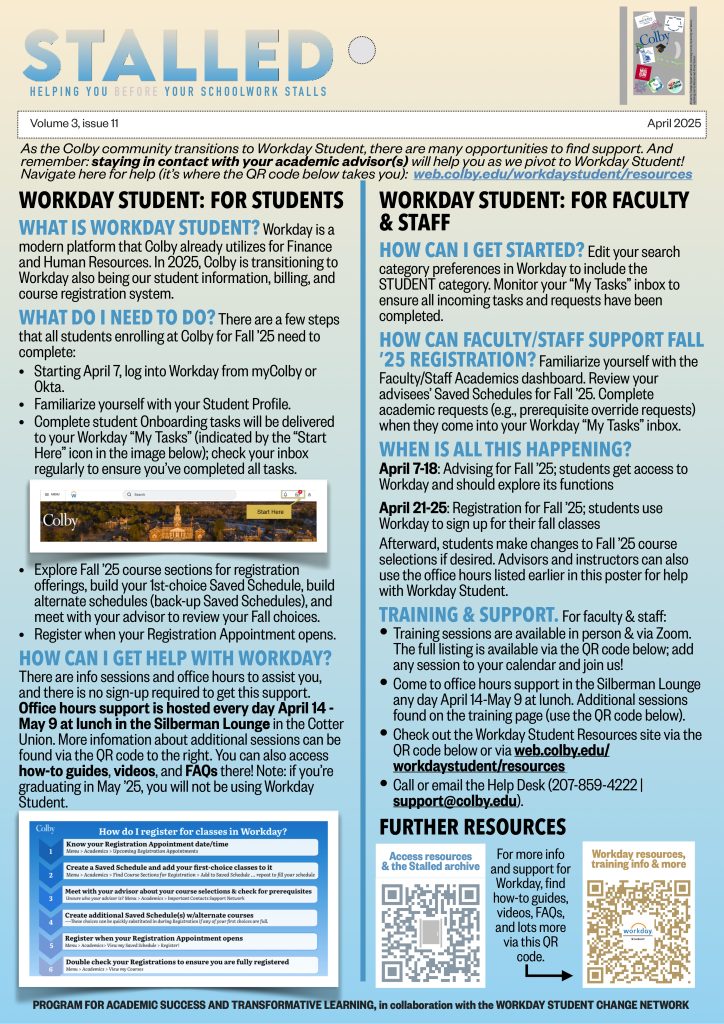
As the Colby community transitions to Workday Student, there are many opportunities to find support. And remember: staying in contact with your academic advisor(s) will help you as we pivot to Workday Student! Navigate here for help (it’s where the QR code below takes you):  web.colby.edu/workdaystudent/resources

WORKDAY STUDENT: FOR STUDENTS

WHAT IS WORKDAY STUDENT? Workday is a modern platform that Colby already utilizes for Finance and Human Resources. In 2025, Colby is transitioning to Workday also being our student information, billing, and course registration system.

WHAT DO I NEED TO DO? There are a few steps that all students enrolling at Colby for Fall ’25 need to complete:

  • Starting April 7, log into Workday from myColby or Okta. 
  • Familiarize yourself with your Student Profile.
  • Complete student Onboarding tasks will be delivered to your Workday “My Tasks” (indicated by the “Start Here” icon in the image below); check your inbox regularly to ensure you’ve completed all tasks.
  • Explore Fall ’25 course sections for registration offerings, build your 1st-choice Saved Schedule, build alternate schedules (back-up Saved Schedules), and meet with your advisor to review your Fall choices.
  • Register when your Registration Appointment opens.

HOW CAN I GET HELP WITH WORKDAY? There are info sessions and office hours to assist you, and there is no sign-up required to get this support. Office hours support is hosted every day April 14 – May 9 at lunch in the Silberman Lounge in the Cotter Union. More information about additional sessions can be found via the QR code to the right. You can also access how-to guides, videos, and FAQs there! Note: if you’re graduating in May ’25, you will not be using Workday Student.

WORKDAY STUDENT: FOR FACULTY & STAFF

HOW CAN I GET STARTED?Edit your search category preferences in Workday to include the STUDENT category. Monitor your “My Tasks” inbox to ensure all incoming tasks and requests have been completed.

HOW CAN FACULTY/STAFF SUPPORT FALL ’25 REGISTRATION? Familiarize yourself with the Faculty/Staff Academics dashboard. Review your advisees’ Saved Schedules for Fall ’25. Complete academic requests (e.g., prerequisite override requests) when they come into your Workday “My Tasks” inbox.

WHEN IS ALL THIS HAPPENING? 

April 7-18: Advising for Fall ’25; students get access to Workday and should explore its functions

April 21-25: Registration for Fall ’25; students use Workday to sign up for their fall classes

Afterward, students make changes to Fall ’25 course selections if desired. Advisors and instructors can also use the office hours listed earlier in this poster for help with Workday Student.

TRAINING & SUPPORT. For faculty & staff:

  • Training sessions are available in person & via Zoom. The full listing is available via the QR code below; add any session to your calendar and join us!
  • Come to office hours support in the Silberman Lounge any day April 14-May 9 at lunch. Additional sessions found on the training page (use the QR code below).
  • Check out the Workday Student Resources site via the QR code below or via web.colby.edu/workdaystudent/resources
  • Call or email the Help Desk (207-859-4222 |[email protected]).

The Colby Museum (3.10)

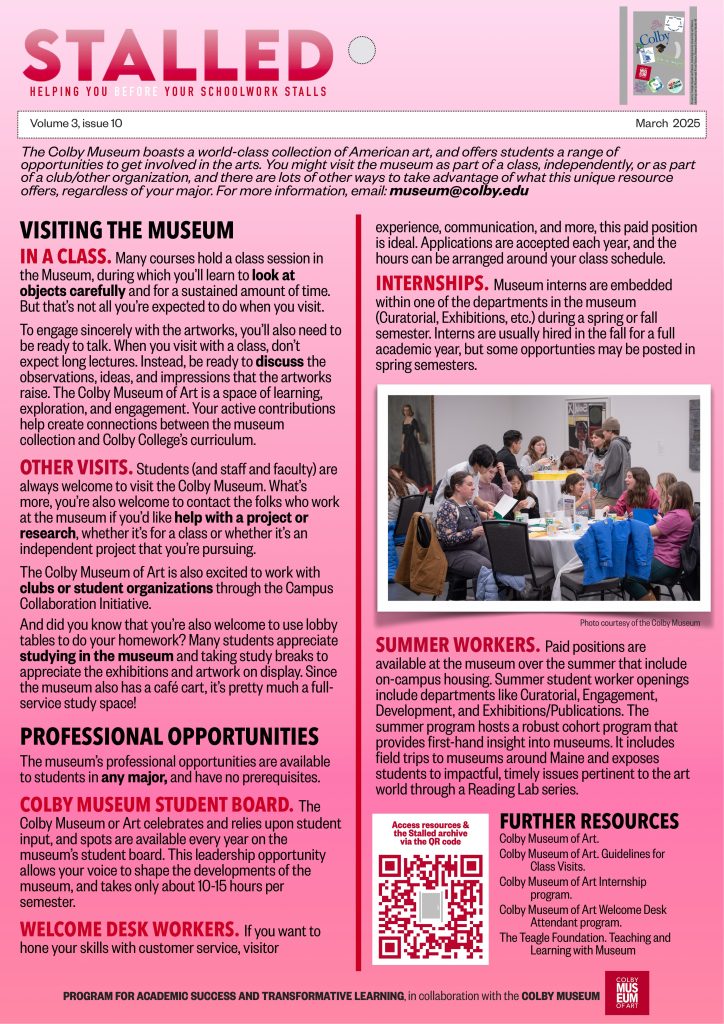
The Colby Museum boasts a world-class collection of American art, and offers students a range of opportunities to get involved in the arts. You might visit the museum as part of a class, independently, or as part of a club/other organization, and there are lots of other ways to take advantage of what this unique resource offers, regardless of your major. For more information, email: [email protected]

VISITING THE MUSEUM 

IN A CLASS. Many courses hold a class session in the Museum, during which you’ll learn to look at objects carefully and for a sustained amount of time. But that’s not all you’re expected to do when you visit.

To engage sincerely with the artworks, you’ll also need to be ready to talk. When you visit with a class, don’t expect long lectures. Instead, be ready to discuss the observations, ideas, and impressions that the artworks raise. The Colby Museum of Art is a space of learning, exploration, and engagement. Your active contributions help create connections between the museum collection and Colby College’s curriculum.

OTHER VISITS. Students (and staff and faculty) are always welcome to visit the Colby Museum. What’s more, you’re also welcome to contact the folks who work at the museum if you’d like help with a project or research, whether it’s for a class or whether it’s an independent project that you’re pursuing. 

The Colby Museum of Art is also excited to work with clubs or student organizations through the Campus Collaboration Initiative. 

And did you know that you’re also welcome to use lobby tables to do your homework? Many students appreciate studying in the museum and taking study breaks to appreciate the exhibitions and artwork on display. Since the museum also has a café cart, it’s pretty much a full-service study space!

PROFESSIONAL OPPORTUNITIES

The museum’s professional opportunities are available to students in any major, and have no prerequisites.

COLBY MUSEUM STUDENT BOARD. The Colby Museum or Art celebrates and relies upon student input, and spots are available every year on the museum’s student board. This leadership opportunity allows your voice to shape the developments of the museum, and takes only about 10-15 hours per semester.

WELCOME DESK WORKERS. If you want to hone your skills with customer service, visitor experience, communication, and more, this paid position is ideal. Applications are accepted each year, and the hours can be arranged around your class schedule.

INTERNSHIPS. Museum interns are embedded within one of the departments in the museum (Curatorial, Exhibitions, etc.) during a spring or fall semester. Interns are usually hired in the fall for a full academic year, but some opportunties may be posted in spring semesters.

SUMMER WORKERS. Paid positions are available at the museum over the summer that include on-campus housing. Summer student worker openings include departments like Curatorial, Engagement, Development, and Exhibitions/Publications. The summer program hosts a robust cohort program that provides first-hand insight into museums. It includes field trips to museums around Maine and exposes students to impactful, timely issues pertinent to the art world through a Reading Lab series. 

FURTHER RESOURCES 

Colby Museum of Art.

Colby Museum of Art. Guidelines for Class Visits.

Colby Museum of Art Internship program. 

Colby Museum of Art Welcome Desk Attendant program.

The Teagle Foundation. Teaching and Learning with Museum Exhibitions

Declaring/changing majors (3.8)

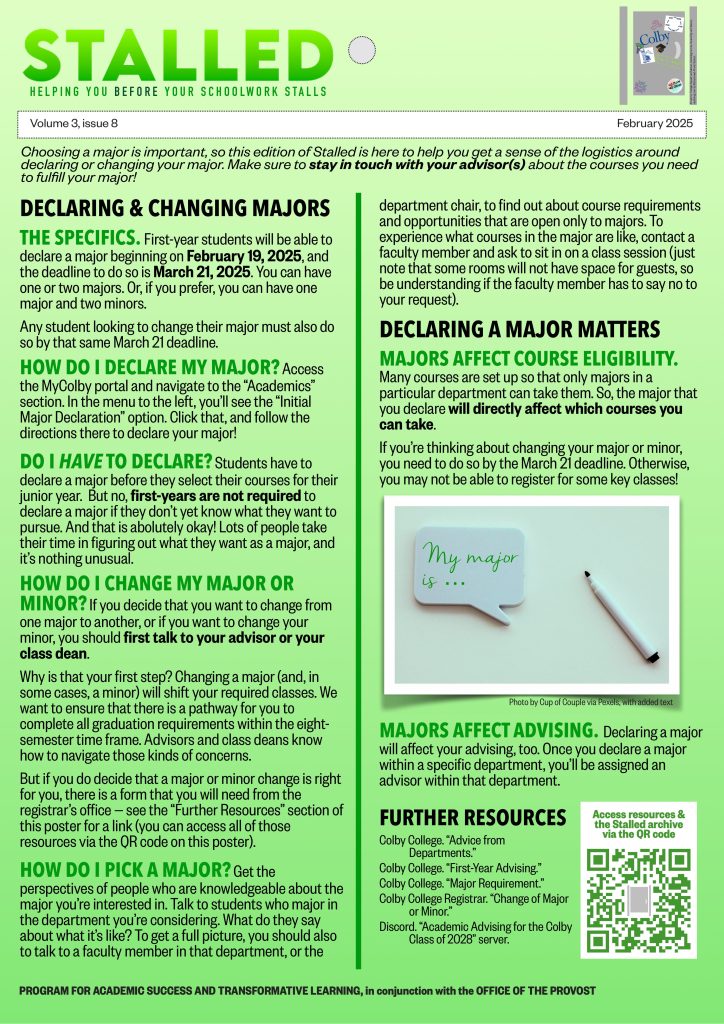
Choosing a major is important, so this edition of Stalled is here to help you get a sense of the logistics around declaring or changing your major. Make sure to stay in touch with your advisor(s) about the courses you need to fulfill your major!

DECLARING & CHANGING MAJORS

THE SPECIFICS. First-year students will be able to declare a major beginning on February 19, 2025, and the deadline to do so is March 21, 2025. You can have one or two majors. Or, if you prefer, you can have one major and two minors.

Any student looking to change their major must also do so by that same March 21 deadline. 

HOW DO I DECLARE MY MAJOR? Access the MyColby portal and navigate to the “Academics” section. In the menu to the left, you’ll see the “Initial Major Declaration” option. Click that, and follow the directions there to declare your major!

DO I HAVE TO DECLARE? Students have to declare a major before they select their courses for their junior year.  But no, first-years are not required to declare a major if they don’t yet know what they want to pursue. And that is abolutely okay! Lots of people take their time in figuring out what they want as a major, and it’s nothing unusual.

HOW DO I CHANGE MY MAJOR OR MINOR? If you decide that you want to change from one major to another, or if you want to change your minor, you should first talk to your advisor or your class dean. 

Why is that your first step? Changing a major (and, in some cases, a minor) will shift your required classes. We want to ensure that there is a pathway for you to complete all graduation requirements within the eight-semester time frame. Advisors and class deans know how to navigate those kinds of concerns.

But if you do decide that a major or minor change is right for you, there is a form that you will need from the registrar’s office — see the “Further Resources” section of this poster for a link (you can access all of those resources via the QR code on this poster).

HOW DO I PICK A MAJOR? Get the perspectives of people who are knowledgeable about the major you’re interested in. Talk to students who major in the department you’re considering. What do they say about what it’s like? To get a full picture, you should also to talk to a faculty member in that department, or the department chair, to find out about course requirements and opportunities that are open only to majors. To experience what courses in the major are like, contact a faculty member and ask to sit in on a class session (just note that some rooms will not have space for guests, so be understanding if the faculty member has to say no to your request).

DECLARING A MAJOR MATTERS

MAJORS AFFECT COURSE ELIGIBILITY. Many courses are set up so that only majors in a particular department can take them. So, the major that you declare will directly affect which courses you can take. 

If you’re thinking about changing your major or minor, you need to do so by the March 21 deadline. Otherwise, you may not be able to register for some key classes!

MAJORS AFFECT ADVISING. Declaring a major will affect your advising, too. Once you declare a major within a specifc department, you’ll be assigned an advisor within that department.

FURTHER RESOURCES 

Colby College. “Advice from Departments.”

Colby College. “First-Year Advising.”

Colby College. “Major Requirement.”

Colby College Registrar. “Change of Major or Minor.”

Discord. “Academic Advising for the Colby Class of 2028” server.

Structured Study Sessions (3.4)

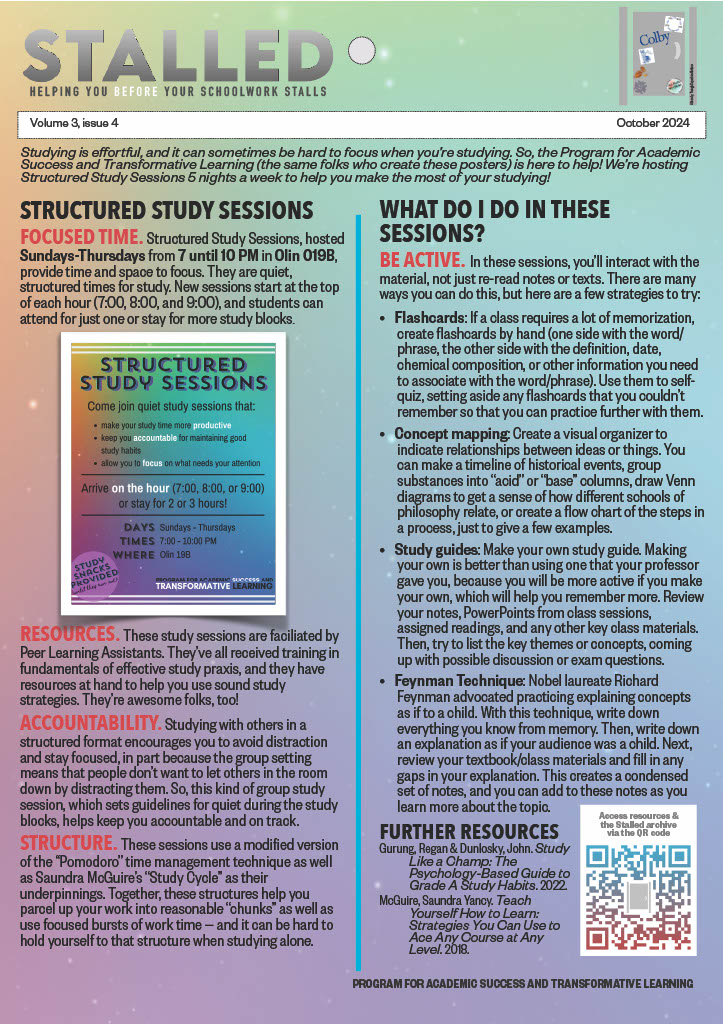
Studying is effortful, and it can sometimes be hard to focus when you’re studying. So, the Program for Academic Success and Transformative Learning (the same folks who create these posters) is here to help! We’re hosting Structured Study Sessions 5 nights a week to help you make the most of your studying!

INTENSE STUDY SESSIONS

FOCUSED TIME. Structured Study Sessions, hosted Sundays-Thursdays from 7 until 10 PM in Olin 019B, provide time and space to focus. They are quiet, structured times for study. New sessions start at the top of each hour (7:00, 8:00, and 9:00), and students can attend for just one or stay for more study blocks.

RESOURCES. These study sessions are faciliated by Peer Learning Assistants. They’ve all received training in fundamentals of effective study praxis, and they have resources at hand to help you use sound study strategies. They’re awesome folks, too!

ACCOUNTABILITY. Studying with others in a structured format encourages you to avoid distraction and stay focused, in part because the group setting means that people don’t want to let others in the room down by distracting them. So, this kind of group study session, which sets guidelines for quiet during the study blocks, helps keep you accountable on better on track.

STRUCTURE. These sessions use a modified version of the “Pomodoro” time management technique as well as Saundra McGuire’s “Study Cycle” as their underpinnings. Together, these structures help you parcel up your work into reasonable “chunks” as well as use focused bursts of work time — and it can be hard to hold yourself to that structure when studying alone.

WHAT DO I DO IN THESE SESSIONS?

BE ACTIVE. In these sessions, you’ll interact with the material, not just re-read notes or texts. There are many ways you can do this, but here are a few strategies to try:

  • Flashcards: If a class requires a lot of memorization, create flashcards by hand (one side with the word/phrase, the other side with the definition, date, chemical composition, or other information you need to associate with the word/phrase). Use them to self-quiz, setting aside any flashcards that you couldn’t remember so that you can practice further with them.
  • Concept mapping: Create a visual organizer to indicate relationships between ideas or things. You can make a timeline of historical events, group substances into “acid” or “base” columns, draw Venn diagrams to get a sense of how different schools of philosophy relate, or create a flow chart of the steps in a process, just to give a few examples.
  • Study guides: Make your own study guide. Making your own is better than using one that your professor gave you, because you will be more active if you make your own, which will help you remember more. Review your notes, PowerPoints from class sessions, assigned readings, and any other key class materials. Then, try to list the key themes or concepts, coming up with possible discussion or exam questions.
  • Feynman Technique: Nobel laureate Richard Feynman advocated practicing explaining concepts as if to a child. With this technique, write down everything you know from memory. Then, write down an explanation as if your audience was a child. Next, review your textbook/class materials and fill in any gaps in your explanation. This creates a condensed set of notes, and you can add to these notes as you learn more about the topic.

FURTHER RESOURCES 

Gurung, Regan & Dunlosky, John. Study Like a Champ: The Psychology-Based Guide to Grade A Study Habits. 2022.

McGuire, Saundra Yancy. Teach Yourself How to Learn: Strategies You Can Use to Ace Any Course at Any Level. 2018.

Academic integrity violations (2.9)

We’ve all heard that academic integrity is something respected and valued at Colby. But what kinds of things violate academic integrity? And what should you do to uphold academic integrity? Read on to learn more.

WHAT’S ACADEMIC INTEGRITY?

NEGLIGENCE vs. DISHONESTY. Academic negligence is a minor unintentional slip-up in academic ethical behavior even though the student should have known better. Colby students should not receive more than one report of academic negligence. 

Academic dishonesty is a significant ethical violation, characterized by willful transgression against academic integrity.  A finding of academic dishonesty results in up to an F in a course (for a 1st report) and a letter in the student’s disciplinary file for 6 years after leaving Colby. But expulsion from the College can result, as well.

SOME INTEGRITY VIOLATIONS. This list is not exhaustive, but is instead intended to help show the range of behaviors that are violations against academic integrity. So, avoid the following:

  • Submitting someone else’s work as your own (including work done by classmates/aquaintances/family members, published material, or material found on the internet)
  • Submitting AI-produced work as your own, and/or not citing AI-generated material even when such material is allowed in assignments
  • Plagiarizing in any way
  • Creating work to be submitted by someone else as their own
  • Giving or receiving answers during an exam or quiz
  • Using unauthorized notes  or materials on an exam or quiz
  • Looking at someone else’s work during an exam or quiz (with or without their knowledge)
  • Obtaining or sharing an unauthorized copy of a test in advance of its scheduled dissemination
  • Using tech inappropriately during assessments or tests, including (but not limited to) accessing Moodle
  • Working with another student/students on an assignment when that is not expressly allowed
  • Stealing or destroying the work of other students
  • Stealing ideas from other students and presenting them as your own
  • Falsifying or fabricating data, references, or citations
  • Turning in work created for another class (unless the professor of the current class explicitly says this is OK)
  • Misrepresenting facts to faculty or administrators
  • Including into an assignment any material that you did not create without citing its source—including not only text but also images, tables, and figures

WHAT YOU SHOULD DO

WHEN IN DOUBT, FIND OUT. Different courses have different guidelines, so it’s imperative to take a good look at the syllabus for each of your courses so that you’ll know what is and isn’t allowed. Also be sure to check assignment instructions, since some professors may have different rules for each assignment.

If you’re still unsure, talk to your professor, either by asking questions in class or by going to their office hours. Also, view the video tutorial/tests from Indiana University linked to the digital version of this poster (via the QR code) to check your plagiarism knowledge. 

REMEMBER WHAT’S IMPORTANT. Most students who are tempted to transgress against academic integrity are worried about their grades. So it’s worthwhile to remember that the consequences for dishonesty are far worse than just a bad grade on an exam or project. Planning ahead and keeping in mind that faculty design courses and assignments to prepare you for post-Colby life will help remove that temptation.

FURTHER RESOURCES 

Colby College . “Academic Integrity.”

Colby College Library Guides. Avoiding Plagiarism: Academic Honesty. Colby College Student Handbook. “Academic Integrity.”

Durranit, Anayat. “What International Students Should Know About Academic Integrity.” US News and World Report (2023).

Indiana University. “How to Recognize Plagiarism: Tutorials and Tests

Campus resources for students (1.4)

Stalled poster 1.4 (text is pasted below)


Colby has many resources for students, and you might not be familiar with all of them. These are a few of the key resources that you should know.

CLASS DEANS. There is a dean for each class year, and they are invaluable resources. If you have a problem and are unsure where to turn, contact your class dean first. They know the most usual issues that students face in the different stages of their time at Colby, but they are pros with handling unusual situations, too. They can also connect you to a Learning Consultant if one-on-one academic support is needed.

ACCOMMODATIONS. Colby’s Office for Student Access and Disability Services helps students get the academic accommodations they need to ensure equitable education opportunities.

MAKING CONNECTIONS. Davis Connects connects students with internships, research opportunities, and information about graduate school and career opportunities. But they also help connect you to off-campus study as well as connect you to funding for those experiences.

PUGH CENTER. A place that fosters inclusion and equity, the Pugh Center is a multicultural common ground and home to many clubs/organizations, programs, and support services.

EMOTIONAL SUPPORT. Make sure to access counseling services when you need them — that’s why Colby has a counselor team! But don’t forget that Colby also has compassionate support in its Office of Religious and Spiritual Life.

FIRST-GEN STUDENTS. Colby’s First-Generation-to-College/Low-Income Program for Student Success supports students and their families throughout their Colby career.

INTERNATIONAL STUDENTS. The Office of Student Financial Services helps with issues relating to immigration, taxes, and student employment, and the Pugh Center (see above) provides cultural activities.

STUDENT SUCCESS FUND. If financial hardship interferes with your path to academic success, meet with the Student Success and Support Case Manager to discuss the Student Success Fund.

If links are broken, search on Colby’s website to find contact info for any of these resources.

© 2026 Stalled

Theme by Anders Noren — Up ↑