Helping you before your schoolwork stalls

Author: khansen (Page 4 of 5)

Academic integrity violations (2.9)

We’ve all heard that academic integrity is something respected and valued at Colby. But what kinds of things violate academic integrity? And what should you do to uphold academic integrity? Read on to learn more.

WHAT’S ACADEMIC INTEGRITY?

NEGLIGENCE vs. DISHONESTY. Academic negligence is a minor unintentional slip-up in academic ethical behavior even though the student should have known better. Colby students should not receive more than one report of academic negligence. 

Academic dishonesty is a significant ethical violation, characterized by willful transgression against academic integrity.  A finding of academic dishonesty results in up to an F in a course (for a 1st report) and a letter in the student’s disciplinary file for 6 years after leaving Colby. But expulsion from the College can result, as well.

SOME INTEGRITY VIOLATIONS. This list is not exhaustive, but is instead intended to help show the range of behaviors that are violations against academic integrity. So, avoid the following:

  • Submitting someone else’s work as your own (including work done by classmates/aquaintances/family members, published material, or material found on the internet)
  • Submitting AI-produced work as your own, and/or not citing AI-generated material even when such material is allowed in assignments
  • Plagiarizing in any way
  • Creating work to be submitted by someone else as their own
  • Giving or receiving answers during an exam or quiz
  • Using unauthorized notes  or materials on an exam or quiz
  • Looking at someone else’s work during an exam or quiz (with or without their knowledge)
  • Obtaining or sharing an unauthorized copy of a test in advance of its scheduled dissemination
  • Using tech inappropriately during assessments or tests, including (but not limited to) accessing Moodle
  • Working with another student/students on an assignment when that is not expressly allowed
  • Stealing or destroying the work of other students
  • Stealing ideas from other students and presenting them as your own
  • Falsifying or fabricating data, references, or citations
  • Turning in work created for another class (unless the professor of the current class explicitly says this is OK)
  • Misrepresenting facts to faculty or administrators
  • Including into an assignment any material that you did not create without citing its source—including not only text but also images, tables, and figures

WHAT YOU SHOULD DO

WHEN IN DOUBT, FIND OUT. Different courses have different guidelines, so it’s imperative to take a good look at the syllabus for each of your courses so that you’ll know what is and isn’t allowed. Also be sure to check assignment instructions, since some professors may have different rules for each assignment.

If you’re still unsure, talk to your professor, either by asking questions in class or by going to their office hours. Also, view the video tutorial/tests from Indiana University linked to the digital version of this poster (via the QR code) to check your plagiarism knowledge. 

REMEMBER WHAT’S IMPORTANT. Most students who are tempted to transgress against academic integrity are worried about their grades. So it’s worthwhile to remember that the consequences for dishonesty are far worse than just a bad grade on an exam or project. Planning ahead and keeping in mind that faculty design courses and assignments to prepare you for post-Colby life will help remove that temptation.

FURTHER RESOURCES 

Colby College . “Academic Integrity.”

Colby College Library Guides. Avoiding Plagiarism: Academic Honesty. Colby College Student Handbook. “Academic Integrity.”

Durranit, Anayat. “What International Students Should Know About Academic Integrity.” US News and World Report (2023).

Indiana University. “How to Recognize Plagiarism: Tutorials and Tests
Note taking (2.8)

You might have learned some notetaking skills in high school … but most students haven’t. Use these tips to help you create notes that will facilitate better learning and aid in using your time effectively.

TAKING NOTES IN CLASS

PREVIEW. In the syllabus or class schedule, many professors include topics for each session. Take a look at that to give you a sense of what the plan is for the session. Then, preview the readings assigned for that class session by skimming them. This will help you know what to expect, and it helps you formulate questions to ask during the class session. If your professor provides PowerPoint slides ahead of time, it can help to review those, too — but you can also compare your notes to the slides after class to see if you missed any key points.

CONSIDER THE CORNELL METHOD. This method divides up the note-taking page into different sections, each with a different purpose. In the left margin is the “cue” column, which is a place to record your questions about material and a place to identify the most important points. The bulk of the page is for general notes, and the bottom is reserved for summary. Fill in the summary section directly after each class as a way to check your understanding of the material. See the image below for what this looks like.

WHAT TO WRITE? Don’t write what the professor says word-for-word. Instead, summarize main ideas and key points in your own words. Use phrases and keywords rather than full sentences (you’ll be able to capture more ideas in your notes that way). Keep in mind that anything that the professor writes on the board is good to record in your notes, and insightful comments by classmates are also good to include in your notes.

PAPER OR DIGITAL? Some classes have “no tech” policies for class, meaning that you’ll have to take notes by hand. Handwriting notes is useful for many reasons, actually. For example, chemistry courses include many equations and diagrams, and it’s far easier to handwrite those (that includes recording them with a stylus on a tablet). Writing by hand also lets you create flowcharts, Venn diagrams, timelines, and more to help you draw relationships between ideas.

TAKING NOTES ON READINGS

WHAT’S THE BIG IDEA? Is there a theme or main idea for the class session during which your class will talk about this reading? Thinking about how this reading connects to the underlying theme of the course, as well as the key ideas of a segment of the course, can help you understand why this reading is important. 

USE YOUR CONFUSION. Are there parts of the text that confuse you, or that you don’t understand? Make a note in the margin (digitally, or on paper) to indicate where you got lost (use the cue column if using Cornell-style note-taking). Then, ask about those confusing ideas during class.

FLAG WHAT’S IMPORTANT. Underline or highlight the main ideas. Did the writer convey a particularly well-expressed idea? Underline or highlight that, too — but make sure to leave a note for yourself that indicates why each underlined or highlighted element is important. If you don’t, you’ll have to spend a lot of time re-reading to remember the importance of each item. 

MAKE CONNECTIONS. Write notes to yourself in the margins to show how ideas connect to other course texts or discussions. If you don’t see how the ideas in an assigned reading connect to other course ideas, think about what that might mean — does this reading express a contrasting or outlier view on a topic? Do you think you might be overlooking a way that the ideas connect? Record any questions you have about connections, or the lack of them, and be sure to bring those to class.

FURTHER RESOURCES 

Alexander Street. “Active Learning: Cornell Notes” (video).

Saint John’s UniverSIty, College of Saint Benedict. “Lecture Note Taking.”

University of North Carolina at Chapel Hill’s Learning Center. “Effective Note-Taking in Class.”

University of North Carolina at Chapel Hill’s Learning Center. “Taking Notes While Reading“.

Time management techniques (2.7)

Managing your time helps you fit your work into your schedule while preserving time for healthy pursuits and self care. Different people find different time management techniques helpful, so here are two of the most popular techniques. Try both, and continue using the one that works best for you. Ask friends what technique they use!

POMODORO TECHNIQUE

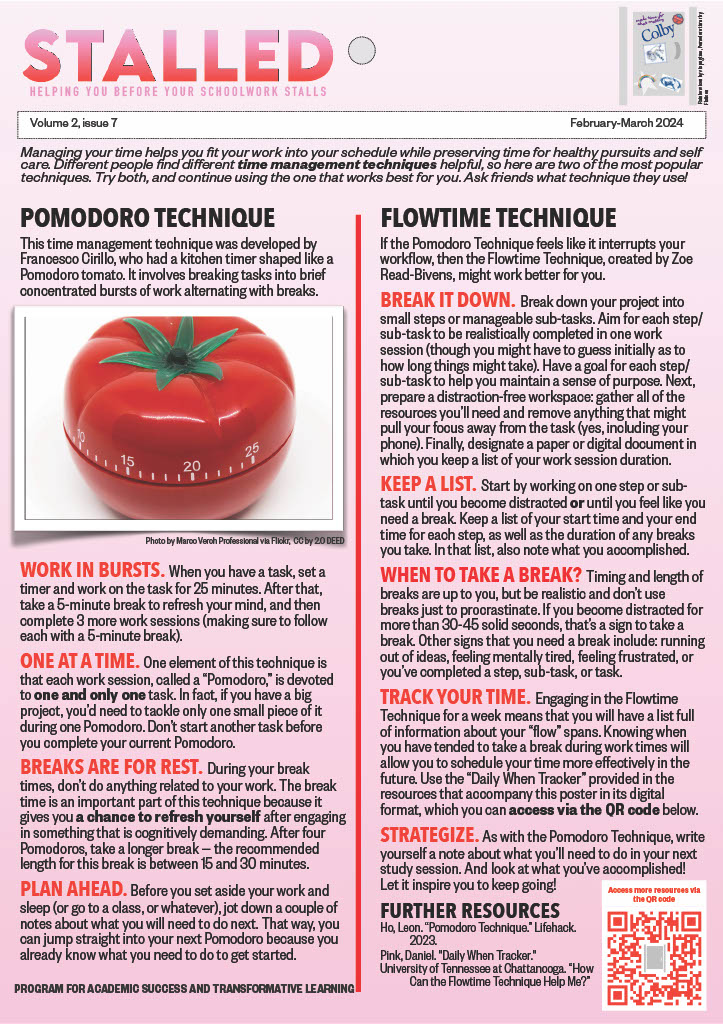
This time management technique was developed by Francesco Cirillo, who had a kitchen timer shaped like a Pomodoro tomato. It involves breaking tasks into brief concentrated bursts of work alternating with breaks.

WORK IN BURSTS.When you have a task, set a timer and work on the task for 25 minutes. After that, take a 5-minute break to refresh your mind, and then complete 3 more work sessions (making sure to follow each with a 5-minute break).

ONE AT A TIME.One element of this technique is that each work session, called a “Pomodoro,” is devoted to one and only one task. In fact, if you have a big project, you’d need to tackle only one small piece of it during one Pomodoro. Don’t start another task before you complete your current Pomodoro. 

BREAKS ARE FOR REST.During your break times, don’t do anything related to your work. The break time is an important part of this technique because it gives you a chance to refresh yourself after engaging in something that is cognitively demanding. After four Pomodoros, take a longer break — the recommended length for this break is between 15 and 30 minutes.

PLAN AHEAD. Before you set aside your work and sleep (or go to a class, or whatever), jot down a couple of notes about what you will need to do next. That way, you can jump straight into your next Pomodoro because you already know what you need to do to get started.

FLOWTIME TECHNIQUE

If the Pomodoro Technique feels like it interrupts your workflow, then the Flowtime Technique, created by Zoe Read-Bivens, might work better for you.

BREAK IT DOWN. Break down your project into small steps or manageable sub-tasks. Aim for each step/sub-task to be realistically completed in one work session (though you might have to guess initially as to how long things might take). Have a goal for each step/sub-task to help you maintain a sense of purpose. Next, prepare a distraction-free workspace: gather all of the resources you’ll need and remove anything that might pull your focus away from the task (yes, including your phone). Finally, designate a paper or digital document in which you keep a list of your work session duration.

KEEP A LIST. Start by working on one step or sub-task until you become distracted or until you feel like you need a break. Keep a list of your start time and your end time for each step, as well as the duration of any breaks you take. In that list, also note what you accomplished.

WHEN TO TAKE A BREAK? Timing and length of breaks are up to you, but be realistic and don’t use breaks just to procrastinate. If you become distracted for more than 30-45 solid seconds, that’s a sign to take a break. Other signs that you need a break include: running out of ideas,, feeling mentally tired, feeling frustrated, or you’ve completed a step, sub-task, or task. 

TRACK YOUR TIME. Engaging in the Flowtime Technique for a week means that you will have a list full of information about your “flow” spans. Knowing when you have tended to take a break during work times will allow you to schedule your time more effectively in the future. Use the “Daily When Tracker,” which you can access via the link below in the “Further Resources” section.

STRATEGIZE. As with the Pomodoro Technique, write yourself a note about what you’ll need to do in your next study session. And look at what you’ve accomplished! Let it inspire you to keep going!

FURTHER RESOURCES 

Ho, Leon. “Pomodoro Technique.” Lifehack. 2023. 

Pink, Daniel. “Daily When Tracker.”

University of Tennessee at Chattanooga. “How Can the Flowtime Technique Help Me?“

Google Calendar Tips (2.6)

As we start a fresh new semester, using a digital calendar can be an immense help with your time management. Here are tips to get started, and if you already use a digital calendar, maximize your use of it! Because Colby uses Google Suite, this advice specifically relates to Google calendar – but similar options exist with most any digital calendar.  Most professional settings use digital calendars, so get familiar with them now!

WHAT TO PUT IN YOUR CALENDAR

CLASS TIMES. Add each of your classes and lab sessions to your calendar. But you don’t have to add each one manually! When adding your first History class, for example, look for the phrase “Does not repeat.” You have the option to change that to a “recurring event,” occuring weekly. You can also pick an end date, which should be the last class session of the semester. If your professor cancels any class, you can delete it from your calendar — but be sure to cancel “only this event” rather than “this and following events” or “all events.”

MEAL & SLEEP TIMES. To be at your best, you need to make healthy choices, including making time for breakfast, lunch, and dinner as well as sleep. So, schedule mealtimes and sleeping time on your calendar to help remind you to maintain healthy habits.

“DOWN” TIME. You need time to recharge your batteries, so make sure to earmark some time for leisure/mental decompression. Yes, actually schedule it! That will help you stick to it.

ASSIGNMENT DUE DATES. Since you have many writing assignments, exams, problem sets, and other academic work due at many different times, enter each one into your calendar so that you can schedule your time effectively — and not miss any deadlines.

STUDY TIME. In order to keep up with your work, you need to schedule regular study time. For most courses, you’ll need about 2-3 hours per credit hour a week. That’s right — you should practice, review, and study even in those weeks when you don’t have a test. 

SOCIAL/CLUB/SPORT EVENTS. Adding your extracurricular activities to your calendar is important to show you when you’re busy, and also to let you see if you are overcommitting yourself. Further, if a sporting event takes place during a scheduled class time, you should contact your professor well ahead of time to make any necessary arrangements. 

BIRTHDAYS & HOLIDAYS. Add your friends’ and family birthdays so you don’t miss any celebrations. Google also lets you add national holiday calendars, so you can add the “Holidays in United States” events — or holidays for any other religion or country (which is essential if you will be traveling and/or studying abroad).

GOOGLE CALENDAR TIPS

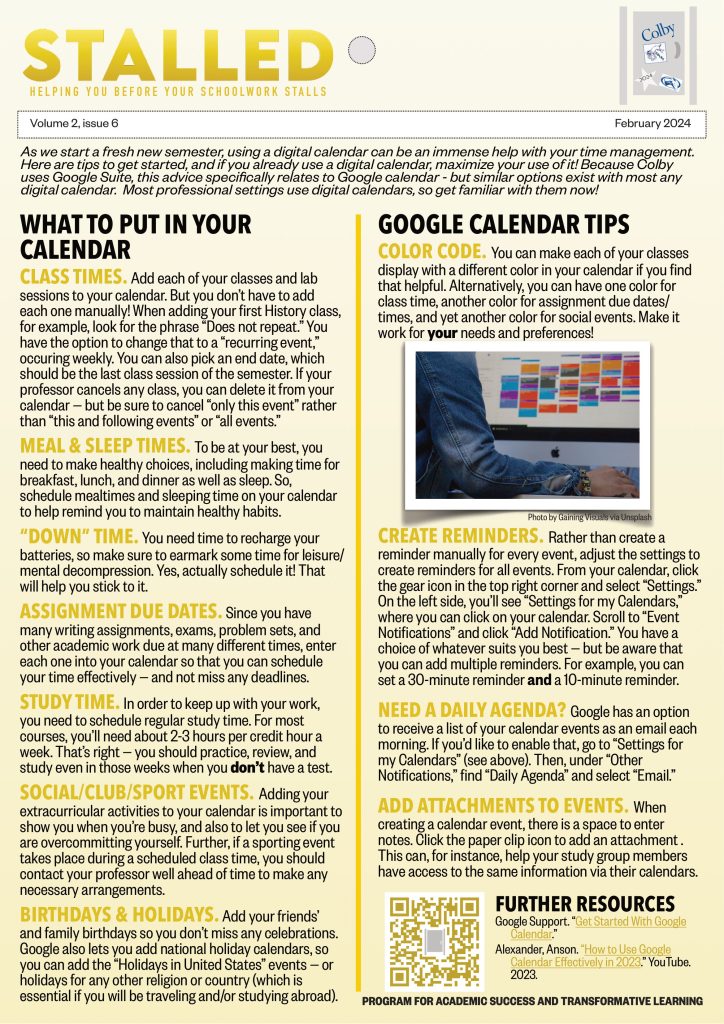
COLOR CODE. You can make each of your classes display with a different color in your calendar if you find that helpful. Alternatively, you can have one color for class time, another color for assignment due dates/times, and yet another color for social events. Make it work for your needs and preferences!

CREATE REMINDERS. Rather than create a reminder manually for every event, adjust the settings to create reminders for all events. From your calendar, click the gear icon in the top right corner and select “Settings.” On the left side, you’ll see “Settings for my Calendars,” where you can click on your calendar. Scroll to “Event Notifications” and click “Add Notification.” You have a choice of whatever suits you best — but be aware that you can add multiple reminders. For example, you can set a 30-minute reminder and a 10-minute reminder.

NEED A DAILY AGENDA? Google has an option to receive a list of your calendar events as an email each morning. If you’d like to enable that, go to “Settings for my Calendars” (see above). Then, under “Other Notifications,” find “Daily Agenda” and select “Email.” 

ADD ATTACHMENTS TO EVENTS. When creating a calendar event, there is a space to enter notes. Click the paper clip icon to add an attachment . This can, for instance, help your study group members have access to the same information via their calendars.

FURTHER RESOURCES 

Google Support. “Get Started With Google Calendar.” 

Alexander, Anson. “How to Use Google Calendar Effectively in 2023.” YouTube. 2023.

What to do when you feel overwhelmed (2.5)

Frustration with your workload, difficulty from non-academic struggles, crying over a tough assignment: there are situations that can make any of us feel overwhelmed. If you find yourself feeling that way, here are some things to keep in mind and and a few actions to try.

NOTE YOUR FRAME OF MIND

TAKE A BREATH. If you are feeling emotional (frustrated, angry, sad), it’s harder for you to work, but attempting to stifle emotions entirely can be counterproductive. It is worth remembering that your emotions are valid, so give yourself a few moments to feel those emotions rather than suppressing them.

FOCUS ON THE GOOD. Voltaire is credited as saying “the best is the enemy of the good,” which means that we threaten the quality of our work when we insist on perfection. Perfection is not a realistic goal, because it really isn’t achievable (by anyone, not just you – this is true of Olympians, Nobel prize winners, and everyone else). Instead, focus on doing good work. This can help take some of the emotional pressure off of yourself by providing a realistic goal. 

REFRAME THE ISSUE. In the moment, an undesired grade or difficulty in a course can loom large. But these things are, in the grand scheme of the entirety of your life, relatively small. Almost no one remembers the grade they earned on each essay or report in college, and that’s because no one grade – even a bad grade for an entire course – can define you. We all miss the mark from time to time, but it doesn’t hold people back from full and happy lives, and it is helpful to remind yourself of this to reground your perspective.

WHAT CAN I DO?

CONSULT THE CALENDAR. Take a look at the next two weeks on your calendar. What are the immediate tasks that you need to complete? Write a list in order of their due dates. Then, take a look at the rest of the term. For any big assignments due at the end of the term, break them down into steps (e.g. for a report, that might include: research/data gathering, drafting sections of the report, editing, and proofreading). Then, work backwards from the due date to figure out when each step should be done. Add those steps to your calendar. Smaller tasksare more manageable, and once you have a small piece of a task done, you will feel better and more in control of your workload.

TALK IT OUT. It might not always seem so, but most students feel overwhelmed from time to time. So, talk to riends, classmates, or roommates about what you are feeling. Sometimes, just knowing that you are not alone in feeling this way can lighten your emotional load – and you could well be lightening your friend’s emotional load, too, with this kind of conversation. 

FIND THE HELP YOU NEED. Campus Counselling Services is a good place to go for more coping strategies. You can reach them at 207-859-4490, and their services are free for Colby students. 

You can also talk to someone in the Dean of Studies office, such as your Class Dean, for help finding resources to put you on more solid academic footing.

In the event of a mental health emergency, call 207-859-4490 (if calling after hours, then press “0”).

FURTHER RESOURCES 

Engineering Expectations. “What to Do If You Are Overwhelmed in College.”

Finkelstein-Fox, Lucy: Crystal L. Park; and Kristen E. Riley. “Mindfulness and Emotion Regulation: Promoting Well-Being During the Transition to College.” Anxiety, Stress, & Coping vol. 31, no. 6 (2018): 639-653. 

LeBlanc, Nicole J. and Luana Marques. “Anxiety in College: What We Know and How to Cope.” Harvard Health Blog. August 27, 2019.  

Purdue University Global. “The College Student’s Guide to Stress Management.” Updated July 2, 2020.  

University of North Carolina at Chapel Hill. “College Stress.” 

Wallis, Ashley. “How to Avoid College Burnout.” Southern New Hampshire University. June 16, 2021.  

Exam wrappers & feedback analysis (2.4)

You can use grades and feedback on assignments to identify strengths and areas of opportunity. Performing an “exam wrapper” or “feedback analysis” activity helps you strategize how to facilitate successful learning. Access your own copy of a template to complete these activities through the QR code at the bottom of this poster.

“EXAM WRAPPER” STEPS

RATIONALE. What was the goal of the module or part of class covered by the exam? The course’s learning objectives (on the syllabus) can give you insight into what your professor wants you to learn in class. In turn, that can help you organize your future studying. 

REFLECTION. Examine your own studying habits leading up to the exam. This can allow you to identify successful study strategies as well as to find (and replace) strategies that were not successful for you.

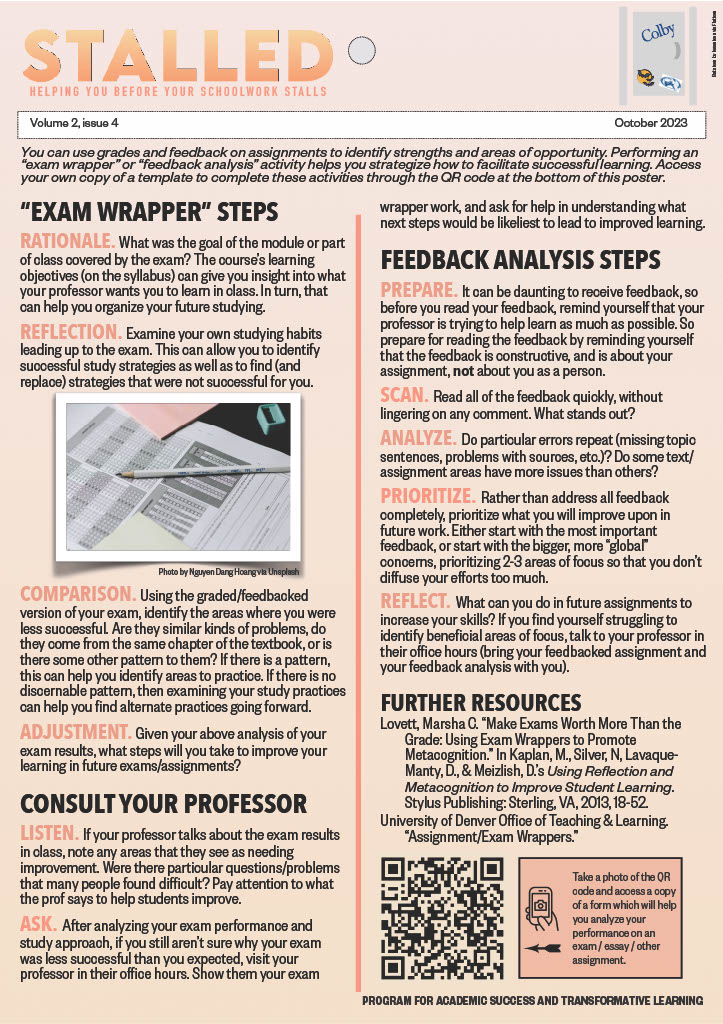
COMPARISON. Using the graded/feedbacked version of your exam, identify the areas where you were less successful. Are they similar kinds of problems, do they come from the same chapter of the textbook, or is there some other pattern to them? If there is a pattern, this can help you identify areas to practice. If there is no discernable pattern, then examining your study practices can help you find alternate practices going forward.

ADJUSTMENT. Given your above analysis of your exam results, what steps will you take to improve your learning in future exams/assignments?

CONSULT YOUR PROFESSOR

LISTEN. If your professor talks about the exam results in class, note any areas that they see as needing improvement. Were there particular questions/problems that many people found difficult? Pay attention to what the prof says to help students improve. 

ASK. After analyzing your exam performance and study approach, if you still aren’t sure why your exam was less successful than you expected, visit your professor in their office hours. Show them your exam wrapper work, and ask for help in understanding what next steps would be likeliest to lead to improved learning. 

FEEDBACK ANALYSIS STEPS 

PREPARE. It can be daunting to receive feedback, so before you read your feedback, remind yourself that your professor is trying to help learn as much as possible. So prepare for reading the feedback by reminding yourself that the feedback is constructive, and is about your assignment, not about you as a person. 

SCAN. Read all of the feedback quickly, without lingering on any comment. What stands out? 

ANALYZE. Do particular errors repeat (missing topic sentences, problems with sources, etc.)? Do some text/assignment areas have more issues than others?

PRIORITIZE. Rather than address all feedback completely, prioritize what you will improve upon in future work. Either start with the most important feedback, or start with the bigger, more “global” concerns, prioritizing 2-3 areas of focus so that you don’t diffuse your efforts too much.

REFLECT. What can you do in future assignments to increase your skills? If you find yourself struggling to identify beneficial areas of focus, talk to your professor in their office hours (bring your feedbacked assignment and your feedback analysis with you).

FURTHER RESOURCES 

Lovett, Marsha C. “Make Exams Worth More Than the Grade: Using Exam Wrappers to Promote Metacognition.” In Kaplan, M., Silver, N, Lavaque-Manty, D., & Meizlish, D.’s Using Reflection and Metacognition to Improve Student Learning. Stylus Publishing: Sterling, VA, 2013, 18-52.

University of Denver Office of Teaching & Learning. “Assignment/Exam Wrappers.”

Access your own copy of a tool for guiding you through your own “exam wrapper” or feedback analysis via the poster’s QR code.

Class participation (2.3)

Stalled poster 2.3 (text is pasted below)

You know you should participate in class, but what does it mean to do so? Professors have differing ideas about what constitutes participation, but here are some aspects of it to consider.

HOW TO PARTICIPATE?

ENGAGED ATTENDANCE. Regular, on-time attendance is key. When you’re in class, professors also expect you to keep your attention on class business, so resist the urge to focus your attention on personal matters, other classes, or other distractions. Professors also expect student engagement, including previewing material before class to be able to follow along during class, and showing curiosity in course content.

DISCUSSION CONTRIBUTION. Class discussions are intended to give you practice in talking through big ideas with others, collaborating to construct shared understanding, and exchanging differing points of view. It’s a good idea to link your discussion contributions to the course’s readings and main ideas. 

TAKING NOTES. Take notes during class, jotting down ideas that arise in discussions, instructions for completing activities/assignments, key terms that are new to you, and anything that helps you understand the course’s content, skills, or methods being taught.

ASKING PROBING QUESTIONS. Come to class with questions based on course readings or on homework. If your questions help create a stronger understanding of course material, then those kinds of probing questions help show that you are participating.

LISTENING. Paying attention to your professor is important, so try your best to listen attentively to them. But it is also important to listen carefully when your classmates speak, so be sure to listen well to them, too.

IN-CLASS ACTIVITY. If your professor asks students to engage in small group discussions, peer responses, problem solving, or any other activity during class time, devote your full attention to it. This is not the time to check your email, get a snack, or otherwise be inattentive — active learning activities count as participation to most professors.

DISCUSSION BOARD POST/RESPONSE. Many courses have discussion boards on their Moodle site, and starting a discussion with a thoughtful analysis or question can contribute to others’ understanding of course material. Posting responses to others’ posts also allows you to participate in an unhurried way. 

WHAT IF PARTICIPATION ISN’T GRADED?

Even if a professor doesn’t assign a participation grade, it’s still important for you to participate in class. Learning is an active enterprise, and if you aren’t engaged, attentive, curious, and questioning during class, you won’t learn as much or remember what you learn as well. You’re at college to develop your intellect, and that’s an activity that demands participation — in fact, that’s why so many professors grade participation! 

HOW DO I KNOW WHAT MY PROFESSOR WANTS?

SYLLABUS. Many professors define what they mean by participation in their syllabus. If yours does, pay close attention to what they wrote in the syllabus. If you have a syllabus that does not define participation, follow the suggestions from the first part of this poster. 

ASK! If you aren’t sure what “participation” means in a course, it’s likely that other students in the class are similarly unclear on the matter. So it will help everyone if you ask during class for the professor’s expectations about how students should participate in their class. 

WHEN ISSUES ARISE. If you experience any barriers in being able to participate fully, be sure to talk to your professor in their office hours about that.

FURTHER RESOURCES 

Petress, Ken. “An Operational Definition of Class Participation.” College Student Journal 40.4 (2006). 

Millersville University. “Class Participation: More Than Just Raising Your Hand.”

Office hours (2.2)

Stalled poster 2.2 (text is pasted below)

If you don’t really know what office hours are, you’re not alone! Take the Stalled challenge: go to office hours with each one of your professors at least once this semester!

WHY SHOULD I GO TO OFFICE HOURS?

Most students don’t start college with a clear understanding of the purpose of office hours. Here are some tips to help you make the most of them!

WHAT ARE OFFICE HOURS? Every professor holds weekly office hours so that students know when to find them for one-on-one conversations. Some professors require students to attend office hours, but you should go even if office hours are not required. Some professors may ask you to schedule a time to go to office hours, so be sure to check your course’s syllabus for details (and for the location of your professors’ offices).

BUT WHY GO? Getting to know your professors will make you more comfortable in class — and it helps them know how best to facilitate learning in their courses by better understanding their students.

WHAT SHOULD I TALK ABOUT IN OFFICE HOURS?

You won’t have time to talk about all of these things in one visit, so we suggest picking just one to start.

HOW THE READING RELATES TO THE COURSE.Readings are assigned for particular reasons, so you should ask your professor if you don’t understand how a particular reading relates to course themes. This is also likely to help you if you need to grapple with readings in an essay or other assignment. If you need advice about how to read the course’s texts effectively, talk about that, too!

HOW TO DO WELL.If you’re visiting office hours at the start of a term, ask about the habits or behaviors that help students succeed in the course. You can also ask how to improve your performance on tests, essays/reports, presentations, or any other task. If the professor works in the department in which you are seeking a major or minor, consider asking about how your work in this specific class fits into your work towards your major or minor. You can also ask about what habits successful majors or minors cultivate.

What you should not do is ask how to get an A in the class. Different people need different things to achieve high grades, and your class performance will be better if you focus on how best to learn rather than how to achieve a specific grade.

HOW TO IMPROVE YOUR WRITING. Different disciplines have different ideas and guidelines about what constitutes good writing. So, consider asking your professor for writing advice before your first writing task in their course is due. If you have specific questions about any feedback your professor provided on draft or final versions of your writing, bring a copy of your work with their comments.

LETTERS OF RECOMMENDATION. If you need a letter of recommendation, go talk to your professor. Tell them what the letter is for, what the letter should emphasize, and, if it’s been a while since you took a course with them, remind them about what course(s) you were in. Pro tips: give them the most recent version of your resume at the same time, and give them at least 2-3 weeks advance notice.

WHAT’S NOT GOING WELL. If you find something in the course material confusing, if you don’t understand the parameters of an assignment, or if you are experiencing personal difficulties that affect your schoolwork, talk to your professor in person during their office hours. It’s helpful to talk face-to-face to discuss these things, which can be harder to do effectively via email, phone, or other communication channel.

ABOUT THEM! Ask about their research, or ask about what got them into their field. You might find a professor with whom you’d like to do research, and you might even be surprised at what you learn!

FURTHER RESOURCES 

Cornell University Learning Strategies Center. “How to Use Office Hours.”

University of North Carolina at Chapel Hill Learning Center. “Using Office Hours Effectively

How to read syllabi, and how & why to email professors (2.1)

Stalled poster 2.1 (text is pasted below)

You receive a syllabus for each of your classes — but do you know how to read a syllabus so as to understand what you’re expected to learn? And do you have questions about emailing your instructors? This edition of Stalled is here to help you!

HOW TO READ SYLLABI

UNDERSTAND THE COURSE GOALS. Have you seen “learning objectives” on a syllabus before? These are the skills and content knowledge that the professors expect you to achieve by the time the course ends. These are the goals that the class tasks are built to help you reach, so think about how you can showcase those skills and knowledge bases in your assignments and other contributions to class.

Every course syllabus is different, so make sure to read each one carefully, but here are some of the most common elements and why they’re important.

KNOW WHAT YOU’LL DO IN CLASS. Many syllabi include schedules so that you know what will happen during the different class sessions. This can help you prepare for class (and can serve as a starting point for creating study guides for exams).

WHAT TYPE OF COURSE IT IS. The assignment types can help you understand what type of course you’re in: is the course based on completing readings and participating in discussions? If so, you’ll need to stay on top of the reading assignments. Is the course problem-set and exam based? Then you’ll need to ensure that you build the skills necessary to complete problems and also understand the difference between different kinds of problems.

GRADE CALCULATION. What are the graded elements of the course? Are some assignments/elements worth more than others in the calculation of the course grade? If so, that can give you a hint as to what the instructor sees as important. If dates for exams or assignments are provided, put those in your (digital or paper) calendar. In particular, put the dates of all final exams in your calendar as soon as you can. Don’t have a calendar? Use Google Calendar!

FURTHER RESOURCES

University of California, Berkeley. “6 Ways to Use Your Syllabus for Success.”

University of Waterloo Writing and Communication Centre. “Reading Your Syllabus For Success.”

HOW & WHY TO EMAIL PROFESSORS

Email is a key way to communicate with faculty, and professors have expectations for emails. Here’s what you need to know!

NAMES MATTER. In conversation and in written communication, it’s a good idea to address faculty as “Doctor” or “Professor” (respectful titles for a terminal-degree-holder who teaches at the collegiate level). If they want you to call them something different, they’ll let you know.

End with your full name, since several students may share the same or similar first names. If you’re speaking face-to-face, introduce yourself by name the first time you talk (and maybe the next few times, too, since professors have lots of students!). 

BE CONCISE. Your professor is an intellectual mentor to you, which places you in the role of mentee. One of the things that that means is that you should be mindful of their time, plan and prepare what you’ll discuss (either via email or in person), and aim to be clear and concise. So: no long-winded sob stories — get straight to the point, and your profs will appreciate that you’ve shown respect for their time.

WHY EMAIL? Speaking to your professor face-to-face is often preferable so that you can have a discussion about issues like how to strengthen your work in a class or how to develop your skills and knowledge in the course subject. 

However, when emergencies arise or something happens before you can meet your professor in their office hours, email is the best way to reach them (unless they have specified a different mode of communication). Email professors when you have an illness that will prevent you from attending class, for example.

FURTHER RESOURCES

Columbia University School of Professional Studies. “How to Talk to Faculty.”

Wood, Sarah. “7 Guidelines for College Student-Professor Interactions.” U.S. News and World Report (July 5, 2022).

How to plan & lead a class discussion (1.6)

Stalled poster 1.6 (text is pasted below)

Has a professor assigned you to lead a discussion during class? Here’s help for creating and fostering a good class discussion.

PLANNING A DISCUSSION

  • Create a list of key concepts and themes. You can use these to formulate questions and find connections within the content.

  • Create two lists of questions, one that you keep to yourself for asking questions to start the discussion (and move it along if there are lulls), and another list that you give to classmates to inspire their thinking. This will help keep the conversation flowing.

  • Feel free to plan a few minutes to ask your classmates to create their own questions. They may have noticed different aspects of the topic/assigned reading than you did.

  • Know your goal for the discussion. Are you hoping to inspire an in-class debate? Do you want to create a mind-map of interrelated ideas? Do you want a range of points of view represented? Or do you have another goal?


LEADING A DISCUSSION
  • Help your classmates by listing key points on the board, which will clue them in about what you plan to discuss. It also helps you know which topics still need to be covered.

  • Bring a list of questions you can ask so that you can move the discussion along at the start (and if there is a lull). Remember, “why” and “how” questions generate discussion better than yes/no questions.

  • Follow up interesting statements with supplemental questions. But make sure to address those questions to the whole class (not only the person who made the statement).

  • Don’t be afraid to let there be silence! People often need a few moments to formulate responses, so let those silences unfold.

« Older posts Newer posts »

© 2026 Stalled

Theme by Anders Noren — Up ↑