Contemporary Graffiti

These articles and video were insightful in their attention to the social histories that led to and were reciprocally produced by the contemporary graffiti movement.

An interesting juxtaposition to note is the way in which graffiti materializes concerns of the self/the intimate, and concerns about contemporary culture and events. Macdonald attends to the motivations and meanings of name “tags.” Within this framework of “dynamics of friction and dispute” (Macdonald 312), the graffiti artist reifies an alter-ego through marking their pseudonym with attention to style, placement, and content. This process is self-reflexive, and, as such, is a way to state: “I am” (314). Through making marks that represent the self, or the ideal double, tags enable graffiti artists to become more than themselves – to leave ripples and a legacy of their presence – because they can “escape the need to represent yourself” (313).  

In contrast, but also contingent on the same gestural process of appropriation of space and reliance on spectatorship, the article by Phillips addressed the globally-minded graffiti by Keith Haring. Focusing on the influence the Jesus Movement had on Haring, this article illuminated the way in which Haring’s work addressed large-scale issues, were apocalyptic in tone and nature, and made accessible commentary on contemporaneous anxieties and concerns.

The “Desire for possessions, for belonging, for a public name, for property and protection…” (Nandrea 113) are produced by, and perpetuate, the American imaginary. Graffiti artists enact agency and authorship by forming communities, responding to large-scale concerns, representing and defending the self, and leaving a legacy: “They can only watch as it thunders past to its next destination… like the train, the name or virtual self is going places” (Macdonald 319).

By appropriating space in view, the graffiti artist redefines communication. Nandrea argues that “Graffiti might teach a child something about spatial potential, about the ways a margin can become a frontier” (112). Thus, contemporary graffiti at once enables place-making and ideal self-representation while making possible social commentary on contemporary culture and politics. 
 

Early Modern Graffiti: Post-Seminar Reflection

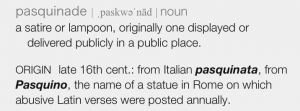
Following this discussion on early modern graffiti, I wish to focus my reflection on the ways in which sites of graffiti become accepted spontaneous monuments. In discussing the Pasquino in Rome, per Juliet Fleming’s attention to the Roman “talking statues” in her article “Graffiti and the Writing Arts of Early Modern England,” I was prompted to reconsider what we validate as an “official” site of graffiti. As the political criticism collected around the Pasquino, the practice of inscribing such commentary became normalized to such an extent that it has ascended to hold meaning through language:

In this scenario, the site and surface upon which the commentary is scratched is expected. Through simple logic, should we consider graffiti to be “marks made on a surface not originally intended to hold these marks,” then the pasquinato etchings no longer ought to be classified as graffiti. However, as we have toyed with in discussion, attempting to categorize, classify, and define graffiti–what counts, what doesn’t count–is a distraction from interrogating the cultural work that such writings and marks do.

At what point do sites of graffiti become accepted, normalized, and reified to transcend their “disruptive” status to become simply a part of the landscape? In the cases of the Pasquino, in “tags” on the table at Jorgenson’s, or even 5Pointz, some sites welcome mark-making. In doing so, the graffiti becomes an expected aspect of the space/surface. By asking this question, it is clear that my modern understanding of graffiti as “disruptive” or an “intervention” shines through––our discussions on early modern, medieval, and ancient graffiti enable me to see the ways in which my modern bias informs my line of inquiry.

Early Modern Graffiti

The question of what is libel is very interesting. When I think of the definition of libel, I usually associate it with politics and the law. I think about political ad campaigns that defame opponents and the legal aftermath of these statements. In a case of libel, the defendant is accused of breaking the law by publishing a false statement. However, in Gordon’s essay, “The Act of Libel,” Gordon focuses on the question of libel and graffiti. Can graffiti be considered libel? Gordon mentions the anonymity of graffiti. Does the anonymity create a better platform for libel? Although Gordon does not discuss legality much in his essay, I associate the term libel with law. This makes me think about 5 pointz and the legal battle that I plan on discussing in my final paper. While law dealing with libel is an established law form, art law is rather new to the field. However, the lawsuit at 5 pointz put graffiti art into a legal context. Was the graffiti at 5 pointz vandalism?

Early Modern Graffiti

I was struck by Fleming’s analysis of Elizabethan graffiti for the ways in which this form of graffiti subverts my understanding of graffiti as a form of “self-“expression. She argues that the projection of subjectivity and authorship upon the acting agents who inscribed Elizabethan graffiti is misinformed. Fleming writes that contemporary graffiti is “overdetermined as the medium of the socially disaffected […] within a culture that discounts matter as that which has no meaning, graffiti will always appear to be the mark of a human subjectivity that survives and protests its own radical dispossession” (Fleming 41).

In contrast, Fleming argues for an understanding of early modern English graffiti and wall writing that heeds the contemporaneous popular practices and understandings of writing. I appreciate the way in which Fleming exposes the aphoristic qualities of writing during these times by illuminating the relationship between the proverb and the posy. In the context of “parietal” graffiti, Fleming writes, of posies, that their “defining characteristic is to be written in such a way that its material embodiment forms an important part of its meaning. The posy, in short, is a saying or poem that is pointed by being written on something” (43). Thus, the act of, and art of, sgraffiato in Elizabethan England was about memory-making and “materializing thought” (44). A form of note-taking to assist in remembering, that takes material form, just as I am now doing on this blog?

Early Modern Graffiti

“Graffiti in its modern sense is an effect of categorization.” (Fleming) Through the study of graffiti we are really reading into the study of the early modern city.

In early modern times, our perception of graffiti is influenced by the fact that from a legal perspective, the practice of graffiti is considered destruction of property rather than writing. We are then forced to think through a veil of criminal act in order to read the implications of these markings. In thinking about this in the context of my research I am wondering if it changes if the markings are either forms/ images or writing. Are people more likely to be mad about a message on a wall or an image? And then by consequence, what has a more powerful message?

Something Gordon mentioned, that I found very interesting was the idea that we all too often fall into the trap of trying to reconstruct the artist through their work, rather than taking it at face value. We try to imagine the person behind the writing or the markings. Is it that we can’t imagine the work existing without a creator? Anonymity is something I have yet to consider in the context of graffiti. There is no pressure to show the work attached to an artist. Some graffiti artists tag their works with special symbols or initials, but a lot of work exists by itself. We keep talking about the idea of authorship and claiming authorship, but what happens when the author wants to remain unknown? How can we contextualize this in an area where individuality is limited?

“In the absence of an author, then, anxieties over unrest supply the image of popular revolt to fill the void.” (Gordon, Page 389) Without an author, the image becomes open, it becomes a message of the space. It both is more elusive, and more pervasive.

Flemming – A Look at Early Modern Graffiti

Interestingly stated early on in this article, Flemming states that “Graffiti, almost by definition, is produced in media and on sites that make its long survival unlikely” (Flemming, 34). This caught my attention quickly and easily because of the validity that this carries with first thought, but then the questioning that results as consequence. In fact, it makes one question not only responses to the placement of graffiti, but the motives behind the art works when they are in places that will likely not survive. Continuing to look at the perplexities of this statement, it also asks us to rethink the conversation the works are having with the locations in which they are placed.

I find it astonishing that we think of graffiti in this way, and then continue to find early modern and medieval graffiti in secular places. Without a doubt one of the least likely places for these works to survive, the tend to flock to these locations, and Flemming argues that this should be no surprise. Without a doubt there are places that graffiti artists would find longer lasting recognition, however within these secular places their works gain meaning in relation to the works they cover, while also in a larger social and economic setting that is the town and the church where they can be found.

As Flemming says “In fact, I imagine the whitewashed domestic wall as being the primary scene of writing in early modern England”, and I seem to agree. However, the ideas behind the production of graffiti continue to be counter intuitive to the path many would assume.


Early Modern Graffiti

These articles work to define graffiti. We have been battling to find a definition in class for the past weeks. Does graffiti need to be permanent? Are street signs graffiti? Can graffiti only be writing? These authors contribute to this topic and determine that there is no cohesive definition in the context of early modern graffiti.

Juliet Fleming begins by discussing how our modern biases affect how we interpret Elizabethan graffiti. She uses the posey ring and post-it notes as a comparison or a modern form of graffiti off of walls. She points out that the wall was designed to be written on and this makes us question if graffiti can then only be created on a wall. Kate and Melanie Giles discuss the concealed communities of the yorkshire horse lads. They make an important point that graffiti is often created out of boredom. Veronique brings up this same idea by pointing out that graffiti is an activity that is ritual like. Rituals are committed for a number of reasons just as graffiti is created for a number of reasons.

Medieval Graffiti Seminar Reflection

Something that really stuck with me this class was the idea of ‘exposed writing.’ What is so unique about graffiti is it is limitless in its exposure. Once put up on a wall there is no control over who can see it. The choice of where it is placed obviously effects the audience but in practice, graffiti is public. Graffiti is often something personal, something like a diary, but it is exposed. It becomes a way to record the happenings of the community, a public platform for intimate conversations.

We also discussed the idea of the intersection between the devotional and the social. The act of scribing your name is these sacred places is a way to bridge the social and the devotional. The act of putting your name, a visual and audible mark of your identity, within these spaces is a way to engage with the space on a deeper level. It shows a level of dedication to the space, but also is a way to interact with the community at large. We can think of it like tagging a space, you want to show that you have been there. In this way you are acquiring the street cred, but also the religious cred.

Medieval Graffiti Post-Discussion Reflection

In regard to the articles read for this class, I was captivated by their underlying (and overt) argument for considering graffiti as a primary source document. This aligns with theoretical approaches of subaltern studies, cultural studies and word and image studies. But of course, as we know, “History” (with a capital H for emphasis) is written by those in power. “Official” documents are controlled by those in positions of power over others, and, considering Foucault and Mbembe’s writings on biopolitics and necropolitics, those in power retain sovereignty by exercising power over “Other” and others’ bodies. Thus, when a marginalized or subordinated group of people are physically vulnerable, the recording of historical events by the powerful is perpetuated through politics of death. Thus, by looking at, decoding, and analyzing graffiti and its contexts, we might come closer to an integral history that values the experiences and histories of those not in power. We might move closer to understanding graffiti as the intimate, the local, or the community collective––that which helps us connect with and understand the conditions of the quotidian.

October 4 – Medieval Graffiti

Throughout my reading on Medieval Graffiti, I was confronted by the question of who was producing the markings that went up within these sacred spaces. In Jones-Baker’s essay we examine the signatures left in the stone within the churches. Some of the most prominent markings are those by the Clergy. These markings are now some of the only historical record we have of names during this time period. Less noticeable, but of equal historical importance are the signatures of the lay people left in some of the foundational stones. Through this reading I kept asking myself, why is it that names are the most common form of graffiti? Why do we feel the need to write our name over everything? Is it out of vain, out of fear of being forgotten?

I absolutely loved the essay on pilgrimage graffiti. Maybe this is because it is something I never realized I did, but I loved thinking about the idea of movement and motion as described through graffiti. The idea of sacred places being continually used as a means of maintaining its significance. Pilgrims will often leave marks on the walls of these sacred sites and as Professor Plesch states “a holy site similarly must remain in use, and such marks are indeed proof of a site’s continuing importance” (79).

It is also important to note the importance of studying graffiti as a means of closer looking at places of worship. Much of the focus throughout this reading was on graffiti found in churches and temples. Graffiti is often overlooked as a subject, but it can be a very personal and a very intimate look into how an individual interacted with a space. We know churches are spaces that exist outside of their identity as a place of worship. In the end it is a physical space people can interact with in any way that they choose. By looking at graffiti we are able to observe these interactions without a veil.