
Medieval Graffiti
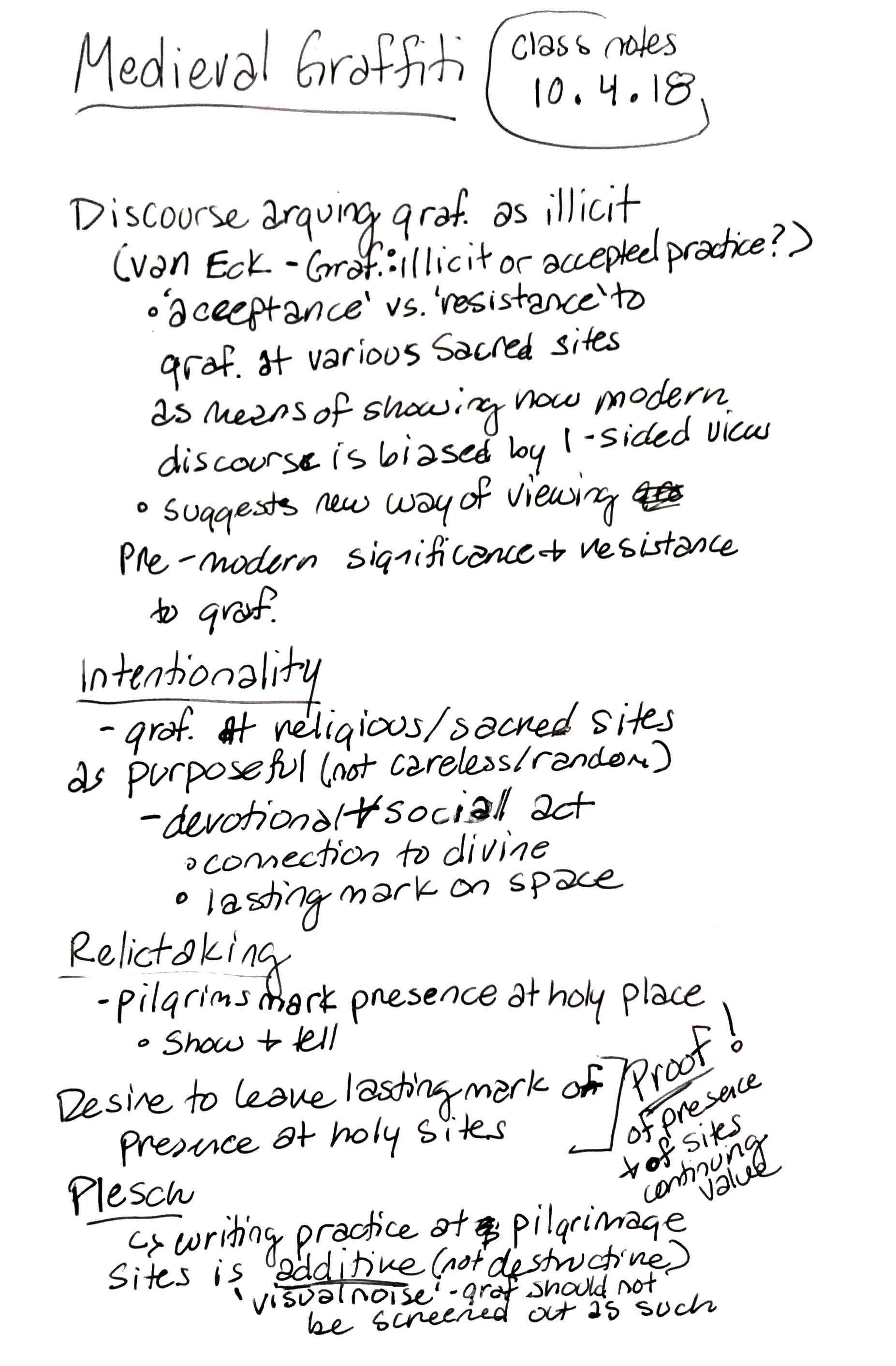
It seems a lot of the readings touched on how graffiti was received in medieval times. In Marianne Ritsema van Eck’s essay, she discusses whether graffiti was an accepted practice, and she focuses on the sacro monte of Varallo. Here creating graffiti was a common practice for pilgrims, however an anti-graffiti campaign is run by Counter-Reformation bishop Carlo Bascape through a series of new rules. I was especially drawn to the comparison the author draws between the graffiti on the walls and Bascape’s signs prohibiting graffiti, for they are both forms of text. She writes “the institutional voice against graffiti was advertised in writing at the same location where it was supposed to prevent illicit writing, thus competing for predominance in that same space (61).” It’s interesting how one form of text can be considered illicit while another is deemed okay.
The comparisons Mia Gaia Trentin drew between Latin and Greek graffiti were also really interesting; Latin graffiti tended to underline the visit to a holy building while Greek graffiti was more closely tied to the devotional religious aspects of the journey. I liked how Trentin gave us context on the people creating these graffiti, because it explained why there is a distinct difference between the Greek and Latin graffiti. While graffiti can tell us about the cultures of different people, we can also learn a lot about the individuals during a certain time period and the way they go about certain processes. For example, in Doris Jones-Baker’s essay, she points out the importance of graffiti in (for example) the interior design of England’s medieval churches. She shows us that “graffiti can sometimes provide the historian with the names, dates, and other information about the craftsmen who built the medieval churches (13).” Through these etchings and sketches of the past, we can learn about the specific people involved in the making of buildings that are still up today.
Medieval Graffiti
In these articles, ancient graffiti isn’t always shown as something that wasn’t illicit, disapproved, or only made by the lower class. Marianne Ritsema van Eck sites many example of graffiti being both approved and unapproved. In the article by O’Donnell, different perspective towards graffiti are shown over history that describe graffiti both as acceptable and unacceptable. According to Fabri, graffiti is a disturbance for later pilgrims, an act of violence and disrespect. This contradicts many of the previous article’s perceptions regarding ancient graffiti, reasserting that a discussion of the social context of graffiti must always be discussed.
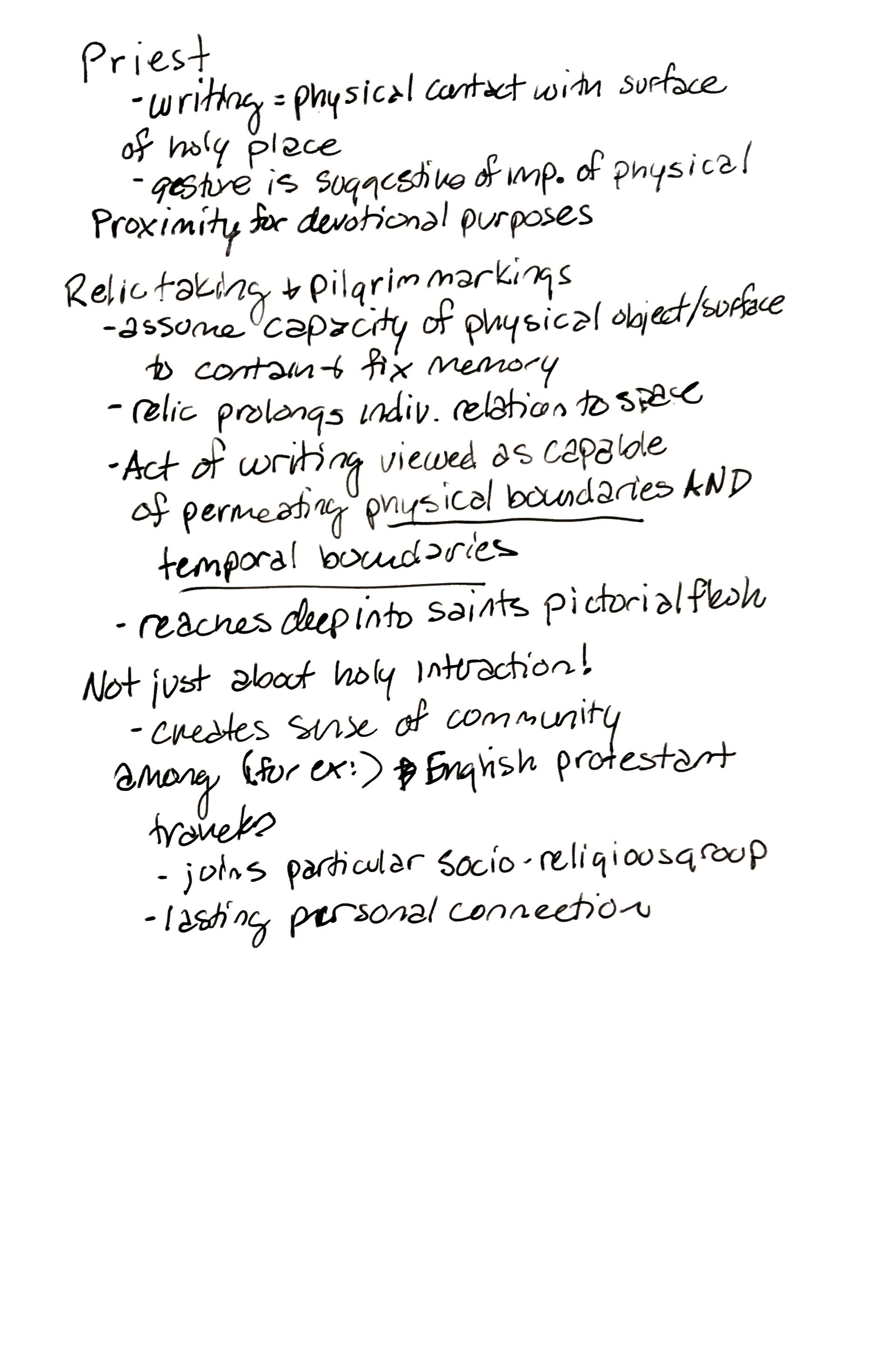
Medieval graffiti was often found in the context of churches. Pilgrimages that passed through churches resulted in pilgrims leaving graffiti to mark that they had completed that part of the pilgrimage. I also found it interesting that O’Donnell sites many situations in which English men would leave graffiti after recognizing other English graffiti, such an act that shows how graffiti served to unite subgroups of people.
Mia Gala and Graves and Rollason both write articles using graffiti as a way to gain information on other topics. Mia Gala discusses the relationships between Latins and Greeks in Cyprus through graffiti while Graves and Rollason determine the history and function of a prior’s chapel in Durham through the graffiti present. This relates to the theme of using graffiti as a framework for approaching different fields of research.
Medieval Graffiti
These articles discussed the significance of placement for graffiti. There is an idea that graffiti attracts graffiti. Many walls are either blank or covered in graffiti, with little room in between.
Van Eck discusses the differences between devotional and social location. Devotional leaves a mark that doesn’t self identify, while social connects the artist and leaves part of their identity. Graffiti is public and permanent in placement, and viewers are therefore forced to see it. This can be compared to a billboard on a highway. Both graffiti and signs are forms of exposed writing. The contemporary view of graffiti is vandalism. Van Eck argues that graffiti was not always accepted and today sometimes is vandalism and sometimes is not. This introduces the question of if commissioned murals are graffiti. If graffiti is intentional and planned, is it graffiti?
Baker says that the way we dedicated buildings to families and benefactors is to write names on an outside of a building as a label. This was the same during the medieval times. There was a large emphasis on labeling with names, and this points to why names are the most common form of graffiti today. With that, medieval history is very much international, and this shows in the graffiti. Graffiti is very specific to place and individual.
Graves asks why people write on walls of religious buildings. The answer is likely out of boredom. Many people would have been waiting outside to enter these buildings during the medieval times. Many people also cross out names, rather than erase or transform them. These people want viewers to be able to see what was there before, but also change its meaning by crossing it out. Lastly, the Christodoulou and Satraki article uses graffiti to understand changes in the power and history of space. I think this is an important takeaway. While graffiti is dependent on the space it is in, the space is also dependent on graffiti for shaping its cultural history.