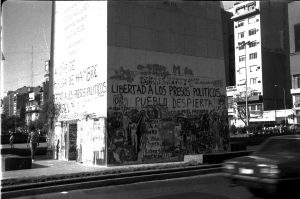
The recent visit to the Museum, reading, and discussion with Beth Finch inspired me to reflect on the ways in which graffiti may be used as a framework to study and interpret images (and words) more broadly. Specifically, I connect our discussion to my analysis of the images produced during the 1983 Siluetazo in Buenos Aires. As many of the images of silhouettes in the original Siluetazo were painted on large sheets of paper, then wheat-pasted onto buildings and trees in Buenos Aires, I have clearly adopted an open definition of graffiti (though it is true that the “ripple” effect of the original Siluetazo produced thousands of images of silhouettes throughout the city––many painted directly on to walls, billboards, buildings, monuments, and the ground), just as coding Spero’s mythological goddesses painted on to the walls (and ceilings) of galleries as graffiti requires an open definition.
From the reading, I also draw similarities between my project and the idea that Spero’s paintings used “architectural space” in inventive and intentional ways. As I have perused hundreds of archival images of the Siluetazo, I have looked at the varying ways in which porteño participants used the architecture of the city as their canvas. The historical roots of the architecture of Buenos Aires––and the displacement and idealism of Parisian Enlightenment and modernity that it connotes––provides a truly remarkable underlying message.