

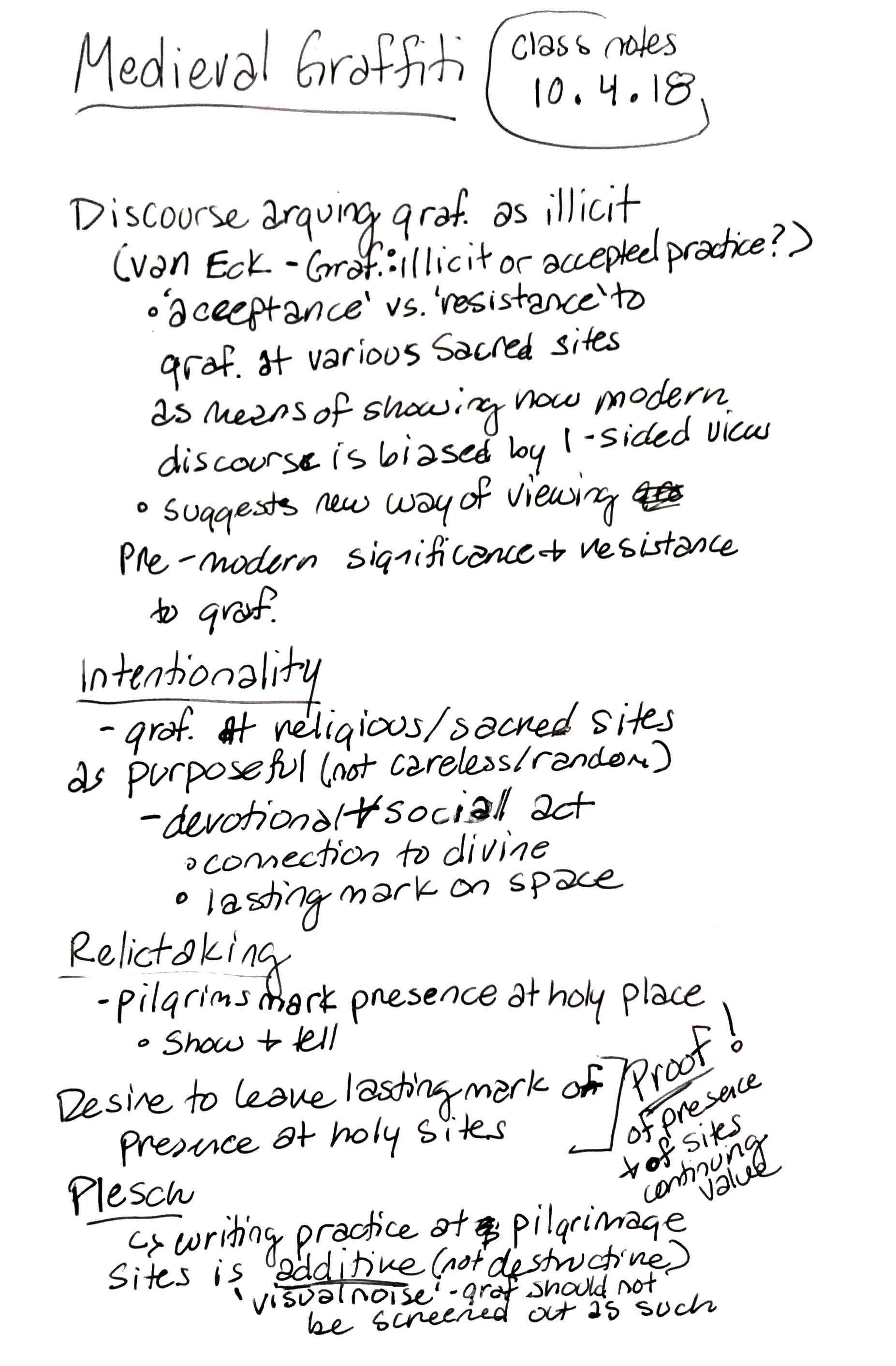
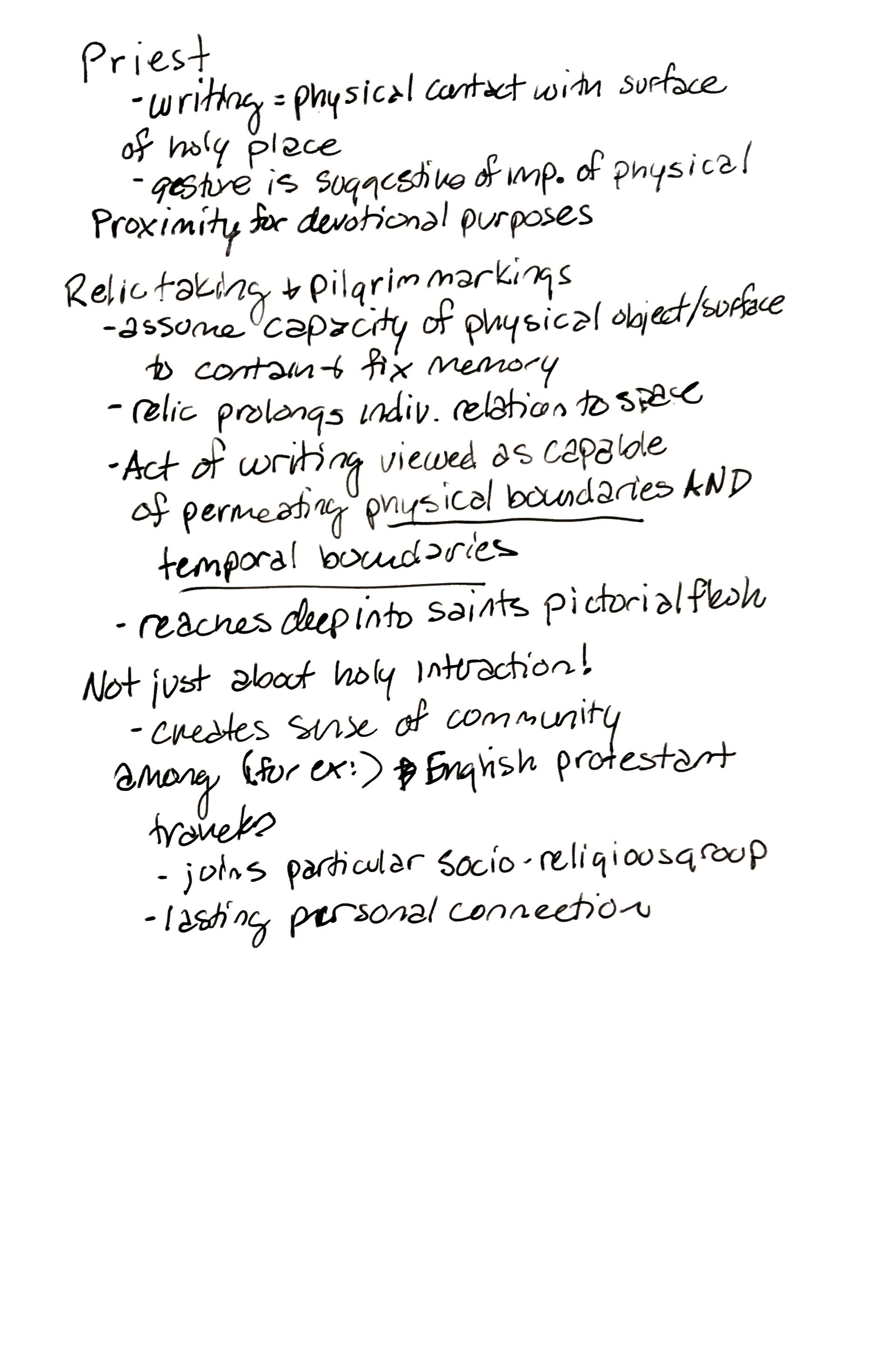
Medieval Graffiti (Notes 10.4.18)
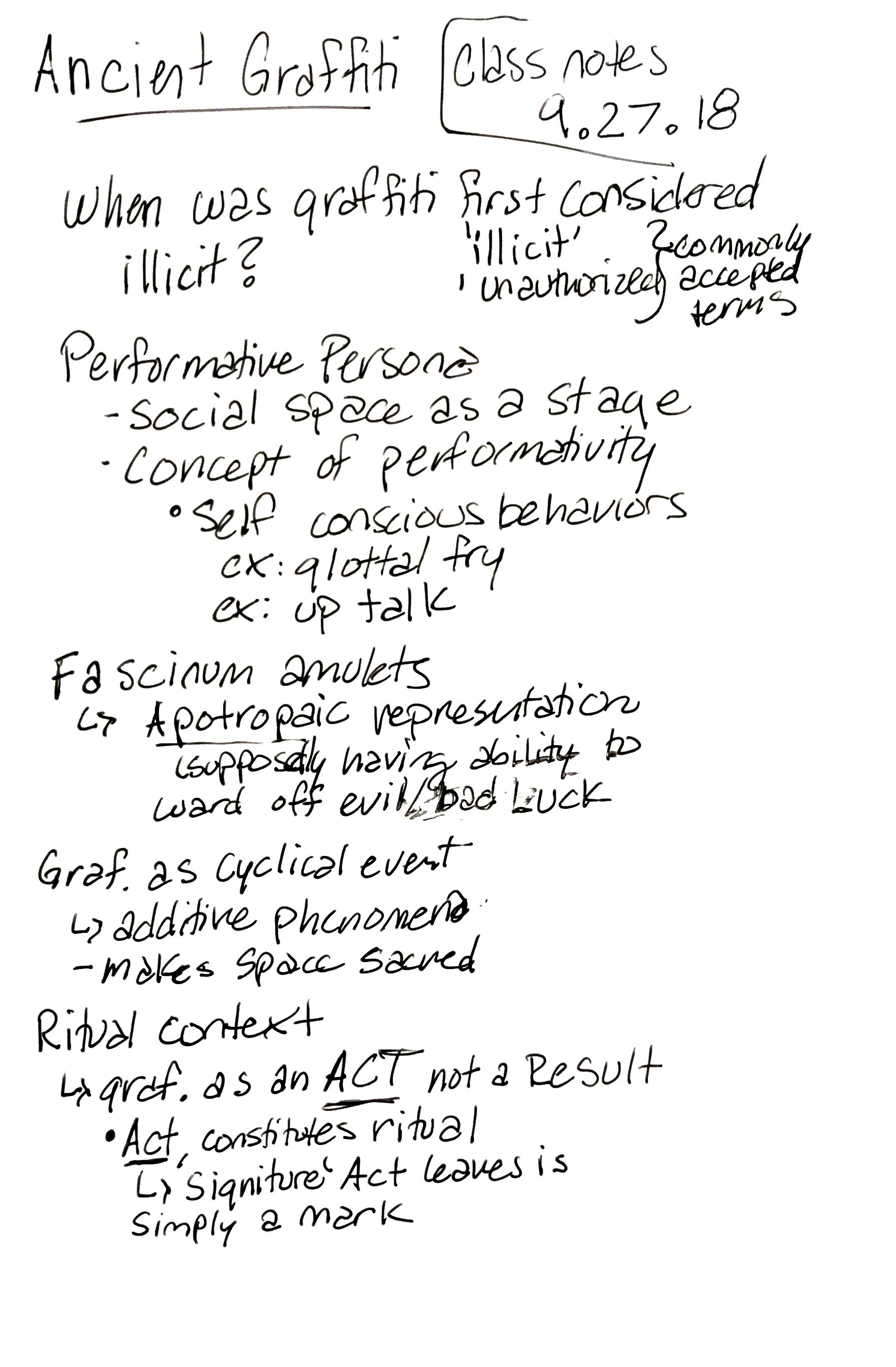
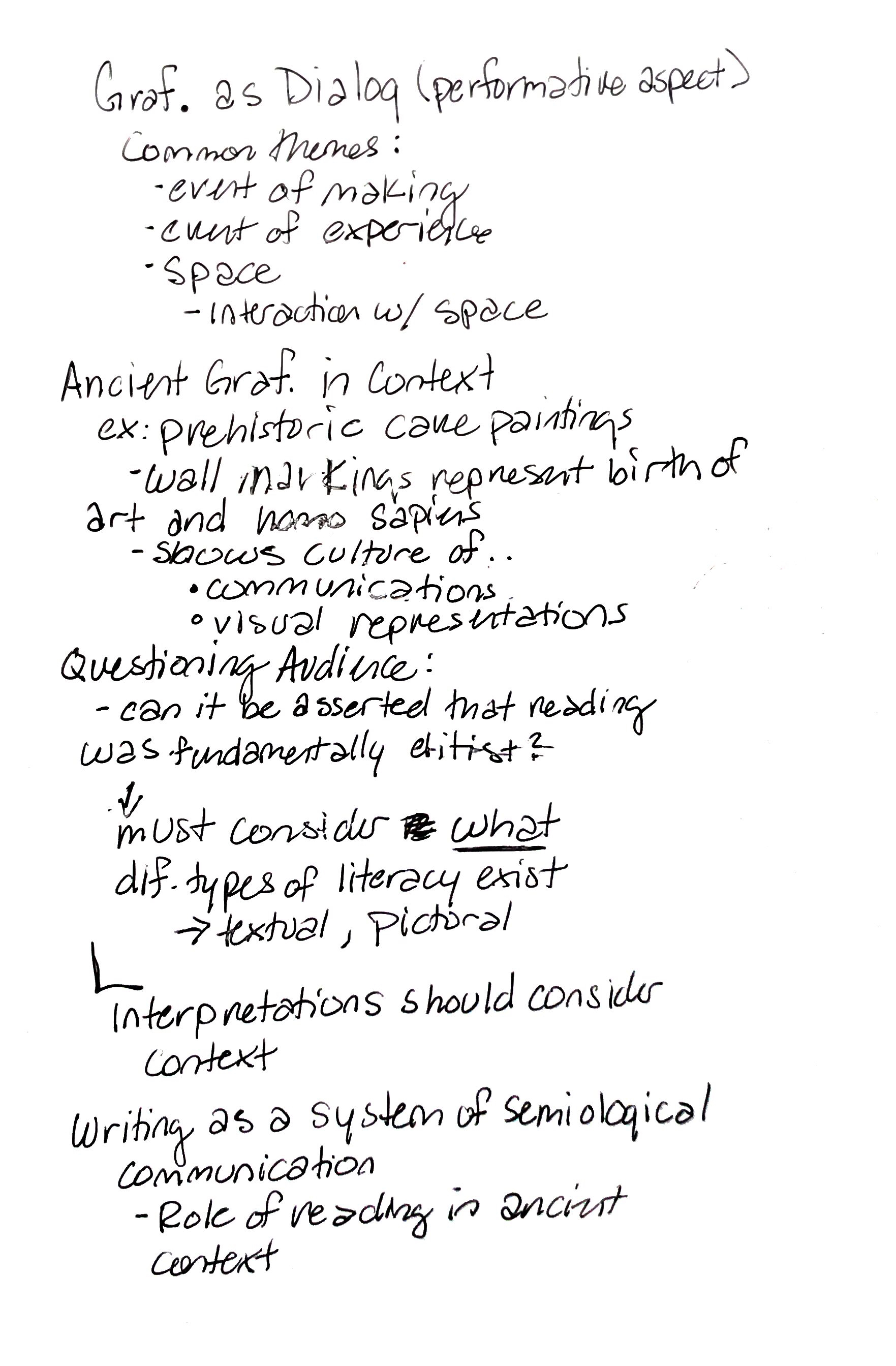
Ancient Graffiti (Notes 9.27.18)
Look Again! Thoughts & Notes
Relationships between Art History and Critical Theory
- Heinrich Wolfflin (1864-1945; Swiss Scholar; p.2)
- Influential in development of formal analysis in AH
- Painterly vs. Linear: Objective classifying principles
- What are the wider implications of chosen theory
- “Discourse” as “Language”
- Produced and Analyzed
- Terry Eagleton – Literary theorist
- “Language grasped as utterance…” (p.9)
- Theory is a discourse – web of many intersecting discourses
- Complexity (science)
- Record of Activity
- Synchronic – Present (x-axis)
- Diachronic – Historical (y-axis)
- Theory – Generally…
- Enlarges perspective
- Promotes formulation of new questions
- Allows for better understanding of subject
- General importance of CONTEXT…
- Social Conditions and Power Structures
- Ex. Social construction of power
- Class Structure & Social Hierarchy
- Who makes interpretations
- Who? Why? What? — led to generation of theory/discourse
- Historical Paradigms
- Influence of Institutions
- Individual experience and agency
- Ex. Behavioral changes
- Points of view — All different…
- Individual
- Cultural
- Familial
- Historical
- Space, time, place, people
- Forms/shapes responses…
- Difference in global perspectives
- Social Conditions and Power Structures
- Theory vs Methodology
- Theory
- Process of questioning leading to new questions
- Research questions
- Framework
- Methodology
- Set of procedures (rules)
- Characterize an Academic Discipline
- Framework for theories
- Theory
- Psychology, Perception of Art, & Psychoanalysis
- Psychoanalysis (broadly) = philosophy of human consciousness; social and individual
- Sigmund Freud (1856-1939; p.88)
- Father of psychoanalysis
- macro and micro theoretical approaches trying to understand and answer the questions of human consciousness
- methodology under which theoretical approaches ask questions in attempt to unlock the mystery of our mind
- Used psychoanalysis to analyze
- Content, subject matter
- Artist relation to work
- Viewer relation to work
- Nature of creativity
- CON – Lack of contextual analysis in favor of universal ideas
- Jacques Lacan (1901-1981, French Psychoanalyst; p.96)
- Updated Freud’s psychoanalytic theory
- How illusion of self comes into being
- Unconscious structured like language
- Issues of socially normative expectations and roles
- Hermeneutics – ways of thinking about thinking
- Polysemous – “of many senses”
- Layers of meaning
- Consciousness shaped by context
- Art as opening being – exists in/creates cultural space within context of viewer perception
- Art functions to shape viewer experience?
- Preconceived notions as variable when considering how viewer interprets and perceives art
- “Myth” as phenomena with “structuralism” giving meaning and structure
- Discourse produces power
- Shaped and perpetuates specific class/social dialogs
- Knowledge secures power
- Polysemous – “of many senses”
- Deconstruction
- Construction of meaning
- Exposes binary oppositions
- Signs aquire meaning by differing from signified
- meaning constantly floating, deferred
- Meaning in motion — straight forward meaning is an illusion
- Meaning relative to context
- Absolute meaning is a fallacy