
A Colby Community Web Site
Relationships between Art History and Critical Theory
At the beginning of the seminar we reviewed deconstruction, something that I didn’t quite understand until discussing in. Deconstruction is like the mathematical conundrum that states that one can never reach a destination because each time you move from point A to B you must first go half the distance, then half the distance left, then half that distance left, and so on, showing you will never reach point B because you would always be halfway away. I find deconstruction to be intriguing because it can definitely stimulate new lines of questioning.
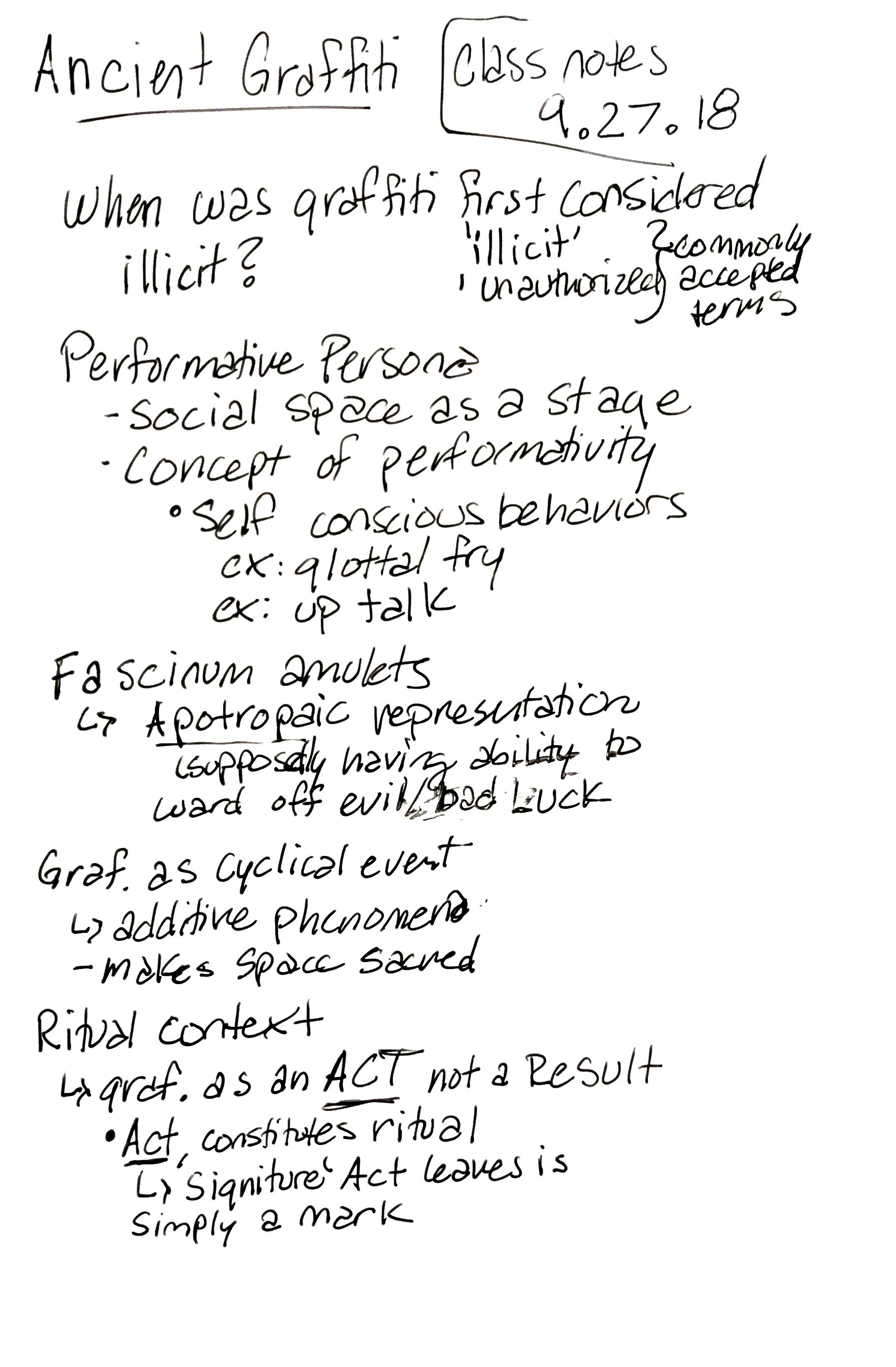
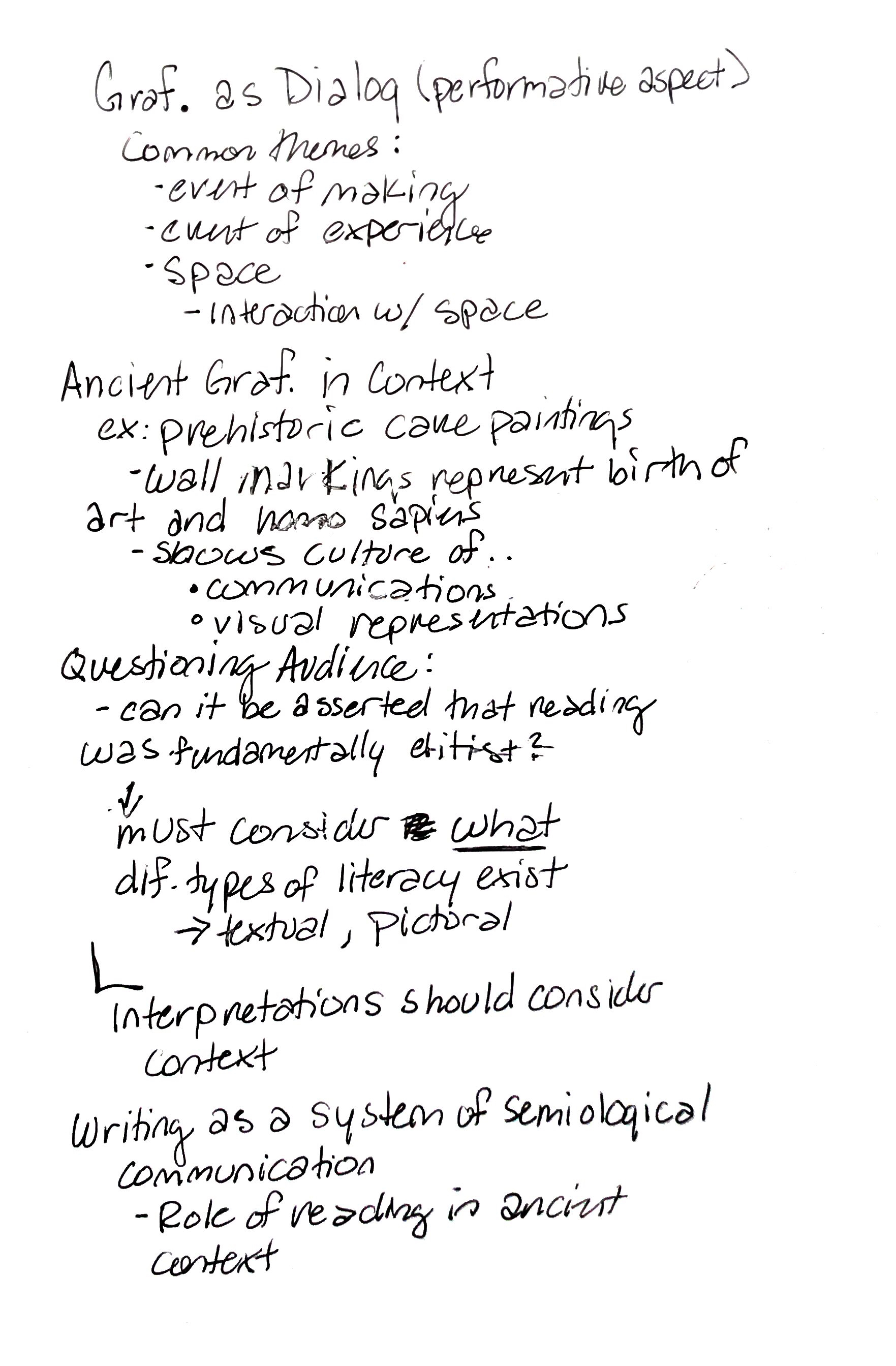
This seminar highlighted some of the important aspects to keep in mind when considering ancient graffiti; it’s performative, it’s connected to space, and it’s a dialogue. Ancient graffiti was performative because it was in your face, it turned spectators into spectacles, it was from a culture where people read out loud, and it was sometimes of a competitive nature. Graffiti made in temples should especially be understood as an act because it was the act of writing that made it a ritual, similar to a signature in modern times. Ancient graffiti is also connected to space; for example in the street intersections of Pompeii apotropaic graffiti could been seen. In Egyptian temples the location of graffiti reflects the daily happenings of temple personnel and shows how the temples have changed over time. The satirical graffiti diminishing the ruler in the Ruler and Protector motifs must’ve been made by elite people of the Mayan society, understood because of its location in an elite temple complex. Lastly, graffiti was a dialogue. This can be seen in the “graffiti spaces” in the Egyptian temples where graffiti stimulated making more graffiti and this accumulation turned it into a sacred space. Graffiti often asks for the “beholder’s share” and therefore doesn’t exist without an audience.
I think most of the readings assigned address what you can get out of interpreting ancient graffiti by paying attention to context. I thought the reading on Mayan graffiti was especially interesting, because the graffiti were made by and for a contemporaneous audience. For one thing, Olton is definitely not making an unreasonable claim in arguing that Mayan graffiti is evidence for a conscious, transgressive community. I don’t think the repeated pattern of making the ruler smaller than the protector is an accident or a coincidence, especially when considering that there are art pieces depicting the ruler as much more authoritative and “royal.” While the ruler is barely even drawn, other details, like the repeated cross-hatching of the protector’s vertical support point to how the artist made his/her details a choice. It was also really interesting that these graffiti were created by and only accessible to the elite class, so it’s plausible that these sketches were a way of communicating dissent toward the ruler. Olton even goes on to say that maybe these images operated as a warning to the ruler from his privileged subjects.
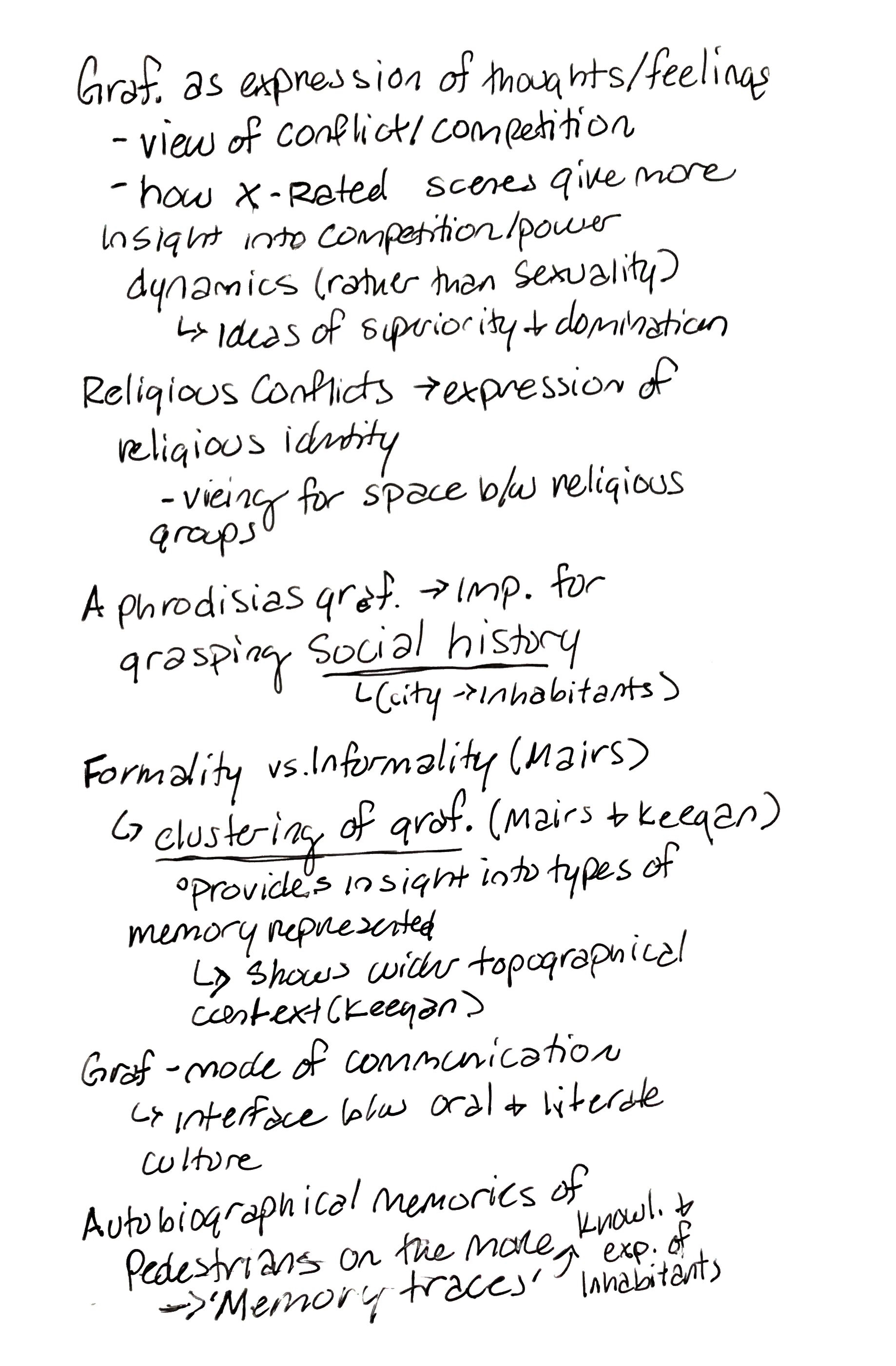
There is a lot of historical information you can gain from ancient graffiti, because they serve as evidence of individual people’s lives. I think in this way you can gain a much more specific perspective on groups of people you otherwise wouldn’t think much of. The Graffiti in the Athenian Agora reading shows just how much you can learn from what seems to be insignificant sketches made by people during this time period. Like the Romans, they engaged in sexual or obscene conversation on the walls. You can also figure things out like how ancient Greeks spoke (casual speech revealed in an example), their backgrounds based on the letters used (slaves used pi instead of phi), the ways Greeks traded and stayed organized, and the importance of religion in their lives.
I enjoyed these articles on ancient graffiti because each synthesized their respective ancient worlds in which graffiti is present through the analysis of the graffiti itself. By asking where and why graffiti was made, the authors give insights into each of the historical worlds of their respective graffiti. The articles considered graffiti made by all different people and found in all different places, but many similarities arose between the articles. Common themes in ancient graffiti include names, advertisements, obscenities, depictions of gods, and messages directed at specific people.
But before any of the authors were able to discuss graffiti, they first attempted to define graffiti and concluded that the definition is vague. Rather, the authors often explained what graffiti is by showing what it isn’t by disproving stereotypes. Frood explained that graffiti is not restricted to the lower class, but was made by all peoples, including priests (285). Baird and Taylor explained that we can’t assume ancient graffiti was illicit, or unauthorized (3). Kellum gave examples of graffiti of interior and exterior, showing graffiti isn’t always a public declaration (285). To give a loose definition, graffiti is a secondary image (not part of the primary decoration of a building) found in a place where it is unintended.
I was particularly intrigued by Frood’s study of temple graffiti to help create a timeline of how the temple has changed over time. Frood wrote that graffiti spaces “make it possible to plot long, probably punctuated, processes of addition, formalizing, and re-formalizing of sacred spaces” (Frood 297). This analysis of architecture using graffiti reaffirms the values of studying graffiti to bring new information to other fields.
Spectacle of the Streetby Barbra Kellum provided some of my favorite examples of ancient graffiti, specifically the discourse between Successus and Severus (287). This public conversation was humorous and a perfect example of how graffiti is a discourse between creator and viewer, reaffirming the idea that viewing graffiti was active, not passive. Frood surprised me by showing that the graffiti of Pompeii was very diverse, including everything from advertisements for restaurants or garments, to showing support for elections or gladiators, to simple jokes or game boards inscribed into the street itself. Kellum’s statement that “The serious and the humorous, the commercial and the sacred, the military and the amatory: all shared the same representational space and frequently intermingled” (290) shows how graffiti was a place of equality where any person could liken themselves to a god or hero. Ancient graffiti as an undiscriminating outlet for any voice relates to modern graffiti and how it stands for activism and a platform for all people.
Each of the articles read discuss the performative effect of making and experiencing graffiti. This is a similar idea to what we discussed in the tattoo seminar. The process of creating and viewing graffiti is equally if not more important the graffiti itself. How does this relationship change when graffiti is displayed inside of a museum or not on a wall?
These articles also attempt to define what graffiti is and then break down the meaning based on class, location, and space. The “Spectacle of the Street” does this through discussing the graffiti of Pompeii. The relationship between interior and the exterior street art becomes an important distinction. This relationship forms a fluid boundary, someone like a secret garden. The Baird and Taylor book focuses on the truisms of graffiti and its use as a way to mark ownership. Today we think of graffiti as an illicit medium, but in reality, it has not always been illicit. Graffiti may be viewed as illicit in urban environments, but in a temple or sacred place, ancient graffiti is accepted. This is an idea that Frood explores as well. Egypt seems to be an exception in the way that we think about graffiti because it is already covered in hieroglyphs and inscriptions. Graffiti in Egypt is writing on top of writing.
A question that I had while doing the reading is can graffiti be temporary? Is chalk art considered graffiti? How does a material change the meaning and experience of graffiti?