
Following this discussion on early modern graffiti, I wish to focus my reflection on the ways in which sites of graffiti become accepted spontaneous monuments. In discussing the Pasquino in Rome, per Juliet Fleming’s attention to the Roman “talking statues” in her article “Graffiti and the Writing Arts of Early Modern England,” I was prompted to reconsider what we validate as an “official” site of graffiti. As the political criticism collected around the Pasquino, the practice of inscribing such commentary became normalized to such an extent that it has ascended to hold meaning through language:
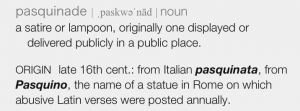
In this scenario, the site and surface upon which the commentary is scratched is expected. Through simple logic, should we consider graffiti to be “marks made on a surface not originally intended to hold these marks,” then the pasquinato etchings no longer ought to be classified as graffiti. However, as we have toyed with in discussion, attempting to categorize, classify, and define graffiti–what counts, what doesn’t count–is a distraction from interrogating the cultural work that such writings and marks do.
At what point do sites of graffiti become accepted, normalized, and reified to transcend their “disruptive” status to become simply a part of the landscape? In the cases of the Pasquino, in “tags” on the table at Jorgenson’s, or even 5Pointz, some sites welcome mark-making. In doing so, the graffiti becomes an expected aspect of the space/surface. By asking this question, it is clear that my modern understanding of graffiti as “disruptive” or an “intervention” shines through––our discussions on early modern, medieval, and ancient graffiti enable me to see the ways in which my modern bias informs my line of inquiry.