Ancient Graffiti Post-Seminar Reflection

Our discussion on ancient graffiti was broadened my understanding and definition of graffiti. In discussing the readings and case studies of graffiti in the ancient world, I came to realize that each definition offered a different perspective on graffiti’s properties, many of which contradicted the others. Is graffiti defined by its location? By its visibility? By its implied viewership? Is it a ritual act, defined by gesture and the event of its making? Is it ephemeral, in this performative sense, or is it lasting “evidence”? Is it inherently communicative, or is its meaning only produced by the author’s intent? Does graffiti define space? Does space define graffiti? How do legality and commissions relate to graffiti?

The readings for this class and the discussion which followed illuminated the multiplicities of definitions. Just as Deconstructionist theory attempts to find meaning, but discovers that meaning is deferred infinitely, perhaps we might reconcile the elusive nature of “defining” graffiti.

Ancient Graffiti Response

I found these chapters and articles to be insightful in their attention to the multifaceted and various ways in which ancient graffiti is/has been defined and materialized. The dialogic nature of these articles, made concrete in the specific occasions of intertextual citation, brings to mind our discussions on discourse and the way in which academic literature respond to, contradict, and build off one another. These articles contradict and complement one another through the definitions they support and discard.

A definition on which the readings seemed to find consensus was loosely based around marks made in unexpected places (Baird and Taylor 4). Deviating from the definition of and assumptions for graffiti within our contemporary social imaginary, this “definition” made room for broad, contextual, holistic study of textual and pictorial imagery in unassuming locations. Nevertheless, while this definition perhaps enabled Frood, Baird and Taylor, and Olton to explore and study the contexts, implications, and interpretations of graffiti in their field-sites, this definition is challenged within the context of Pompeii. As explored in Kellum’s article, the Roman “street was the pivotal performative arena in a visual culture where viewership was active…” (Kellum 283); the performative quality of visual culture and graffiti in the street aided in the construction of and performance of subjectivities. Not only was graffiti expected, but it affirmed individuality and identity within the framework of a performative social “stage” (287).

Among the articles, however, a source of unity appears to be the emphasis on decoding graffiti via a word and image approach that heeds the dialogic relationship among images. Graffiti “can be viewed in dialogue with one another as text and image,” write Baird and Taylor (Baird and Taylor 8). Similarly, Frood writes of the way in which secondary images “activate and enliven” primary (read: official) images (Frood 293).

In emphasizing a context-driven interpretation of graffiti, these texts point toward a key function (whether intentional or in its aftermath) of graffiti-as-event: that by scratching into a surface, its writers-artists engage in actions of place-making (Frood 298). In applying the functional effect of place-making to my own research this semester, I hope to explore the affective experience of place, dynamic and rendered a site of (discontinuous) communication through palimpsests of graffiti.

Look Again! 4-6 Post-discussion Reflection

Post-Discussion Response

In this section of seminar, student presentations on critical theories spanned Feminist theory through Post-Structuralism. Many of these theories seek to give a voice to those voices often under or misrepresented by challenging the cannon and the glorified “masters.”

Our discussion on artistic “genius,” including the identities and conditions that enable their elevation to the cannon inspired me to think beyond art and art history. In addition to glorifying their “originality,” “creative innovation,” “tortured-ness” and isolation, the recognition of their artistic “genius” stands upon the hierarchical nature of binary oppositions as they relate to identity: these artistic “geniuses” represent identities with access to power: straight, white, cis-gender men, middle-elite class (bourgeoisie), European, with access to education and networks of economic exchange. These identities, and the projection of “innovation” onto their characters, have enabled them to be included in the cannon.

As discussed in seminar, post-structural theorist Michel Foucault questioned the construction of power. His line of inquiry includes: How does knowledge secure power? Mobilizing this question, I locate a line of tension in our conversation and discourse that seeks to include marginalized artists and voices into the narrative. How does knowledge secure power? The majority of the theorists included in D’Alleva’s text are straight, white, cis-gender men from “Western” nations, highly educated and well-connected. That they might argue for a reading of art and literature that emphasizes sub-altern voices and production while embodying the structures of power that have kept those voices and production in the margins is both ironic and contradictory. But it does not come as a surprise.

What forms of art are considered to be art? Feminist and sub-altern scholars have emphasized the ways in which women’s art has been historically deemed as “craft,” thereby “less-than.” The same questions applied to art history from sub-altern and Feminist theory are relevant in academia. Knowledge secures power as texts are presented as historical “truth.” How is knowledge secured? Who has access to education? What forms of knowledge are considered to be knowledge?

Look Again! 4-6 Response

This final section of D’Alleva’s text Look Again! covered various critical theories that have emerged since the early 20th century, running the gamut from psychoanalysis and art to postmodernist theory. Though many of these theories differ and contradict one another in myriad ways, I found an intriguing commonality to be the way in which they pay attention to the viewer’s reception––whether psychological or contextual––and interpretation.

The text offers, under the subheading “the gaze,” that “to look is to assert power” (D’Alleva 106). Pairing this aphorism with E.H. Gombrich’s take on reception, in which he argues, as paraphrased by the text, that “no image tells its own story […] the viewer actively completes the work of art,” (109) we might infer that the work of art is not a static object, but an object-in-the-world (after Heidegger, qtd. 123). When gazed upon, visually decoded or encountered, the viewer engages with the work of art in a discursive and reciprocal relationship. The viewer brings to the encounter prior experiences, knowledge and biases which inform and influence his/her/their experience; from a hermeneutical lens, this viewer, far from an “ideal viewer,” comes to  the encounter with the work of art in a specific moment “in history and rooted in time” (123). By looking, the viewer asserts power through the lens of these prior experiences. Simultaneously, as Barthes would argue, without the viewer there would be no “text” (or work of art) to read (113). These theories, especially hermeneutics, will be useful in studying graffiti art over the course of this semester; they will assist me in analyzing and understanding my own positionality, the experiences and biases I have accrued over my life, and the particular moment in history, place, and time from which I am “reading” the graffiti.

In addition to reception theories I and II and hermeneutics, this section of Look Again! covered structuralism, post-structuralism, deconstruction, modernism and postmodernism. While I feel that I have a working knowledge of all, I would like to learn more about structuralism, post-structuralism and deconstruction in more detail. Having read Foucault within an anthropological context, I am familiar with his work on biopolitics and subjectivities, yet require additional examples of the application of his work in art history.

Look Again! 1-3 Post-Discussion Reflection

Post-Discussion Reflection

Following yesterday’s discussion and presentations in the seminar, I wish to highlight and reflect on several key takeaways. Of importance was the attention given to key terms and jargon, the differences and interconnectedness between “theory” as framework and “methodology” as practice, and the dynamic and reciprocal relationship between theory and object.

As observed in class, critical theories respond in varied ways to different works of art; some theories, when applied to a given work of art, may not stimulate inquiry or discourse as well as others. For example, only some artworks may respond to an iconographic approach. In particular, I found the discussion surrounding Semiotics and Word and Image studies to be engaging and relevant to our seminar’s focus. De Saussure’s work on signs and systems will be crucial in research throughout this seminar. Through this theoretical approach, graffiti––especially when both word and image are present––is a “signifier” and a visual index with spatial dynamics. “Decoding” the graffito via Word and Image and/or Semiotic modalities may elucidate the ways in which graffiti is a form of discontinuous communication; the “signifier” references the “signified” and the word and image (and word as image) are works of art.

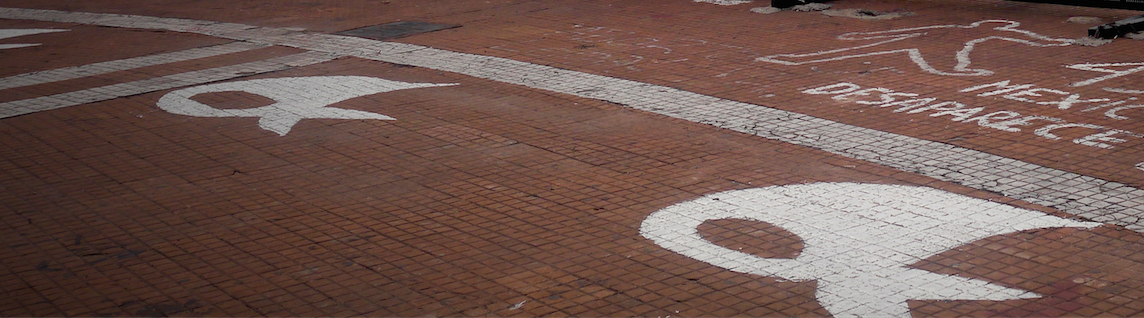
Understanding these critical theories will enable depth and new learning in my own research on graffiti/street art markings of the pañuelo blanco in Buenos Aires.

CW, “Pañuelo Blancos in Plaza de Mayo,” Buenos Aires, 2017.

These markings can be understood as signifiers that reference the signified: the material white scarves (formerly diapers) worn by las Madres de la Plaza de Mayo. The material white scarves, furthermore, reference another layer of symbolic meaning: memory, grief and injustice surrounding los desaparecidos. From our discussion surrounding Word and Image and Semiotics, I see how illuminating these critical theories will be throughout our research on graffiti this Seminar.

Look Again! 1-3

In this section of Look Again!, D’Alleva introduces critical theory by providing multiple definitions for “theory” and elaborating on its function in framing “better questions” for a “more focused inquiry” (11-12). In these chapters, the text continues to introduce numerous theories, terms, theorists, ideologies, and situates theories into dialectic relationships with one another. In doing so, the text exemplifies a main point from many of the contextual theories found in chapter three––that contexts vary across space and time, are influenced by a variety of factors (embodied experiences of identity, positionalities, intersecting tensions, etc.), and offer multiple means through which to frame questions.

I find D’Alleva’s narrative approach useful in broadening my understanding of these theories. The text clearly articulates its own narrative structure, offers definitions in accessible language, provides examples of theories-in-practice and questions for inquiry, and cites additional resources. Through reading these chapters, I feel more confident in my understanding of critical theory and more familiar with theorists who have developed and/or challenged various theoretical frameworks. I appreciate the attention the text paid to the functions of culture and art in societies, as attended to by Gramsci’s contributions to Marxist Theory. In various anthropology courses, I have studied Gramsci’s theories of cultural hegemony (50), and appreciate the ways in which D’Alleva’s text addresses art and visual culture, as understood within their specific contexts and the conditions for their production, and the cultural work they do.

I would like to learn more about––or discuss in class––the ways in which these theories relate and respond to one another. For example, how do proponents for Formalism in art history reconcile the conditions that made possible the artwork in question? Are Formalism and Marxist theory mutually exclusive?