
Post-Discussion Reflection
Following yesterday’s discussion and presentations in the seminar, I wish to highlight and reflect on several key takeaways. Of importance was the attention given to key terms and jargon, the differences and interconnectedness between “theory” as framework and “methodology” as practice, and the dynamic and reciprocal relationship between theory and object.
As observed in class, critical theories respond in varied ways to different works of art; some theories, when applied to a given work of art, may not stimulate inquiry or discourse as well as others. For example, only some artworks may respond to an iconographic approach. In particular, I found the discussion surrounding Semiotics and Word and Image studies to be engaging and relevant to our seminar’s focus. De Saussure’s work on signs and systems will be crucial in research throughout this seminar. Through this theoretical approach, graffiti––especially when both word and image are present––is a “signifier” and a visual index with spatial dynamics. “Decoding” the graffito via Word and Image and/or Semiotic modalities may elucidate the ways in which graffiti is a form of discontinuous communication; the “signifier” references the “signified” and the word and image (and word as image) are works of art.
Understanding these critical theories will enable depth and new learning in my own research on graffiti/street art markings of the pañuelo blanco in Buenos Aires.
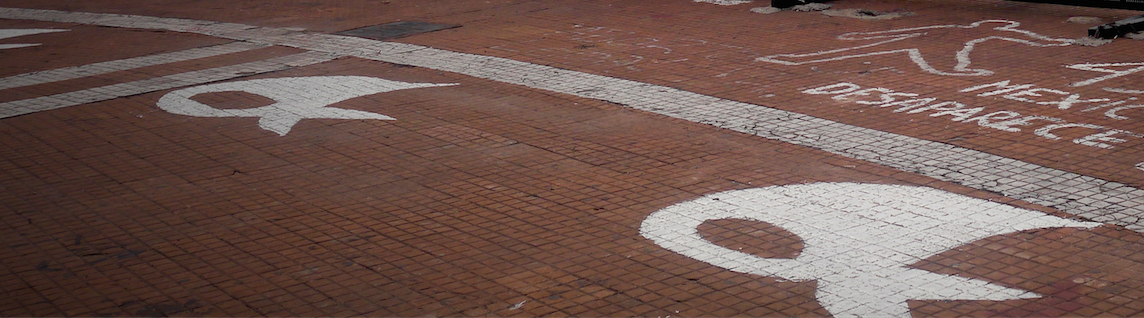
These markings can be understood as signifiers that reference the signified: the material white scarves (formerly diapers) worn by las Madres de la Plaza de Mayo. The material white scarves, furthermore, reference another layer of symbolic meaning: memory, grief and injustice surrounding los desaparecidos. From our discussion surrounding Word and Image and Semiotics, I see how illuminating these critical theories will be throughout our research on graffiti this Seminar.