Look Again! 4-6 Response

This final section of D’Alleva’s text Look Again! covered various critical theories that have emerged since the early 20th century, running the gamut from psychoanalysis and art to postmodernist theory. Though many of these theories differ and contradict one another in myriad ways, I found an intriguing commonality to be the way in which they pay attention to the viewer’s reception––whether psychological or contextual––and interpretation.

The text offers, under the subheading “the gaze,” that “to look is to assert power” (D’Alleva 106). Pairing this aphorism with E.H. Gombrich’s take on reception, in which he argues, as paraphrased by the text, that “no image tells its own story […] the viewer actively completes the work of art,” (109) we might infer that the work of art is not a static object, but an object-in-the-world (after Heidegger, qtd. 123). When gazed upon, visually decoded or encountered, the viewer engages with the work of art in a discursive and reciprocal relationship. The viewer brings to the encounter prior experiences, knowledge and biases which inform and influence his/her/their experience; from a hermeneutical lens, this viewer, far from an “ideal viewer,” comes to  the encounter with the work of art in a specific moment “in history and rooted in time” (123). By looking, the viewer asserts power through the lens of these prior experiences. Simultaneously, as Barthes would argue, without the viewer there would be no “text” (or work of art) to read (113). These theories, especially hermeneutics, will be useful in studying graffiti art over the course of this semester; they will assist me in analyzing and understanding my own positionality, the experiences and biases I have accrued over my life, and the particular moment in history, place, and time from which I am “reading” the graffiti.

In addition to reception theories I and II and hermeneutics, this section of Look Again! covered structuralism, post-structuralism, deconstruction, modernism and postmodernism. While I feel that I have a working knowledge of all, I would like to learn more about structuralism, post-structuralism and deconstruction in more detail. Having read Foucault within an anthropological context, I am familiar with his work on biopolitics and subjectivities, yet require additional examples of the application of his work in art history.
Look Again! 1-3 Post-Discussion Reflection

Post-Discussion Reflection

Following yesterday’s discussion and presentations in the seminar, I wish to highlight and reflect on several key takeaways. Of importance was the attention given to key terms and jargon, the differences and interconnectedness between “theory” as framework and “methodology” as practice, and the dynamic and reciprocal relationship between theory and object.

As observed in class, critical theories respond in varied ways to different works of art; some theories, when applied to a given work of art, may not stimulate inquiry or discourse as well as others. For example, only some artworks may respond to an iconographic approach. In particular, I found the discussion surrounding Semiotics and Word and Image studies to be engaging and relevant to our seminar’s focus. De Saussure’s work on signs and systems will be crucial in research throughout this seminar. Through this theoretical approach, graffiti––especially when both word and image are present––is a “signifier” and a visual index with spatial dynamics. “Decoding” the graffito via Word and Image and/or Semiotic modalities may elucidate the ways in which graffiti is a form of discontinuous communication; the “signifier” references the “signified” and the word and image (and word as image) are works of art.

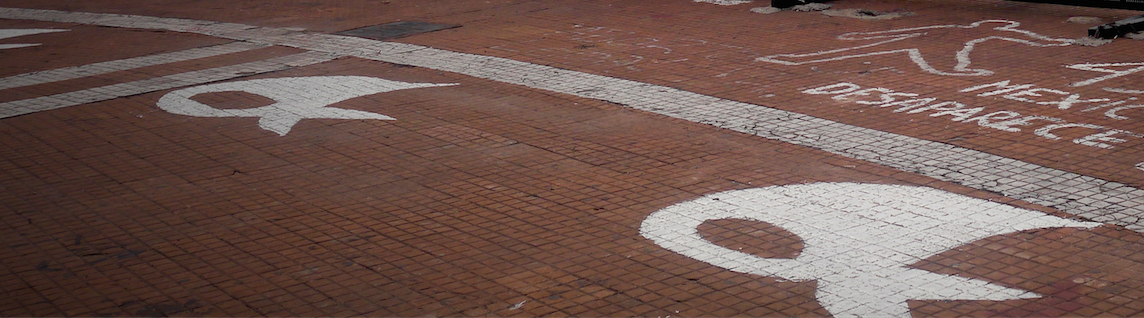
Understanding these critical theories will enable depth and new learning in my own research on graffiti/street art markings of the pañuelo blanco in Buenos Aires.

CW, “Pañuelo Blancos in Plaza de Mayo,” Buenos Aires, 2017.

These markings can be understood as signifiers that reference the signified: the material white scarves (formerly diapers) worn by las Madres de la Plaza de Mayo. The material white scarves, furthermore, reference another layer of symbolic meaning: memory, grief and injustice surrounding los desaparecidos. From our discussion surrounding Word and Image and Semiotics, I see how illuminating these critical theories will be throughout our research on graffiti this Seminar.

Look Again! chapters 1-3

I find chapter 2 of Look Again! especially important in understanding how to read art and what constitutes as art. The analysis of form, symbol, and sign greatly influence the interpretation of any piece of art as well as define pieces that may not typically be considered art. The idea of reading art comes from semiotic theory. Semiotics is the theory of signs. Signs can take the form of words, images, sounds, gestures, objects, and even ideas. The theory says that these signs can only function if they are interpreted and recognized. Swiss linguist, Ferdinand de Saussure has a two-part theory of the composition of signs. Saussure believes that there is a signifier and a signified. The signifier is the form that the sign takes and the signified is the concept it represents.

“In semiotics, a text is an assemblage of signs constructed (and interpreted) according to the rules or conventions of a particular medium or form of communication” (D’Alleva 39). By this definition, novels, poems, and symbols in graffiti can all be categorized as texts. The process of interpreting these texts through the system of rules is called reading. Art historians: Mieke Bal, Louis Marin, and Norman Bryson have developed the “idea of reading as a very specific semiotic methodology for interpreting visual images” (D’Alleva 39). The English word “tree” is a signifier for a signified living tree that you see when you look out your window. American philosopher, Charles Sanders Peirce has said, “a sign…is something which stands to somebody for something in some respect or capacity. It addresses somebody, that is, creates in the mind of that person an equivalent sign, or perhaps a more developed sign”(D’Alleva 33).

This idea of semiotics applies to graffiti when we consider gang graffiti. Just as when people see a tree, they often think of the word tree in their head, when members of a gang see a piece of graffiti with a gang’s mark/symbol, they too think of the signified because that is the meaning that it has in their mind. This idea could also be applied when looking at signature handwritings and styles of graffiti that are specific to a signified person or group.

Look Again! 1-3

In this section of Look Again!, D’Alleva introduces critical theory by providing multiple definitions for “theory” and elaborating on its function in framing “better questions” for a “more focused inquiry” (11-12). In these chapters, the text continues to introduce numerous theories, terms, theorists, ideologies, and situates theories into dialectic relationships with one another. In doing so, the text exemplifies a main point from many of the contextual theories found in chapter three––that contexts vary across space and time, are influenced by a variety of factors (embodied experiences of identity, positionalities, intersecting tensions, etc.), and offer multiple means through which to frame questions.

I find D’Alleva’s narrative approach useful in broadening my understanding of these theories. The text clearly articulates its own narrative structure, offers definitions in accessible language, provides examples of theories-in-practice and questions for inquiry, and cites additional resources. Through reading these chapters, I feel more confident in my understanding of critical theory and more familiar with theorists who have developed and/or challenged various theoretical frameworks. I appreciate the attention the text paid to the functions of culture and art in societies, as attended to by Gramsci’s contributions to Marxist Theory. In various anthropology courses, I have studied Gramsci’s theories of cultural hegemony (50), and appreciate the ways in which D’Alleva’s text addresses art and visual culture, as understood within their specific contexts and the conditions for their production, and the cultural work they do.

I would like to learn more about––or discuss in class––the ways in which these theories relate and respond to one another. For example, how do proponents for Formalism in art history reconcile the conditions that made possible the artwork in question? Are Formalism and Marxist theory mutually exclusive?

Look Again! Chapters 1-3

This reading reminded me a lot of the conversations we had in “Theories and Methods of Art History” last semester. One of the main goals of the reading was to establish a definition of ‘theory’ and put it in context with ‘methods’. An interesting moment for me was when the author stated they wanted to be careful to define a canon for critical theory. By doing so, we would include and exclude different works. Creating a theory is about an exploration of your own intellectual interests and questions, rather than following what is trendy.

The second chapter in our reading discussed how art works produced and reflected meaning. What is so obvious about art history, is that a lot of it is based on comparison. I have never really thought about how foundational comparison is within this field of study. Iconographic/iconological analysis is almost entirely rooted in comparison. We use similarities and differences to weight importance and get a better understanding of the history of the work. It is interesting to think how art history has changed simply because we have more works to compare to.

The third chapter

Directions for Research Diary Entries

To post an entry:

1.  Click on the “+New” tab right above the Graffiti title, and scroll down to “Post.”

2.  That will bring you to the “Edit Post” page.

3.  Type the title of your post in the blank space immediately under the “Edit Post” title.

4.  Type your post in the text box.  You can use any of the formatting controls above the text box.

5. In the “Categories” box in the middle of the right-hand sidebar, select the applicable date for your post.

7. In the upper right-hand corner, in the “Publish” box, click “Edit” under the “Published on” date and time. Set the date and time to 12 a.m. (12:00) on Monday. The blue “Publish” button should now say “Schedule.”

8.  Once you are done, click on the blue “Schedule” button.

When it has been published, you can view your post by returning to the Graffiti homepage. You can also edit your post by clicking on the edit link at the bottom of your post.  That will return you to the “Edit Post” page where you can edit as you wish.  Once you are done, click on the blue “Update” button at the far right of the screen.

For further assistance, please contact Ellen Freeman or Mark Wardecker