Have you ever heard the Chinese proverb that says, “the land nurtures its own people (yi fang shui tu yang yi fang ren)”? This proverb emphasizes the importance of the land in shaping the character, values, culture, and traditions of the people who live there. It also encourages us to learn about people by learning about their land. Therefore, when learning about Ghana’s education, specifically elite education at Sankofa International College, I started by learning about the land of Ghana.
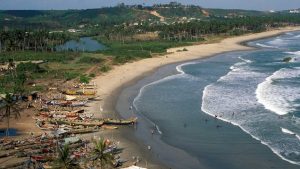
Ghana landscape
Photograph by The Africa Image Library, Alamy. Retrieved from National Geographic Kids
Ghana is a coastal country that can be divided into three regions based on the landscape: the southern coastal region, the inland forest region, and the northern savanna region. The coastal region has most of the urban centers due to its exposure to European influences in the past through trade. The inland and northern regions consist of most rural villages that have struggled with poverty due to hardships in agriculture and a slave-raiding history. However, the inland forest region gave rise to influential political ideas that sparked the initiation of a large political empire in Kumasi. Moreover, these rural villages still hold on to traditional African religions that emphasize honoring ancestors and building a community of respect. But the urban cities have a different story with European influences. Even today, traditional African religions are often more prevalent in rural areas, whereas urban areas have a more diverse cultural landscape, with Christianity and Islam being the majority religions (Check out this document to learn more about Ghana’s landscape).
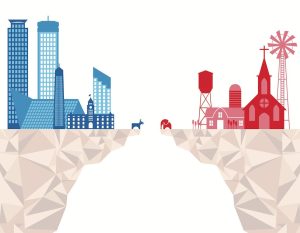
Rural and Urban Divide Cubism Art
Image by Josh Jones – Star Tribune
Considering the rural and urban differences in values and practices, let’s zoom in to look at the educational divide. Regarding education, rural communities consider it an entrenched and deep-set value and urban communities also stress it a lot. Although both rural and urban communities value education, the availability of high-quality education resources is not shared equally across the country. Specifically, there are great disparities in senior high school (SHSs) education, which then leads to different outcomes in university and the workplace. Urban SHSs often have better infrastructure and educational resources, more qualified and experienced teachers, and a more positive and academic-driven atmosphere that motivates students to study hard than rural SHSs. As a result, urban SHSs have more students who advance to competitive national universities with high West Africa Senior Secondary Certificate Examination (WASSCE) scores. This creates a problem because parents often work hard to get their children into urban SHSs, even if that means asking their kids to join the visual arts program, a program that is socially believed to be for academically weak students. Obviously, the widespread downward outlook and conception towards visual arts are problematic because this view creates an unnecessary academic subject hierarchy that reframes students’ choice and passion for different subjects. Nevertheless, parents’ wish for sending kids to urban SHSs speaks to the harsh fact of the rural-urban educational divide in Ghana and calls for attention and action to close the gap (Check out this journal article for more information).
Given Ghana’s rural and urban divide situation, I was not surprised to learn that the elite school, Sankofa International College, is located in a rich sprawling suburban neighborhood. But the neighborhood is not without its struggles, as local people refer to it as “Ghana’s richest slum.” Despite the poverty and unreliable power supply, the school continues to expand its luxury athletic facilities, including a pristine soccer field that relies on sprinklers to keep it green (Check out this article from the Global Sites webpage for more information). The school’s almost outlandish facilities redefine the geographic boundary between city and rural areas through its enormous wealth and privileges. Interestingly, the student population at Sankofa is divided between wealthy backgrounds and those who are not, and social class differences are not allowed to be discussed.
However, some students are aware of the rural-urban divide through their parents’ background and volunteer work. A 12th-grade Sankofa student discussed in the interview that she grew up knowing her mom is from a more rural, poor fishing village, and her dad is from a middle-class village close to a city. The student also talked about the joy and pride she gained from volunteering in her mom’s organization which aims to spread knowledge and empower people from rural villages. This volunteer work is a step towards bridging the rural-urban gap.
In the end, let’s not forget the proverb that reminds us that the land shapes the people who live there as we work towards building education equity. We can all learn from the land and dedicate ourselves to closing the rural-urban divide if it exists.