As the legend goes, an angry father confronts his son about the damage to a cherry tree. “I cannot tell a lie,” young George Washington proudly asserts, “I did cut it with my hatchet.” Washington Senior proceeds to forgive his son, because George’s honesty was more valuable than a thousand trees. This legend has been retold over and over to extol the virtues of honesty and morality. But what if the young George cannot tell a lie because he is a bad liar with a poor working memory?
What comes to mind when you hear the word “gamer”? For non-gamers this term is often accompanied with a negative stigma. For some people, you might envision an average person, someone who studies hard in school or works a nine to five job while enjoying video games in their down time. But for others, many will associate this word with someone who lives in their parent’s basement, lacks social skills, has a diet consisting of Doritos and coke, and hardly sees the light of day. Some people may even think back to the time they saw that YouTube video of a “gamer” freaking out and breaking their TV or keyboard via a rage infused “gronk” spike. If you don’t know what a gronk spike is, click here.
In the modern age, because of how large of an influence technology plays in our daily lives, this negative stigma seems to be fading as more and more people are playing video games. However, spending hours a day playing is still often viewed as unproductive and wasted time. But what if I were to tell you that playing video games, specifically first person shooter games (FPS), could increase a person’s attentional capacity- the amount of information that a person can attend to at any given moment, the processing of peripheral information, and ability to multitask? To start, I’d bet there would be a lot of kids rushing to their parents defending their hours of play video games in hopes of being allowed to spend more time playing. I can envision the conversation now: Read more…
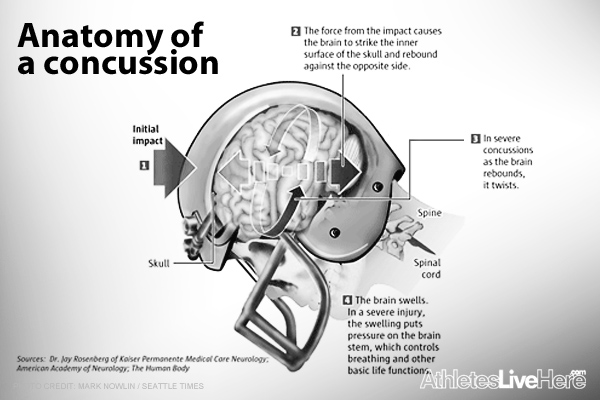
The world of sports is a dangerous place for athletes.The speed and power of athletes can sometimes result in collisions and injuries that can leave athletes sidelined anywherefrom a few minutes to an entire season… or worse.But, only the injuries that we can see on the outside are easy to diagnose and treat.Injuries, with equal severity (if not more), happen frequently and can go unnoticed.An athlete’s brain is at constant risk of injury during sports.Even a small bumping of heads with another athlete can result in concussion.These brain injuries can leave people with a loss of memory, dizziness, blurred vision, and sometimes completely knocked-out.Diagnosing concussions can be tricky because athletes often do not show immediate or significant symptoms. According to Tracey Covassin, Bryan Crutcher, & Jessica Wallace (2013), the way athletic trainers and doctors assess whether or not an athlete is concussed or cleared for activity requires increasing concussive symptoms. So is there another way, or is the injured athlete’s depressing reality just a pro-longed road to recovery?
Have you ever been so angry and frustrated at something that you begin having irrational thoughts or actions? Say you stub your toe and begin screaming profanities at the bureau that you stubbed it on. In your normal state of mind, you would know that it’s ridiculous to be screaming at inanimate objects when the cause of your frustration is entirely on you. So why do these irrational thoughts or actions happen in the first place, and why does our self-control seem to disappear in these instances? Self-control depletion, or losing the ability to control oneself has been recently looked at in greater detail, and real world implications of self control depletion are being discovered. An area that self-control depletion can have a large effect is in sports competition. Anyone who has played competitive sports knows the feeling of being so frustrated with an aspect of the game that they no longer act as themselves, and rather act on frustration and anger. Whether it comes from a ref blowing an obvious call or an opposing player performing a blatant foul on you or one of your teammates, a normally rational and unaggressive player can lose their self-control quickly. A study in 2014 by Englert and Bertrams looked at self–control depletion, focusing their study on the effects that self-control depletion has in sports. Being able to have self-control is a very important part of most competitive sports. From flipping over a chess table because you are frustrated by your lack of strategy, to hitting an opposing football player with the truck-stick because they badmouthed your teammate on the previous play, self-control comes into play more often than not in competitive play. Understanding the effects of self-control depletion in sports may just give you the competitive edge.
Self-control can be defined as the process of voluntarily controlling an impulse or habitual action, such as choosing to eat an apple instead of a piece of cake when you are on a diet. Much like how attention is a limited resource, self-control is also limited in its capacity. In sports, attention is spread to many different things, and since it is a limited resource, it is difficult to pay attention to self-control while attending to so many other distractions. Attention has often been described as a “spotlight”, and you must move the spotlight around to focus your attention on different things. In sports, that spotlight is constantly moving around, trying to focus on the most important aspect of the game. Since you are trying to focus on so many different things, you are spending much less time focusing on your self-control, and allowing it to get out of hand when presented with situations requiring utmost self-control.
After a first act of self-control, the resource is depleted for a certain amount of time, and it is not replenished instantly (Baumeister et al., 1998). This time period where the resource has been depleted is called “ego depletion”, and further acts of self-control are temporarily impaired during this period. This study also aimed to look at how certain aspects of sporting competitions can actually deplete self-control strength. In order to do this, the experimenters relied on the effect of vicarious depletion. Vicarious depletion can be described as mentally reliving the actions of a person who had to exert self-control and having your own self-control depleted as well.
What is your thought process when you see someone’s face for the first time? This is a tough question, and quite honestly I could not think of anything specific myself. Upon perceiving a face, it only takes us a few seconds to cognitively process it and gather all the necessary information about it. For something so seemingly easy and quick, one would not expect any difference between how different people perceive and process faces, right? Wrong. What if I told you that women processed males and female faces differently? If you are a woman like myself, you are probably puzzled, as you probably never had a difficult time recalling and identifying faces of your peers regardless of their gender. Evidence suggests that women are better at remembering female faces than they are at remembering male faces. In the paper titled “Women Own-gender Bias in Face Recognition Memory: the role of attention at encoding,” researchers investigated the role attention played in women’s ability to better remember faces of fellow females than faces of males. Read more…
There are 1.23 billion people worldwide who spend an hour a day, on average, playing video games, reported by Time.com. I used to be one of those game players when I was in elementary school. However, my parents enforced me to quit playing games by setting up strict time limits, and even locked the computer with a password that I have never successfully cracked. My parents are not the only ones who are of the belief that playing video games is not beneficial at all, but a waste of time. Searching “video game playing” on Google, the top 10 search results are on how to quit playing video games and why video games can ruin one’s life. On the contrary, recent bestseller books and psychology studies argued against this common belief that playing video games is in fact not a total waste of time. When people play games, they are “wholeheartedly engaged in creative challenges,” said Jane McGonigal, a game designer and bestseller author, cited in Time.com.
Have you ever worked on a homework assignment with your cell phone near you so that you can hear when you get a notification? I know I have. Cell phone use has become widespread in today’s society. Everywhere you go, you see people with cell phones in their hands, and they commonly try to use their cell phones as they do something else. You might see someone looking down at a cell phone while driving, texting while chatting with a friend, and scrolling through a social media app while doing homework. Research has shown that the use of cell phones during a concurrent task can be very distracting and can impair performance on that task, but what about when you receive a notification and do not check or respond to it?
Many people carry their phones with them almost everywhere they go. For example, you might bring your cell phone to class and store it in your pocket, or leave your cell phone lying on your desk while you work on a homework assignment. So what happens when you hear a ring or feel vibrations from your cell phone, alerting you that you’ve received a notification? Does it affect your attention? Does simply getting a notification on your cell phone, without checking it, have a cost to your attention? Researchers Stothart, Mitchum, and Yehnert (2015) conducted a study to examine this question.
Imagine that you go to a magic show. You spend the $10 entry fee at the entrance of the theater. You sit down among the throng of eager audience members waiting to see the dazzling, awe-inspiring tricks that will not just bend your mind’s perception, but also the very laws of nature. Eventually, the magician takes the stage, and everybody including yourself suddenly becomes silent and still in anticipation. Then, he starts to perform tricks ranging from pulling rabbits out of hats to hoops that magically can become bound and unbound together at the flick of the wrist. Before you know it, the show is almost over, but the magician has prepared for the audience a grand finale involving two mysterious doors. What happens next cannot be described with words as eloquently as this following clip:
If you had asked the high school version of myself about some of the parents of my peers not allowing their children to play football because of the sports dangers, I would have laughed at the idea. To me this was the greatest game in the world, a game that teaches the values of hard work, perseverance, and a humbleness that is hard to learn other places in life. How can you simply tell someone who has dedicated countless hours and years to their craft that they can no longer do the thing they love the most? But the dreaded “C word” whispered in both high school and college locker rooms across the country is doing just that, as the length of recovery for athletes with a history of concussions is being questioned.
Imagine a boy who grew up never knowing where his next meal would come from or when it would come. Now imagine a boy who had everything handed to him.
Who do you predict will have higher cognitive functioning, which consists of processes such as pattern recognition, memory, attention, and language? If you guessed the second boy, you are correct. Childhood adversity has been shown to negatively impact important cognitive functions, such as language development, sustained attention, and memory, which result in poor reading and math abilities, lower IQs and academic achievement (Fernald, Weber, Galasso & Ratsifandrihamanana, 2011). To figure out why this is the case, we must consider an important characteristic of our brains—their plasticity, or ability to change!
So, why is plasticity an important characteristic of our brains? What are the advantages of our cognitive functioning being susceptible to change? Adaptation! Adaptation got Mittal, Griskevicius, Simpson, Sung, and Young (2015) thinking about the universality of the negative impact on cognitive functions that childhood adversity has been shown to have. If the brains of those who grow up in stressful environments can be negatively affected by their experiences shouldn’t that mean that they could also be positively affected? The work of Mittal et al. (2015) tells us the answer!


 The world of sports is a dangerous place for athletes.



Recent Comments