
Last Tuesday marked our last meeting of the Origins seminars, but rather than having just one presenter, we heard a little bit about many origin stories selected by the Seminar Class (232). Throughout this semester, I have continued to be surprised by the variety of origins our presenters discussed, and these presentations demonstrated the theme’s far reach historically and globally: from the origins of journalism, to the origins evil, the origins of the use of “trans,” the origins of refugees in Lewiston Maine, and many others. Not only have I learned that the theme of origins has a much greater scale than I understood at the beginning of the semester, but there is a clear, greater value in considering the origin of something. An origin, regardless of whether its a historical event or a more personal matter, tells the story of a fairly intricate process that requires an assortment of factors to fall perfectly in place. With the alignment of these pieces, it then creates a significant, sometimes universal and sometimes personal, impact that then continues on throughout history.
Two of the projects we saw demonstrated the scale of this impact that origins can have pretty perfectly. The first was one of the seminar posters about the Origins of Journalism, and how the industry has transformed from order to chaos. This students detailed research told the story of how journalism not only was established, but also how its origin led to the place the industry rests today. The poster drew from the original processes, and then tied them directly to journalism in today’s world of social media and how quickly information is shared around the world. A process, so technical and personal in its original production, has transformed into a global network that completely changed how we receive news on a daily basis.
On the more personal end of the spectrum, I also spent time with one of the Artist’s Books (AR287) students and heard about the personal impact her project titled “1932” tells the story of. In her book, she combined her background in art and family experience to tell a story about her grandfather and the significance of that year for him. Her final project demonstrated the origin and history of bookmaking that the course material covered over the semester, and it further showed the personal interpretation that an origin story can embody. Not only can one origin be interpreted differently from person to person, but the entire theme of an origin can tell very different stories as well.
Before beginning our seminars this semester, when I thought of origins what came to mind was either an image of an olive tree, coupled with my very basic understanding of the story of Adam and Eve, or Charles Darwin’s Origin of Species and the well known graphic Janet Browne used in her presentation. (See below)
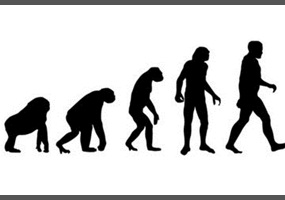
Source: http://cf.mp-cdn.net/5b/9e/eeadabfa9dba62a6a008a15fa323-how-to-prove-that-the-evolution-theory-of-charles-darwin-is-true.jpg
However, the Arts and Humanities theme completely challenged and successfully redefined my idea of origins, as I haven’t been able to help noting again and again in my posts this semester.
Leave a Reply
You must be logged in to post a comment.