Ancient Graffiti Response

I found these chapters and articles to be insightful in their attention to the multifaceted and various ways in which ancient graffiti is/has been defined and materialized. The dialogic nature of these articles, made concrete in the specific occasions of intertextual citation, brings to mind our discussions on discourse and the way in which academic literature respond to, contradict, and build off one another. These articles contradict and complement one another through the definitions they support and discard.

A definition on which the readings seemed to find consensus was loosely based around marks made in unexpected places (Baird and Taylor 4). Deviating from the definition of and assumptions for graffiti within our contemporary social imaginary, this “definition” made room for broad, contextual, holistic study of textual and pictorial imagery in unassuming locations. Nevertheless, while this definition perhaps enabled Frood, Baird and Taylor, and Olton to explore and study the contexts, implications, and interpretations of graffiti in their field-sites, this definition is challenged within the context of Pompeii. As explored in Kellum’s article, the Roman “street was the pivotal performative arena in a visual culture where viewership was active…” (Kellum 283); the performative quality of visual culture and graffiti in the street aided in the construction of and performance of subjectivities. Not only was graffiti expected, but it affirmed individuality and identity within the framework of a performative social “stage” (287).

Among the articles, however, a source of unity appears to be the emphasis on decoding graffiti via a word and image approach that heeds the dialogic relationship among images. Graffiti “can be viewed in dialogue with one another as text and image,” write Baird and Taylor (Baird and Taylor 8). Similarly, Frood writes of the way in which secondary images “activate and enliven” primary (read: official) images (Frood 293).

In emphasizing a context-driven interpretation of graffiti, these texts point toward a key function (whether intentional or in its aftermath) of graffiti-as-event: that by scratching into a surface, its writers-artists engage in actions of place-making (Frood 298). In applying the functional effect of place-making to my own research this semester, I hope to explore the affective experience of place, dynamic and rendered a site of (discontinuous) communication through palimpsests of graffiti.
Ch. 4-6 Post-Seminar

Before coming to this seminar I thought I had a general idea of what the differences were between subjects such as anthropology and sociology. However, after that class I realized I could not give you a clear answer on what the distinctions are between these studies. After looking it up, I got that anthropology is “the study of human societies and cultures and their development,” and sociology is, “the study of the development, structure, and functioning of human society.” Even in their definitions they’re pretty similar, so I guess the confusion was justified. This book has made me realize that although there are these different fields of study, many are interdisciplinary and cross paths in a lot of different ways with each other.

Look Again! 4-6 Post-discussion Reflection

Post-Discussion Response

In this section of seminar, student presentations on critical theories spanned Feminist theory through Post-Structuralism. Many of these theories seek to give a voice to those voices often under or misrepresented by challenging the cannon and the glorified “masters.”

Our discussion on artistic “genius,” including the identities and conditions that enable their elevation to the cannon inspired me to think beyond art and art history. In addition to glorifying their “originality,” “creative innovation,” “tortured-ness” and isolation, the recognition of their artistic “genius” stands upon the hierarchical nature of binary oppositions as they relate to identity: these artistic “geniuses” represent identities with access to power: straight, white, cis-gender men, middle-elite class (bourgeoisie), European, with access to education and networks of economic exchange. These identities, and the projection of “innovation” onto their characters, have enabled them to be included in the cannon.

As discussed in seminar, post-structural theorist Michel Foucault questioned the construction of power. His line of inquiry includes: How does knowledge secure power? Mobilizing this question, I locate a line of tension in our conversation and discourse that seeks to include marginalized artists and voices into the narrative. How does knowledge secure power? The majority of the theorists included in D’Alleva’s text are straight, white, cis-gender men from “Western” nations, highly educated and well-connected. That they might argue for a reading of art and literature that emphasizes sub-altern voices and production while embodying the structures of power that have kept those voices and production in the margins is both ironic and contradictory. But it does not come as a surprise.

What forms of art are considered to be art? Feminist and sub-altern scholars have emphasized the ways in which women’s art has been historically deemed as “craft,” thereby “less-than.” The same questions applied to art history from sub-altern and Feminist theory are relevant in academia. Knowledge secures power as texts are presented as historical “truth.” How is knowledge secured? Who has access to education? What forms of knowledge are considered to be knowledge?

Look Again! Chapters 406

Throughout my academic career, I have encountered Sigmund Freud several times. However, his “penis argument” was new to me. I had never heard of this part of his Oedipus vs. Electra complex, and found his argument to be very…quaint. It was so interesting to learn how easily he categorized the world. For someone who had such advanced ideas in the 19th century that emphasized the experience and psyche of the unconscious individual, it is contradictory to have such a narrow opinion of male and female gender and sexuality. As D’Alleva says, his theories “reflect Freud’s experience of nineteenth-century bourgeois male culture, not the range of human experience.” He claims to understand and speak for all, but ends up missing so much. Freud places the penis at the very center of all of humanity’s sexuality, what we all apparently strive to have/attain, which consequently belittles the female clitoris and vagina. Which really, just exhibits the pattern and power of ‘the man’, something that has become such a dominant theme throughout our history.

It is interesting to study Freud within the discipline of art history, as he is usually more relevant within the fields of psychology, political science and philosophy. Additionally, his low opinion of women and their sexuality is an interesting component to add to art history, which already struggles with the lack of great female artists. So many women were denied access to education and artistic training, mainly because they were not wealthy white men. As D’Alleva mentions, Freud has had many critics for the great majority of his theories, but yet some of his arguments in art history remain uncontested, as he attempted to psychoanalytically explain great artists like Michelangelo and Leonardo da Vinci. Freud’s approach to art history consists of psychoanalyzing the artist’s intentions, personality and works. Most art historians do not use Freud’s pathographical approach (with good reason), as it is incredibly difficult already to figure out an artist’s conscious intentions, never mind their unconscious intentions. However, it is certainly intriguing to read Freud’s attempts to understand these complex artists.

Chapters 4-6 Look! Again

Chapters 4-6 in D’Alleva’s Look! Again, provide another interesting look on some of the most important foundations of art history. Focusing on the section on structuralism and post structuralism specifically (for the purpose of my short class presentation), I want to take this opportunity to reflect on a few specific pieces of D’Alleva’s arguments concerning these movements.

Between my senior capstone art history class and this class alike, the ideas of synchronic and diachronic aspects have presented themselves week after week in my reading. In this section in particular, myths are questioned using synchronic and diachronic approaches, and this breaks the form of structuralism into a more digestible format when compared to other theories of art history. I find it fascinating how structuralists could argue the need for rigidity in structural norms within culture, while individuals such as Levi-Strauss argue that the “structure” can also be looked at in this manner of synchronic vs. diachronic.

As Strauss says “myths are important because they provide a logical model capable of overcoming contradiction”, others argue that from this results the death of the author. Interestingly, I would disagree and prefer to blend the approaches, as the “number of codes available in the artist’s or author’s culture” seem to be something, that in my mind, can be undercover by the author via myth decoding.

Although this topic becomes increasingly “meta” the more that one divulges into the details, it is interesting to ask if structuralists and post structuralists can potentially work with each other instead of against each other. Offering each other solutions (at least potential) for the shortcomings and criticisms of each theory.

Look Again! Chapters 4-6

I found chapter 5 the most interesting of these chapters. I had never heard of hermeneutics before. Hermeneutics focuses on the theory and practice of interpretation. Modern hermeneutics includes both verbal and non-verbal communication,  as well as semiotics, presuppositions, and pre-understandings. Hermeneutics has been broadly applied in the humanities, especially in law, history and theology. This concept goes back to semiotics and focuses on Peirce’s construction of the sign.

The idea that the viewer completes a work of art can be attributed to hermeneutics. This is important in art theory. The practice of displaying art and having viewers interpret it completes the piece. Art is a process rather than an object. Art historians who engage with hermeneutic theory shift their attention away from iconography and towards the experience of the work of art. The relationship between the viewer and the art helps us interpret an object.

Look! Again chapters 4-6

Chapters four through six of Look! Again by D’Alleva presented theories that were at times perplexing but always thought provoking. Each of the theories questioned either the interplay of works of art with context or the viewer. Psychoanalysis, The Psychology of Art, Reader Response Theory, the Aesthetics of Reception, and Hermeneutics all analyze how a viewer interprets a piece of art, considering the context of the viewing, and pre-understandings of the viewer. Psychoanalysis also attempts to theorize how an artist made a piece of art and makes claims stating that the artist is not in control of the piece but is just releasing unconscious energy through imagery. Hermeneutics argued that the interpretation of art also changes depending on the time and place of interpretation and that the act of interpretation is a circle, where one enters in the middle due to preconceptions.

Reader-response theory was one theory that especially captured my attention because I finally began to understand why my older sister is a comparative literature major. I’ve never been fond of analyzing text, and so I couldn’t appreciate what she was doing as a comparative lit major, nor why it intrigued her. Reader response theory states that a text or work of art does not have pre-given meaning, meaning happens through reading or viewing. By learning about reader-response theory and how it can be applied to artwork, I learned that what I find so interesting in art history is not so different from what she finds appealing in comparative literature. Reader-response theory also made me question if or how often theory is used in her discipline.

Look Again! Chapters 4-6

I found the discussion of the gaze to be extremely interesting. D’Alleva defines the “gaze” as a “process of looking which includes a network of relationships” (106). According to D’Alleva, the gaze is a powerful way to assert ones authority. D’Alleva then goes on to discuss the gaze in terms of film theory, which made me think back to discussions of the gaze that I had in History of Photography sophomore year.

In History of Photography we read a chapter titled “The Photograph as an Intersection of Gazes: The Example of National Geographic.” This essay written by Catherine Lutz and Jane Collins discusses the multiple layer of “gazes” apparent in a photograph. Lutz and Collins argue that there are 7 different kinds of gazes for National Geographic photos: photographers, institutional/magazines, readers’, non western subjects gaze, gaze of the western in the photo, the gaze returned or retracted from the mirrors that many non westerners hold in photographs, and our own, academic gaze. Although these 7 gazes apply directly to National Geographic photographs, they still help to expand on D’Alleva’s arguments about the gaze. Lutz and Collins takes D’Alleva’s discussion about the gaze one step further by showing the complexity and interconnectedness of the gaze. While D’Alleva uses film theory to discuss the experience of viewing, Lutz and Collins uses a specific source, National Geographic,  to understand the relationship between the subject, the artist, the viewer, and society at large.

Look Again! 4-6 Response

This final section of D’Alleva’s text Look Again! covered various critical theories that have emerged since the early 20th century, running the gamut from psychoanalysis and art to postmodernist theory. Though many of these theories differ and contradict one another in myriad ways, I found an intriguing commonality to be the way in which they pay attention to the viewer’s reception––whether psychological or contextual––and interpretation.

The text offers, under the subheading “the gaze,” that “to look is to assert power” (D’Alleva 106). Pairing this aphorism with E.H. Gombrich’s take on reception, in which he argues, as paraphrased by the text, that “no image tells its own story […] the viewer actively completes the work of art,” (109) we might infer that the work of art is not a static object, but an object-in-the-world (after Heidegger, qtd. 123). When gazed upon, visually decoded or encountered, the viewer engages with the work of art in a discursive and reciprocal relationship. The viewer brings to the encounter prior experiences, knowledge and biases which inform and influence his/her/their experience; from a hermeneutical lens, this viewer, far from an “ideal viewer,” comes to  the encounter with the work of art in a specific moment “in history and rooted in time” (123). By looking, the viewer asserts power through the lens of these prior experiences. Simultaneously, as Barthes would argue, without the viewer there would be no “text” (or work of art) to read (113). These theories, especially hermeneutics, will be useful in studying graffiti art over the course of this semester; they will assist me in analyzing and understanding my own positionality, the experiences and biases I have accrued over my life, and the particular moment in history, place, and time from which I am “reading” the graffiti.

In addition to reception theories I and II and hermeneutics, this section of Look Again! covered structuralism, post-structuralism, deconstruction, modernism and postmodernism. While I feel that I have a working knowledge of all, I would like to learn more about structuralism, post-structuralism and deconstruction in more detail. Having read Foucault within an anthropological context, I am familiar with his work on biopolitics and subjectivities, yet require additional examples of the application of his work in art history.

Look Again! 1-3 Post-Discussion Reflection

Post-Discussion Reflection

Following yesterday’s discussion and presentations in the seminar, I wish to highlight and reflect on several key takeaways. Of importance was the attention given to key terms and jargon, the differences and interconnectedness between “theory” as framework and “methodology” as practice, and the dynamic and reciprocal relationship between theory and object.

As observed in class, critical theories respond in varied ways to different works of art; some theories, when applied to a given work of art, may not stimulate inquiry or discourse as well as others. For example, only some artworks may respond to an iconographic approach. In particular, I found the discussion surrounding Semiotics and Word and Image studies to be engaging and relevant to our seminar’s focus. De Saussure’s work on signs and systems will be crucial in research throughout this seminar. Through this theoretical approach, graffiti––especially when both word and image are present––is a “signifier” and a visual index with spatial dynamics. “Decoding” the graffito via Word and Image and/or Semiotic modalities may elucidate the ways in which graffiti is a form of discontinuous communication; the “signifier” references the “signified” and the word and image (and word as image) are works of art.

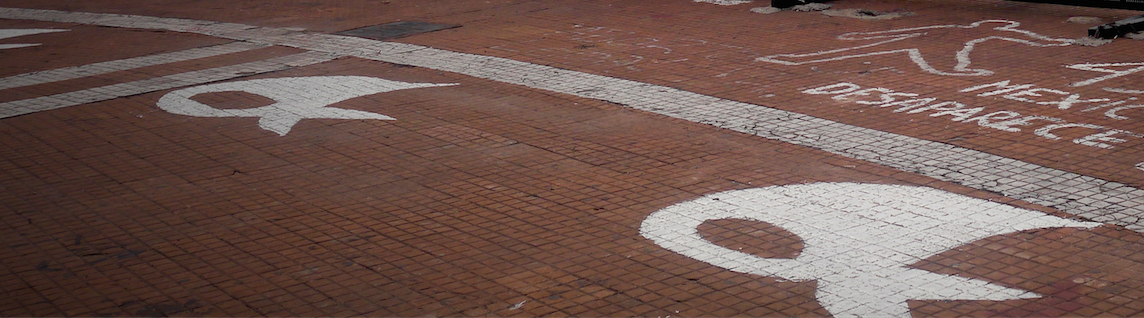
Understanding these critical theories will enable depth and new learning in my own research on graffiti/street art markings of the pañuelo blanco in Buenos Aires.

CW, “Pañuelo Blancos in Plaza de Mayo,” Buenos Aires, 2017.

These markings can be understood as signifiers that reference the signified: the material white scarves (formerly diapers) worn by las Madres de la Plaza de Mayo. The material white scarves, furthermore, reference another layer of symbolic meaning: memory, grief and injustice surrounding los desaparecidos. From our discussion surrounding Word and Image and Semiotics, I see how illuminating these critical theories will be throughout our research on graffiti this Seminar.