After looking at The Croft School’s website for a bit I began to see a lot of connections with my old middle and high school. One of the biggest similarities is the idea of global citizenship. I remember when I was in school we had two field lessons a month. One was to go see universities/colleges and the other was to go do community service. I remember that we used to go to parks and spend the day planting trees, repainting signs or walls, and picking up trash. When we were out on field lessons, one of our mottos was to always leave the place better than we found it. The difference between The Croft School and our school was that we weren’t focused on being global citizens we were focused on giving back to our community.
We visited parks and neighborhoods around our school and where we came from and when wherever we went, we made a difference. We focused on our immediate future and tried to clean up the areas that we spent most of our time in. We knew that once we graduated school we would be going out to bigger places and making a difference wherever we ended up, but we had to start in the places where we lived. One can’t expect to change the world without taking care of business in their backyard.
On The Croft School’s website, one thing that stood out was the following quote: “We want to form young people who will be useful to the country and are trustworthy.” This made me question, how involved are they teaching their students to be? Are they teaching them to get involved in the community no matter what the issue may be? Or are they teaching them to pick and choose what they get involved in? I believe that as elite members of society they have to watch their reputation. I wouldn’t see these kids being taught to get involved in events like the protest for free education in Chile because of a fear of being kicked out of their school and their elite group. How useful are they teaching their kids to really be? Are they really teaching them to be part of a global community or the globally elite?
School rules are present in both elite and non-elite schools. They aim to establish and promote good behavior and ensure that the school community is a safe place to learn. This week, I found myself curious about the differences that exist between The Chilean School rules and my own public school experience.
The Chilean School rulebook opens “Pupils of the school must obey the following rules based on The Chilean Schools philosophy, and the general standards of behavior expected. When followed carefully they will enable the school to run smoothly, which is in the common interest of both pupils and their parents/guardians to support. We hope that infractions will be few and far between.” This seems pretty straightforward to me and matches up to other public and private school codes of conduct. The rule book is a relatively short document when compared to my own school’s rule book, which was handed out on the first day of schools and printed in the planners given to each student. I expected The Chilean school’s rules to be fancy and elaborate.
My idea of a fancy and elite rule book
Instead, I find the document focusing more on individual students self-regulation and the school expects students to hold themselves accountable for their actions. This idea of personal responsibility is one I have previously discussed in education classes here at Colby. Elite schooling institutions often give their students more personal responsibility and choice as opposed to other schools, where rules are specific and listed out.
Dress Code
In my high school experience, the school’s dress code was pretty tame. We could not have holes in our jeans and the bottoms we wore had to extend past the length of one’s finger tip. Some days students would be able to get away with almost anything, while other days the rules were enforced. The Chilean School, however, adheres to a strict uniform policy that communicates their eliteness by marking them as members of a school community.
Tardiness
The rule book of my school claimed to have a strict policy on unexcused absences. I arrived ATLEAST three minutes late every day, and only received a small handful of detentions as a result. The Chilean school also has a no tolerance policy on lateness. The rule book states that students who have an unexcused tardy must go in front of the school’s administration to explain their lateness before they can return to class. I am curious to see if this rule is enforced as strictly as their policy claims it is.
Water Balloons
One of the highlights of reading the rule book was the lengthy section on the banning of water ballons. Other than the water balloon ban, rules don’t go into explicit detail and are left to the interpretation of the reader. This interest me, and makes me question how big a problem water balloons where to deserve a special section in the rule book.
We’ve dedicated a lot of class time to talking about Bourdieu’s analysis of the notion of ‘capital.’ The whole concept is new to me, and although I’m aware that my understanding of it is still shallow at best, these conversations have provided me with a new way of looking at who can, and what it truly means to receive a good education. Let me elaborate.
There are few other things in this world that human beings would willingly spend hundreds of thousands of dollars on, knowing it will require hard work and likely cause copious amounts of stress. Education is one of these few. Why? Our discussions in class have made me realize, that while the reason is indefinitely very complex, at it’s core it’s because education is an investment, and a means of accruing several forms of capital. This capital is supposed to aid your future endeavors. In other words, by paying for a good education, you better your odds of attaining a higher status in whatever you choose to do next.
There was a light bulb that went on at some point in one of our class discussions as I looked around at my classmates. We are all worth over a quarter of a million dollars. By the time one graduates from Colby College alone, not even considering the thousands of dollars put into getting him or her here in the first place, there is more money invested in their education than some people make over the course of their entire lifetime.
And realizing this got me thinking… does all this actually matter as much as we think it does? Is the payoff really worth the initial investment? According to an article published in the New York Times, the average tuition of a private university in the United States for the 2015/2016 academic year was a whopping $43,921. For a public university out of state, it was $34,031, and for a public in-state university, it was $19,548. Admittedly there is a wide range there, but when the starting cost is over $19,000, you’re fighting an uphill battle from the start.
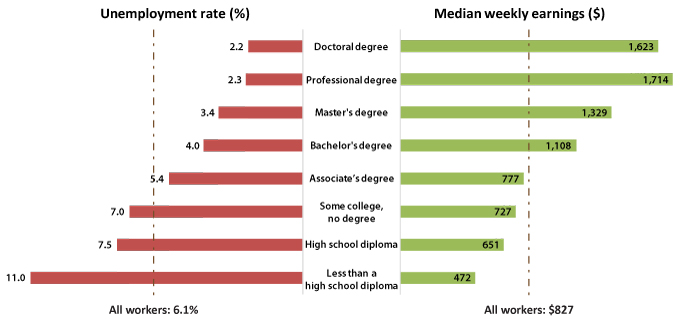
So if the theory is that it all pays off in the future, where’s the evidence? Indeed, a study conducted by Georgetown University’s School of Education suggests that even after factoring in tuition costs and loss of time acquiring wage because of school, “bachelor’s degree holders earn 31% more than those with an associate’s degree, and 74% more than those with just a high school diploma.” It seems like every website has a different average income salary for high school graduates versus a bachelors or masters/phD graduates, but it appears irrefutable that there is indeed a much higher “payout” correlated with more years spent in (and on) academia. Bourdieu is clearly onto something here…
(Click to make graphic larger)
These class discussions all happened in tandem with the research my group was doing on Chile, which got me wondering if this correlation exists as robustly in a global context. I had a shockingly hard time finding numbers illustrating the education wage gap on Chile (or really any Latin American country), but it seems widely agreed upon that more years in school means more subsequent income. In fact, the New York Times published an article in 2014 with the very clear title: “A Simple Equation: More Education = More Income.”
Honestly, researching this topic has left me with more questions than answers. Why is it so much easier to find data on the US, as opposed to developing countries? Is it simply because I’m using an American search engine? Or is it because of the neo-colonial system the US has seemingly transformed education into, where privatization for economic gain is the driving force? Is the US an anomaly, or the documented norm? I’m tempted to argue the latter, especially because of the Chilean student protests that call for loss of economic gain in post-secondary education. But then why is there a lack of accessible data? Additionally, I got to wondering how the “elite-ness” of a university education changes subsequent income. If a public state university costs around $19,000 dollars while a private university costs $43,000, is there a benefit to ponying up so much more money for private academia? Is it important globally, or just in the United States? Questions, questions, questions. Not so many answers…
The first time I checked out the school website for the Chilean School was during my biochemistry class. Being accustomed to seeing my school’s chemistry page and even my high school homepage, I was ready for information about the school. So when the school’s website popped up onto my screen, I was already expecting the classic large photo showing off the school’s aesthetic. What I was not expecting, was for their homepage to have so little information. In fact, the headmaster’s message was a sentence and most of the information pertaining to the school including the admissions info and policy documents of the Chilean School were in Spanish.
I went back to see my high school webpage and it felt like I had been hit with a truckload of info…
Too much, too much, too much
I gathered two things from this. The first, was that in order to be elite, it had to involve the limitation of information in some shape or form. This seemed linked to methods of communication and demonstrated the hidden languages of the social classes. In this way, the elite implicitly conveyed their eliteness through exclusive “language.” Although the idea of elite is one of limitless possibilities as portrayed through the photos, in particular of the buildings and architecture, it demonstrates the lack of integration. The second, is the difference in target audience and from this the competition. Although it is hard to say, as the admissions information for the Chilean School was in Spanish, the school seemed to be appealing to an international elite. By “international elite,” the focus seems heavy on those whose eliteness is transnational and almost transferable from one country to another, such as those who can speak English. In short, the Chilean School seemed to appeal to a global audience on an individual scale as people who wanted to attend were competing with one another for entry. On the contrary, my high school’s website seemed to be appealing to students from NYC, while simultaneously competing with the other Specialized High Schools in NYC. In fact, the high school I attended seemed more concerned with it’s public image and reputation. One thing in particular that struck out was the section of my high school’s website titled “In the News.” This section was dedicated to news articles on the school and notable students and alum entirely to promote the school image. In this way, my high school’s website appealed more to a local audience, such as NYC or the NYC Board of Education, which ultimately rates and ranks this school.
My research group chose to focus on the way in which extra curricular activities impact all aspects of the Croft School’s educational experience, including academics, social structure, as well at the culture of the extra curricular activities themselves. Through this research, I have come across various perspectives on the purpose and significance of incorporating extra curricular activities into schools.
Previous studies have looked at the effect of involvement in extracurricular activities on adolescents’ positive youth development. Typically, these studies look at adolescents’ self worth evaluation and self concept. Generally, there is a positive relationship between involvement in extra curricula’s and a students general self worth and concept (Blomfield & Barber, 2011). A study focusing that focused on whether or not this phenomenon has different effects in schools with a low socioeconomic status found that there was a greater positive relationship between extra curricular activities and the positive effects on an adolescents development among schools with children from a predominantly low socioeconomic status household (Blomfield & Barber, 2011). This finding emphasizes the importance of providing students with activities, clubs, and sports outside of the classroom in order to promote they development in a positive way.
A different study focused on the ways in which extra curricular activities enhance a persons human capital, which, in this article, was used to essentially refer to a persons ability to succeed in and graduate from the various levels of schooling. (So many forms of capital, so little time). Assuming the premise that extra curricular activities allow students to develop important skills outside of the classroom is true, these researchers found that involvement in these extra curricular activities correlates to a “1.5 to 2 percent improvement in test scores and a 5 percent improvement in Bachelors degree attainment” (Lipscomb, 2007).
I then looked at the HMC, which stands for “the Headmasters and Headmistresses Conference,” which the Croft school is apart of. From what I gather off of their website,the HMC is an association that supports independent institutions. Through supporting these institutions the HMC is also able to instill its values and opinions on the academic process. It’s like another step in the process of being, and maintaining your status as, elite. If you click on over to the page where the extra curricular opportunities are discussed (it can be found as a link stemming from the “why a HMC School?”) you will find the organizations proud declaration that HMC schools, “provide unrivaled co-curricular opportunities enabling children to develop a wide range of talents, skills and abilities” (HMC website). So, the HMC also believes that these activities outside of the classroom enhance one’s potential for success academically and potentially in life in general, as the website claims that “exceptional co-curricular programmes ensures that HMC independent schools are successful and outstanding” (HMC Website). The programs provided are described as “exceptional” and “unrivaled”, as if to suggest that the students success in and out of school will transitively be “exceptional” and “unraveled”. The HMC’s site also mentions the potential for students to develop into professional athletes, even Olympic medalists through their programs and facilities. Differing from that first article I read, in which these sports and clubs were for the purpose of positively supporting an adolescents development, the HMC school would like to put that on steroids in order to foster the eliteness of their clubs and sports.
I figured if I want to potentially analyze a Croft students involvement in extra curricular sports or activities, it would only be fair to do so on myself as well. I like to keep things fair. So, my primary involvement in extra curricular activities, at Colby and also in middle and high school, is sports. Specifically, I run track (read: cross country, indoor track, and outdoor track cause its never ending fun) for Colby, as I did for my high school. In thinking about the ways in which track supported my development (thinking back to high school here when I believe most of my maturing took place) I do think that sports, I am referencing track specifically, allowed me to develop positively, specifically as it increased my self confidence, ability to manage stress, and work collaboratively with a team or authority figure (i.e. my coach) with one goal in mind. As silly as it may seem, relentless training to merely chop off some seconds on the time it takes me run around an oval provided me with confidence in my ability to achieve. In this way, and others, I do see the importance of extra curricular activities as an important factor in a school’s success. Looking at the way in which it boosts my potential human capital, I think the only benefits are from the skills acquired through my participation. Colby College has beautiful facilities and a wonderful coaching staff, and yet we do not emphasize the perfecting of sports, rather the effort and hard work of sports. As a Division 3 school, the focus simply cannot be on being the best. We are not. I am not. How does Colby instill its institutional values, then, into the athletics department? I think that, at Colby, the benefits that come with extra curricular sports and clubs come from the community of that particular activity, and the pride in working towards something you choose in addition to academics. In this way, I can see how Colby’s values are reinforced through athletics.
Lipscomb, S. (2007, August). Secondary school extracurricular involvement and academic achievement: A fixed effects approach. Economics of Education Review,26(4), 463-474. http://dx.doi.org/10.1016/j.econedurev.2006.02.006

 After looking at The Croft School’s website for a bit I began to see a lot of connections with my old middle and high school. One of the biggest similarities is the idea of global citizenship. I remember when I was in school we had two field lessons a month. One was to go see universities/colleges and the other was to go do community service. I remember that we used to go to parks and spend the day planting trees, repainting signs or walls, and picking up trash. When we were out on field lessons, one of our mottos was to always leave the place better than we found it. The difference between The Croft School and our school was that we weren’t focused on being global citizens we were focused on giving back to our community.