
More Education = More Capital = More Income
We’ve dedicated a lot of class time to talking about Bourdieu’s analysis of the notion of ‘capital.’ The whole concept is new to me, and although I’m aware that my understanding of it is still shallow at best, these conversations have provided me with a new way of looking at who can, and what it truly means to receive a good education. Let me elaborate.
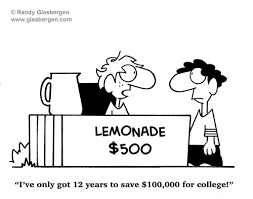
There are few other things in this world that human beings would willingly spend hundreds of thousands of dollars on, knowing it will require hard work and likely cause copious amounts of stress. Education is one of these few. Why? Our discussions in class have made me realize, that while the reason is indefinitely very complex, at it’s core it’s because education is an investment, and a means of accruing several forms of capital. This capital is supposed to aid your future endeavors. In other words, by paying for a good education, you better your odds of attaining a higher status in whatever you choose to do next.
There was a light bulb that went on at some point in one of our class discussions as I looked around at my classmates. We are all worth over a quarter of a million dollars. By the time one graduates from Colby College alone, not even considering the thousands of dollars put into getting him or her here in the first place, there is more money invested in their education than some people make over the course of their entire lifetime.

And realizing this got me thinking… does all this actually matter as much as we think it does? Is the payoff really worth the initial investment? According to an article published in the New York Times, the average tuition of a private university in the United States for the 2015/2016 academic year was a whopping $43,921. For a public university out of state, it was $34,031, and for a public in-state university, it was $19,548. Admittedly there is a wide range there, but when the starting cost is over $19,000, you’re fighting an uphill battle from the start.
So if the theory is that it all pays off in the future, where’s the evidence? Indeed, a study conducted by Georgetown University’s School of Education suggests that even after factoring in tuition costs and loss of time acquiring wage because of school, “bachelor’s degree holders earn 31% more than those with an associate’s degree, and 74% more than those with just a high school diploma.” It seems like every website has a different average income salary for high school graduates versus a bachelors or masters/phD graduates, but it appears irrefutable that there is indeed a much higher “payout” correlated with more years spent in (and on) academia. Bourdieu is clearly onto something here…
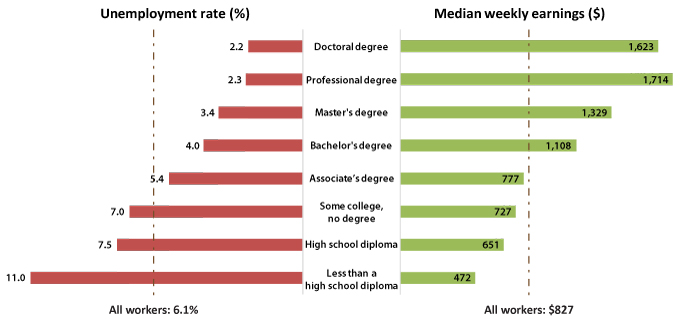 (Click to make graphic larger)
These class discussions all happened in tandem with the research my group was doing on Chile, which got me wondering if this correlation exists as robustly in a global context. I had a shockingly hard time finding numbers illustrating the education wage gap on Chile (or really any Latin American country), but it seems widely agreed upon that more years in school means more subsequent income. In fact, the New York Times published an article in 2014 with the very clear title: “A Simple Equation: More Education = More Income.”
Honestly, researching this topic has left me with more questions than answers. Why is it so much easier to find data on the US, as opposed to developing countries? Is it simply because I’m using an American search engine? Or is it because of the neo-colonial system the US has seemingly transformed education into, where privatization for economic gain is the driving force? Is the US an anomaly, or the documented norm? I’m tempted to argue the latter, especially because of the Chilean student protests that call for loss of economic gain in post-secondary education. But then why is there a lack of accessible data? Additionally, I got to wondering how the “elite-ness” of a university education changes subsequent income. If a public state university costs around $19,000 dollars while a private university costs $43,000, is there a benefit to ponying up so much more money for private academia? Is it important globally, or just in the United States? Questions, questions, questions. Not so many answers…