What Would Bourdieu Say? Connecting His Theories To Our Findings
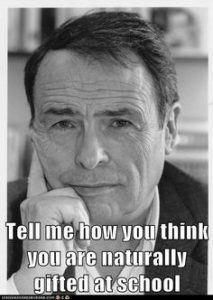
Despite his dense and sometimes complicated writing, Pierre Bourdieu has provided us with new perspectives and a deeper understanding of elite schooling. The purpose of this blog entry is to relate some of Bourdieu’s theories and concepts to some of the major findings from our research on the Sankofa International College, an elite school in Ghana.
The Sankofa school consists of nearly half disadvantaged students and the slight majority come from well-to-do families. The students who come from more advantaged backgrounds are what Bourdieu would call the “prize winners”. The prizewinners are the typical elite students whose parents have lots of social and economic capital and put their kids in prestigious schools which reproduce elites. Something that distinguishes the prizewinners from other students is that “they are more inclined to judge their work as very good or excellent and tend to use the same adjectives to describe the kind of student they are and the kind of student they would like to be” (Bourdieu 14). Elite students feel a sense of comfort and security in their high social status which makes it easier for them to display their confidence in the classroom. However, it is more challenging for disadvantaged students to exhibit this same level of confidence. Even though the disadvantaged have been selected as the “chosen ones” to attend this elite school, the fact that they are not inherently elite themselves causes them to feel insecure at times since they are non elites in an elite space. The way they adjust to this and carry themselves in the school relates to another one of Bourdieu’s concepts called habitus. Habitus refers to an individual’s embodied disposition and ingrained tendencies. Habitus strongly influences how students interact with their classmates and teachers and how they view themselves.
Another finding from the data is that the disadvantaged students said that they put a lot of pressure on themselves to do well academically. In a couple of interviews, students said that they try so hard academically because education is their “way out”, and will give them a chance to make a better life for themselves. Bourdieu touches upon this in his discussion of reproducing capital. He writes, “the interest that an agent brings to her studies depends not only on her current or anticipated academic success but also on the degree to which her social success depends on her academic success” (Bourdieu 276). This is a strategy that disadvantaged students use to generate their own capital. By doing well academically, students are then usually able to get into really prestigious colleges which can help them land a high paying job. This demonstrates how students accumulate cultural capital and convert it into economic capital.
The last main point that I will touch on is how Sankofa puts a strong emphasis on assimilation and unity. They forbid students from openly talking about their social differences because they want all students to see themselves as equals. I think their reason for doing this could help be explained by what Bourdieu’s offers here:
“Each of the members of the group of chosen people, in addition to sharing in the symbolic capital collectively held and concentrated in their title, also shares, in a logic that is truly one of magical shareholding, in the symbolic capital than each member of the group holds as an individual” (79).
This suggests that each members’ personal symbolic capital contributes to one another, thus giving everyone in the group additional capital that they would not be able to attain just on their own. By putting disadvantaged students around elite students, I think the school hopes that to an extent the eliteness will “rub off” on the less fortunate students. This would then allow them to access forms of cultural and social capital that they would not have otherwise.
Overall, reading Bourdieu’s theories helps us make sense of our findings on Sankofa and gain a better understanding of elite schools.