The Grey Area in Mandatory Community Service
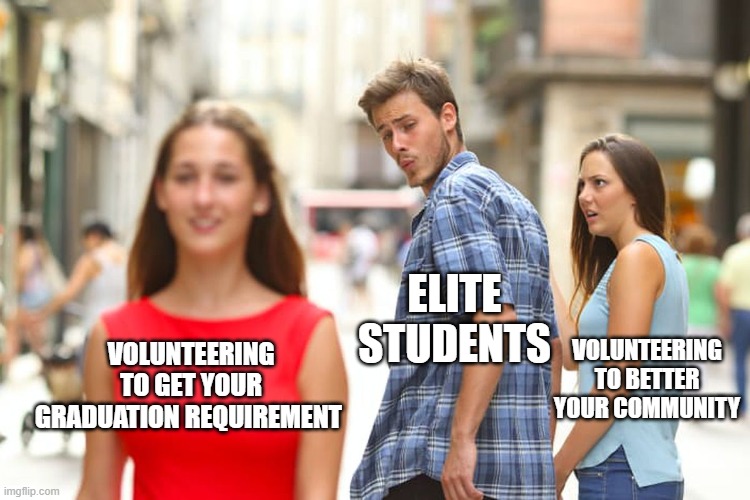
When asked about community service, 17 year old Taiwanese high schooler Ashley gave answers to the tune of ‘I do this for my school,’ or ‘I am able to through my school.’ Answers like these are not uncommon among students as several others said similar things. It made me think back to my own experiences with community service and how I was able to volunteer, through my school, for the reason of seeming more intriguing to higher education. Having these thoughts surface, the question of if community service through elite schools is performative or is it actually helping students and the community come to light?
Students in the interviews that I read were able to give back to their communities through programs like National Honor Society. Through this, they are able to do things such as teach younger children English as well as participate in service projects like building schools here in the states. Some students go off on their own and see what needs help in their community. Maggie, a Taiwanese student from the aforementioned high school, goes into their local village to teach children English at the library. Eno, another student, described his time volunteering as solely to complete a graduation requirement and as soon as his requirements were done, he quit.
While it is not a requirement in most higher education to have done community service, many schools like to see that you have done something to better your community. Since elite schools’ main purpose is to further students both in academics and life it is not uncommon for them to require a certain number of hours spent doing community service. The issue arises because of the fact that it is mandatory for school. Since it is mandatory, it is possible for students, like Eno, to see it as a box to check and get over with. If it is seen like this then is the real purpose of community service being taken seriously?
In another part of the interview, students were asked about if they were aware of their social class. Many students brought up the fact that they knew of their standing because of when they had to go into the local area and work with people of a lower socioeconomic status because of their schools mandatory community service. In this sense, elite schools mandatory community service works as a way to make students more globally and socially aware, criteria of a global citizenship education.
The main question of, if students in elite schools get what they are supposed to out of mandatory community service, really has to be taken student by student. For example, we have students who go out on their own to really try and help their community, for the sake of putting it on applications or not, they are committing to hours of community service. On the other hand, we see students who look at this as a thing to check off a list, who might not be putting their best effort into their service. While both can be considered performative in some light, they are also both technically helping their community. The final say of whether or not it is beneficial does come down to each and every student.