Asian parenting style is often portrayed as controlling, demanding, and harsh–characteristics most representative of authoritarian parenting (i.e., one of the four main parenting styles, the other three are authoritative, permissive, and neglectful). In her controversial book Battle Hymn of the Tiger Mother published in 2011, Amy Chua labels Chinese mothers’ parenting style as “tiger parenting” which is described as strict, restrictive, and emotionally unsupportive. This is not rare in Asian families. For example, Tam and colleagues (2018) point out that tiger parenting has become increasingly prevalent in highly competitive societies, such as Hong Kong. In the meanwhile, there has also been increasing research focusing on parenting in elite families. Sherman (2017) examined the conflicts and interactions between parenting, privilege, and moral worth in elite families in New York. In addition to parenting at home, there is also research studying how elite parents interact with schools. For instance, Howard and Maxwell’s (2021) study shows how elite parents in Taiwan work with the school to bridge cultural differences and plan a future for their children who are determined to be the next elite generation.
https://imgflip.com/i/7bmoz9
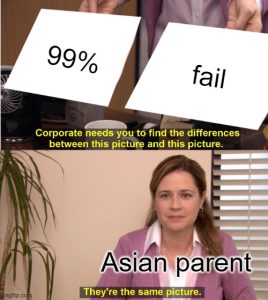
Elite parenting in Taiwan is an interesting case to study because it integrates both traditional Asian parenting and Western elite parenting styles. In our interviews with elite Taiwanese students, we see how the two parenting styles combine. In three interviews, the students explicitly talk about the high expectations their parents have for them. They are required to get good grades. However, their parents are almost never satisfied with their grades and always urged them to get higher ones. One student says, “My parents are always like if you get a B-, you better get a B+, A- you better get an A+, something like that,” and the consequence of not achieving their expectations is that they would “want to kill” him. Although this might be an exaggeration, we see how Asian parents could be so demanding and strict. Furthermore, Asian parents also have higher control over the goal of their children. For example, one student complains that his parents always try to “tell me to be, to go in a certain direction,” and another student says that his parents care a lot about “the name of the university” whereas he cares more about his “major.” Although their parents do not directly interfere with their plans, they try hard to influence their children’s decisions. These parents are typical Asian parents who practice an authoritarian parenting style.
Moreover, these Taiwanese parents also practice elite parenting strategies as Western elite parents do. They try to cultivate “an appropriate habitus of privilege” in their children (Sherman, 2017). What this means is that they teach their children to behave “appropriately,” such as by being nice and working hard, while also teaching them how to occupy an advantaged position. In the interviews, the students mentioned the values that their parents emphasize at home. One student mentions trying hard and being thankful and another student mentions respecting elders. These two are both tied to the idea of behaving “appropriately” emphasized in elite parenting as I mentioned above. One other student explains that her family greatly values “service” and that her parents “want to see their children contribute to the community.” This is exactly the second part of elite parenting. When children are in advantaged positions, elite parents try to expose them to less advantaged groups by, for instance, requiring them to do community service. In this way, children will learn what “normal” life is like and also feel “morally worthy” in an unequal society.
In conclusion, how elite parents in Taiwan educate their children is a rather complicated but interesting study. Deeply influenced by Asian culture, many of them practice an authoritarian parenting style. However, in hopes of sending their children to Western countries, they also integrate a more Western-elite parenting style when educating their children.

 https://imgflip.com/i/7bmoz9